wayground logo

Free Printable Worksheets

Font size

S
M
L
XL
Worksheets

Y9 Biology Review

Total questions: 100

Worksheet time: 1hrs 17mins

Name
Class
Date
1.
Jelly-like substance found inside cell that acts as a medium for chemical reactions within the cell
a)
Nuclear Membrane
b)
Golgi Body
c)
Cytoplasm
d)
Ribosome
2.
"powerhouse of the cell" breaks down sugar molecules to release energy, site of cellular respiration, double membrane, self-replicating, contains own DNA, cristae
a)
Mitochondria
b)
Chloroplast
c)
Cell Wall
d)
Vesicle
3.
"Storage tanks" Can hold food, water or waste for the cell
a)
Ribosomes
b)
Vacuole
c)
Chloroplast
d)
Nucleolus
4.
"Gatekeeper" Separates the cell from the rest of the environment and helps control what passes in and out of the cell.  Semi-permeable: allows some materials to pass through but not all
a)
Cell Wall
b)
Cytoplasm
c)
Mitochondria
d)
Cell Membrane
5.
Rigid outer layer made of cellulose that supports and protects the cell (plant, fungi, and bacterial cells)
a)
Nucleolus
b)
Golgi Body
c)
Cell Wall
d)
Cytoskeleton
6.
The organelle that uses the energy of sunlight to make food for the cell.
a)
Chloroplast
b)
Ribosome
c)
Mitochondria
d)
Nucleus
7.
Contains the Cell's DNA and is a part of the processes of growth, metabolism, and reproduction.
a)
Downy
b)
Nucleus
c)
Cell Wall
d)
Golgi Complex
8.
A group of tissues that work together
a)
Organ
b)
Tissue
c)
Cell
d)
Steak
9.
A group of similar cells that work together
a)
Molecule
b)
Tissue
c)
Organ
d)
Cell
10.
An organelle that makes proteins for a cell
a)
Nucleus
b)
Golgi Body
c)
Ribosome
d)
Endoplasmic Reticulum
11.
Which letter is the vacuole?
a)
E
b)
F
c)
G
d)
I
12.
"I"  is which organelle?
a)
chloroplast
b)
cytoplasm
c)
mitochondria
d)
golgi
13.
Which organelle is found in a plant cell and NOT an animal cell?
a)
vacuole
b)
lysosome
c)
cell wall
d)
cell membrane
14.
How does the cardiovascular system and the respiratory system work together?
a)
The cardiovascular system transports oxygen around the body while the repiratory system gives the body oxygen
b)
The cardiovascular system makes cells while the respiratory system moves them where they are suppose to go.
c)
The cardiovascular system allows the body to have energy while the repiratory system makes cells
d)
The cardiovascular system transports nutrients around the body while the respiratory system brings oxygen into the body
15.
What cell part is NOT found in all cells?
a)
Cell Wall
b)
Cell Membrane
c)
Cytoplasm
d)
Genetic Material
16.
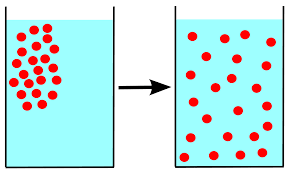
The picture below is an example of _________________.
a)
osmosis
b)
isotonic
c)
diffusion
d)
active transport
17.
Osmosis is the movement of _____ across a membrane.
a)
food
b)
energy
c)
oxygen
d)
water
18.
Permeable means
a)
things can pass through
b)
the concentration levels are different
c)
it is permanent
d)
things are stuck
19.
What a cell needs to transport particles by active transport?
a)
Sun
b)
Wind
c)
Energy
d)
Channels
20.
A person would never have pure water put into their veins in a hospital because their cells would...
a)
Shrink/Dehydrate
b)
Expand
21.
A person should never drink salty water because their cells would
a)
shrink
b)
expand
22.
If there is 5 percent water inside a cell and 5 percent water outside a cell
a)
more water will move inside the cell
b)
more water will move outside the cell
c)
There will be no movement of water cells
23.
The movement of molecules against a concentration gradient
a)
simple diffusion
b)
facilitated diffusion
c)
active transport
d)
osmosis
24.
The picture is an example of...
a)
active tranport
b)
passive transport
c)
diffusion
d)
osmosis
25.
What do antibiotics cure?
a)
bacteria
b)
virus
c)
parasite
d)
fungus
26.
Which pathogen needs a host cell to reproduce?
a)
virus
b)
bacteria
c)
fungus
d)
parasite
27.
Which pathogen is most likely to look like a worm or insect?
a)
Virus
b)
Bacteria
c)
Fungi
d)
Protist
28.
Which pathogen can be prevented with vaccines
a)
Virus
b)
Bacteria
c)
Fungi
d)
All of them
29.
Which pathogen reproduces using binary fission (Asexual Reproduction)?
a)
Virus
b)
Bacteria
c)
Fungi
d)
Parasite
30.
This is the word for a disease causing organism.
a)
Phagocyte
b)
Pathogen
c)
Pandemic
31.
Which best explains how a nonliving virus is able to reproduce?
a)
A virus becomes living when in contact with a host organism.
b)
A virus infects a host organism by injecting its DNA into the cells of the host organism.
c)
A virus infects a host organism by pulling the DNA from the cells of the host organism into itself.
d)
A virus becomes living when a sufficient number of viruses invade a host organism and cause an infection.
32.
Which best distinguishes an infectious disease from a noninfectious disease?
a)
Infectious diseases can be cured with antibiotics; noninfectious diseases cannot.
b)
Infectious diseases can be prevented with vaccines; noninfectious diseases cannot.
c)
Infectious diseases can be spread from one organism to another; noninfectious diseases cannot.
d)
Infectious diseases cannot be transmitted from one organism to another; noninfectious diseases can.
33.
What is a major difference between prokaryotic and eukaryotic cells?
a)
Eukaryotic cells are multicellular and Prokaryotic cells are unicellular.
b)
Eukaryotic cells have been on earth longer than Prokaryotic cells.
c)
Prokaryotic cells do not have a nucleus or membrane bound organelles
d)
Prokaryotic cells are bacteria and viruses that make you sick.
34.
Which of the following is not a kind of pathogen?
a)
Bacteria 
b)
Protists 
c)
Mosquitoes 
d)
Fungi 
35.
Athlete's foot is an example of this pathogen
a)
Bacteria
b)
Virus
c)
Fungus
d)
Protozoan
36.
Which is not an infectious disease?
a)
Malaria
b)
diabetes
c)
food poisoning
d)
measles
37.
Cause of common cold and flu.
a)
Viruses
b)
Bacteria
c)
Reaction by the body to substances
38.
a single-celled organism that lacks a nucleus is called
a)
a bacteriophage
b)
a virus
c)
a protist
d)
bacteria
39.

Which of the following would be considered an epidemic?

a)

Ebola spreading through the United States and Europe.

b)

An outbreak of the flu at Coulwood.

c)

Malaria cases in Africa and South America.

d)

The Bubonic Plague spreading through Europe and Asia.

40.

What specialized agency of the United Nations that is concerned with international public health?

a)

Environmental Protection Agency

b)

Centers for Disease Control

c)

World Health Organization

d)

The American Red Cross

41.

Which of the following is the best example of direct contact?

a)

Sneezing in your hand and then touching a door knob.

b)

Coughing in a room without covering your mouth.

c)

Spitting in your hand and then shaking someone else's hand.

d)

Eating under-cooked chicken that's been exposed to salmonella

42.

The amount of people who have been affected with measles has drastically reduced over the years. Which statement best explains why this is possible?

a)

Use of antibiotics

b)

Introduction and use of vaccines

c)

People are living healthier lives

d)

Living environments are cleaner today

43.
How are monoclonal antibodies produced?
a)
Taken from bone marrow
b)
From a clone of a single cell
c)
From an embryo
d)
All of the above
44.
What are antibodies made of?
a)
Carbohydrate
b)
Protein
c)
Polysacchiaride
d)
Lipid
45.
What is a monoclonal antibody?
a)
Antibodies produced by pathogens
b)
Antibodies produced from a single group of genetically identical B cells
c)
Antibodies produced in the same organism
d)
None of the above
46.
What are uses of monoclonal antibodies?
a)
Diagnosis in pregnancy tests
b)
to detect pathogens
c)
to treat cancer
d)
All of the above
47.
Why are monoclonal antibodies not widely used?
a)
They are expensive to produce
b)
They don't work as well as expected
c)
There are too many side effects
d)
All of the above
48.
What is the first stage of producing monoclonal antibodies?
a)
Stimulating mouse lymphocytes to make an antibody
b)
collect spleen cells from a mouse
c)
Form hybridoma cells
d)
produce myeloma cells
49.
Most of the chloroplast cells are found in the
a)
upper epidermis
b)
pallisade mesophyll layer
c)
lower epidermis
d)
stomata
50.
The water needed for photosynthesis comes into the leaves through the
a)
upper epidermis
b)
stomata
c)
guard cells
d)
xylem cells
51.
The important gases, carbon dioxide and oxygen, enter and leave the leaf through the
a)
upper epidermis
b)
phloem
c)
stomata
d)
guard cells
52.
The role of the guard cell is to
a)
help control the temperature of the plant
b)
control how much water enters the leaf
c)
control how much glucose is stored
d)
control the movement of water vapour & gases 
53.
Transpiration helps the plant
a)
make more sugars at night
b)
move water from the roots to the stem and leaves
c)
move sugars from the leaf to be stored in the stem & roots
d)
make more chloroplasts
54.
Sugar and the products of photosynthesis move through the plant in 
a)
the phloem cells
b)
the xylem cells
c)
the root hair cells
d)
palisade mesophyll layer
55.
How many daughter cells are produced in mitosis?
a)
1
b)
2
c)
4
d)
6
56.
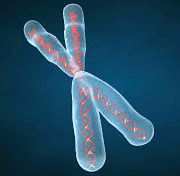
How many chromosomes does a human cell have?
a)
42
b)
46
c)
24
d)
64
57.
Cells of organism must replicate for ?
a)
growth
b)
repair of damaged cells
c)
replacement of dying cells.
d)
All of the above
58.
How many cells are created at the end of Mitosis?
a)
1 diploid cell
b)
2 diploid cells
c)
3 diploid cells
d)
4 diploid cells
59.
The dark "spider" looking things on opposite sides of the cell are called "Spindle Fibers".  What is their job?
a)
Eating the chromosomes
b)
Pulling the chromosomes apart
c)
Putting the chromosomes together
60.
What do capillaries, the smallest blood vessels, do?
a)
Exchange O2 only
b)
Exchange CO2 only
c)
exchange nutrients and  oxygen for waste 
d)
break down foods
61.
What are the 4 components of blood?
a)
White blood cells, Platelets, bone marrow, and oxygen
b)
Plasma, Platelets, yellow blood cells, and nutrients
c)
Plasma, White blood cells, red blood cells, and Platelets
d)
Platelets, Red blood cells
62.
Where does blood go after the right atrium?
a)
left atrium
b)
left ventricle
c)
right ventricle
d)
aorta
63.
Where does the blood go after it goes into the pulmonary arteries?
a)
lungs
b)
heart
c)
head
d)
hands
64.
Which blood vessels carry blood to the heart?
a)
Aorta
b)
veins
c)
arteries
d)
arterioles
65.
Which blood vessels carry blood away from the heart?
a)
capillaries
b)
veins
c)
arteries
66.
2?
a)
Heart
b)
Right Ventricle
c)
Left Atrium
d)
Left Ventricle
67.
7?
a)
Left Atrium
b)
Left Ventricle
c)
Aortic Valve
68.
A flap of tissue that prevents blood from flowing backward
a)
Aorta
b)
Atrium
c)
Septum
d)
Valve
69.
Valves in veins
a)
make the use of a skeletal muscle pump unnecessary for venous blood flow
b)
are the leading cause of high blood pressure.
c)
cause venous blood flow to go in only one direction
d)
are formed of the tunica media
70.
These have muscular walls:
a)
capillaries
b)
veins
c)
venules
d)
arteries
71.
Supply the heart.
a)
Phrenic arteries
b)
Thoracic aorta
c)
Aortic arch
d)
Coronary arteries
72.
Which of these is an example of a drug that wasn't tested properly and so resulted in harmful side effects?
a)
Paracetamol
b)
Statins
c)
Thalidomide
d)
Nicotine 
73.
What is a placebo?
a)
A second type of drug given to all people in a trial
b)
A 'dummy' pill given to all people in the trial
c)
A 'dummy' pill given to half of the people in the trial
d)
A drug that will probably harm the patients taking it 
74.
What is a double blind trial?
a)
The participants take the drug blindfolded
b)
When the scientist and the participants are unaware of whether they are taking the drug or placebo
c)
When the participants choose what they want to take without telling the scientist
d)
When the scientist knows who is taking the drug but the participants don't
75.
Why are clinical drug trials important?
a)
They can improve the health of patients
b)
To understand whether the drug causes any harmful side effects
c)
They help test the effectiveness of the drug 
d)
To test whether the drug works and if it causes any harmful side effects
76.
Why are double blind trials important?
a)
They make sure the results are fair and unbiased
b)
If the scientist knows who has taken the drug they will lie or change results to show it works
c)
They are the only type of clinical trials available 
d)
Patients might lie about any side effects they feel 
77.
What is a drug?
a)
An illegal substance that harms the body 
b)
A substance that modifies chemical reactions of the body
c)
A treatment for illness
78.
What cells have NO nucleus?
a)
Leaf cells
b)
Animal cells
c)
Red blood cells
d)
egg cells
79.
What cells carry electrical signals?
a)
Red Blood Cells
b)
Palisade Cells
c)
Sperm cells
d)
Nerve Cells
80.
What cell is much larger than other animal cells?
a)
Egg cell
b)
Sperm cell
c)
Leaf cell
d)
Root hair cell
81.
The role of these specialised cells is to help fight off infection and foreign bodies.
a)
Palisade Cells
b)
Nerve Cells
c)
White Blood Cells
d)
Red Blood Cells
82.
Specialized cells that absorb water by osmosis
a)
Nerve Cell
b)
Xylem
c)
Palisade Cell
d)
Root Hair Cell
83.
A stem cell is...
a)
specialised
b)
unspecialised
c)
large
84.
Cells with tiny hair like structures on it.It functions to remove dust and bacteria from trachea.
a)
Sperm
b)
palisade
c)
Ciliated cell
d)
plant cell
85.
This is a example of........ 
a)
organ system
b)
cells
c)
organ
d)
tissue
86.
Directs all cell activities through the DNA located there.
a)
Lysosomes
b)
Nucleus
c)
ribosomes
d)
Mitochondria
87.
What is the purpose  of an enzyme?
a)
give permission for the reaction
b)
raise activation energy
c)
speed up reactions
d)
control how many reactions occur
88.
What is a substance called if it speeds up a chemical reaction?
a)
reusable
b)
catalyst
c)
specific
d)
fragile
89.
Each enzyme only has 1 substrate that will fit its active site.  What is this called?
a)
reusable
b)
catalyst
c)
specific
d)
fragile
90.
Which of the following conclusions can be drawn from this graph?
a)
The optimum pH of the enzyme is 6.6.
b)
The optimum pH of the enzyme is 5.8
c)
The enzyme’s activity increases as pH increases 5.0 to 9.0
d)
The enzyme’s activity is greater around pH of 8.0 .
91.
Which chemical is classified as an enzyme?
a)
Galactose
b)
Lipid
c)
Protease
d)
Manganese dioxide
92.
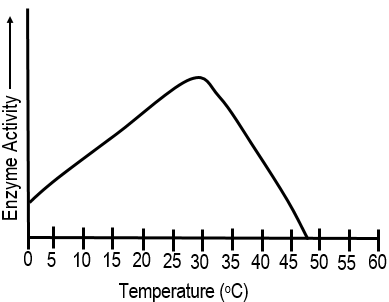
Based on the graph, what is the optimal temperature for this enzyme? 
a)
15oC
b)
40oC
c)
30oC
d)
35oC
93.
What happens when enzymes are heated to a high temperature?
a)
The enzymes die.
b)
The shapes of the enzyme are altered denature
c)
The enzymes' amino acid sequence changes.
d)
The enzymes remain the same
94.
Babies do not have well developed digestive systems for breaking down proteins; therefore baby food is prepared after treatment with which enzyme? 
a)
protease
b)
lipase
c)
carbohydrase
d)
synthase
95.
Bile is made by which digestive organ?
a)
Gallbladder
b)
Stomach
c)
Rectum
d)
Liver
96.
Nutrients from digested food are absorbed in which digestive organ?
a)
Small Intestine
b)
Stomach
c)
Large Intestine
d)
Gallbladder
97.
As waste moves through the digestive system, the ______ absorbs water before storing waste in the rectum.
a)
Small intestine
b)
Stomach
c)
Esophagus
d)
Large intestine
98.
Which secondary organ makes digestive juices like insulin to help absorb food in the small intestine?
a)
Large intestine
b)
Pancreas
c)
Liver
d)
Gallbladder
99.
Number 7 is pointing to...
a)
Mouth
b)
Esophagus
c)
Small intestine
d)
rectum
100.
The diploid number of human chromosomes is
a)
23
b)
46
c)
92