wayground logo

Free Printable Worksheets

Font size

S
M
L
XL
Worksheets

Principles of Science S2 Final Exam Review

Total questions: 89

Worksheet time: 1hrs 9mins

Name
Class
Date
1.
a)
280.57 g
b)
260.57 g
c)
265.7 g
d)
266 g
2.
a)
1.7 mL
b)
2 mL
c)
1.6 mL
d)
1.8 mL
3.
a)
15 cm
b)
10.5 cm
c)
10.6 cm
d)
10.4 cm
4.
a)
60 C
b)
59 C
c)
61 C
d)
62 C
5.
Convert 94.5 cm to m
a)
.945 m
b)
9.45 m
c)
945 m
d)
.0945 m
6.
Convert 600 Kg to dg
a)
60000 dg
b)
6000000 dg
c)
.06 dg
d)
.006 dg
7.
Convert 45 HL to DL
a)
450 DL
b)
4500 DL
c)
.045 DL
d)
4.5 DL
8.
Convert 1.7 mm to Km
a)
0.00000017 Km
b)
0.0000017 Km
c)
1700000 Km
d)
17000000 Km
9.
Convert 21.56 cm to m
a)
215.6 m
b)
21.56 m
c)
2.156 m
d)
0.2156 m
10.
Convert 0.0056 Hg to g
a)
0.056 g
b)
0.56 g
c)
5.6 g
d)
56 g
11.
Write the following number in scientific notation: 2105600
a)
2105.6x10-3
b)
2105.6x103
c)
2.1056x10⁶
d)
2.1056x10⁻⁶
12.
Write the following number in scientific notation: 0.0028412
a)
2.8412x10⁻³
b)
2.8412x10³
c)
2841.2x10-6
d)
2841.2x106
13.
Write the following in standard notation: 2.065x10¹⁰
a)
0.00000000002065
b)
0.0000000002065
c)
20650000000000
d)
20650000000
14.
Write the following in standard notation: 8.015x10⁻⁶
a)
0.000008015
b)
0.0000008015
c)
8015000
d)
8015000000
15.
12m = ___mm
a)
12,000
b)
120
c)
1,200
d)
120,000
16.
What is a PUSH or PULL of an object?
a)
Motion
b)
Force
c)
Friction
d)
Gravity
17.
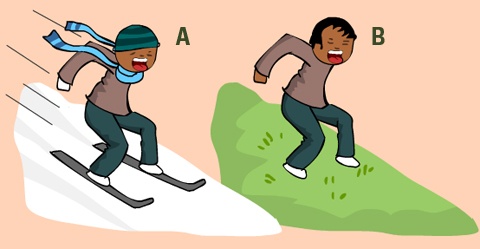
Why is it harder for the boy in Image B to get down the hill?
a)
Motion
b)
Friction
c)
Work
d)
Displacement
18.
Which force produces a change in motion?
a)
unbalanced force
b)
balanced force
c)
gravitational force
d)
frictional force
19.
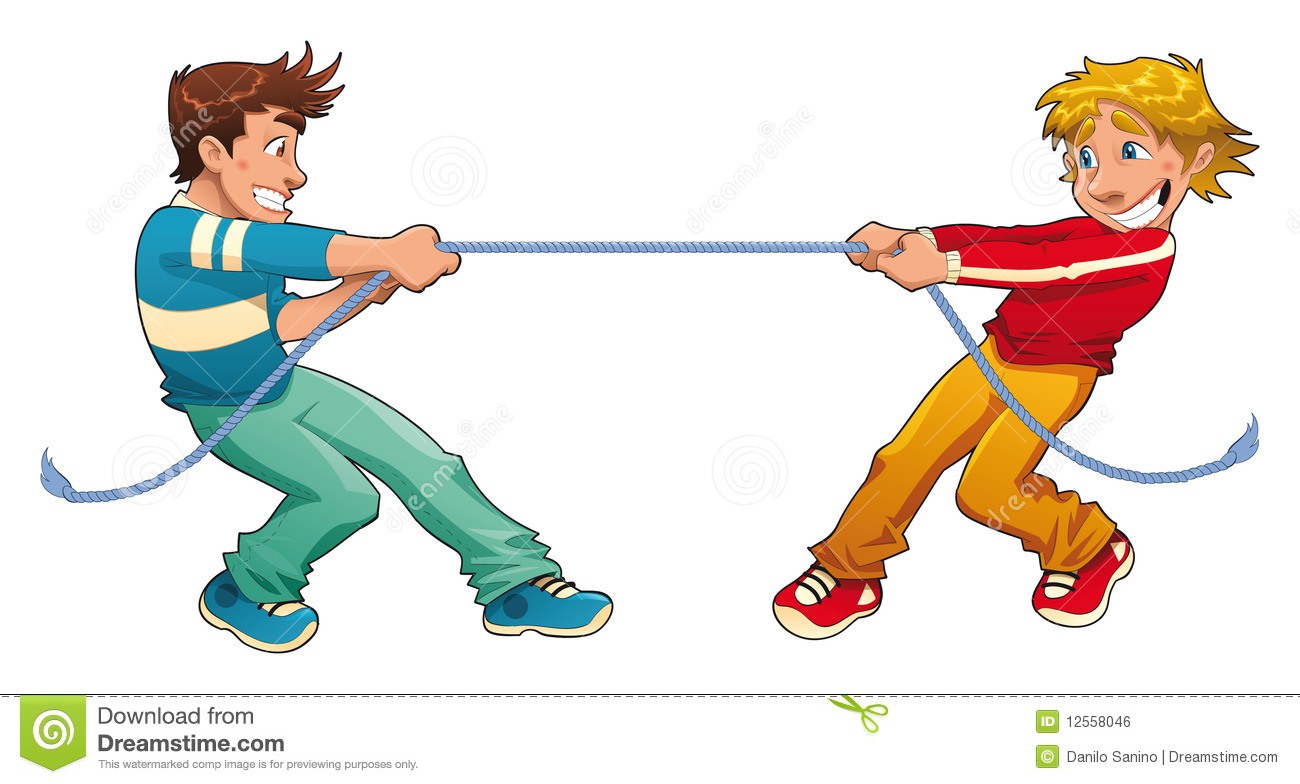
If these boys are pulling with the same amount of force.  What will happen?
a)
The boy in blue will win.
b)
They will not move at all.
c)
The boy in red will win.
d)
Both will fall down.
20.
_______________ is how fast an object changes over time. 
a)
speed
b)
velocity
c)
momentum
d)
acceleration
21.
What is the formula for force?
a)
F=M/A
b)
F=A/M
c)
F=M*A
d)
F=M*F
22.
What happens when two forces act in the same direction?
a)
They cancel each other out.
b)
The stronger one prevails.
c)
Their strengths are added.
d)
Their sum divided by the two is the total force.
23.
When you tell the direction and speed of an object, you give its
a)
motion
b)
velocity
c)
acceleration
d)
mass
24.
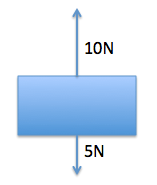
What is the net force on the block? (click on the words to view the picture)
a)
5 Newtons up
b)
5 Newtons down
c)
15 Newtons up
d)
15 Newtons down
25.
If a 10 kilogram object accelerates suddenly at 15 m/s2, how much force was applied to the object?
a)
150 Newtons
b)
15 Newtons
c)
150 kilograms
d)
100 kilograms
26.
A baseball is thrown a distance of 50 meters. What is the speed if it takes 2 seconds to cover that distance?
a)
100 m/s2
b)
25 m/s2
c)
52 m/s2
d)
100 seconds
27.
Speed is different from velocity because
a)
Velocity has a direction
b)
Speed uses Distance /Time
c)
Velocity doesn't include time
d)
Velocity doesn't include distance
28.
During which interval is the object speeding up?
a)
A to B
b)
B to C
c)
D to E
d)
E to F
29.
What is this graph showing?
a)
Constant Speed
b)
Acceleration (speeding up)
c)
Deceleration (slowing down)
d)
No motion
30.
8 N to the left , and 4 N to the right. Find the net force. Is this balanced 
a)
12 N Right  No
b)
4 N Left  No
c)
12 N Right  Yes
d)
4 N Left  Yes
31.
What type of energy is in this picture?
a)
Kinetic
b)
Elastic Potential
c)
Chemical
d)
Gravitational Potential 
32.
Energy of motion is which type of energy?
a)
Potential
b)
Kinetic
c)
Sound
d)
Gravitational
33.
What kind of energy is represented in the picture?
a)
Thermal
b)
Chemical
c)
Sound
d)
Nuclear
34.
What kind of energy is represented in this picture?
a)
Thermal
b)
Potential
c)
Nuclear
d)
Mechanical
35.
A battery converts what type of energy to another?
a)
sound to kinetic
b)
light to heat
c)
mechanical to electrical
d)
chemical to electrical
36.
What is the energy transformation for this battery powered car?
a)
Chemical-sound-thermal-light
b)
Chemical-electrical-mechanical-sound
c)
mechanical-electrical-sound 
d)
light-sound-mechanical
37.
Name the Energy conversion from the Sun to a growing apple tree.
a)
Nuclear → Electrical
b)
Gravitational → Thermal
c)
Chemical → Motion
d)
Radiant → Chemical
38.
Which energy transformation is shown?
a)
electrical > radiant
b)
chemical > electrical > radiant
c)
mechanical > radiant
d)
electrical > thermal
39.
Which energy transformation is shown?
a)
mechanical > chemical
b)
radiant > chemical
c)
chemical > thermal
d)
chemical > mechanical
40.
According to which law of energy, energy can't be created or destroyed?
a)
First law of motion
b)
The law of tacos
c)
Laws of Energy
d)
law of conservation of energy
41.
Which letter has the most gravitational potential energy?
a)
H
b)
E
c)
M
d)
Y
42.
The ability to do work 
a)
Law of Conservation of Energy
b)
Radiation
c)
Fission
d)
Energy
43.
Light given off by the Sun is an example of...
a)
mechanical energy
b)
chemical energy
c)
radiant energy
d)
thermal energy
44.
Gasoline burning to allow a car engine to run is an example of...
a)
mechanical energy
b)
chemical energy
c)
radiant energy
d)
thermal energy
45.
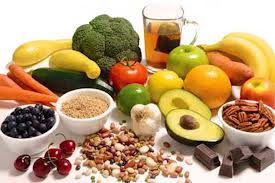
Food is a form of this type of energy.
a)
Light energy
b)
chemical energy
c)
Sound energy
d)
Thermal energy
46.
The tectonic plates float on the 
a)
lithosphere
b)
lower mantle
c)
outer core
d)
asthenosphere
47.
The part of the earth that includes the crust and the upper mantle and is split into tectonic plates is the
a)
lithosphere
b)
 crust
c)
asthenosphere
d)
mantle
48.
The hottest layer
a)
crust
b)
inner core
c)
mantle
d)
outer core
49.
The coolest layer
a)
crust
b)
inner core
c)
mantle
d)
outer core
50.
The thickest layer
a)
crust
b)
inner core
c)
mantle
d)
outer core
51.
This layer is completely liquid
a)
crust
b)
inner core
c)
mantle
d)
outer core
52.
This layer is a mix between solid and liquid
a)
crust
b)
inner core
c)
mantle
d)
outer core
53.
This layer is completely solid due to the intense pressure it is under
a)
crust
b)
inner core
c)
mantle
d)
outer core
54.
The theory stating the continents were once joined in a large mass that broke apart.
a)
Continental Drift
b)
Seafloor Spreading
c)
Plate Tectonics
d)
Pangaea
55.
The circular pattern of heating, rising, cooling, sinking of magma in the mantle causing tectonic plates to move.
a)
Plate Tectonics
b)
Convection Currents
c)
Pangaea
d)
Subduction
56.
Volcanoes are most often formed at this boundary.
a)
Divergent
b)
Convergent
c)
Normal
d)
Transform
57.
The Mid-Atlantic Ridge is formed at this boundary.
a)
Divergent
b)
Convergent
c)
Normal
d)
Transform
58.
What would you be most likely to find at a transform boundary?
a)
Earthquakes
b)
Volcanoes
c)
Mountains
d)
Rift
59.
What would you be most likely to find at a convergent boundary between a continental and oceanic plate?
a)
Mountains
b)
Volcanoes
c)
Mid-Ocean Ridge
d)
Rift
60.
What would you be most likely to find at a convergent boundary between two pieces of continental crust?
a)
Volcano
b)
Mountain
c)
Rift
d)
Island Arc
61.
According to the Big Bang Theory, what did the universe begin as?
a)
Cosmic soup
b)
Primordial Atom
c)
Black Hole
d)
Atomic Bomb
62.
In relation to us, most galaxies are…
a)
Approaching
b)
Receding
c)
Motionless
63.
The existence of the cosmic background radiation implies that
a)
the big bang model is wrong.
b)
the universe began in a hot, dense state.
c)
the universe did not have a moment of creation.
d)
the universe began in a cold, low-density state. 
64.
If an object is moving toward us, its spectrum will experience
a)
no shift
b)
red shift
c)
black spectrum
d)
blue shift
65.

Which of the following is NOT evidence of the Big Bang Theory?

a)

most galaxies are red-shifted

b)

CMBR everywhere

c)

the universe is gaining matter

d)

the universe is expanding

66.
About how long ago do scientists believe the universe began?
a)
13-14 billion years ago
b)
13-14 million years ago
c)
12-13 billion years ago
d)
12-13 million years ago
67.
In red shift, the wavelengths of light become
a)
Bluer
b)
shorter
c)
longer
68.

a huge collection of hundreds of billions of stars held together by gravity

a)

galaxy

b)

neutron stars

c)

black hole

d)

supergiant

69.

an enormous explosion that occurs when a massive star dies

a)

black hole

b)

nuclear fusion

c)

supernova

d)

solar wind

70.

stars at the beginning of their life cycle that fuse hydrogen atoms into helium atoms

a)

red giant

b)

black hole

c)

white dwarf

d)

main sequence star

71.

a hot, dense, slowly cooling sphere of carbon that remains when a red giant star dies

a)

red giant

b)

supergiant

c)

black hole

d)

white dwarf

72.

stars that have left the main sequence to fuse heavier and more complex elements such as carbon

a)

red giant

b)

white dwarf

c)

black dwarf

d)

black hole

73.

an immense cloud of dust & gas where stars are born

a)

black hole

b)

nebula

c)

prominence

d)

supernova

74.

process which fuses the nuclei of multiple atoms into one and releases massive amounts of energy

a)

nebula

b)

prominences

c)

solar wind

d)

nuclear fusion

75.

What unit is best used to measure the DISTANCE between two galaxies?

a)

miles

b)

kilometers

c)

light-years

d)

astronomical units (AU)

76.

Sirius is a star about 8.6 light years away from Earth. Which of these statements is correct based on this information?

a)

It would take about 8.6 years for astronauts to travel to Sirius.

b)

Light from Sirius takes about 8.6 years to reach Earth.

c)

Light from Sirius takes about 8.6 light years to reach Earth.

d)

Light from Sirius takes about 8.6 billion years to reach Earth.

77.

Where does nuclear fusion occur in a star?

a)

the core

b)

the corona

c)

a nebula

d)

a supernova

78.

Which of the following is TRUE about main-sequence stars?

a)

They will ALL end in a supernova.

b)

They ALL fuse hydrogen atoms into helium.

c)

They will ALL become a white dwarf.

d)

They are the hottest known stars.

79.
What is the hottest color star?
a)
Orange
b)
Red
c)
Blue
d)
White
80.
Early astronomers classified stars based on their 
a)
temperature. 
b)
color. 
c)
core width
d)
brightness.
81.
As the distance between a star and an observer increases, the apparent magnitude
a)
increases (brighter)
b)
remains the same
c)
decreases (dimmer)
d)
not enough information given
82.
Stars that form when a star collapses and the remaining material does not have a charge are called
a)
pulsars.
b)
black holes. 
c)
neutron stars.
d)
white dwarfs. 
83.
What is the coolest color star?
a)
Orange
b)
Red
c)
Blue
d)
White
84.
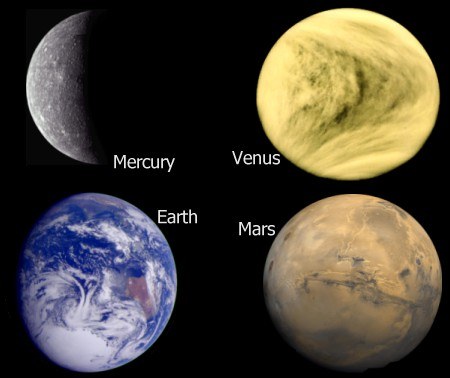
Earth and the other planets closest to the Sun are made mostly of _______
a)
gas
b)
metal
c)
water
d)
rock
85.
Earth's ________ on its axis causes day and night.
a)
rotation
b)
revolution
c)
phase
d)
comet
86.
One of the main differences between the outer and inner planets is __________.
a)
The inner planets all have water
b)
the inner planets are much bigger than the outer planets
c)
the outer planets are gas planets
d)
the outer planets have rings, and the inner planets don't
87.
Where is the asteroid belt found?
a)
between earth and mars
b)
Between Uranus and Neptune
c)
Between Mercury and Venus
d)
Between Mars and Jupiter
88.
Select the order from smallest to largest.
a)
Sun, Milky Way, solar system, universe
b)
Sun, Milky Way, universe, solar system
c)
Sun, solar system, Milky Way, universe
d)
Sun, solar system, universe, Milky Way
89.
A spiral galaxy of stars that contains our Sun
a)
Planisphere
b)
Intensity
c)
Star
d)
Milky Way