wayground logo

Free Printable Worksheets

Font size

S
M
L
XL
Worksheets

Honors Biology Spring Final Exam Review

Total questions: 70

Worksheet time: 52mins

Name
Class
Date
1.
In pigs, the allele for a wavy, rough coat (R) is dominant to the allele for a soft, fine coat (r). A rough coat boar and a soft coat sow mate. They produce several litters, 50% are rough coat and 50% are smooth coat. What were the genotypes of the parents?
a)
RR × rr
b)
Rr × rr
c)
RR × Rr
d)
Rr × Rr
2.
Impala share the African plains with other grazing animals and predators. Which change would lead to a DECREASE in the impala population?
a)
a reduction in the lion population
b)
an increase in the number of other grazing animals
c)
an increase in restrictions on the hunting of impala
d)
a reduction in the populations of other impala predators
3.
The snowshoe rabbit has white fur in winter and dark fur in summer. What is the main survival advantage of this fur color change to the rabbit?
a)
The light fur keeps the rabbit from getting sunburned in summer.
b)
The fur color is an adaptive form of camouflage to avoid predators.
c)
The dark fur absorbs more sunlight so the rabbit is warmer in winter.
d)
The white fur is more valuable to fur trappers, so the animal will be trapped and better fed in winter.
4.
The diagram shows the leg bones of a (Left -> Right): Orangutan, dog, pig, cow, tapir, and horse. Most of the animals have the same bones, although some are shaped differently and placed in different positions.
What does this suggest about mammals?
a)
That they shared a common ancestor.
b)
That mammals are evolving to become more and more like one another.
c)
That they developed their bone structure independently of one another.
d)
That the shape of the bones has less to do with the environment pressures on the animal, and more to do with what their relatives are.
5.
Green and brown algae share many common features. Both have pigments for trapping sunlight and use photosynthesis for energy. Both store their food as sugars. Both have cell walls and plant-like bodies. However, their DNA suggests that they are not even remotely related to one another. Green algae and brown algae show __________________ evolution, since they look similar, but are not close relatives
a)
convergent
b)
divergent
c)
homologous
d)
vestigial
6.
Darwin discovered twenty different species of finches in the Galapagos islands. He hypothesized that as new islands arose, finches colonized the islands and rapidly changed into new species, depending on what food was available on each new island. The rapid formation of many new species, as in this case, is called
a)
gradualism
b)
speciation
c)
adaptive radiation
d)
geographic isolation
7.
_______________, harmful or helpful, is considered to be the source for new alleles and a main contributor to the diversity of life on Earth.
a)
Mitosis
b)
Mutation
c)
Transcription
d)
Translation
8.
Suppose orange beetles and green beetles live in the same environment. Green beetles are harder to see on leaves, so birds eat primarily orange beetles. According to the theory of natural selection, in the future orange beetles will
a)
move to a place without green beetles.
b)
decrease in population until they possibly become extinct.
c)
reproduce to their full potential until they increase in number
d)
breed with green beetles until there are no longer orange beetles.
9.
A species of insect is newly introduced into the United States from the Philippines. This insect becomes established, laying its eggs on the leaves of oak trees. How can a biologist determine if the relationship between the insect and the oak tree is commensalism, mutualism, or parasitism?
a)
If the insect benefits, the relationship is parasitism.
b)
If both the insect and the tree benefit, the relationship is commensalism.
c)
If the insect benefits and the tree neither benefits nor is harmed, the relationship is mutualism.
d)
If the insect benefits and the tree neither benefits nor is harmed, the relationship is commensalism.
10.
An ecological pyramid is sometimes used to show both the flow of matter and energy in an ecosystem. The pyramid narrows as matter and energy flow from the bottom to the top. What does this pyramid tell you about the energy in this ecosystem?
a)
Energy stays the same. Only the number of living things change.
b)
Energy decreases from the top to the bottom as organisms are larger in size.
c)
Energy increases from bottom to top because the organisms get larger in size.
d)
Energy decreases from bottom to top because some is used at each level for life processes.
11.
Apple farmers are currently having a very difficult time with pesticide-resistant insects. These insects are no longer being killed by the current chemical treatments, thus causing a lot of damage to the apple crops. In reaction to this, researchers are developing newer and stronger chemicals to help control the bugs.
Why are the apple farmers seeing these new, stronger bugs?
a)
The bugs were not native to the area and thus cannot be killed by normal chemicals.
b)
Changes in the weather have led to stronger insects that can survive these harsh changes.
c)
The strongest bugs were able to survive pesticides, reproduce and create more resistant pests.
d)
The apple trees are producing too many apples, which is allowing the insects to reproduce rapidly.
12.
While working in the lab with samples of food, Rachel saw this rod-shaped organism under the microscope. With further tests, Rachel noticed that the organism was single-celled and did not contain a nucleus. Which of these did Rachel conclude was the best way to classify this organism?
a)
bacteria
b)
fungus
c)
protist
d)
virus
13.
If one defines life as the simplest form capable of displaying the most essential attributes of a living thing, one very quickly realizes that the only real criterion for life is the ability to replicate. Only systems that contain nucleic acids are capable of this phenomenon. This sort of reasoning has led to a new definition of organism:
An organism is the unit element of a continuous lineage with an individual evolutionary history.
Considering the new definition of life, all but one piece evidence supports the fact that a virus must be referred to as an organism. That is:
a)
Viruses contain nucleic acids.
b)
Viruses are capable of replication.
c)
Viruses have a simple cellular structure.
d)
Viruses have an evolutionary history and that implies lineage.
14.
Compare primary and secondary succession of an ecosystem. What is the distinction between them?
a)
Primary succession is the sequence of plants that colonize a new area, while secondary succession is the sequence of animals that move once plant life is established.
b)
Primary succession is the sequence of species that become established early in a newly colonized area, while secondary succession is the sequence of species that move in much later.
c)
Primary succession is the establishment of a new community in an existing ecosystem that was disturbed, while secondary succession is the establishment of a community in an area that was altered due to fire.
d)
Primary succession is the establishment of a community in an area with no soil, while secondary succession is the establishment of a new community in an existing ecosystem that was disturbed by some catastrophic event.
15.

Which describes the type of cross shown in the picture?

a)

codominance: both homozygous alleles make up the phenotype for the heterozygous

b)

incomplete dominance: both homozygous alleles become a mixture for the heterozygous

c)

Mutation: change in the DNA

d)

Nondisjunction: chromosomes separate incorrectly

16.
Dimples is dominant to no dimples. According to the Punnett square, what are the odds the offspring would have dimples?
a)
25%
b)
50%
c)
75%
d)
100%
17.
What pattern of inheritance is described by this example?
a)
codominance
b)
incomplete dominance
c)
simple dominance
d)
multiple alleles
18.
Colorblindness is more common in males than in females because
a)
Fathers pass the allele for colorblindness to their sons only
b)
The allele for colorblindness is located on the Y chromosome.
c)
The allele for colorblindness is recessive and located on the X chromosome.
d)
Males who are colorblind have two copies of the allele for colorblindness.
19.
What can you determine regarding the trait shown by individuals 4 and 8.
a)
It is recessive
b)
It is dominant
c)
It is sex-linked
d)
It cannot be determined
20.
karyotype depicts
a)
Turner's
b)
Edward's
c)
klinefelter's  
d)
Down's Syndrome 
21.
Karyotype depicts
a)
turner's
b)
edward's
c)
klinefelter's
d)
Down's 
22.

What organisms are the most important to the nitrogen cycle?

a)

Plants

b)

Animals and Plants

c)

Decomposers and Bacteria

d)

Bacteria

23.

Homologous structures are..

a)

same structure, same function

b)

same structure different function

c)

different structure, same function

d)

different structure, different function

24.

Analogous structures are...

a)

same structure, different function

b)

same structure. same function

c)

different structure, same function

d)

different structure. different function

25.
Which of the following is a term for a group of similar organisms that can reproduce fertile offspring?
a)
individual
b)
population
c)
species
d)
fossil
26.
Why are advantageous traits more likely to be passed onto offspring?
a)
Because they are more likely to survive and reproduce.
b)
Because they come from dominant alleles.
c)
Because they come from recessive alleles.
d)
Because the trait is an acquired phenotype.
27.
Which part of the neuron is a long fiber that send information to other cells?
a)
dendrite
b)
terminal
c)
cell body
d)
axon
28.
Label the Neuron-What does the letter "A" represent?
a)
Axon
b)
Dendrite
c)
Axon Terminal
d)
Cell Body
29.
The regulation of steady, life maintaining conditions inside an organism despite changes in the environment.
a)
homeostasis
b)
reflexes
c)
stimulus
d)
neuron
30.
Endocrine glands produce __________ which maintain the body in homeostasis
a)
oils
b)
neurotransmitters 
c)
tears
d)
hormones
31.
All hormones __. 
a)
are produced by endocrine glands.
b)
are carried to target cells in the blood. 
c)
are lipid-soluble molecules.
d)
are protein molecules.
32.
Autotrophs make up the _______ level in all ecosystems.
a)
First
b)
Second
c)
Third
d)
Fourth
33.

A living relationship between two species in which one organism is harmed and the other steals nutrition is called...

a)

mutualism

b)

commensalism

c)

parasitism

d)

niche

34.
A collection of organisms that make up a community as well as all of the nonliving aspects of the environment.
a)
Population
b)
Community
c)
Habitat
d)
Ecosystem
35.
In a forest ecosystem, which of the following is the best example of a limiting factor for a rabbit population?
a)
Squirrel Population
b)
Sunlight
c)
Grass available
36.
Which organism is a primary producer?
a)
phytoplankton
b)
krill
c)
copepods
d)
carnivorous plankton
37.
The crocodile and bird have a _______________ relationship.  The crocodile benefits by having its teeth cleaned.  The bird benefits by gaining food and protection.  Both animals benefit from this relationship.
a)
parasitism
b)
predator and prey
c)
mutualism
d)
commensalism
38.
Finches on the Galapagos Islands had different beaks in order to help them do what?
a)
Build nests
b)
Fight off predators
c)
Collect food sources
d)
Compete with rivals
39.

Adaptations are:

a)

physical or behavioral tendencies.

b)

physical or behavioral characteristics that help an organisms survive and reproduce.

c)

physical or behavioral characteristics that do not help the organism in any way.

d)

genetic mutations that have gone wrong.
40.

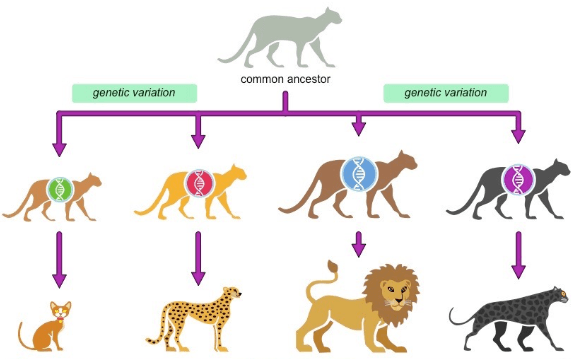
The process by which two populations of the same species become so different that they can no longer interbreed.

a)

natural selection

b)

artificial selection

c)

speciation

d)

fossilization

41.
What is one reason that strawberries are surviving in the winter season?
a)
they have larger leaves
b)
they have genetic variations allowing them to be resistant to cold
c)
they reproduce more
d)
the color is dark
42.
Which symbiotic relationship is described by one individual benefiting and the other being neither harmed nor benefited?
a)
Mutualism
b)
Commensalism
c)
Parasitism
d)
Competition
43.
If a homozygous dominant (AA) individual is crossed to a homozygous recessive (aa) individual, what will the genotypes be of the offspring?
a)
50% AA, 50% aa
b)
25% AA, 50% Aa, 25% aa
c)
100% Aa
d)
50% AA, 50% Aa
44.
In animals, sexual reproduction depends on the production of gametes. Which of the following processes produces gametes in animals? 
a)
Meiosis
b)
Binary fission
c)
Mitosis
d)
Fragmentation 
45.
A herd of zebras would be considered a
a)
community
b)
species
c)
ecosystem
d)
population
46.
Two organisms of different species exist in a relationship in which each individual benefits from the activity of the other:
a)
commensalism
b)
parasitism
c)
herbivory
d)
mutualism
47.
All of the following are density-dependent factors that limit animal populations EXCEPT.
a)
weather
b)
predation
c)
food competition
d)
birthrate
48.
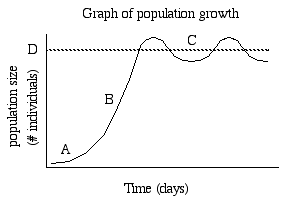
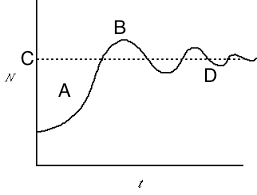
Which point on the graph represents carrying capacity?
a)
A
b)
B
c)
C
d)
D
49.
Which letter shows the the exponential growth of a population?
a)
A
b)
B
c)
C
d)
D
50.
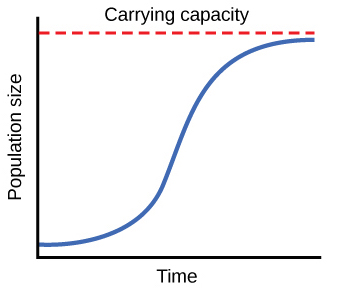
__________ growth shows growth of a population under environmental constraints (carrying capacity-K) that sets a maximum population size 
a)
logistic
b)
exponential
c)
niche
d)
uniform
51.

What is the carrying capacity of the following population?

a)

1000

b)

8000

c)

800

d)

600

52.
In pigs, the allele for a wavy, rough coat (R) is dominant to the allele for a soft, fine coat (r). A rough coat boar and a soft coat sow mate. They produce several litters, 50% are rough coat and 50% are smooth coat. What were the genotypes of the parents?
a)
RR × rr
b)
Rr × rr
c)
RR × Rr
d)
Rr × Rr
53.
 A frameshift mutation could result from 
a)
a base insertion only.
b)
a base deletion only. 
c)
a base substitution only. 
d)
either an insertion or a deletion of a base.
54.
If black and white true-breeding mice are mated and the result is all gray offspring, what inheritance pattern would this be indicative of?
a)
dominance
b)
codominance
c)
multiple alleles
d)
incomplete dominance
55.
In humans, hemophilia is an X-linked recessive trait. If a man and a woman have a son who is affected with hemophilia, which of the following is definitely true?
a)
The mother carries an allele for hemophilia
b)
The father carries an allele for hemophilia
c)
The father is afflicted with hemophilia
d)
both parents carry an allele for hemophilia
56.
Hemophilia is a recessive x-linked disorder.
Which genotype represents a male with hemophilia?
a)
XHXh
b)
XhXh
c)
XHY
d)
XhY
57.
Which of the following DOES NOT increase variation in the next generation?
a)
Independent Assortment
b)
Random Fertilization
c)
Crossing Over
d)
Asexual reproduction
58.
Meiosis results in ______.
a)
4 genetically distinct haploid gametes
b)
2 genetically distinct cells
c)
2 genetically identical cells
d)
4 genetically identical cells
59.
In a sex-linked inheritance pedigree you would expect to see
a)
more affected females
b)
all carrier males
c)
more affected males
d)
an equal number of affected males and females
60.
If this image were real, it would represent what type of inheritance?
a)
incomplete dominance
b)
codominance
c)
polygenic inheritance
d)
compete dominance
61.
A child has type O blood, if mother has type A blood, what would the fathers blood type be
a)
A,B, or O
b)
AB or A
c)
AB or B
d)
O only
62.
Why would a population with a large amount of genetic variation be more likely to survive a severe climate change in its environment?
a)
Individuals will only create offspring well-suited to the climate change
b)
The individuals would produce more offspring
c)
Individuals better suited to the new climate will help less-suited individuals survive
d)
Some individuals will posses traits better suited to the new climate and be more likely to pass them on
63.
Is this trait (the shaded individuals) dominant or recessive?
a)
dominant
b)
recessive
64.
Blood type AB is an example of:
a)
epistasis
b)
codominance
c)
incomplete dominance
d)
hybrid vigor
65.
What is the genotype of the great-grandfather? (Individual 2)
a)
A_
b)
aa
c)
Aa
d)
AA
66.
Antibiotics work against most
a)
Bacteria
b)
Bacteria & Viruses
c)
Vaccines
d)
Viruses
67.
Vaccinations are used for
a)
Curing the illness
b)
Preventing the Illness
c)
Getting the illness
68.
What do antibodies attach to on the pathogen?
a)
Anti inflammatory
b)
Antigens
c)
Antiseptic
d)
Antibodies
69.

Produces the hormone insulin and glucagon, which controls the level of glucose in the blood.

a)

Thyroid Gland

b)

Pancreas

c)

Thymus Gland

d)

Pituitary Gland

70.
Are chemicals that travel in the blood and cause changes in different parts of the body
a)
Hormones
b)
Glands
c)
Parathyroid 
d)
Adrenal Gland