

wayground logo

Free Printable Worksheets

Font size

S
M
L
XL
Worksheets

Unit 3 / Unit 5 Review

Total questions: 68

Worksheet time: 35mins

Name
Class
Date
1.
What are the two items that living systems take in and conver them into something that they can use?
a)
Energy and Matter
b)
Light and Water
c)
Nutrients and Water
d)
Carbon and Oxygen
2.
What type of organism captures light energy and convert it into chemical energy in order to carry out cell processes in the cell?
a)
Producers
b)
Consumers
c)
Decomposers
d)
Autotrophs
3.
What do you call the process where organisms capture and transform light energy from the sun and store it in high energy sugar molecules, such as glucose?
a)
Photosynthesis
b)
Chemosynthesis
c)
Cellular Respiration
d)
Fermentation
4.
What kind of energy that is released from the sun that plants uses to create chemical energy?
a)
Light Energy
b)
Heat Energy
c)
Sound Energy
d)
Thermal Energy
5.

After light energy is absorbed into the plant, it is converted it into what kind of energy?

a)
Chemical Energy
b)
Mechanical Energy
c)
Nuclear Energy
d)
Kinetic Energy
6.
What are the reactants / inputs for photosynthesis?
a)
Carbon Dioxide, Water, and Light Energy
b)
Glucose and Oxygen
c)
Nitrogen and Water
d)
Carbon and Hydrogen
7.
What are the products / outputs for photosynthesis?
a)
Glucose and Oxygen
b)
Carbon Dioxide and Water
c)
Light Energy and ATP
d)
Glucose and Heat
8.
What form of energy is light known as?
a)
Electromagnetic Radiation
b)
Thermal Radiation
c)
Kinetic Energy
d)
Potential Energy
9.

Since visible light consists of different wavelengths, they correspond to different types of what?

a)
Color
b)
Energy
c)
Matter
d)
Forces
10.
What part of the plant cell is in charge of photosynthesis?
a)
Chloroplast
b)
Mitochondria
c)
Nucleus
d)
Ribosome
11.
What do you call the stacks of disk-shaped sacs that can be found in the inner membrane of the chloroplast?
a)
Thylakoids
b)
Grana
c)
Stroma
d)
Cytoplasm
12.
What do you call the pigment molecules that can be found in thylakoids that makes plants green?
a)
Chlorophyll
b)
Carotenoids
c)
Xanthophylls
d)
Phycobilins
13.
There are some producers that can be found in dark oceans and deep caves where sunlight cannot reach. What specific vents do these organisms thrive on that releases hydrogen sulfide through these cracks?
a)
Hydrothermal Vents
b)
Geothermal Vents
c)
Cold Seeps
d)
Ocean Vents
14.
What is the process of using chemical energy to make sugar from carbon dioxide for energy storage called?
a)
Chemosynthesis
b)
Photosynthesis
c)
Respiration
d)
Fermentation
15.
What is the difference between photosynthesis and chemosynthesis?
a)
With chemosynthesis, producers use chemical energy as their starting input. Compared to photosynthesis, producers use light energy as their starting input.
b)
Chemosynthesis only occurs in plants, photosynthesis occurs in all organisms.
c)
Photosynthesis occurs only at night, while chemosynthesis occurs during the day.
d)
Photosynthesis produces ATP, while chemosynthesis produces glucose.
16.
What specific process is complementary with photosynthesis?
a)
Cellular Respiration
b)
Fermentation
c)
Anaerobic Respiration
d)
Glycolysis
17.
What are the two energy carrying molecules that changes light energy into chemical energy?
a)
ATP and NADPH
b)
FADH2 and NADH
c)
ADP and AMP
d)
Glucose and Oxygen
18.
How many stages of photosynthesis are there?
a)
Two
b)
Three
c)
One
d)
Four
19.
Which part of the chloroplast does the light dependent reactions occur in?
a)
Thylakoids
b)
Stroma
c)
Inner Membrane
d)
Outer Membrane
20.
Which part of the chloroplast does the light independent reactions occur in?
a)
Stroma
b)
Thylakoids
c)
Inner Membrane
d)
Outer Membrane
21.
What are the inputs needed for the light dependent reactions to occur?
a)
NADP+, ADP, Water, and Light Energy
b)
Oxygen and Glucose
c)
Carbon Dioxide and Water
d)
Glucose and ATP
22.
What are the outputs that are released in light dependent reactions?
a)
Oxygen, ATP, and NADPH
b)
Glucose and Carbon Dioxide
c)
ATP and Water
d)
NADPH and Heat
23.
What are the inputs needed for the light independent reactions to occur?
a)
Carbon Dioxide, Water, and NADPH
b)
Oxygen and Glucose
c)
ATP and NADH
d)
Light and Water
24.
What are the outputs that are released in light independent reactions?
a)
NADP+, ADP, and Glucose
b)
Oxygen and Water
c)
Carbon Dioxide and Heat
d)
ATP and NADPH
25.
Photosynthesis can be broken down into two parts: PHOTO + SYNTHESIS, which part of photosynthesis is the LIGHT DEPENDENT REACTIONS in charge of?
a)
PHOTO
b)
SYNTHESIS
c)
Energy Transfer
d)
Carbon Fixation
26.
Photosynthesis can be broken down into two parts: PHOTO + SYNTHESIS, which part of photosynthesis is the LIGHT INDEPENDENT REACTIONS in charge of?
a)
SYNTHESIS
b)
PHOTO
c)
Light Absorption
d)
Energy Production
27.
In light dependent reactions, light is captured and transferred in the thylakoid membrane by two groups of molecules. What are these two group molecules called?
a)
Photosystem II and Photosystem I
b)
Chlorophyll and Carotenoids
c)
ATP Synthase and Cytochrome Complex
d)
NADP+ and NADPH
28.
What specific cycle takes in carbon dioxide and produces glucose that can be found in LIGHT INDEPENDENT REACTIONS?
a)
Calvin Cycle
b)
Krebs Cycle
c)
Glycolysis
d)
Electron Transport Chain
29.

In our bodies, we are similar in a way with cars because we both have the same reaction to gain energy that is needed to break specific bonds and release energy.

What is this specific reaction called?

a)

Combustion Reaction

b)

Respiration

c)

Fermentation

d)

Photosynthesis

30.

What are the INPUTS for CELLULAR RESPIRATION?

a)

Oxygen and Glucose

b)

Carbon Dioxide and Water

c)

ATP and NADPH

d)

Glucose and Water

31.

What are the OUTPUTS for CELLULAR RESPIRATION?

a)

Oxygen and Glucose

b)

Carbon Dioxide and Water

c)

ATP and NADPH

d)

Glucose and Water

32.

What are the ENERGY RELEASED during CELLULAR RESPIRATION?

a)

Oxygen and Glucose

b)

Carbon Dioxide and Water

c)

ATP and Heat

d)

Glucose and Water

33.

Since Cellular Respiration needs oxygen, what type of process is it called?

a)

Aerobic

b)

Anaerobic

c)

Oxidated

d)

Dioxidated

34.

Which part of the cell does CELLULAR RESPIRATION take place?

a)

Mitochondria

b)

Chloroplast

c)

Golgi Apparatus

d)

Ribosomes

35.

Which of the following is NOT part of the MITCHONDRIA?

a)

Cristae

b)

Outer Membrane

c)

Intermembrane Space

d)

Stroma

36.

Which of part of the MITOCHONDRIA is the inner membrane with many folds?

a)

Cristae

b)

Thylakoids

c)

Intermembrane Space

d)

Stroma

37.

Which of part of the MITOCHONDRIA separates the mitochondrion from the rest of the cell?

a)

Cristae

b)

Outer Membrane

c)

Intermembrane Space

d)

Stroma

38.

Which of part of the MITOCHONDRIA is the space between two membrane within the mitochondria?

a)

Cristae

b)

Outer Membrane

c)

Intermembrane Space

d)

Stroma

39.

Which of part of the MITOCHONDRIA has the greater surface area and why?

a)

Inner Membrane; It has many folds.

b)

Outer Membrane; It is smooth

c)

Matrix; It is dense with enzymes.

d)

Intermembrane Space; It holds ions.

40.

What did you notice about the direction between cellular respiration and photosynthesis?

a)

They are opposite processes to each other

b)

They are both energy-storing processes.

c)

They require the same inputs and outputs.

d)

They occur in the same cellular organelles.

41.

How does shape and size of the inner membrane of the mitochondrion affect the production of ATP?

a)

The larger surface area from folds increases ATP production.

b)

The inner membrane shape has no effect on ATP production.

c)

A smaller membrane size produces more ATP.

d)

The shape reduces surface area, which increases ATP production.

42.

Photosynthesis and Cellular Respiration are complementary to each other.

With that being said, which of the following terms occur FIRST?

a)

Absorption of Sunlight

b)

ATP Production

c)

Production of Sugars

d)

Breakdown of Sugars

43.

Photosynthesis and Cellular Respiration are complementary to each other.

With that being said, which of the following terms occur SECOND?

a)

Absorption of Sunlight

b)

ATP Production

c)

Production of Sugars

d)

Breakdown of Sugars

44.

Photosynthesis and Cellular Respiration are complementary to each other.

With that being said, which of the following terms occur THIRD?

a)

Absorption of Sunlight

b)

ATP Production

c)

Production of Sugars

d)

Breakdown of Sugars

45.

Photosynthesis and Cellular Respiration are complementary to each other.

With that being said, which of the following terms occur LAST?

a)

Absorption of Sunlight

b)

ATP Production

c)

Production of Sugars

d)

Breakdown of Sugars

46.

Which of the following can be categorized under PHOTOSYNTHESIS?

a)

Absorption of Sunlight

b)

ATP Production

c)

Production of Sugars

d)

Breakdown of Sugars

47.

Which of the following can be categorized under CELLULAR RESPIRATION?

a)

Absorption of Sunlight

b)

ATP Production

c)

Production of Sugars

d)

Breakdown of Sugars

48.

What is the regular pattern of growth, DNA duplication and cell division that occurs in eukaryotic cells called?

a)

Cell Cycle

b)

Mitosis

c)

Binary Fission

d)

Cytokinesis

49.

How many parts are there in the Cell Cycle?

a)

2

b)

5

c)

6

d)

1

50.

What are the two parts of the Cell Cycle?

(MULTIPLE ANSWERS)

a)

Resting Phase

b)

Dividing Phase

c)

Multiplying Phase

d)

Destruction Phase

51.

Which phase of the cell cycle is known as the resting phase?

a)

Synthesis

b)

Mitosis

c)

Interphase

d)

Cytokinesis

52.

Which phase of the cell cycle is known as the dividing phase?

a)

Synthesis

b)

Mitosis

c)

Interphase

d)

Cytokinesis

53.

Within Interphase, there multiple phases before the cell enter its dividing phase in the Cell Cycle.

Which of the following below is the CORRECT ORDER for the Interphase?

a)

G1, S, G2

b)
G1, G2, S
c)
G2, S, G1
d)
S, G1, G2
54.

Within Interphase, there multiple phases before the cell enter its dividing phase in the Cell Cycle.

Which of the following below stages below is when the cell grows, carry out normal functions and replicate their orgranelles?

a)
G1 phase
b)
M phase
c)
G2 phase
d)
S phase
55.

Within Interphase, there multiple phases before the cell enter its dividing phase in the Cell Cycle.

Which of the following below stages below is when the DNA is replicated in the cell?

a)
G1 phase
b)
M phase
c)
G2 phase
d)
S phase
56.

Within Interphase, there multiple phases before the cell enter its dividing phase in the Cell Cycle.

Which of the following below stages below is when additional growth occurs within the cell?

a)
G1 phase
b)
M phase
c)
G2 phase
d)
S phase
57.

Which type of cells divide more frequently and a shorter lifespan due to wear and tear?

a)

Muscle cells

b)

Neurons

c)

Skin cells

d)

Liver cells

58.

Which of the following is the proper order for MITOSIS?

a)

Prophase, Metaphase, Anaphase, Telophase, Cytokinesis

b)

Interphase, Anaphase, Metaphase, Telophase, Cytokinesis

c)

Prophase, Anaphase, Telophase, Metaphase, Cytokinesis

d)

Prophase, Interphase, Metaphase, Telophase, Cytokinesis

59.

Which stage of MITOSIS does the picture model above?

a)
Anaphase
b)
Metaphase
c)
Prophase
d)
Telophase
60.

Which stage of MITOSIS does the picture model above?

a)
Anaphase
b)
Metaphase
c)
Prophase
d)
Telophase
61.

Which stage of MITOSIS does the picture model above?

a)
Anaphase
b)
Metaphase
c)
Prophase
d)
Telophase
62.

Which stage of MITOSIS does the picture model above?
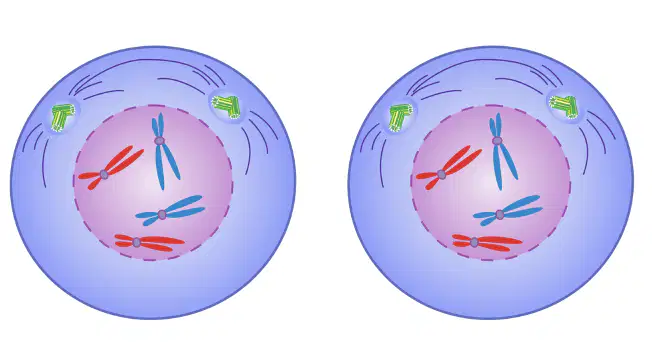
a)
Anaphase
b)
Metaphase
c)
Prophase
d)
Telophase
63.

Which stage of MITOSIS does the picture model above?

a)

Cytokinesis

b)
Metaphase
c)
Prophase
d)
Telophase
64.

Which stage of MITOSIS does the nuclear envelope breaks down, centrioles BEGIN to move to opposite poles, and spindle fibers form?

a)
Anaphase
b)
Metaphase
c)
Prophase
d)
Telophase
65.

Which stage of MITOSIS spindel fibers attach to the centromere of each chromosome. They align the chromosome along the equator OR THE MIDDLE OF THE CELL?

a)
Anaphase
b)
Metaphase
c)
Prophase
d)
Telophase
66.

Which stage of MITOSIS chromatids separate APART to opposite sides of the cell.?

a)
Anaphase
b)
Metaphase
c)
Prophase
d)
Telophase
67.

Which stage of MITOSIS when the nuclear membranes start to form, chromosomes begin to uncoil and the spindle fibers fall apart?

a)
Anaphase
b)
Metaphase
c)
Prophase
d)
Telophase
68.

Which stage of MITOSIS when the cell has completely divided the cytoplasm creating two daughter cells, each with a genetically identical nucleus?

a)

Cytokinesis

b)
Metaphase
c)
Prophase
d)
Telophase
