wayground logo

Free Printable Worksheets

Font size

S
M
L
XL
Worksheets

IB Genetics, Mitosis, & Meiosis ~ Corona Refresher!

Total questions: 70

Worksheet time: 6hrs 34mins

Name
Class
Date
1.
The haploid number of human chromosomes is
a)
11
b)
12
c)
23
d)
46
2.
What term is given to the entire genetic information found in an organism?
a)
Genotype
b)
Genome
c)
Chromosome
d)
Gene
3.
One of the two forms of a gene is called....
a)
a genotype
b)
an allele
c)
a hybrid
d)
a trait
4.
If Albinism (to be an Albino) is a recessive trait represented by (a), what is the percentage of offspring will be Albino?
a)
25%
b)
50%
c)
75%
d)
100%
5.
What is a Dominant Allele?
a)
An allele whose trait always shows up in the organism when the allele is present.
b)
An allele that is masked when a dominant allele is present.
c)
The scientific study of heredity.
d)
A characteristic that an organism can pass on to its offspring through its genes.
6.
An organism's _______ describes its genetic composition. An organism's _______ describes its appearance or observable characteristics.
a)
phenotype; genotype
b)
species; heredity
c)
heredity; species
d)
genotype; phenotype
7.
Ken is blood type B and Barbie is blood type A.  How can they have children who are types AB, and O?
a)
Alleles A and B are co-dominant, but allele O is recessive
b)
Alleles A and B are incompletely dominant, but allele O is recessive
c)
Alleles A and B are co-dominant, but allele O is completely dominant
d)
Alleles A and B are incompletely dominant, but allele O is completely dominant
8.

Suhitha is blood type B and Kieran is blood type A. How can they have children who are types A, B, AB, and O?

a)

Suhitha: IBIB

Kieran: IAIA

b)

Suhitha: IBIB

Kieran: IAi

c)

Suhitha: IBi

Kieran: IAi

d)

Suhitha: IBi

Kieran: IAIA

9.
Which of the following statements about homologous chromosomes is correct?
a)
Each gene is at the same locus on both chromosomes.
b)
They are two identical copies of a parent chromosome which are attached to one another at the centromere.
c)
They come from the same parent
d)
They are chromosomes that have identical genes and alleles.
10.
The structure labeled A is...
a)
a chromatid
b)
a centriole
c)
a centromere
d)
a chromosphere
11.
The chromosome of a bacterium...
a)
occurs in multiple pairs within the cell
b)
is wrapped around proteins
c)
has a circular shape
d)
is found within the nucleus
12.
The cell cycle is regulated by...
a)
cyclins
b)
cyclin dependent kinases
c)
histones
d)
cyclin dependent kinases & cyclins
13.
Which of the following can cause genetic mutations?
a)
ionizing radiation
b)
UV light
c)
carcinogenic chemicals
d)
all of these
14.
What is the primary cause of the conformational change in the hemoglobin of individuals with sickle cell anemia?
a)
A single base substitution results in glutamic acid being replaced by valine during translation
b)
Low concentrations of oxygen causes normal red blood cells to change shape
c)
Individuals lack iron in their diet which causes them to be anemic
d)
The individual is completely lacking the gene to code for hemoglobin
15.
Mutations commonly occur during replication.  Which enzyme is responsible for 'proof-reading' the new DNA strand to correct any possible errors?
a)
DNA polymerase
b)
Ligase
c)
Primase
d)
Helicase
16.

What phase is shown in the picture during meiosis?

a)

anaphase 1

b)

anaphase 2

c)

metaphase 1

d)

telophase 1

17.
When an area of a chromatid is exchanged with the matching area on a chromatid of its homologous chromosome, _________________ occurs
a)
crossing over
b)
mutagenesis
c)
hybridization
d)
fertilization
18.
Which process and type of resulting cells are represented?
a)
mitosis, gametes
b)
mitosis, body cells
c)
meiosis, gametes
d)
meiosis, body cells
19.
What is one of the advantages, why is it better to reproduce sexually versus asexually?
a)
survival of the fittest
b)
overproduction
c)
genetic variation
d)
cloning
20.

Identify the phase of meiosis.

a)

Metaphase I

b)

Metaphase II

c)

Prophase I

d)

Anaphase II

21.
When homologous chromosomes match up, they form a structure call a ___________.
a)
tetrad
b)
triad
c)
diploid
d)
gamete
22.

Which phase?

a)

Metaphase I

b)

Metaphase II

c)

Anaphase I

d)

Anaphase II

23.

What is the purpose of PCR?

a)

To produce millions of copies of DNA.

b)

To produce millions of copies of a specific region of DNA

c)

To add nucleotides to a DNA sequence

d)

To watch polymerase work.

24.

What does PCR stand for?

a)

Polymerase Cytoplasmic Reaction

b)

Polymerase Chromosomal Reaction

c)

Polymerase Chain Reaction

d)

Probably Cannot React

25.

What happens in the Denature step of PCR?

a)

The DNA nucleotides are broken apart.

b)

The base-pairing rules for DNA are reversed.

c)

The double-stranded DNA is separated into two single strands of DNA.

d)

The DNA is returned to its natural setting.

26.

What happens during the Anneal step of PCR?

a)

Primers are created.

b)

The primers attach to the target DNA region.

c)

Primers copy the new DNA strand.

d)

Primers sequence DNA

27.

What is the function of a primer?

a)

To identify the particular region of DNA to be copied by PCR.

b)

To copy DNA.

c)

To create DNA nucleotides.

d)

To maintain the temperature of the PCR reaction.

28.

If the target sequence is GCATTA, what is the complementary sequence?

a)

TACGGC

b)

CGTAAT

c)

GCATTA

d)

ATGCCG

29.

What is a restriction enzyme?

a)

Enzyme that cuts DNA

b)

Enzyme that add to the DNA strand

c)

Enzyme that builds proteins

d)

Enzyme that breaks down lipids

30.

Asymetrical ends of DNA after being cut by a restriction enzyme

a)

Competent Ends

b)

Sticky Ends

c)

Ligated Ends

d)

Restrictive Ends

31.

From where does Taq polymerase come?

a)

Bacteria that live in hydrothermal vents/hot springs.

b)

Pig cells

c)

The rain forest

d)

The CDC

32.
DNA cutting "scissors" are
a)
Bacteriophages
b)
Restriction Enzymes
c)
DNA Enzymes
d)
Plasmids
33.

What are the uses of PCR?

a)

Cloning

b)

Paternity Testing

c)

Genotyping

d)

DNA Profiling

34.

Based on these results whose blood was found in the blood stain at the crime scene?

a)

Bob

b)

Sue

c)

John

d)

Lisa

35.

DNA is recovered from a dead soldier who was so badly injured she could not be formally identified. Which parents have lost their child?

a)

Parents C and D

b)

Parents E and F

c)

Parents A and B

d)

Parents G and H

36.

Why do the fragments of DNA in gel electrophoresis travel away from the negative electrode?

a)

DNA is negatively charged so attracted to the positive end of the unit

b)

DNA is positively charged so is attracted to the negative end of the unit

c)

the agarose gel is negatively charged

d)

the agarose gel is positively charged

37.

In gel electrophoresis, the largest DNA fragment will appear....

a)

closest to the starting wells

b)

farthest from the starting wells

c)

three quarters away from the starting wells

d)

it depends on how many fragments there are

38.

Restriction Enzymes . . .

a)

cut DNA at precise locations

b)

help bacteria to pick up DNA

c)

move DNA through a gel

d)

copy DNA

39.

Why do bacteria have restriction enzymes?

a)

To prevent them from being infected by viruses

b)

To help them get DNA into their cell

c)

Restriction enzymes are an essential enzyme needed during replication

d)

To cut their DNA into more manageable fragments

40.

What shape are plasmids?

a)

linear

b)

circular

c)

double helix

d)

they are various shapes

41.

Gel electrophoresis enables scientists to.....

a)

separate DNA fragments.

b)

combine DNA fragments.

c)

count the genes in DNA

d)

insert DNA in cells

42.

Restriction Enzyme HamIL1 reads AGCT, and cuts between A and G. Cut the following DNA:

GCTTAGCTTGACAGCTAGCT

How many fragments are there?

a)

1

b)

2

c)

3

d)

4

43.

Who's yo daddy?!

a)

Dad 1

b)

Dad 2

c)

Dad 3

d)

None of the dads

44.
This is the cell cycle checkpoint that makes sure the correct number of chromosomes are present and attached to microtubules.
a)
G1 Checkpoint
b)
G2 Checkpoint
c)
M Checkpoint
d)
S Checkpoint
45.
Identical copies of a chromosome held together by a centromere
a)
sister chromatids
b)
genes
c)
centromere
d)
centriole
46.
What is cancer?
a)
The heart does not receive enough blood.
b)
Sudden disruption of blood flow to part of the brain.
c)
Blood filled weak spot.
d)
Uncontrolled growth and spread of abnormal cells.
47.
Why does the S phase always occur before the M phase in the cell cycle?
a)
The cell must have 2 sets of chromosomes in order to complete M phase
b)
The cell must grow to a certain size before beginning M phase
c)
The cell must complete all the necessary checkpoints in order to enter M phase
d)
The cell must begin the process of cytokinesis before beginning the M phase
48.
Why does chemotherapy cause nausea and a person's hair to fall out?
a)
The dying tumor cells cause these effects on the body
b)
Chemotherapy kills all rapidly dividing cells in the body
c)
These are effects of the cancer and not from the chemotherapy
d)
The chemotherapy stops all cell division within a cell
49.
When a cell is not actively dividing and is getting on with it's regular cell duties, it is in which phase?
a)
interphase
b)
anaphase
c)
prophase
d)
telophase
50.
In which type of cells will mitosis occur?
a)
egg cells
b)
sperm cells
c)
gametes
d)
somatic cells
51.
What must a cell do in late interphase before mitosis?
a)
perform replication
b)
perform transcription
c)
perform translate
d)
nothing at all
52.
Which phase?
a)
Prophase
b)
Metaphase
c)
Anaphase
d)
Telophase
53.
Which phase?
a)
Prophase
b)
Metaphase
c)
Anaphase
d)
Telophase
54.
Which phase?
a)
Prophase
b)
Metaphase
c)
Anaphase
d)
Telophase
55.
Which phase?
a)
Prophase
b)
Metaphase
c)
Anaphase
d)
Telophase
56.
Which phase?
a)
Prophase
b)
Metaphase
c)
Anaphase
d)
Telophase
57.
These structures pull the spindle fibers and attached chromosomes to opposite ends of the cell.
a)
Spindle fiber
b)
Centriole
c)
Chromosome
d)
Centromere
58.
Place these cells in order of mitosis.
a)
A, B, C, D, E
b)
B, E, D, A, C
c)
C, E, A, D, B
d)
B, D, A, E, C
59.
How many chromosomes does a human somatic cell have?
a)
46
b)
92
c)
50
d)
23
60.
What is a checkpoint in the cell cycle?
a)
A check to see if the cell is ready to move on
b)
A check to slow mitosis down
c)
A check to see if the cell is performing mitosis or meiosis
d)
A check to make sure the cell doesn't die
61.
During which stage in mitosis does the chromatin condense?
a)
Prophase
b)
Metaphase
c)
Anaphase
d)
Telophase
62.
We count the number of chromosomes by.....
a)
the number of 'arms'
b)
the number of centromeres 
c)
the number of centrioles
d)
the number of chromatids
63.

A roan cow shows co-dominance in fur color (orange & white). What is the phenotype ratio expected if a roan cow and a roan steer mate together?

a)

4: Orange and White

b)

1: Orange : 1 White

c)

2 Orange: 2 Orange and White: 0 White

d)

1: Orange: 2 Orange and White: 1 White

64.
If one parent has type AB blood and the other parent has type O, what is the percentage chance that they will have a child with type AB blood?
a)
0%
b)
25%
c)
50%
d)
75%
65.

Orange or black fur is a single, X-linked, co-dominant trait in cats. Calico cats have white fur with patches of orange and black. Is it true that calico cats can only be female?

a)

Yes, because they have 2 'X' chromosomes, and therefore can have both the orange and black alleles (XOXB)

b)

No, males can be calico because they can have both the alleles for orange and black (XOYB)

c)

Yes because the trait is found on the X chromosome (XOBX)

d)

No, males can be calico because the trait is found on the X chromosome (XOBY)

66.
Jim has type AB blood. His dad could be type O.
a)
True
b)
False
c)
Maybe
67.
Which of the following genotypes belongs in the red box in the Punnett square, and what would the genotype be for the trait?
a)
XBX- female heterozygous
b)
XbX- female homozygous recessive
c)
XBX - female homozygous dominant
d)
XbY - male heterozygous recessive
68.

Bob is blood Type B and Hilda is Type A, their son Barry is Type O. What are the only possible genotypes of Bob and Hilda?

a)

Bob: IBi

Hilda: IAi

b)

Bob: IBi

Hilda: IAIA

c)

Bob: IBIB

Hilda: IAi

d)

Bob: IBIA

Hilda: IAi

69.

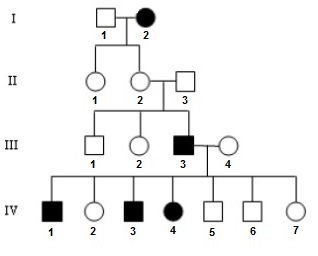
If hemophilia is a sex-linked recessive trait, what genotype would individual III-3 have?

a)

XhX

b)

XhXh

c)

XhYh

d)

XhY

70.
Is it possible for individual IV-2 to be a carrier? Why?
a)
No, because her parents don't have the trait.
b)
No, because she doesn't have the trait.
c)
Yes, because her siblings have it.
d)
Yes, because her parents are carriers.