wayground logo

Free Printable Worksheets

Font size

S
M
L
XL
Worksheets

Quiz 1-7th Grade

Total questions: 107

Worksheet time: 2hrs 54mins

Name
Class
Date
1.
An experiment is performed on plants to see how different liquids affect plant growth. Each plant in the experiment is given a different liquid; water, apple juice, or milk. Each plant has the same amount of soil, sunlight, and listens to the same music. In this investigation, the independent variable is ...
a)
The type of plant
b)
The amount of sunlight
c)
The type of music
d)
The type of liquid
2.
A student is planning an experiment to find out how the height from which he drops a ball affects how high the ball bounces. The dependent variable is the _____.
a)
Diameter of the ball
b)
Force acting on the ball
c)
Height that the ball bounces
d)
Height from which the ball is dropped
3.
The variable that is being tested or changed
a)
independent variable
b)
dependent variable
c)
control variable
4.
FIND THE INDEPENDENT VARIABLE FOR THE QUESTION:
Which brand of laundry detergent works better to remove grass stains?
a)
type of clothing
b)
brand of detergent
c)
cleanliness of clothes
5.
FIND THE DEPENDENT VARIABLE FOR THE QUESTION:
Do tree frogs jump farther than blue dart frogs?
a)
distance jumped
b)
jumping conditions
c)
type of frog
6.
An observation that includes what something LOOKS LIKE
a)
Qualitative
b)
Quantitative
c)
Inference
d)
Prediction
7.
Joseph and Caitlin were choosing the players for their teams. It was Caitlin's turn to choose, and only Jason was left. Caitlin said, "Jason."

We can infer that…
a)
Jason was the best player.
b)
Caitlin wanted Jason on her team.
c)
Jason was not a very good player.
d)
Caitlin had a hard time choosing a team member.
8.
A possible explanation to a problem that has not yet been tested. 
a)
data
b)
theory
c)
hypothesis
d)
fact
9.
Should experiments be repeated over and over to see if the results are the same each time?
a)
yes
b)
no
10.
There are two types of data. Which type of data involves descriptions/photographs/illustrations that cannot be counted or measured?
a)
qualitative
b)
quantitative
11.
In a controlled experiment, how many independent variables can be worked with at a time? 
a)
one
b)
none
c)
two or more
d)
how ever many makes sense.
12.
Which statement is an inference about this picture?
a)
The van is tan.
b)
The  van ran into KFC. 
c)
The driver was hungry. 
d)
Red and white are part of the KFC building. 
13.
Which is NOT a step in the scientific method?
a)
Make observation
b)
Form a theory
c)
Collect data
d)
Form a hypothesis
14.
Scientists frequently repeat the experiments of others scientists. Why is this important in science?
a)
Scientists often ask each other for help in performing experiments.
b)
Replication of experiments helps to confirm and verify results.
c)
Scientists frequently perform other scientists’ experiments in order to practice their technique.
d)
Repeating experiments is an effective way to make sure a laboratory is in optimal condition.
15.
Caira reads in a science journal that replication and repetiton are so important, but she did not understand the  difference between them. Which of the following best explains the two terms?
a)
Repetition is when a scientist repeats an experiment; replication is when a scientist conducts an experiment on genetic material.
b)
Repetition is when a scientist does the same experiment a number of times; replication is when other scientists reproduce a scientist’s experiment.
c)
Repetition is when a scientist publishes in more than one scientific periodical; replication is when another scientist reproduces another scientist’s results.
d)
Repetition is when a scientist commits an error in an experiment the first time and must repeat it; replication is when a scientist repeats an experiment to make sure it is valid.
16.
An environmental group contacts Nina to get her procedures so that they can check her results.
a)
repetition
b)
replication
17.
An environmental group contacts Nina to get her procedures so that they can check her results.
a)
repetition
b)
replication
18.
Which example is a hypothesis written in the correct format?
a)
How do pulleys make work easier?
b)
I predict that light travels in a straight line.
c)
If a needle floats on water, then it will work like a compass.
d)
The ice will melt the fastest on the cotton ball.
19.
The dependent variable in this experiment is - 
a)
Number of Bacteria
b)
Time of Incubation
c)
Culture Number
d)
Type of Bacteria
20.
A biology class of 24 students decides to measure the height of each student and then calculate the average height for the class. Which of these is a possible source of error in this activity?
a)
The number of males and females in the class
b)
The difference in the ages of the students in the class
c)
The total number of students in the class
d)
The accuracy of making and recording measurements
21.
Which following statement is an inference?
a)
The boy is in pain.
b)
The boy's knee is bleeding.
c)
The boy has tears coming from his eyes.
22.

The skunk omits an odor.

a)

Qualitative Observation

b)

Quantitative Observation

c)

Opinion

d)

Inference

23.
What is an observation?
a)
an opinion
b)
a fact
c)
what you decide
d)
a conclusion
24.
What is an observation for this picture?
a)
The man is scared
b)
The man is going to get eaten
c)
There is a man in a kayak
d)
The man is paddling fast
25.
The penguin got pushed in.
a)
Observation
b)
Inference
26.
There are fourteen penguins.
a)
Observation
b)
Inference
27.
There are 54 players on the Carolina Panthers football team. 
a)
qualitative 
b)
quantitative 
28.
There are 75 trees in the forest. 
a)
Qualitative 
b)
Quantitative
29.
The clouds are grey and ground is wet. 
a)
Qualitative
b)
Quantitative
30.
Before the 1800's people didn't have right or left shoes.  They had shoes of just one shape that they used for both feet.  When people first saw right and left shoes, they laughed.  They called them "crooked shoes."  "What a silly idea," they said.  You can tell that shoes before 1800:
a)
were pretty
b)
didn't look alike
c)
didn't fit very well
31.
Tim looked out the window. The house looked so lonely. Tim's father put the last suitcase in the trunk and started up the car. Thor, his dog, put his head on Tim's lap, like he understood how  Tim was feeling. "It's okay Thor," he said, "Dad says we will like California." What is happening?
a)
Tim is sad because his dog doesn't have a house to live in.
b)
Tim is taking a trip to visit peolpe he doesn't know.
c)
Tim is taking Thor to live with his grandmother.
d)
Tim is moving to California with his family.
32.
Many breeds of dogs are used for work. In many cultures dogs are used to herd sheep. The dogs keep the flock from being attacked by animals such as wolves. They also keep sheep from wandering off. Sheepdogs are known for their loyalty and gentleness. Based on your reading of the text, you can INFER that:
a)
Sheepdogs are not very smart dogs.
b)
Sheepdogs are gentle and loyal.
c)
There are many breeds of dogs.
d)
Wolves are afraid of sheepdogs.
33.
Which sentence from the selection suggests that Suzy likes to play basketball?
a)
Suzy's mom makes Suzy practice basketball every day.
b)
Suzy looks forward to her basketball games.
c)
Suzy scored 5 points in her last basketball game.
d)
Suzy and her mom get ice cream after her basketball games.
34.
Which of the following shows why Sam refused to play in the tournament?
a)
SAM: Yeah, I think so, too.
b)
SAM: Why? Because I 'm a girl?
c)
SAM: Oh, I don't think so.
d)
SAM: You wouldn't appreciate my talents, since I'm a girl!
35.
Which sentence suggests that Joanna rode her bike to school?
a)
Joannaʼs hair was a little messy when she got to school.
b)
Joanna crossed three streets on her way to school.
c)
Joanna went four blocks on her way to school.
d)
Joanna had to put her helmet inside the classroom closet.
36.
The line stretched forever. People put their bags on the floor and inched them forward. My father and I removed our shoes. There was an announcement about a gate change and a delay on an arrival from Chicago. Where am I?
a)
The airport
b)
The museum
c)
A basketball game
d)
A karate class
37.
Tex opened the can of peaches with his knife and cooked them over the fire. He shared them with his buddy Dusky and they told stories of stampedes and bandits until they tired of talking. Tex took off his boots and unrolled his blanket. He didn't mind sleeping under the stars. He put his hat over his face and fell asleep with his head on his pack. During the night a scorpion found itself next to Tex. The scorpion was very tired and, unlike Tex, the scorpion did not want to sleep under the stars. He liked small dark places, like Tex's boot. He crawled into the front of Tex's boot and fell asleep. When Tex awoke in the morning, he couldn't wait to get a jump on the day. He put on his hat, clicked on his belt and gun holsters...what happened next?
a)
He put on his boot and was stung by the scorpion.
b)
He made a cup of coffee over the fire.
c)
He went back to work.
d)
The scorpion died in the boot.
38.
Who first proposed binomial nomenclature as a way of classifying organisms?
a)
Carolus Linnaeus
b)
Carl's Jr.
c)
Charles Darwin
d)
Henry Groseclose
39.
Which trait do only humans have, according to the cladogram?
a)
jaws
b)
mammary glands & hair
c)
terrestrial during all life stages
d)
bipedal & opposable thumbs
40.
What is the study of classification called?
a)
Taxonomy
b)
Geology
c)
Anatomy
d)
Geometry
41.
What are the three domains?
a)
Green, Blue, Red
b)
Autotrophic, Heterotrophic, Both
c)
Archea, Eukarya, Bacteria
d)
Marine Organism, Land Organism, or Both
42.
Which of these is not a model?
a)
hot wheels/match box car
b)
action figure doll
c)
dump truck
d)
a picture of the inside of humdinger
43.
Sal is studying the solar system. He makes a physical model using different-sized foam balls to represent the planets. Which best describes why a physical model is a useful tool for studying the solar system?
a)
Solar system models can be used to study a system that is too big to study directly.
b)
A model of the solar system eliminates the need for scientists to study the solar system directly.
c)
A model of the solar system provides an exact replica of the actual solar system, so scientists can experience what each planet is like.
d)
A model of the solar system can provide more data about the solar system than direct observations.
44.
What is the SI unit for mass?
a)
meter
b)
liter
c)
gram
d)
kelvin
45.
When scientists create a representation of a complex process, they are:
a)
inferring
b)
predicting
c)
classifying
d)
making models
46.
A kilogram is equal to _______ grams?
a)
10
b)
100
c)
1000
d)
10000
47.
When experimenting with the growth of a plant, a scientist uses three (of the same type of) plants, two different fertilizers, equal light, and equal water. What type of variable is the fertilizer?
a)
Dependent
b)
Independent
c)
Control
d)
Compound
48.
Research Question: Does the type of gasoline put in a car effect how fast the car can drive. What is the independent variable?
a)
Type of gasoline
b)
which car the gas is put into
c)
how fast the car can drive
d)
how much gas is put into the car
49.
What would the INDEPENDENT variable be in an experiment testing which types of paper airplane goes furthest?
a)
the paper used
b)
the type of paper airplane
c)
the distance of each plane's flight
d)
how hard the plane is thrown
50.
An experiment is performed on plants to see how different liquids affect plant growth. Each plant in the experiment is given a different liquid; water, apple juice, or milk. Each plant has the same amount of soil, sunlight, and listens to the same music. In this investigation, the independent variable is ...
a)
The type of plant
b)
The amount of sunlight
c)
The type of music
d)
The type of liquid
51.
Ms. S set up an experiment to see how the mass of a ball affects the distance it rolls off a ramp. What is the dependent variable?
a)
Distance traveled by the ball
b)
Height of the ramp
c)
Mass of the ball
d)
Where the experiment took place.
52.
Tiffany was investing how fast it took Hayden to react to different sounds. Identify the independent variable.
a)
How fast Hayden reacted
b)
different sounds
c)
types of music
d)
Hayden
53.
Mr. S normally uses praise as a reward to train his dog. He wants to know the best way to train his dog, so he sets up an experiment to find out if there is a better way to get his dog to respond to commands. What is his dependent variable?
a)
Type of reward
b)
Praise
c)
Type of dog
d)
Amount of time the dog follows commands
54.
 In a controlled experiment, the variable that is changed to test the hypothesis is called the –
a)
Controlled Variable
b)
Responsive Variable
c)
Dependent Variable
d)
Independent Variable
55.
The measurable factor in an experiment is known as the: 
a)
Control
b)
Independent Variable
c)
Constant
d)
Dependent Variable
56.
Alexandra is testing the quality of her Nikon camera against the camera on her iPhone.  The different cameras is the __ variable.
a)
constant (same)
b)
dependent (measured)
c)
independent (changes)
57.
Khaleel is testing how the use of stress balls during testing affects a student's test score.  The students' average test scores who used the stress balls is the __ variable.
a)
dependent (measured)
b)
constant (same)
c)
independent (changes)
58.
In a controlled experiment, how many variables can be worked with at a time? 
a)
one
b)
none
c)
two or more
d)
how ever many makes sense.
59.
A student is planning an experiment to find out how the height from which he drops a ball affects how high the ball bounces. The dependent variable is the _____.
a)
Diameter of the ball
b)
Force acting on the ball
c)
Height that the ball bounces
d)
Height from which the ball is dropped
60.
Paco's daughter will be participating in an upcoming dance recital. She will require a different costume for each dance she plans to performs.
c = the number of costumes Paco's daughter will require
d = the number of dances Paco's daughter plans to perform

Which of the variables is independent?
a)
c
b)
d
61.
Sarah is bringing treats to her elementary school class on her birthday. The number of treats she brings in is based on the number of students in her class.
t = the number of treats
s = the number of students

Which of the variables is independent?
a)
s
b)
t
62.
Dilcia wants to know how drinking milk affects how tall a Monica grows. Which is the independent variable?
a)
Monica's growth
b)
drinking milk
63.
Ramone wants to know: does the distance a person kicks a soccer ball effect how well they will do on their math test.  What is the dependent variable?
a)
How far they kick the soccer ball
b)
who the person is
c)
how well they do on the math test
d)
Type of soccer ball.
64.
Kreedence wants to know if birds prefer to eat in one place over another. She makes three feeders out of 2-liter bottles and paints all of them red. She fills each of the feeders with the same amount of mixed birdseed, and plans to keep the feeders out for 10 days before measuring how much seed is eaten from each feeder. She puts each of the feeders in her back yard: one feeder in a large dead tree, another feeder she sits on the dog house, and the last she sits in a small bushy tree.
What is the dependent variable?
a)
Length of the birdfeeders
b)
Amount of time feeders are outside
c)
Amount of seed eaten
d)
Location the feeders are put in.
65.

1) Which of the following is NOT an example of a scientific question?

a)

How much time will it take to get there?

b)

Why is that dog limping?

c)

Where did you put the book?

66.

What must be TRUE of any hypothesis?

a)

It must be proven correct

b)

It must not be based on observations

c)

It must be testable

67.

Which question could be tested as a scientific investigation?

a)

Which brand of tire has the greatest effect on the racecar’s speed?

b)

Which paint color is best for a racecar?

c)

What type of racing is the most fun to watch?

68.

is a prediction that possibly answers a scientific question

a)

observation

b)

scientific inquiry

c)

hypothesis

69.
What number is the metric system based?
a)
10
b)
20
c)
1
d)
100
70.
What is another way you can make reference to the metric system?
a)
International de System
b)
English system
c)
Standard 
d)
Inches
71.
Convert 8 kilometers to meters
a)
800 m
b)
80,000 m
c)
8,000 m
d)
.008 m
72.
7,000 g = ____ kg
a)
70
b)
700
c)
7
d)
0.07
73.
The amount of matter in an object is the
a)
mass
b)
volume
c)
length
d)
density
74.
The amount of space an object takes up is its'
a)
mass
b)
volume
c)
length
d)
density
75.
The base for mass is the
a)
meter
b)
gram
c)
kilogram
d)
liter
76.
The base unit for length is the
a)
second
b)
gram
c)
meter
d)
liter
77.
What is the volume of this rectangular prism?
a)
14cm3
b)
35cm3
c)
70cm3
d)
37cm3
78.
How many centimeters in a meter? 
a)
1000
b)
100
c)
10
d)
.1
79.

Which of the following is a correct Hypothesis about Mary playing soccer?

a)

Mary hypothesized she would be a soccer played

b)

If Mary practiced kicking then she would make more goals

c)

Mary practiced kicking every day

d)

Mary thought the goal should be bigger to make more points

80.
What is the definition of "weight"?
a)
measure of the force of gravity on your body
b)
the time it takes to get on a ride 
c)
the amount of matter in an object
d)
the size of an object
81.
What is measured with a graduated cylinder?
a)
Passage of time
b)
Distance from one thing to another
c)
Weight of an object
d)
Volume of liquid
82.
Where do we read the level of liquid?
a)
The highest point the liquid touches
b)
The bottom of the meniscus,flat surface,eye level
c)
Half way between, we make an educated guess and round it
d)
Somewhere about there
83.
Jack has a rock. The rock has a mass of 14g and a volume of 2cm3. What is the density of the rock?
a)
7 mL
b)
7 g/cm3
c)
28 g/cm3
d)
1/7 g/cm3
84.
Which units of measurement are used for volume?
a)
grams
b)
centimeters
c)
grams/milliliter
d)
milliliter
85.
What is the volume of Object X?
a)
10.0 cm3
b)
15.0 cm3
c)
20.0 cm3
d)
25.0 cm3
86.

How close a measurement is to the true value is called..

a)

Accuracy

b)

Precision

c)

Significant

d)

Estimate

87.
When a measurement is repeatable and consistent it is said to have...
a)
High precision
b)
Low precision
c)
High accuracy
d)
Low accuracy
88.
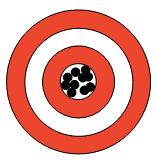
This bullseye demonstrates...
a)
High Accuracy & High Precision
b)
High Accuracy & Low Precision
c)
Low Accuracy & High Precision
d)
Low Accuracy & Low Precision
89.
?
a)
High Accuracy & High Precision
b)
High Accuracy & Low Precision
c)
Low Accuracy & High Precision
d)
Low Accuracy & Low Precision
90.
T8 - The Independent Variable is represented on which Axis?
a)
A
b)
X
c)
B
d)
Y
91.
T7 - Jacob wants to record his results for the temperature of each day in the past week. What graph or table should he use? 
a)
Data table
b)
Bar graph
c)
histogram 
d)
Line graph
92.
T9 - What is the best title for this graph?
a)
The effect of the number of trees on the type of tree
b)
The change in type of trees over number of trees
c)
Number of trees vs. Type of trees
d)
A comparison of the number of trees for 5 different types of trees
93.
The BEST reason another scientist is unable to replicate an experiment...
a)
They did it wrong.
b)
They had variables that were not controlled.
c)
They didn't follow the procedure.
d)
They measured wrong.
94.
Scientists have MANY trials so their results are 
a)
countable
b)
graphable
c)
reliable
d)
hard to understand
95.
Scientists frequently repeat the experiments of others scientists. Why is this important in science?
a)
Scientists often ask each other for help in performing experiments.
b)
Replication of experiments helps to confirm and verify results.
c)
Scientists frequently perform other scientists’ experiments in order to practice their technique.
d)
Repeating experiments is an effective way to make sure a laboratory is in optimal condition.
96.
Caira reads in a science journal that replication and repetiton are so important, but she did not understand the  difference between them. Which of the following best explains the two terms?
a)
Repetition is when a scientist repeats an experiment; replication is when a scientist conducts an experiment on genetic material.
b)
Repetition is when a scientist does the same experiment a number of times; replication is when other scientists reproduce a scientist’s experiment.
c)
Repetition is when a scientist publishes in more than one scientific periodical; replication is when another scientist reproduces another scientist’s results.
d)
Repetition is when a scientist commits an error in an experiment the first time and must repeat it; replication is when a scientist repeats an experiment to make sure it is valid.
97.
Josue goes to Silver River each week for 4 weeks and collects 5 samples of water to test the pH.
a)
repetition
b)
replication
98.
Dr. Smith has been reading about another scientist’s research in a physics journal. He plans to do these experiments himself and see if he gets the same result.
a)
repetition
b)
replication
99.
Kevin was mixing a batch of glue and borax solution to make silly putty and discovered a new substance that glows in the dark. He gave Ja'nay his specific amounts of ingredients and the steps of his procedure. He asked Ja'nay to try the experiment to see if she gets the same results.
a)
repetition
b)
replication
100.
Haylena baked chocolate chip cookies that wound up looking like muffins. She asked Lunelka to use the same directions and see if her cookies also look like muffins.
a)
repetition
b)
replication
101.
Ms. Spiers has taught Mini Bear to run a maze. She thinks that the hamster will go faster if she puts its favorite treat at the end. She has the hamster run the maze ten times with the favorite treat and ten times with a regular food pellet. She uses a stopwatch to measure how long it takes for the hamster to get to the reward.
a)
repetition
b)
replication
102.
Ryan is testing golf balls. He drops three different brands of balls from 40 cm and measures how high they bounce. He drops each ball 10 times.
a)
repetition
b)
replication
103.
Anthony was given a set of 5 metal cubes. He calculated the densities of each to determine the type of metal in each. The densities were really close to each other, so he asked his friend Robert to do the same experiment and see if he gets the same results.
a)
repetition
b)
replication
104.
Which of the following is a scientific observation? 
a)
The potato is brown in color.
b)
The potato tastes the best.
c)
The potato may cause allergies.
d)
The potato smells funny. 
105.
Why should an experiment be repeated?
a)
to form a hypothesis
b)
to reduce the chance of error
c)
to change controls
d)
to identify the problem
106.
This is the outcome of the experiment. We get data and results from this.
a)
Independent Variable
b)
Dependent Variable
c)
Control
d)
Constant
107.
Which is the dependent variable in Amelia's experiment?
a)
the number of bean plants in each group 
b)
the amount of water given daily to each plant 
c)
the height of each bean plant 
d)
the amount of fertilizer given to each group of bean plants