Wayground logo

Free Printable Worksheets

Font size

S
M
L
XL
Worksheets

Unit 2: Atoms

Total questions: 53

Worksheet time: 2hrs 14mins

Name
Class
Date
1.
This particle is found in the nucleus and has no charge
a)
Neutron
b)
Proton
c)
Electron
2.
This particle is found in the nucleus and has a positive charge
a)
Electron
b)
Proton
c)
Neutron
3.
This is a negatively charged particle found outside the nucleus
a)
Electron
b)
Proton
c)
Neutron
4.
This contains most of the mass of an atom
a)
Electron Cloud
b)
Nucleus
c)
Electron
5.

The first person to ever talk about an atom was

a)

Democritus

b)

Rutherford

c)

Dalton

d)

JJ Thomson

6.
All matter is made of what?
a)
energy 
b)
atoms 
c)
electrons 
d)
compounds 
7.

How did Rutherford discover the nucleus?

a)

Cathode tube ray experiment

b)

Gold Foil Experiment

c)

Planetary Model

d)

Plum Pudding Model

8.
Who stated that all atoms of the same element are excacty alike?
a)
Democritus
b)
Dalton
c)
Thomson
d)

Bohr

9.
What scientist is best known for his "Plum Pudding" model of the atom?
a)

J.J. Thomson

b)
Ernest Rutherford
c)
John Dalton
d)
Democritus
10.
What contribution did John Dalton make to atomic theory? 
a)
He discovered that every atom was positively charged. 
b)
He discovered that every element consisted of one type of atom.  
c)
He discovered that atoms had nuclei. 
d)
He discovered that atoms could be divided into smaller parts. 
11.
J.J. Thomson provided evidence that an atom...
a)
is the smallest particle of matter
b)
contains negatively charged particles
c)
has an overall negative charge
d)
has an overall positive charge
12.
Rutherford's gold foil experiment provided evidence that...
a)
negative and positive charges are spread evenly throughout the atom.
b)
alpha particles have a positive charge.
c)
gold is not a dense as previously thought.
d)
there is a dense positively charged nucleus at the center of an atom.
13.
An atom's overall charge is ________.
a)
positive 
b)
depends
c)
neutral 
d)
negative 
14.
What does the nucleus of an atom contain?
a)
Electrons and neutrons
b)
Protons and neutrons
c)
Neutrinos and positrons
d)
DNA and RN
15.
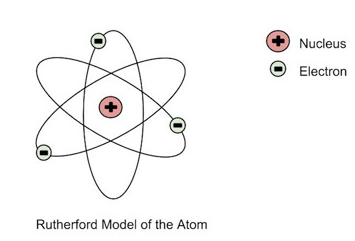
Who came up with this model of an atom?
a)

J.J. Thomson

b)
Ernest Rutherford
c)
Neils Bohr
d)
James Chadwick
16.
True or False: The majority of an atom is made up of empty space
a)
True
b)
False
17.
Contributes basically no mass to an atom.
a)
protons
b)
neutrons
c)
electrons
d)
protons and neutrons
18.
Neon has an atomic number of 10 and an atomic mass of 20.180.  How many protons, electrons, and neutrons will it have?
a)
P=10 E=10 N=11
b)
P=5  E=5  N=10
c)
P=10  E=10  N=10
d)
P=10  E=5  N=5
19.
The atomic number for Oxygen is 8, so
a)
there are 8 protons in the atom
b)
the atomic mass is less than 8
c)
the mass of the atom is 8
d)
the atom is decaying
20.
Which scientist proposed a model of the atom in which the electrons are orbiting at different levels?
a)
Niels Bohr
b)
James Chadwick
c)
John Dalton
d)
Ernest Rutherford
21.
Which scientist saw the atom as a positively charged sphere with negative particles (electrons) embedded within?
a)
J.J. Thomson
b)
Niels Bohr
c)
John Dalton
d)
Ernest Rutherford
22.
Why has the model of an atom changed over time?
a)
Scientists discovered new information about atoms over time.
b)
Scientists couldn't agree on what the atom looked like.
c)
Atoms today are different than they were for Democritus in Greece.
d)
Atoms are always changing and may be different in the future.
23.
Whose model is in the picture displayed?
a)
Thomson
b)
Dalton
c)
Modern
d)
Rutherford
24.

24.1% of all the isotopes of a an element have a mass of 75.23 amu, 48.7% have a mass of 74.61 amu, and 27.2% have a mass of 75.20 amu.

What is the average mass of this element?

a)

74.92 amu

b)

24.97 amu

c)

75.01 amu

d)

74.51 amu

25.

An element with 4.35% have a mass of 49.9461 amu, 83.79% have amass of 51.9405 amu, 9.50% have a mass of 52.9407 amu, and 2.36% have a mass of 53.9389amu. Round your answer to 5 sig figs.

a)

51.996 amu

b)

52.199 amu

c)

53.455 amu

d)

17.332amu

26.

How many moles are in 19.82 g Mg?

a)

1.226mol Mg

b)

481.7mol Mg

c)

1.000mol Mg

d)

0.8155 mol Mg

27.

How many moles are in 3.01 x 10²² atoms of magnesium?

a)

0.0500 moles

b)

1.81 x 1046 moles

c)

5.00 x 10²¹ moles

d)

5.00 moles

28.

How many grams are in 1.2 x 1024 atoms of carbon?

a)

28 grams of carbon

b)

24 grams of carbon

c)

6.02 grams of carbon

d)

1.2 grams of carbon

29.

The number 6.022 x 10²³, which is the number of particles found in a mole.

a)

molar mass

b)

mole

c)

Avogadro's number

d)

hydrate

30.
A wave with a large wavelength will have a ______ frequency and _____ energy
a)
high, low
b)
high, high
c)
low, high
d)
low, low
31.
Which has the LONGEST wavelength and, therefore, the lowest frequency/energy
a)
Gamma Rays
b)
Radio Waves
c)
Visible Light
d)
Infrared rays
32.
Which has the SHORTEST wavelength and, therefore, the highest frequency/most energy
a)
Radio waves
b)
Ultraviolet Rays
c)
Gamma Rays
d)
X-rays
33.

Put the visible light colors in order from longest wavelength to shortest wavelength

a)

Violet, Blue, Green, Orange, Yellow, Red

b)

Red, Yellow, Green, Orange, Blue, Indigo

c)

Red, Orange, Yellow, Green, Blue, Violet

34.
Which color has the highest frequency?
a)
red
b)
orange
c)
green
d)
blue
35.
Lowest energy state of an atom
a)
Ground
b)
Excited
36.
When an atom has all of its electrons in the lowest energy orbitals available, the atom is  
a)
in ground state
b)
in excited state
c)
giving off light energy
d)
unstable
37.
For an electron to change from ground state to an excited stated it must...
a)
Absorb energy
b)
Release energy
38.
Light is emitted when an electron moves from the ________ state to the _________ state
a)
excited, ground
b)
ground, excited
39.
The number of protons in the nucleus of an atom is the ____________ ____________.
a)
Atomic Number
b)
Atomic Mass
c)
Mass Number
d)
12
40.
What is an element that has a different number of neutrons called?
a)
ion
b)
isotope
c)
carbon
d)
radioactive
41.

Which of the following scientist developed a mathematical equation that led to the most current model of the atom?

a)

Dalton

b)

Schrodinger.

c)

Thomson

d)

Dalton

42.
Which is the correct sequence of the scientists who made major changes in the model of the atom?
1-JJ Thomson
2-Erwin Schrodinger
3-John Dalton
4-Niels Bohr
5-Ernest Rutherford
a)
2, 1, 4, 3, 5
b)
3, 1, 5, 4, 2
c)
5, 3, 2, 1, 4
d)
4, 3, 2, 1, 5
43.
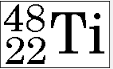
How many protons does this isotope of titanium have?
a)
48
b)
22
c)
26
d)
70
44.
How many neutrons does the isotope of lithium have?
a)
8
b)
3
c)
4
d)
5
45.
In a correctly written symbol what would be located in the "A" position?
a)
number of neutrons
b)
atomic number
c)
number of electrons 
d)
mass number
46.

How many grams are in 1 mole of Chromium?

a)

6.022 x10²³

b)

12.011

c)

51.996

d)

63.546

47.

Convert 3.75 x1024 atoms of Chromium to moles.

a)

6.23 moles

b)

6.2 x10²³ moles

c)

0.16 moles

d)

0.07 moles

48.

How many grams is 0.0825 moles of Silver?

a)

0.0825 grams

b)

4.97 x10²² grams

c)

6.022 grams

d)

8.90 grams

49.

Convert 12.00 grams of Chromium to atoms.

a)

1.390 x10²³ atoms

b)

0.23078 atoms

c)

7.22 x1024 atoms

d)

5.018 x10²² atoms

50.

Rutherford discovered what part of the atom

a)

nucleus

b)

neutron

c)

proton

d)

electron

51.

Who proposed the theory that electrons orbit the nucleus in specific orbits.

a)

Bohr

b)

Democritus

c)

Rutherford

d)

Chadwick

52.

This particle balances the charges from the protons to make the atom neutral

a)

proton

b)

electron

c)

neutron

d)

nucleus

53.

Rutherford experimented with ____

a)

Gold foil and alpha particles

b)

Cathode rays and alpha particles

c)

electron and alpha particles

d)

gold foil and cathode rays