
Font size
S
M
L
XL
 Worksheets
Matter, Transitions in State, Radioactivity, & Heating Curves
Total questions: 94
Worksheet time: 1hrs 20mins
Name
Class
Date
1.
What is an Atom?
a)
Microscopic particles that make up matter
b)
Microscopic Protons
c)
Microscopic Neutrons
d)
Microscopic Nucleus
2.
What are compounds?
a)
Substances made of one or more types of elements.
b)
Substances made of one or more types of neutrons.
c)
Substances made of one or more types of nuclei.
d)
Substances made of one or more type of electron.
3.
What is a pure substance?
a)
Protons Neutrons and Electrons.
b)
Particles that collide.
c)
Substance that can be separated by physical means.
d)
Substance that cannot be separated by physical means.
4.
What is an atom made of?
a)
Subatomic elements
b)
Protons Neutrons and Electrons
c)
Microscopic Particles
d)
Positive Negative Neutral
5.
What is the charge of a Proton?
a)
Positive
b)
Negative
c)
Neutral
6.
What is the charge of a neutron?
a)
Positive
b)
Negative
c)
Neutral
7.
What is the charge of an electron?
a)
Positive
b)
Negative
c)
Neutral
8.

What is the atomic number of Carbon?
a)
6
b)
12.0107
c)
C
d)
Carbon
9.
Where can we find a list of all of the elements?
a)
Element List
b)
Element Chart
c)
Periodic Table
d)
Periodic Chart
10.
Which of the follow are NOT physical properties?
a)
Color
b)
Flammability
c)
State of Matter
d)
Taste
11.
Conductors
a)
generate power
b)
generate electricity
c)
generate light
d)
generate sound
12.
Solubility is
a)
an items ability to dissolve
b)
an items ability to melt
c)
an items ability to freeze
d)
an items ability to boil
13.
Physical properties can be
a)
heard
b)
tasted
c)
observed
d)
grown
14.
Chemical properties are the way a substance
a)
restarts
b)
reacts
c)
renews
d)
reviews
15.
Which one is NOT a compound?
a)
H2O
b)
CO2
c)
NaCl
d)
Ne
16.
Which of the following is NOT an example of matter?
a)
Rocks
b)
Minerals
c)
Oxygen
d)
Sound
17.
Metals are good conductors.
a)
True
b)
False
18.

Glucose (C6H12O6) contains atoms of carbon, hydrogen, and oxygen that are chemically bonded together. What type of matter is glucose?
a)
Glucose is an element
b)
Glucose is a compound
c)
Glucose is a mixture
d)
Glucose is a metal
19.

The smallest particle of any element that still has the properties of that element is called
a)
an atom
b)
a compound
c)
a solution
d)
a mixture
20.
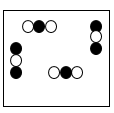
What does the diagram show?
a)
A mixture of two elements
b)
A pure compound
c)
A mixture of two compounds
d)
A mixture of a compound & element
21.
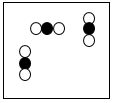
What does the diagram show?
a)
A mixture of two elements
b)
A pure compound
c)
A mixture of two compounds
d)
A mixture of a compound & element
22.
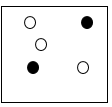
What does the diagram show?
a)
A mixture of two elements
b)
A pure compound
c)
A mixture of two compounds
d)
A mixture of a compound & element
23.
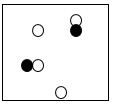
What does the diagram show?
a)
A mixture of two elements
b)
A pure compound
c)
A mixture of two compounds
d)
A mixture of a compound & element
24.
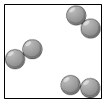
Which description below is a true statement about the diagram?
a)
The diagram can be classified as an element and a molecule
b)
The diagram can be classified as a compound
c)
The diagram can be classified as a mixture of two compounds
d)
The diagram can be classified as a mixture of two elements
25.

Which statement below is TRUE about compounds?
a)
The properties of compounds are totally different than the properties of the elements that form them
b)
All compounds are listed on the Periodic Table of Elements
c)
A compound is a pure substance that is made from one type of atom
d)
The properties of compounds are the same as the properties of the elements that form them
26.

A pure substance that is made from one type of atom is a(n) ______________ .
a)
Mixture
b)
Atom
c)
Element
d)
Compound
27.
Mixtures are separated through ___________changes.
a)
mixture
b)
compound
c)
physical
28.
Vertical columns in the periodic table are called _________ of elements and have similar properties.
a)
groups
b)
periods
29.
The horizontal rows on the periodic table are known as
a)
periods.
b)
atoms.
c)
groups or families.
d)
valence electrons.
30.

What is the atomic mass of Neon?
a)
10
b)
20.18
c)
10.18
d)
20.18
31.

How many protons are in Beryllium?
a)
4
b)
9
c)
5
d)
2
32.

How many neutrons are in a Gold atom?
a)
79
b)
196
c)
118
d)
275
33.

How many electrons does an Iodine atom have?
a)
53
b)
126
c)
73
d)
179
34.
An element's atomic number is always equal to how many ______________ it has.
a)
protons
b)
neutrons
c)
electrons
d)
nuclei
35.
An element has an atomic mass # of 30 and contains 12 protons. If it is a neutral element how many electrons will it contain?
a)
30
b)
12
c)
18
d)
10
36.
4822 Ti
How many neutrons are in this element?
How many neutrons are in this element?
a)
22
b)
48
c)
26
d)
44
37.
How many valence electrons does Potassium have?
a)
1
b)
2
c)
3
38.
How many valence electrons does Sulfur have?
a)
6
b)
10
c)
2
39.
How many valence electrons does Magnesium have?
a)
2
b)
6
c)
8
40.
How many electrons does Copper have?
a)
29
b)
30
c)
54
41.
How many electrons are found in each shell for the element Calcium?
a)
2, 8, 8, 2
b)
2, 8, 2, 8
42.
Which subatomic particles contribute the most to the mass of an atom?
a)
Protons, Neutrons, Electrons
b)
Protons only
c)
Protons and Electrons
d)
Protons and Neutrons
43.
What is an atom mostly made up of?
a)
protons
b)
electrons
c)
empty space
d)
neutrons
44.

What line segment represents only the solid state?
a)
A-B
b)
B-C
c)
C-D
d)
D-E
45.

In which segment is the kinetic energy remaining constant?
a)
A-B
b)
B-C
c)
C-D
d)
E-F
46.

What state(s) of matter are present at D-E?
a)
Solid-liquid
b)
Liquid
c)
Liquid-gas
d)
Gas-Solid
47.
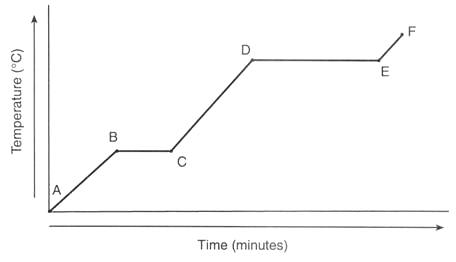
Between which points is the temperature of the substance remaining constant?
a)
A-B only.
b)
A-B, C-D, E-F
c)
B-C only.
d)
B-C, D-E
48.

What state of matter is segment 5?
a)
Solid
b)
Liquid
c)
Gas
d)
Plasma
49.

A substance's heating curve is shown in the graph. What is its boiling point?
a)
100 C
b)
60 C
c)
80 C
d)
20 C
50.
Which of the following terms identifies the change from a liquid to gas?
a)
Vaporization
b)
Condensation
c)
Deposition
d)
Sublimation
51.
When the temperature of matter increases the particles...
a)
speed up and move closer
b)
speed up and move farther apart
c)
slow down and move closer together
d)
slow down and move farther apart
52.
No definite shape, but has a definite volume
a)
Gas
b)
Liquid
c)
Solid
53.
Definite shape and a definite volume.
a)
Gas
b)
Liquid
c)
Solid
54.
No Definite Shape and No Definite Volume
a)
Gas
b)
Liquid
c)
Solid
55.
Phase change from a solid to a gas.
a)
sublimation
b)
deposition
c)
condensation
d)
evaporation
56.
Phase change from a gas to a liquid.
a)
condensation
b)
evaporation
c)
melting
d)
deposition
57.
What happens to the energy of particles in a substance as it changes from gas, to liquid, to solid?
a)
KE decreases
b)
KE increases
c)
KE stays the same
d)
KE goes up and then goes down
58.

This type of graph is called a:
a)
Phase diagram
b)
Heating curve
c)
State of matter
d)
Temperature chart
59.
True or false: melting and freezing occur at the same temperature!
a)
True
b)
False
c)
I don't know
60.

From 30 degrees to 55 degrees, what state of matter is the substance?
a)
Solid
b)
Liquid
c)
Gas
d)
Plasma
61.

What is the name of this element?
a)
Helium
b)
Hydrogen
c)
Argon
d)
Silver
62.
Isotopes are elements with a different amount of
a)
protons
b)
neutrons
c)
electrons
d)
atoms
63.
an element will always have the same number of
a)
neutrons
b)
protons
c)
isotopes
d)
atoms
64.
How are electrons arranged in an atom?
a)
In groups of five
b)
In energy levels
c)
By color
d)
By shape
65.
Rows on the period table are called _____ while columns are called _____.
a)
groups, families
b)
groups, periods
c)
periods, groups
d)
families, groups
66.
An element with five valence electrons is
a)
phosphorus
b)
oxygen
c)
beryllium
d)
rubidium
67.

How many electrons are in the outer (valence) shell of Chlorine (Cl)?
a)
1
b)
3
c)
6
d)
7
68.
Which group of the periodic table is composed of inert (not reactive) gases?
a)
alkali metals
b)
alkaline earth metals
c)
halogens
d)
noble gases
69.
Which types of elements have intermediate properties of metals and nonmetals?
a)
metals
b)
nonmetals
c)
metalloids
d)
gases
70.

What's a valence electron?
a)
electrons in the second energy level
b)
electrons in the outermost energy level
c)
the atomic number
d)
electrons in the first level
71.
How many electrons should Flourine have around its Lewis dot model?
a)
5
b)
6
c)
7
d)
8
72.
How many electrons should Carbon have around its Lewis dot model?
a)
1
b)
3
c)
4
d)
5
73.

What are electrons?
a)
Negatively charged particles
b)
Neutrally charged particles
c)
Positively charged particles
d)
Uncharged particles
74.
1. The flammability of a substance is
a)
A. a chemical property.
b)
B. related to the density
c)
C. a physical property.-
d)
D. changeable.
75.
3. 1. What is formed when particles of two or more substances are distributed evenly among each other?
a)
A. compound
b)
B. suspension
c)
C. solution
d)
D. element
76.
5. When materials combine to form a mixture, they
a)
A. keep their original properties.
b)
B. react to form a new substance with new properties.
c)
C. combine in a specific ratio.
d)
D. always change their physical state.
77.
7. 1. If a spoonful of salt is mixed in a glass of water, what is the water called?
a)
A. solute
b)
B. solution
c)
C. solvent
d)
D. element
78.
8. How is a compound different from a mixture?
a)
A. Compounds have two or more components.
b)
B. Each substance in a compound loses its characteristic properties.
c)
C. Compounds are commonly found in nature.
d)
D. Solids, liquids, and gases can form compounds.
79.
25. Italian dressing
a)
A. HOMOGENEOUS
b)
B. HETEROGENEOUS
80.
27. Sugar water.
a)
A. HOMOGENEOUS
b)
B. HETEROGENOUS
81.
A sample of matter, either an element or a compound, that has definite chemical and physical properties.
a)
element
b)
molecule
c)
pure substance
d)
metal
82.
In a solution of salt and water, where the salt completely dissolves, what part of the solution is the salt?
a)
solute
b)
solution
c)
solvent
d)
element
83.
This type of reaction occurs when light nuclei combine to form a larger, single nucleus.
a)
Fission
b)
Fusion
c)
single displacement
d)
double displacement
84.
This type of reaction occurs when a heavy nucleus, such as U-235, splits into two or more parts.
a)
Fission
b)
Fusion
c)
Chain reaction
d)
synthesis
85.
The least penetrating type of radiation
a)
Alpha particle
b)
Beta particle
c)
gamma ray
86.

a)
Fission reaction
b)
Fusion reaction
c)
Decomposition reaction
d)
Combustion
87.
Which particle of nuclear radiation penetrates the most material (making it the most harmful)?
a)
alpha particle
b)
beta particle
c)
gamma particle
d)
omega particle
88.
A particle made up of two protons and two neutrons, identical to a helium atom, ejected from a nucleus during a nuclear reaction:
a)
alpha particle
b)
beta particle
c)
gamma particle
d)
omega particle
89.
What is a beta particle?
a)
proton
b)
positron
c)
electron
d)
neutrino
90.

In order of most to least penetrating radiation we have
a)
Alpha , Beta, Gamma
b)
Beta , Gamma , Alpha
c)
Gamma, Beta, Alpha
d)
Gamma, Alpha, Beta
91.
What is Half-life?
a)
The amount of time it takes for some of the nuclei in a sample of the isotope to decay
b)
The amount of time it takes for half the electrons in a sample of the isotope to decay
c)
The amount of time it takes for half the nuclei in a sample of the isotope to decay
d)
the amount of time it takes to double the nuclei in a sample of the isotope to decay
92.
The half-life of Zn-71 is 2.4 minutes. If one had 100.0 g at the beginning, how many grams would be left after 7.2 minutes has elapsed?
a)
100.0g
b)
50.0g
c)
12.5g
d)
8.5g
93.
The half life of iodine-131 is 8 days. What fraction of an iodine-131 sample will remain after 40 days?
a)
1/2
b)
1/64
c)
1/5
d)
1/32
94.
As a sample of Neon-19 undergoes radioactive decay, its half-life will
a)
decrease
b)
increase
c)
remain the same
d)
start over
Reset

