wayground logo

Free Printable Worksheets

NEW

Font size

S
M
L
XL
Worksheets

Measurement and Scientific Tools

Total questions: 40

Worksheet time: 3hrs 8mins

Name
Class
Date
1.

How close a measurement is to the true value is called..

a)

Accuracy

b)

Precision

c)

Significant

d)

Estimate

2.
When a measurement is repeatable and consistent it is said to have...
a)
High precision
b)
Low precision
c)
High accuracy
d)
Low accuracy
3.
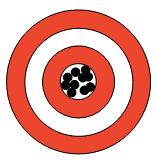
This bullseye demonstrates...
a)
High Accuracy & High Precision
b)
High Accuracy & Low Precision
c)
Low Accuracy & High Precision
d)
Low Accuracy & Low Precision
4.
?
a)
High Accuracy & High Precision
b)
High Accuracy & Low Precision
c)
Low Accuracy & High Precision
d)
Low Accuracy & Low Precision
5.
What is the unit for length in the SI system?
a)
meter
b)
inches
c)
feet
d)
yards
6.
Which of the following is NOT a unit in the SI system of units?
a)
kilogram
b)
second
c)
inch
d)
meter
7.
The standard unit of time is ________.
a)
day
b)
hour
c)
minute
d)
second
8.
How many m are there in one km?
a)
1
b)
10
c)
100
d)
1000
9.
How many cm are there in one m?
a)
1
b)
10
c)
100
d)
1000
10.
The prefix kilo is equal to 
a)
1
b)
10
c)
100
d)
1000
11.
Another name used for the metric system of measurement is
a)
International system of length
b)
International system of units (SI units)
c)
Measurement system
d)
Measurement international
12.
The metric system is based on what number? 
a)
1
b)
0.10
c)
10
d)
100
13.
The metric unit for mass is the
a)
ounce
b)
pound
c)
kilogram
d)
liter
14.
Which unit is not a unit in the SI system?
a)
meter
b)
liter
c)
pound
d)
Kelvin
15.
How many meters are in three kilometers?
a)
3
b)
.003
c)
300
d)
3000
16.
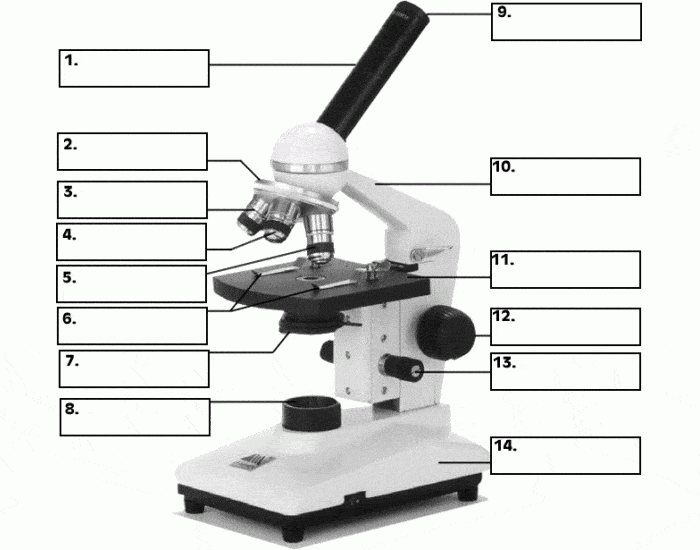
Part 9
a)
Body tube
b)
Eyepiece
c)
Objective
d)
Light Source
17.
Part 10
a)
Stage
b)
Arm
c)
Base
d)
Diaphragm
18.
Part 11
a)
Stage Clips
b)
Stage
c)
Diaphragm
d)
Illuminator
19.
This holds the eye piece and connects it to the objective
a)
Arm
b)
Base
c)
Body Tube
d)
Objective
20.
Part 12
a)
Fine Adjustment Knob
b)
Coarse Adjustment Knob
c)
Diaphragm
d)
Objective
21.
Part 14
a)
Stage
b)
Diaphragm
c)
Base
d)
Illuminator
22.
Part 13
a)
Fine Adjustment Knob
b)
Course Adjustment Knob
c)
Stage
d)
Diaphragm
23.
This bring the specimen into sharp focus
a)
Coarse Adjustment Knob
b)
Fine Adjustment Knob
c)
Eyepiece
d)
Diaphragm
24.
Connects to the base and helps carry the microscope easily
a)
Arm
b)
Base
c)
Body Tube
d)
Revolving Nosepiece
25.
This moves the specimen up or down to adjust the slide containing specimen
a)
Fine Adjustment Knob
b)
Coarse Adjustment Knob
c)
Stage
d)
Diaphragm
26.
Used to control the amount of light reaching the specimen
a)
Illuminator
b)
Stage
c)
Eyepiece
d)
Diaphragm
27.
Used to hold the slides in place
a)
Stage
b)
Stage Clips
c)
Diaphragm
d)
Arm
28.
Part that holds two or more objectives
a)
Stage
b)
Stage Clip
c)
Revolving Nosepiece
d)
Body Tube
29.
The flat surface where the slide with the specimen is placed
a)
Base
b)
Arm
c)
Stage
d)
Diaphragm
30.
Part 1
a)
Eyepiece
b)
Body Tube
c)
 Arm
d)
Objective
31.
Part 2
a)
Objectives
b)
Body Tube
c)
Revolving Nosepiece
d)
Stage
32.
Part 3
a)
Low Objective
b)
Medium Objective
c)
High Objective
d)
Revolving Nosepiece
33.

A spoken or written summary of observations

a)

Description

b)

explanation

c)

accuracy

d)

precision

34.

Interpretation of events or observations

a)

Description

b)

explanation

c)

accuracy

d)

precision

35.

a description of how close a measurement is to an accepted value

a)

Description

b)

explanation

c)

accuracy

d)

precision

36.

a description of how similar or close measurements are to each other

a)

Description

b)

explanation

c)

accuracy

d)

precision

37.

Uses words to describe an observation (senses)

a)

Qualitative Observation

b)

Quantitative Observation

c)

International System of Units

d)

Significant Digits

38.

Uses numbers to describe an observation

a)

Qualitative Observation

b)

Quantitative Observation

c)

International System of Units

d)

Significant Digits

39.

The internationally accepted system for measurement

a)

Qualitative Observation

b)

Quantitative Observation

c)

International System of Units

d)

Significant Digits

40.

The number of digits in a measurement that are known with a certain degree of reliability

a)

Qualitative Observation

b)

Quantitative Observation

c)

International System of Units

d)

Significant Digits