wayground logo

Free Printable Worksheets

Font size

S
M
L
XL
Worksheets

Unit 1 Chemistry Test: Intro to Chem, Metric, Measurement

Total questions: 66

Worksheet time: 2hrs 22mins

Name
Class
Date
1.

Which of the following is a chemical change/property?

a)

HCl reacts with Mg

b)

A piece of copper is cut in half

c)

A sugar cube is ground up

d)

Ethyl alcohol evaporates

2.

Classify this matter: Chocolate chip cookie dough

a)

pure substance: element

b)

pure substance: compound

c)

homogeneous mixture

d)

heterogeneous mixture

3.

Classify this matter: Air (about 70% N2 , 20% O2 , and 10% other gases)

a)

pure substance: element

b)

pure substance: compound

c)

homogeneous mixture

d)

heterogeneous mixture

4.
A pure substance that cannot be broken down into other substances by chemical or physical means. 
a)
compound          
b)
atom
c)
mixture 
d)
element
5.
A pure substance made up of two or more elements that are chemically combined. 
a)
compound          
b)
atom
c)
mixture 
d)
element
6.

Which of the following is a chemical change/property?

a)

Iron rusts

b)

Sugar dissolves in water

c)

A bike tire is inflated

d)

Water is absorbed by towel

7.

Which of the following is a physical change/property?

a)

Water freezing at 32 degrees Fahrenheit

b)

Mayonnaise goes bad after sitting in the sun for hours

c)

Potassium reacts violently with water

d)

Food is digested in the stomach

8.
This diagram represents a _____.
a)
pure substance that is a compound
b)
mixture of elements
c)
pure substance that is an element
d)
mixture of compounds
9.

Which of the following is a chemical change/property?

a)

Wood burns

b)

A wall is painted

c)

A substance boils at 450 degrees Celcius

d)

Copper wiring conducts electricity

10.

Which of the following is a chemical change/property?

a)

fireworks exploding

b)

ice melting

c)

water boiling

d)

painting wood

11.
Water is an element
a)
true
b)
false
12.
Which of the following describes a precipitate?
a)
a liquid forms when a block of metal is heated
b)
a solid forms when one liquid is poured into another
c)
a gas forms when a solid is placed in a liquid
d)
bubbles form when an acid is poured on a rock
13.
Which of these is NOT a sign that a chemical change has occurred? 
a)
A change in state
b)
An unexpected color change
c)
A temperature change
d)
The formation of a precipitate
14.

Density

a)

Chemical Property

b)

Physical Property

15.
A characteristic that can be observed or measured without changing the identity of a substance
a)
Physical property
b)
Physical change
c)
Physical reaction
d)
Trait
16.
In a chemical reaction
a)
The atoms of the reactants always stay together to form the products
b)
The atoms of the reactants unbond, rearrange, and then rebond to form the products
c)
Completely new atoms are formed which combine to make the products
d)
Some atoms disappear while others multiply to form the products
17.
Nonmetals occur to the ________of the dark zig-zag on the periodic table. 
a)
A. right
b)
B. middle
c)
C. left
18.
What element in Group 1 is not a metal but a nonmetal?
a)
Helium
b)
Lithium
c)
Hydrogen
d)
Oxygen
19.
A student is given a sample of an unknown substance. He is asked to determine if it is classified as a metal, a metalloid, or a nonmetal. He discovered that the unknown element conducted some heat and electricity, had a shiny luster, and broke easily. This element is most likely a 
a)
metal
b)
nonmetal
c)
metalloid
d)
cannot be determined
20.
The elements argon, krypton, and xenon are all non-metals. What property would these elements have in common?
a)
Good conductor of thermal energy
b)
Poor conductor of electricity
c)
Shiny, lustrous surface
d)
Soft and malleable
21.
Nickel is?
a)
Metal
b)
Nonmetal
22.
Sulfur is?
a)
Metal
b)
Nonmetal
23.
Radon is?
a)
Metal
b)
Nonmetal
24.

The metric (SI) prefix that corresponds to the multiplication factor 1x10¹² is

a)

tera-

b)

micro-

c)

Mega-

d)

Giga-

25.
The metric (SI) prefix that corresponds to a multiplication factor of 1.0×10⁻² is 
a)
deci-
b)
centi-
c)
milli-
d)
hecto-
26.
The metric (SI) prefix that corresponds to a multiplication factor of 1.0×10⁻⁹ is 
a)
micro-
b)
nano-
c)
Mega-
d)
Giga-
27.

Calculate the number of cm3 in 0.692 L

a)

0.00692 cc

b)

692 cc

c)

0.000692 cc

d)

6.92 mL

28.
Which of the following correctly compares 7 g and 698 mg?
a)
7 g 〉 689 mg
b)
7 g 〈 689 mg
c)
7 g = 689 mg
d)
Impossible to tell
29.
What did I measure if I record that something was 56 mL?
a)
Volume
b)
Mass
c)
Time
d)
Distance
30.
What did I measure if I record that something was 25 kg?
a)
Volume
b)
Mass
c)
Distance
d)
Time
31.
Which of these would be correct to put at the end of a density answer?
a)
g/cm
b)
cm3
c)
g/ml
d)
g/lb
32.
15.6 L = ___________ mL
a)
15,600
b)
156,000
c)
1,560,000
d)
15,600,000
33.
Is 4,000 mg greater than, less than, or equal to 4 g?
a)
greater than
b)
less than
c)
equal to
34.
Which units are NOT used for volume?
a)
cm3
b)
m3
c)
mm3
d)
km2
35.
One side of a cube measures 7 m.  What is the volume of this object?
The mass of the cube is 1,100 g.  What would the density of this cube be?
a)
3.20 g/mL
b)
3.20 g/cm 3
c)
3.02 g/km 3
d)
3.20 g/m 3
36.

What do you call the "dip" in the water of the graduated cylinder that we use to measure the volume of an irregular object?

a)

a measurement dip

b)

menicus

c)

eclipsis

d)

density

37.

If you have a gold brick that is 2.000 cm by 3.000 cm by 4.000 cm and has a density of 19.3 g/cm3, what is its mass?

a)

463.2 g/cm3

b)

463.2 g

c)

0.804 kg

d)

0.804 g

38.
If a block of wood has a density of 0.6 g/cm3 and a mass of 120 g, what is its volume?
a)
200 cm3
b)
0.005 cm3
c)
200.0 ml
d)
72 ml
39.

Determine the mass of an ethyl alcohol that exactly fills a 0.3000 L container if the density of ethyl alcohol is 0.7890 g/mL.

a)

380.228 grams

b)

0.00263 grams

c)

236.7 grams

d)

0.2367 grams

40.

A cylinder with a diameter of 2.9 cm and a mass of 86 grams has a density of 1.43 g/ml. What is the height of the cylinder

a)

9.1 cm

b)

60.4 cm

c)

19.1 cm

d)

28.6 cm

41.
Round "6050" to two significant digits.
a)
6100
b)
61
c)
605
d)
60
42.
Solve and round accordingly.
"7.9 + 9.19 + 75.351"
a)
92.4
b)
92.441
c)
92.44
d)
92
43.
Solve and round accordingly. 
"9.4991 - 7.3"
a)
2.2
b)
2.1991
c)
2.200
d)
2.20
44.

Multiply:

(3.40 x 10⁵)(1.20 x 10⁻³)

a)

4.08 x 10⁻⁸

b)

4.8 x 10²

c)

4.08 x 10²

d)

4.08 x 10⁻¹⁵

45.
How many sig figs are there?
100.00
a)
1
b)
3
c)
4
d)
5
46.
How many sig figs are there?
0.000008
a)
1
b)
2
c)
6
d)
7
47.
How many sig figs are there?
0.00400
a)
1
b)
3
c)
5
d)
6
48.
How many sig figs are there?
4000.
a)
1
b)
3
c)
4
49.
How many sig figs are there?
27000000
a)
2
b)
5
c)
8
50.

Round the following to 3 significant figures


543,785

a)

5.00 x 10⁵

b)

544

c)

544,000

d)

545

51.
Calculate 123000 m x 3234 m and give your answer with the appropriate number of significant figures.
a)
3.97 x 10⁻⁷ m2
b)
39800000 m2
c)
398 m2
d)
3.98 x 10⁸ m2
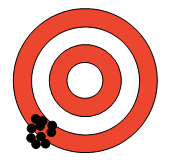
52.
This bullseye demonstrates...
a)
High Accuracy & High Precision
b)
High Accuracy & Low Precision
c)
Low Accuracy & High Precision
d)
Low Accuracy & Low Precision
53.

The best movie genre is (yes, this is a real question; its to give your brain a rest from dimensional analysis! :))

a)

Action

b)

Romantic Comedy

c)

Sci Fi

d)

Animae

54.

Convert 50. decimeters/week to kilometers/year

a)

.026 kilometers/year

b)

2.6 kilometers/year

c)

.26 kilometers/year

d)

26 kilometers/year

55.

Convert 3.8 km/s to miles/year

a)

74 898 000 miles/year

b)

120 000 000 miles/year

c)

75 000 000 miles/year

d)

2,000,000

56.

On Dr. Davis' bookshelf, there are 23 science textbooks, each with an average of 31 chapters. If there are 5 pages on average for every chapter, how many total pages are there? (Round your answer to 2 sig figs)

a)

3.6 x 10⁴ pages

b)

36 pages

c)

3.6 x 10² pages

d)

3600 pages

57.

You roof has a leak. If it leaks at a rate of 14 drops per minute, how many hours will it take to fill a 5 gallon bucket? (20 drops = 1 mL; 30 mL = 1oz; 64 oz = 1 gal) [Round answer to 2 sig figs]

a)

230 hours

b)

950 hours

c)

190 hours

d)

1900 hours

58.
How many inches are in 1 mile?
(Hint:  5280 ft = 1 mi)
(3 ft = 1 yd)
a)
66,330 in
b)
63,360 in
c)
63,660 in
d)
63,066 in
59.

Convert 65.5 m3 to mL.

a)

0.000 065 50 mL

b)

0.0655 mL

c)

65 500 000 mL

d)

6550 mL

60.

Convert 0.74 Kcal/min to cal/s.

a)

74 cal/s

b)

12 cal/s

c)

44 400 cal/s

d)

740 cal/s

61.

Convert 27.45 g/cm2 to mg/mm2.

a)

2.745 mg/mm2

b)

0.2745 mg/mm2

c)

2745 mg/mm2

d)

274.5 mg/mm2

62.

Convert 98.6 Kelvin to degree Celsius

a)

-14.6 C

b)

371 C

c)

-174.4 C

d)

-174.4 K

63.

The SI unit of length is

a)

meter

b)

kilometer

c)

centimeter

d)

yard

64.

Convert 882 micrograms to grams

a)

882 000 g

b)

0.882 g

c)

0.000 882 g

d)

0.008 82 g

65.

A student measures the mass of a sample as 9.67 g. Calculate the percent error, given that the correct mass is 9.82 g.

a)

15.3 % error

b)

15.0 % error

c)

10.2 % error

d)

1.53 % error

66.

Given: volume of tennis ball = 85 mL, and a tennis court of dimensions: l = 34.6 m, h = 16.8 m, and w = 22.7 m, how many tennis balls could fit into the court?

a)

155 235 952 tennis balls

b)

155 235 tennis balls

c)

160 000 000 tennis balls

d)

160 000 tennis balls