
 Worksheets
Weather Review
Total questions: 67
Worksheet time: 1hrs 28mins
Name
Class
Date
1.
How does the air move in a sea breeze?
a)
wind moves from north to south
b)
wind moves from ocean to the land
c)
wind moves from the land to the ocean
d)
wind moves from south to north
2.
How does the air move in a land breeze?
a)
From east to west
b)
From west to east
c)
From the land to the ocean
d)
From the ocean to the land
3.
When warm air rises, ______ pressure forms at the surface of the land or sea.
a)
high
b)
some
c)
low
d)
none
4.
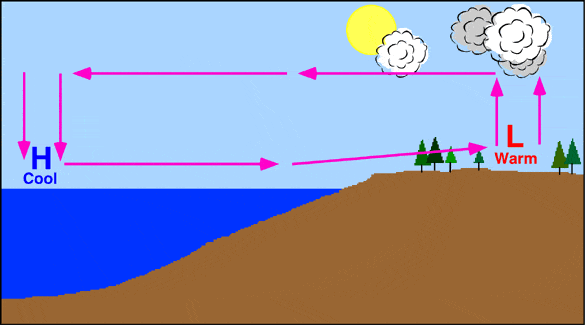
Is this a land or a sea breeze?
a)
land breeze
b)
sea breeze
5.
The jet stream usually moves from
a)
north to south
b)
west to east
c)
east to west
d)
south to north
6.
When the jet stream travels south (below North Carolina), it brings _________ weather to us.
a)
sunny
b)
warmer
c)
windy
d)
colder
7.
Which term best describes how the earth's atmosphere is heated?
a)
Spirally
b)
Unevenly
c)
Circularly
d)
Kinetically
8.
When Earth's rotation causes the wind to curve
a)
cloudy
b)
Coriolis effect
c)
high pressure
d)
low pressure
9.
Winds that blow from the west are called ____.
a)
Easterlies
b)
Polars
c)
Westerlies
d)
Temperates
10.
if you wanted to find the jet steam, where would you go?
a)
the area around the poles
b)
the area around the equator
c)
10 km above the earth's surface
d)
1 km above the earth's surface
11.
Which best describes how winds in the jet stream blow?
a)
between a boundary of cold air and a boundary of warm air
b)
between two boundaries of hot air
c)
no pattern
d)
between two boundaries of cold air
12.

Why does warm air rise?
a)
Warm air is more dense than cooler air.
b)
Warm air has more pressure than cooler air.
c)
Warm air is less dense than cooler air.
d)
Warm air has a higher dew point than cooler air.
13.
Wind speed is measured by a
a)
barometer
b)
anemometer
c)
wind vane
d)
thermometer
14.
Which is the best explanation for how air masses move across the United States?
a)
The prevailing westerlies move air masses from west to east across the United States but may be deflected by the jet stream.
b)
The trade winds move air masses from west to east across the United States.
c)
The jet stream moves air masses from the Pacific Ocean across the United States.
d)
The warm air of the Gulf Stream causes air masses to move from the Atlantic Ocean to the Pacific Ocean.
15.

Near the top of the troposphere is a narrow band of high speed winds called the______.
a)
westerlies
b)
jet stream
c)
trade winds
d)
local winds
16.
Which global winds have the greatest impact on the weather in the US?
a)
trade winds
b)
prevailing westerlies
c)
doldrums
d)
polar easterlies
17.
What global wind is located from 0 to 30 degrees North and South of the Equator?
a)
Trade Winds
b)
Prevailing Westerlies
c)
Polar Easterlies
d)
Doldrums
18.
A device that is used to measure atmospheric pressure is a ___________.
a)
barometer
b)
thermometer
c)
kilometer
d)
micrometer
19.
In the morning, Carlos noticed that the air pressure reading on the barometer was beginning to drop. What kind of weather can he most likely expect in the evening?
a)
The weather will be cloudy with a chance of rain.
b)
The weather will be warmer with clear skies.
c)
The weather will be clear and windy.
d)
The weather will be sunny and cool.
20.
On a cold, cloudy day, the local weather forecaster predicts that a high pressure system will be moving into the area in the next 24 hours. Which weather conditions will this system most likely bring to the area?
a)
stormy
b)
sunny
c)
snowy
d)
hot
21.
Which most likely produces clear, cool weather?
a)
zero air pressure
b)
stable air pressure
c)
a low pressure system
d)
a high pressure system
22.
Which is most associated with a thunderstorm?
a)
low air pressure
b)
high air pressure
c)
winds blowing from the West
d)
winds blowing from the East
23.
Which will most likely result from a low pressure weather system?
a)
warm temperatures
b)
cloudy conditions
c)
clear conditions
d)
cool temperatures
24.
What kind of weather happens during a warm front?
a)
Light rain or light snow
b)
Heavy rain or heavy snow
c)
Clear skies, temp. warms
d)
Clear skies, temp. cools
25.
What kind of weather happens during a cold front?
a)
Light rain or light snow
b)
Heavy rain or heavy snow
c)
Clear skies, temp. warms
d)
Clear skies, temp. cools
26.
What kind of weather happens after a cold front moves out?
a)
Light rain or light snow
b)
Heavy rain or heavy snow
c)
Clear skies, temp. warms
d)
Clear skies, temp. cools
27.
What kind of weather happens after a warm front moves out?
a)
Light rain or light snow
b)
Heavy rain or heavy snow
c)
Clear skies, temp. warms
d)
Clear skies, temp. cools
28.

Which front is this?
a)
Warm front
b)
Cold front
c)
Occluded front
d)
Stationary front
29.

Which front is this?
a)
Warm front
b)
Cold front
c)
Occluded front
d)
Stationary Front
30.

What is happening in Missouri along the cold front?
a)
Clear skies
b)
Severe weather
c)
Light rain or light snow
d)
Heavy rain or heavy snow
31.
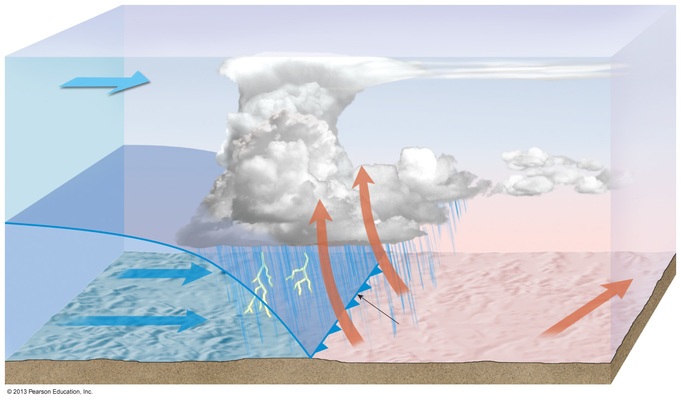
What type of storm front is this?
a)
warm front
b)
cold front
c)
stationary front
d)
occluded front
32.
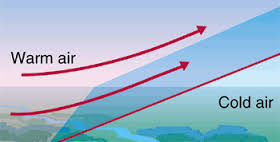
Which type of front is pictured?
a)
Cold front
b)
Warm front
c)
Occluded front
d)
Stationary front
33.
rapidly moving cold air mass runs into a warm air mass the cold air slides under the warm air. This is called a .....
a)
cold front
b)
warm front
c)
stationary front
34.
A front is
a)
where warm air is cooling at earth's surface
b)
a line where hot and cold air are separating
c)
a line where two different air masses meet
d)
where cold air is rising and forming rain clouds
35.
Clouds that bring thunderstorms.
a)
cumulonimbus
b)
cirrus
c)
stratus
d)
fog
36.
They are highest clouds in the sky. They look curly, white and feathery. Usually mean good weather.
a)
Cumulus
b)
Cumulonimbus
c)
Cirrus
d)
Stratus
37.
This is sometimes called a thunderhead cloud. It looks very tall like mountains and heavy rain comes from it.
a)
Cumulus
b)
Cirrus
c)
Stratus
d)
Cumulonimbus
38.
They are low in the sky and look soft and fluffy.
a)
Cirrus
b)
Cumulonimbus
c)
Cumulus
d)
Stratus
39.
These clouds are the closest to the ground. Their name means layer- or sheet like. They bring rain or snow and cover most of the sky.
a)
Cirrus
b)
Stratus
c)
Cumulonimbus
d)
Cumulus
40.
Which cloud brings nice weather?
a)
Cumulonimbus
b)
Cumulus
c)
Stratus
41.

what type of cloud is shown?
a)
cumulus
b)
cirrus
c)
stratus
42.

what type of cloud is shown?
a)
cumulus
b)
cirrus
c)
stratus
43.

what type of cloud is shown?
a)
cumulus
b)
cirrus
c)
stratus
44.

This weather instrument is a...
a)
anemometer
b)
Christmas ornament
c)
wind vane
d)
barometer
45.

What is the name of this tool?
a)
Barometer
b)
Hygrometer
c)
Rain Gauge
d)
Thermometer
46.
A rain gauge measures what?
a)
Air pressure
b)
Wind speed
wind speed
wind speed
c)
Amount of rain fall
d)
Wind direction
47.

This weather instrument is an...
a)
wind vane
b)
anemometer
c)
barometer
d)
thermometer
48.
Which tool measures wind speed?
a)
Anemometer
b)
Hygrometer
c)
Barometer
d)
Wind Vane
49.
What is the water cycle?
a)
the 3 forms of water
b)
the movement of water on, above, or below the surface of the Earth
c)
when water melts
d)
when clouds form
50.

What part of the water cycle does this picture show?
a)
condensation
b)
precipitation
c)
evaporation
51.
Which of these is an example of precipitation?
a)
snow
b)
air
c)
clouds
d)
vapor
52.
What is the energy source for the water cycle?
a)
the sun
b)
the earth
c)
water
d)
the moon
53.
What is evaporation?
a)
The part of the water cycle when the sun heats up water, turning it from a liquid into water vapor or steam. It rises from the ground into the air.
b)
The part of the water cycle when the water vapor in the air gets cold. The water turns back into a liquid and forms clouds.
c)
The part of the water cycle when clouds get heavy and can no longer hold the liquid water. This causes the water to fall from the sky to the earth as rain, snow, sleet, or hail.
54.
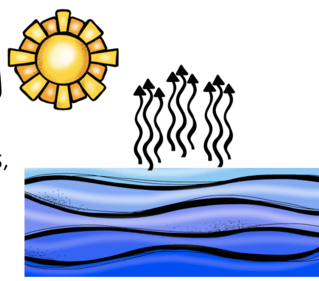
Evaporation happens when the sun ___________ water and turns it into vapor.
a)
cools
b)
heats up
c)
freezes
d)
lights up
55.

What is it called when plants give off water vapor as a waste product?
a)
condensation
b)
evaporation
c)
sublimation
d)
transpiration
56.
What is the process during which water cools and turns from a gas to a liquid?
a)
Codensation
b)
Runoff
c)
Precipitation
d)
Evaporation
57.
Why do hurricanes die out soon after hitting landfall?
a)
Cloud types change.
b)
Warm water no longer feeds them.
c)
Rotation of the storm changes direction.
58.
Which is most likely an effect of the Gulf Stream?
a)
heavy rains in California
b)
severe drought in Australia
c)
milder winter temperatures in Florida
59.
What is the cause of rising surface temperatures of the Pacific Ocean, drought in the western United States, and flooding on the Pacific coast of South America?
a)
the Gulf Stream
b)
the Jet Stream
c)
La Nina
d)
El Nino
60.
El Nino occurs when the tropical ocean waters are warmer in which ocean?
a)
Atlantic
b)
Indian
c)
Pacific
d)
Arctic
61.
During __________ surface temperatures in the eastern Pacific are colder than average.
a)
El Nino
b)
La Nina
62.
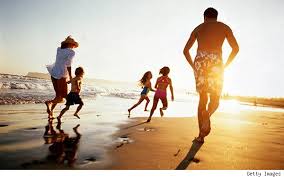
The sun shines down on this family as the play on the beach.
a)
conduction
b)
convection
c)
radiation
63.

A group of friends gather around a fire to stay warm.
a)
conduction
b)
convection
c)
radiation
64.

Walking on the warm sand sand with your bare feet.
a)
conduction
b)
convection
c)
radiation
65.

Which direction will the heat flow while this person holds a hot cup of tea?
a)
from the cup to her hand
b)
from her hand to the cup
c)
no heat is transferred
66.
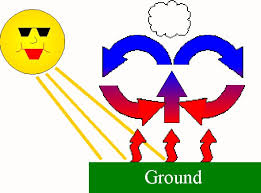
Warm air rises and the cool air sinks.
a)
conduction
b)
convection
c)
radiation
67.

The warm air from this heater creates a current when the warm air rises and the cold air sinks.
a)
conduction
b)
convection
c)
radiation
100 %

