Wayground logo

Free Printable Worksheets

Font size

S
M
L
XL
Worksheets

Earth Layers & Plate Tectonics

Total questions: 40

Worksheet time: 32mins

Name
Class
Date
1.
The core is made-up of what two elements?
a)
iron and nickel
b)
iron and oxygen
c)
nickel and silicon
d)
oxygen and silicon
2.
The order of the earth’s compositional layers from most dense to least dense are
a)
Inner Core, Crust, Mantle and Outer Core
b)
Crust, Mantle, Outer Core and Inner Core
c)
Inner Core, Outer Core, Mantle and Crust
d)
Crust, Outer Core, Inner Core and Mantle.
3.
The solid, outer layer of the Earth that consists of the crust and the rigid upper part of the mantle
a)
Lithosphere
b)
Mesosphere
c)
Mantle
d)
Crust
4.
Which layer of the Earth is the most dense?
a)
crust
b)
mantle
c)
inner core
d)
outer core
5.
Which layer of the Earth is responsible for Earth's magnetic field?
a)
outer core
b)
inner core
c)
mantle
d)
crust
6.
Temperature _____________________ as you go deeper into the earth.
a)
increases
b)
decreases
c)
goes up and down depending on the layer
d)
stays the same
7.
Pressure ______________________ as you go deeper into the Earth
a)
increases
b)
decreases 
c)
goes up or down depending on the layer
d)
stays the same
8.
Which layer of Earth is characterized by rock that is plastic, or soft enough to flow?
a)
asthenosphere
b)
crust
c)
lithosphere
d)
inner core
9.
______________________crust is thinner and more dense than ____________ crust.
a)
bread, pizza
b)
continental, oceanic
c)
land, water
d)
oceanic, continental
10.
Which crust is made up of basaltic rock?
a)
oceanic
b)
continental
11.
Relative to oceanic crust, continental crust is ___________.
a)
more mafic
b)
thinner
c)
denser
d)
made of a wider assortment of rocks
12.
Which layer of the Earth is the only liquid layer?
a)
Outer Core
b)
Inner Core
c)
Mantle
d)
Lithosphere
13.
Using data from seismic waves, geologists have learned that Earth's interior is made up of several
a)
continents
b)
layers
c)
ridges
d)
trenches
14.

The process of circular motion in the Earth’s mantle that causes the plates of the lithosphere to move is called

a)

convection

b)

conduction

c)

deposition

d)

drifting

15.
The huge pieces of the earth's crust are called ____________________________. 
a)
crust
b)
plates
c)
directions
d)
seismos
16.
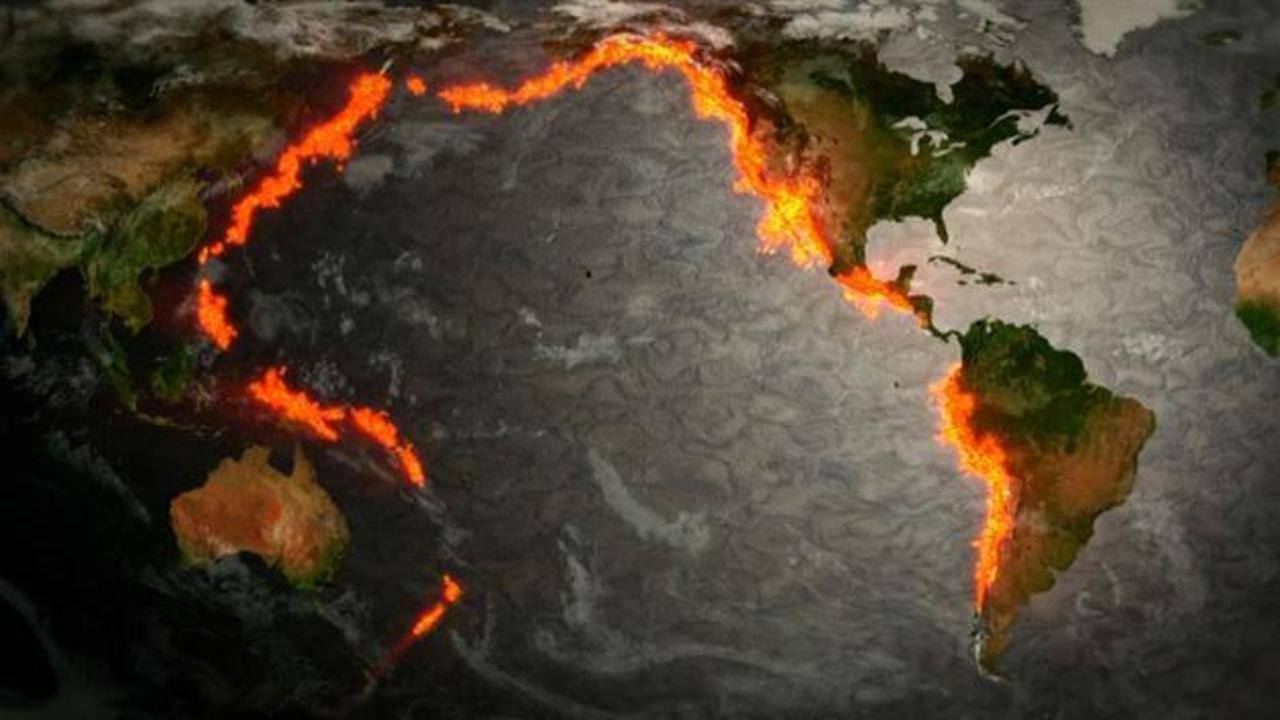
Which ocean in the world is also known as the "Ring of Fire"
a)
Atlantic
b)
Indian
c)
Arctic
d)
Pacific
17.
Mountains form from ...
a)
plates sliding past one another
b)
collision of plates
c)
plates moving away from each other
18.
Which of the following is where one plate slides under another plate?
a)
submarine zone
b)
divergence zone
c)
subduction zone
d)
lower zone
19.
What does the theory of continental drift state?
a)
The continents were once joined in a super-continent and have moved over time
b)
Continents are stationary and do not move
c)
The Earth is broken into lithospheric plates that move due to convection currents
d)
none of the above
20.
Who is the person credited with developing the theory of continental drift?
a)
Harry Hess
b)
Galileo
c)
Alfred Wegener
d)
Newton
21.
What is Pangaea?
a)
The name of a German Scientist
b)
the name of the supercontinent that existed millions of years ago
c)
another name for continental drift
d)
the name of an ancient fossil
22.
Which piece of evidence did Wegener use to prove continental drift?
a)
The shape of the continents
b)
Similar fossils found on separate continents
c)
Tree fossils found in odd places
d)
All of the above
23.
The movement of Earth's crust along plate boundaries produces
a)
earthquakes
b)
volcanoes
c)
mountains
d)
All of these options. 
24.
What percent of the Earth's volcanoes reside in the Ring of Fire?
a)
75%
b)
100%
c)
90%
d)
0%
25.
How is it possible for new crust to be formed without increasing the surface area of the Earth?
a)
Crust is destroyed at the same time it is created
b)
New crust is underwater where it sinks
c)
New crust breaks more easily than old crust
26.
The Himalayas in Asia are an example of what type of plate boundary?
a)
divergent
b)
continent-to-continent convergent
c)
ocean-to-continent convergent
d)
transform
27.
The Ring of Fire is famous for
a)
deadly volcanoes
b)
terrible earthquakes
c)
terrifying tsunamis
d)
all of the above
28.
Which of the following causes Earth's tectonic plates to move?
a)
Energy from the Sun
b)
Magnetic Pole Reversal
c)
Convection currents in the mantle
d)
Faults in Mountain Ranges
29.
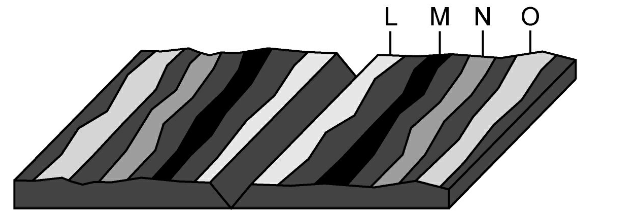
Where would the oldest rock be found?
a)
L
b)
M
c)
N
d)
O
30.
The Great Rift Valley in Africa and the Mid-Ocean Ridge were all created by this boundary
a)
Divergent
b)
Convergent
c)
Reform
d)
Transform
31.
Earthquakes and volcanoes are most likely found in which locations?
a)
At plate boundaries
b)
in oceans
c)
in the middle of continents
d)
in the middle of plates
32.
When an oceanic plate and a continental plate collide, which one will subduct?
a)
oceanic
b)
continental
c)
neither
33.

Label each plate boundary.

34.
Question Image

Match the following

a)
  • thicker, less dense, forms landmasses, composed mostly of granite, generally older than oceanic crust

1.

Continental crust

b)

thinner, more dense, located under oceans and seas, composed mostly of basalt, generally younger than continental crust

2.

Oceanic crust

c)

Boundary where two tectonic plates meet

3.

Plate boundary

35.

Label the parts of the plate boundary

36.
Question Image

Match the following

a)

A plate boundary where two tectonic plates slide horizontally past one another

1.

Transform boundary

b)

process in which two lithospheric plates of different densities converge and the denser one sinks into the mantle beneath the other

2.

Subduction

c)

A plate boundary where two tectonic plates move apart from each other

3.

Divergent boundary

d)

A plate boundary where two tectonic plates move toward each other and collide

4.

Convergent boundary

37.

​ (a)   the process by which rock material moves under Earth’s outer layer and into the mantle due to plate motion

Choose from the below words
subduction
uplift
weathering
sediment
38.

According to the graph, how many kilometers from the Mid-Atlantic Ridge are rock samples that are 75 million years old? ​

​ (a)  

Choose from the below words
1,150 Km
3 Km
1,300 Km
800 Km
1,000 Km
39.

Drag the labels to the correct the locations on the diagram.

40.

Identify different parts of Earth's structure: