
 Worksheets
Astronomy TEST Review
Total questions: 71
Worksheet time: 44mins
Name
Class
Date
1.

All stars begin their life in a
a)
Main Sequence
b)
Nebula
c)
Protostar
d)
Black Dwarf
2.

The life cycles of stars are determined by their:
a)
mass (size)
b)
color
c)
distance from Earth
d)
luminosity
3.

A gigantic explosion that causes the death of a large star is called
a)
pulsar
b)
red giant
c)
supernova
d)
black hole
4.

A ________ is an object so dense with so much gravity that even light cannot escape.
a)
neutron star
b)
white dwarf
c)
blackhole
d)
black dwarf
5.
A star is born when ________________ begins to happen.
a)
nuclear fusion
b)
nuclear abrasion
c)
crying
d)
nuclear fission
6.
More massive stars continue to fuse elements in their cores all the way up to ________.
a)
silicon
b)
iron (Fe)
c)
carbon
d)
plutonium
7.
Where does the sun's energy originate?
a)
Nuclear reactions of heavy elements.
b)
Nuclear fusion of smaller into larger elements.
c)
Nuclear reactions of cells
d)
Nuclear fission reactions
8.
When a young, developing star becomes massive enough and dense enough, the process of _______ begins.
a)
H --> He fusion
b)
He --> C fusion
c)
He --> C --> O fusion
d)
fission
9.
In the Giant and Supergiant phases of a star's life, ________ fuses and makes heavier elements.
a)
Hydrogen
b)
Helium
c)
Carbon
d)
Oxygen
10.
What is the sun mostly made up of
a)
Helium
b)
Core
c)
Carbon
d)
Hydrogen
11.
A light year is...
a)
The speed light travels
b)
How long it takes light to get to you from the sun
c)
The distance light can travel in a year
d)
How many years it takes light to be emitted
12.
The apparent shift in the position of an object when viewed from different locations is called
a)
Retrograde motion
b)
Parallax
c)
Triangulation
d)
Precession
13.
The average distance between the earth and the sun is the
a)
Astronomical unit
b)
Light year
c)
Parsec
d)
Perihelion
14.
Hubble observed that galaxies are
a)
expanding
b)
moving away from us
c)
moving towards us
d)
standing still
15.
What were the original two elements in our universe?
a)
Lithium and Carbon
b)
Hydrogen and Neon
c)
Helium and Chlorine
d)
Hydrogen and Helium
16.
What is Cosmic Background radiation (i.e. relic radiation)?
a)
Evidence of a large explosion in the universe leaving radiation/"heat" behind
b)
It is the life force that supports the universe
c)
Evidence of blackholes actually existing
d)
Evidence of that the universe is heating
17.
Weather, climate, and the atmosphere are studied in this branch of Earth Science.
a)
Astronomy
b)
Meteorology
c)
Oceanography
d)
Geology
18.
The study of the living and non-living parts of Earth's oceans.
a)
Geology
b)
Meteorology
c)
Biosphere
d)
Oceanography
19.
What is the Biosphere?
a)
The crust of the Earth
b)
All living things on the Earth
c)
The gaseous sphere around the Earth
d)
The ocean and everything in it
20.
What is the geosphere?
a)
The Earth (rocks, mountains, the crust...)
b)
All living things on the Earth
c)
The gaseous sphere around the Earth
d)
Everything outside of Earth
21.
What is the Atmosphere?
a)
The Earth (rocks, mountains, the crust)
b)
All living things on the Earth
c)
The gaseous sphere around the Earth
d)
Everything outside of Earth
22.
The study of the stars and other celestial bodies.
a)
Meteorology
b)
Astronomy
c)
Oceanography
d)
Geology
23.
What is the Hydrosphere?
a)
All the water on the Earth
b)
All living things on the Earth
c)
The gaseous sphere around the Earth
d)
The Earth (rocks, mountains, the crust)
24.

Mount Everest is:
a)
Atmosphere
b)
Biosphere
c)
Geosphere
d)
Hydrosphere
25.
Studies the solid portions of the earth, including volcanoes, earthquakes, and fossils.
a)
Geology
b)
Geography
c)
Meteorology
d)
Oceanography
26.
What is an example of something from the exosphere?
a)
Water
b)
Jupiter
c)
Rocks
d)
Air
27.

This picture shows
a)
Atmosphere
b)
Biosphere
c)
Hydrosphere
d)
Geosphere
28.
While speaking to a colleague, a scientist makes the following statement: "I propose that Bald Eagle eggs in northern Maine will have thinner shells than those from birds in southern Alaska due to increased levels of pesticides in the water." This statement is a
a)
theory
b)
law
c)
conclusion
d)
hypothesis
29.
Scientific theories can be tested.
a)
True
b)
False
30.
Scientific theories are based on
a)
general assumptions of how systems work.
b)
mathematical principles that can be proven true.
c)
large amounts of data collected over time.
d)
observations from within only one scientific discipline.
31.
Scientific theories do not change once they have been written down.
a)
True
b)
False
32.
Laws are usually mathematically defined.
a)
True
b)
False
33.
The atomic number tells you what?
a)
number of electrons
b)
number of protons
c)
number of neutrons
d)
both electrons and protons in an atom.
34.
The simplest substance is..?
a)
Carbon
b)
An element
c)
Water
d)
A simple compound
35.
A proton is....
a)
A negatively charged subatomic particle
b)
A positively charged subatomic particle
c)
A neutrally charged subatomic particle
d)
The only subatomic particle located in the nucleus
36.
A neutron has a charge of
a)
+2
b)
No charge
c)
-1
d)
+1
37.
An element's identity is determined by the number of
a)
electrons.
b)
protons.
c)
neutrons.
d)
valence.
38.
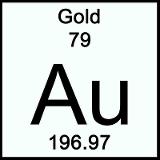
Which number is the atomic mass?
a)
79
b)
196.97
39.
What does the atomic mass tell you?
a)
Basically,the number of electrons and protons
b)
The number of neutrons
c)
Basically, the number of protons and neutrons
d)
The number of protons.
40.

How many protons are in Beryllium?
a)
4
b)
9
c)
5
d)
2
41.

What does "1.00794" mean in this image?
a)
number of protons
b)
number of neutrons
c)
average number of protons and neutrons
d)
average number of valence electrons
42.
Why is water NOT on the periodic table?
a)
It is naturally occuring
b)
It is a compound, not an element
c)
It exists as a solid, a liquid, and a gas
d)
Its chemical formula doesn't fit
43.
As you move from left to right across the periodic table, the atomic number increases.
a)
True
b)
False
44.

In the diagram given, what happens as we move to the left?
a)
Stars Get Larger
b)
Stars get Colder
c)
Stars get hotter
45.
Which category is our Sun located in?
a)
White Dwarfs
b)
Supergiants
c)
Main Sequence
d)
Giants
46.
The HR Diagram shows a relationship of a star's surface temperature and its
a)
color
b)
size
c)
apparent magnitude
d)
absolute magnitude
47.
A small, hot star near the end of its life is a star called a
a)
white dwarf
b)
red dwarf
c)
supergiant
d)
protostar
48.
What color are the hottest stars?
a)
red
b)
yellow
c)
orange
d)
blue
49.
Which has the LONGEST wavelength and, therefore, the lowest frequency/energy
a)
Gamma Rays
b)
Radio Waves
c)
Visible Light
d)
Infrared rays
50.
Select the correct order increasing energy of waves on the electromagnetic spectrum.
a)
Radio, Micro, Infra, Visible, Ultra, X-ray, Gamma
b)
Gamma, X-ray, Ultra, Vis, Infra, Micro, Radio
c)
Vis, Micro, Infra, Ultra, X-ray, Gamma, Radio
d)
Micro, Radio, Vis, Infra, Ultra, X-ray, Gamma
51.
Which color has the least amount of energy?
a)
red
b)
orange
c)
green
d)
blue
52.
All electromagnetic waves have the same...
a)
frequency
b)
speed
c)
wavelength
d)
energy
53.

The blue section of the wave is measuring _________________.
a)
wavelength
b)
crest
c)
trough
d)
amplitude
54.

_____________________light is the only type of EM wave detected by the human eye.
a)
Red
b)
Gamma
c)
Microwave
d)
Visible
55.

Label Part 2
a)
#2 Core
b)
#2 Radiation zone
c)
#2 Convection zone
d)
#2 Corona
56.
In what form does the Sun's energy travel to Earth?
a)
Heat
b)
Electrical energy
c)
Electromagnetic radiation
d)
Mechanical energy
57.
What is a prominence
a)
Invisible part of the sun
b)
visible part of the sun
c)
outer layer of the sun
d)
arch shaped flumes of hot gas
58.
What is a solar flare
a)
explosion of magnetically charged particles that can reach far into space
b)
visible part of the sun
c)
outer layer of the sun
d)
arch shaped flumes of hot gas
59.
Sunspots are dark because they are _____ than the area around them
a)
hotter
b)
cooler
c)
longer
d)
less magnetic
60.
Solar Flares can cause all of the following EXCEPT
a)
Damage to I.S.S.
b)
Knock out radio signals
c)
Northern Lights
d)
Droughts
61.
When we look at the sun, what layer are we viewing?
a)
photosphere
b)
chromosphere
c)
corona
d)
convection zone
62.
What layer of the sun's atmosphere gives the sun its "white halo" during a solar eclipse?
a)
chromosphere
b)
photosphere
c)
corona
d)
atmosphere
63.

When solar winds enter the Earth's atmosphere at the poles, what is created?
a)
auroras
b)
solar flares
c)
sunspots
d)
warmer temperatures
64.
Planets orbit the Sun in a shape called a(n)
a)
circle
b)
ellipse
c)
focus
d)
perihelion
65.
When a planet orbits the Sun, one of the foci of the elliptical orbit is
a)
the axis
b)
the perihelion
c)
the center
d)
the Sun
66.
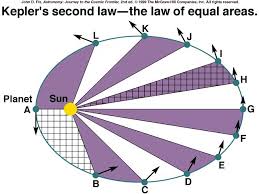
Where is the planet moving faster
a)
Position A to B
b)
Position B to C
c)
Position H to I
d)
Position I to J
67.

What is true about the area between points A, B and the Sun, and the area between points H, I and the Sun?
a)
The area between A, B and the Sun is the largest.
b)
The area between H, I and the Sun is the largest
c)
Both areas are equal in size
d)
There is not enough information to determine the areas
68.
A planet moves __________ when it is farthest from the sun.
a)
faster
b)
slower
69.
The place where a planet is closest to the Sun as it orbits the Sun is called the
a)
perihelion
b)
aphelion
70.
The place where a planet is farthest away from the Sun in its orbit around the Sun is called the
a)
aphelion
b)
perihelion
71.
Kepler's third law of planetary motion describes a relationship between the
a)
shape of orbit and location of Sun.
b)
orbital velocity and position in orbit
c)
distance from the Sun and length of year.
d)
path of epicycle and position.
100 %

