wayground logo

Free Printable Worksheets

Font size

S
M
L
XL
Worksheets

Earth Space Final Review

Total questions: 176

Worksheet time: 2hrs 14mins
Name
Class
Date
1.
The boundary  between two air masses is known as:
a)
front
b)
storm
c)
climate
d)
flood
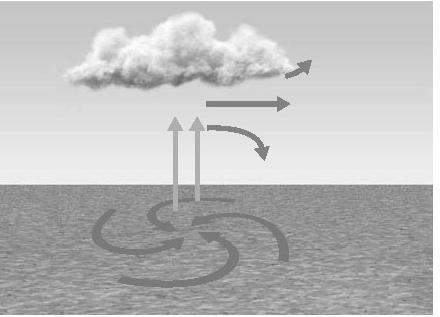
2.
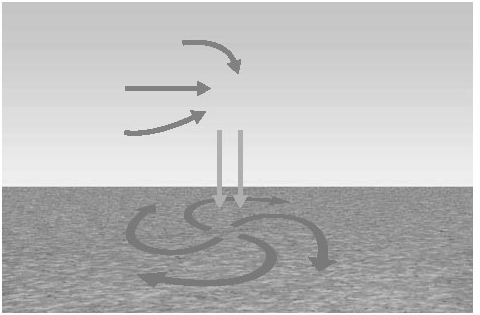
Which type of pressure system is pictured?
a)
high
b)
low
c)
medium
d)
none
3.
What type of weather would you expect with the pressure system pictured?
a)
clear
b)
cloudy
c)
severe storms
d)
hot
4.
Which type of pressure system is pictured?
a)
high
b)
low
c)
medium
d)
none
5.
What type of weather would you expect from the pressure system pictured?
a)
clear
b)
cloudy
c)
hot
d)
stormy
6.
When air contains as much moisture as possible at a specific temperature, it is:
a)
at its dew point
b)
saturated
c)
at its dew point AND saturated
d)
none of the rest
7.
Cold air traveling south from Canada is:
a)
continental tropical
b)
continental polar
c)
maritime tropical
d)
maritime polar
8.
Warm air mass that does not carry water:
a)
continental tropical
b)
continental polar
c)
maritime tropical
d)
maritime polar
9.
Cold air mass that is carrying water is:
a)
continental tropical
b)
continental polar
c)
maritime tropical
d)
maritime polar
10.
Humidity is the...
a)
Amount of Water Vapor in the Air
b)
Amount of Wind in the Air
c)
Amount of Precipitation in the Air
d)
Amount of Pressure in the Air
11.
Warm air near the Earth’s surface rises and then cools and drops, this creates a _________________ in the atmosphere.
a)
run-off
b)
Greenhouse Effect
c)
convection current
d)
water cylce
12.
Because the earth is spinning on its axis, the global winds appear to curve. This is known as the __________ ________.
a)
Coriolis Effect
b)
Greenhouse Effect
c)
Climate Effect
d)
Atmosphere Effect
13.
Where does a hurricane form?
a)
Over a cold body of water
b)
Over a warm body of water
c)
Over cold land
d)
Over warm land
14.
What kind of weather is usually associated with a low pressure system?
a)
Sunny weather
b)
Precipitation (rain, snow, etc.)
15.
What kind of weather is usually associated with a high pressure system?
a)
Sunny weather
b)
Precipitation (rain, snow, etc.)
16.
In what direction do winds always blow?
a)
From areas of high pressure to areas of low pressure
b)
From areas of low pressure to areas of high pressure
17.
What layer does weather occur in?
a)
mesosphere
b)
troposphere
c)
thermosphere
d)
stratosphere
18.
Where is the ozone layer located?
a)
Thermosphere
b)
Troposphere
c)
Stratosphere
d)
Mesosphere
19.
What are the daily conditions of temperature, humidity and precipitation?
a)
weather
b)
climate
20.
What are the yearly conditions of temperature, precipitation and humidity?
a)
weather
b)
climate
21.
What imaginary line divides our world into the northern and southern hemispheres?
a)
equator
b)
international date line
22.
As your distance from the equator increases, what happens to temperature?
a)
temperature increases
b)
temperature decreases
23.
Which climate zone gets the least amount of direct sunlight and is the coldest?
a)
tropical
b)
temperate
c)
polar
24.
Which climate zone gets the most amount of direct sunlight and rainfall and is the warmest?
a)
tropical
b)
temperate
c)
polar
25.
As altitude increases, what happens to temperature?
a)
temperature increases
b)
temperature decreases
26.
What are the imaginary lines that determine weather patterns and run parallel to the equator?
a)
latitude
b)
longitude
27.
Which factor does not affect climate?
a)
longitude
b)
distance from large bodies of water
c)
latitude
d)
altitude
28.
What instrument measure air pressure?
a)
barometer
b)
thermometer
29.
When air pressure is high, what type of weather do we experience?
a)
sunny and clear
b)
rainy and cloudy
30.
When air pressure is low, what type of weather do we experience?
a)
sunny and clear
b)
rainy and cloudy
31.
Which gas in our atmosphere is most abundant?
a)
Argon
b)
Oxygen
c)
Nitrogen
d)
Carbon Dioxide
32.
What is the percentage of oxygen in Earth's atmosphere?
a)
1%
b)
21%
c)
78%
d)
90%
33.
In which layer of the atmosphere does weather occur?
a)
Mesosphere
b)
Thermosphere
c)
Stratosphere
d)
Troposphere
34.
What decreases as you go up in the atmosphere?
a)
Altitude
b)
Atmosphere
c)
Meteors
d)
Air Pressure
35.
What is the lowest main layer of Earth's atmosphere?
a)
Thermosphere
b)
Troposphere
c)
Stratosphere
d)
Mesosphere
36.
What is the second lowest main layer of Earth's atmosphere?
a)
Thermosphere
b)
Troposphere
c)
Stratosphere
d)
Mesosphere
37.
What are the 2 most abundant gases in Earth's atmosphere?
a)
carbon dioxide and oxygen
b)
carbon dioxide and nitrogen
c)
nitrogen and oxygen
d)
nitrogen and hydrogen 
38.
Which of the following is the correct order of the atmosphere layers from Earth to space?
a)
troposphere, stratosphere, mesosphere, thermosphere, exosphere
b)
troposphere, mesosphere, thermosphere, exosphere, stratosphere
c)
thermosphere, stratosphere, mesosphere, troposphere, exosphere
d)
troposphere, stratosphere, mesosphere, exosphere, thermosphere
39.
The density of our atmosphere _____________ with an increase in altitude.
a)
Increases
b)
Gets greater
c)
Decreases
d)
Gets heavier
40.
Which layer protects the earth from meteors?
a)
Troposphere
b)
Stratosphere
c)
Mesosphere
d)
Thermosphere
41.
Describe how the ozone layer protects the earth.
a)
Absorbs solar radiation, Protects Earth from UV Rays,  and emits heat
b)
Ozone in the lower atmosphere is a pollutant
42.
Airplanes fly in which layers of the atmosphere?
a)
Troposphere, Stratosphere, and Mesosphere
b)
Stratosphere and Mesosphere
c)
Troposphere and Stratosphere
d)
Troposphere Stratosphere, Mesosphere, and Thermosphere
43.
The force that air exerts on all objects is called-
a)
density
b)
altitude
c)
infrared radiation
d)
air pressure
44.
Which layer of the atmosphere do most satellites orbit the Earth?
a)
Stratosphere
b)
Mesosphere
c)
Exosphere
d)
Ionosphere
45.
Which layer contains the ionosphere, a layer of charged particles, that interact with solar winds to cause the auroras?
a)
Exosphere
b)
Stratosphere
c)
Thermosphere
d)
Mesosphere
46.
Which layer contains the least number of molecules (mainly hydrogen and helium)?
a)
Thermosphere
b)
Exosphere
c)
Troposphere
d)
Stratosphere
47.
Which of the following is true of hot air?
a)
It is more dense
b)
It is heavier
c)
It has more air pressure 
d)
It is lighter and less dense 
48.
Which is true of cold air?
a)
It is lighter and more dense
b)
It is heavier and less air pressure
c)
It is heavier and more air pressure
d)
It is less dense and has less air pressure. 
49.
Which best defines wind? 
a)
It is lighter and more dense
b)
It is convection currents
c)
All are correct
d)
It is horizontal movement of air
50.
How does wind move?
a)
From areas of low pressure to areas of high pressure.
b)
From areas of high pressure to areas of low pressure.
c)
From areas of high temperature to areas of low tempreture 
d)
From areas of low temperature to areas of high temperature
51.
What are the two classifications of wind? 
a)
Local Winds and Global Winds 
b)
Global and Land Wind
c)
Local and Coriolis Wind 
d)
Tradewinds and Sea Winds
52.
According to the Coriolis Effect, which direction does the wind deflect objects in the Northern Hemisphere? 
a)
To the Right
b)
To the Left
c)
Towards the North Pole
d)
South
53.
According to the Coriolis Effect, which direction does objects deflect to in the Southern Hemisphere? 
a)
To the Left
b)
To the Right
c)
North
d)
South
54.
Which statement is false? 
a)
Global Wind wants to flow from the Poles to the Equator
b)
Global Wind wants to flow from the Equator to the Poles. 
c)
The Earth rotates, on its axis, towards the east at about 1000mph
d)
The Coriolis Effect deflects objects towards the right in the Northern Hemisphere.
55.
Which is not true about the Jet Stream?
a)
It is fast moving wind.
b)
It is in the stratosphere
c)
It can move large air masses of hot or cold air over large distances 
d)
It is stationary and does not change its location. 
56.
Oceans help regulate climate because they...
a)
Take longer to heat up and cool down
b)
Stay cool
c)
Stay warm
d)
Don't change temperature 
57.
The periodic change in winder patterns that allows warm water to reach Asia is called...
a)
La Nina
b)
El Nino
c)
Global Warming
d)
Coriolis Effect
58.
When are the sun's rays directly on the equator?
a)
Equinox
b)
Solstice
c)
September 22
September 21
d)
December 22
59.
When are the sun's rays on the tropic of Cancer?
a)
Winter Solstice
b)
Summer Solstice
c)
Spring Equinox
d)
Fall Equinox
60.
What layer is the hottest?
a)
Core
b)
Crust
c)
Mantle
61.
If you traveled from the center of Earth to the surface, the pressure would...
a)
increase
b)
decrease
c)
stay the same
d)
unsure
62.
True or False: 
The Earth's thin shell of hard rock is called the crust.
a)
True
b)
False
63.
Which layer is made up of iron and nickel?
a)
Crust
b)
Mantle
c)
Inner Core
d)
Lithosphere
64.
What are the two types of crust?
a)
top crust,bottom crust
b)
oceanic crust, continental crust
c)
water,land
d)
none of the above 
65.
If we compare the temperature and pressure of the Earth’s mantle to the core, what differences can we expect as we move downward into the Earth?
a)
Both the temperature and pressure increase.
b)
Both the temperature and pressure decrease.
c)
The temperature increases and the pressure decrease.
d)
The temperature decreases and the pressure increases.
66.
Identify each layer - #15.
a)
Lithosphere
b)
Mantle
c)
Crust
d)
Asthenosphere
67.
What is the outer core composed of?
a)
Basalt
b)
Granite
c)
Solid Metals
d)
Molten (liquid) Metals
68.
Identify each layer - #19.
a)
mantle
b)
lithosphere
c)
inner core
d)
outer core
69.
Identify each layer - #20.
a)
mantle
b)
asthenosphere
c)
inner core
d)
outer core
70.
What part of the crust is the arrow pointing to?
a)
Continental Crust
b)
Oceanic Crust
c)
Bread Crust
71.
What layer of Earth do we live on?
a)
Crust
b)
Core
c)
Mantle
72.
True or False: The Earth's crust is thick melted rock
a)
True
b)
False
73.
True or False:  The Earth's crust is made of rock
a)
True
b)
False
74.
True or False: The Earth's crust is thicker than the inner layers.
a)
True 
b)
False
75.
True or False: Roads, buildings and trees are found on Earth's crust.
a)
True
b)
False
76.
What Layer is 3?
a)
Crust
b)
Mantle
c)
Outer Core
d)
Inner Core
77.
This layer is 67% of Earth's mass, and is the layer between the crust and the core
a)
Mantle
b)
Asthenosphere
c)
Oceanic Crust
d)
Mesosphere
78.
Scientists determine what Earth’s interior looks like by using:
a)
Volcanoes
b)
Seismic Waves
c)
Continental Drift
d)
Convection Currents
79.
True or FalseThe most abundant elements in the Earth's crust are silicon and oxygen.
a)
True
b)
False
80.
This the study and description of the shape of the land and surface features.
a)
Biology
b)
Topography
c)
Geology
d)
Oceanography
81.
Contour lines that are very close together indicate the land is _______________
a)
gentle/gradual
b)
a forest
c)
steep
d)
a swamp
82.
Contour lines that are very far apart indicate the landscape is _____________
a)
gentle/gradual
b)
steep
c)
a forest
d)
a swamp
83.
V-shaped contour lines show a
a)
mountain top
b)
stream valley
c)
depression
d)
steep slope
84.
What do close contour lines represent on a map?
a)
waterfall
b)
steep area
c)
gradual area
d)
river
85.
How many mountain peaks are represented?
a)
one
b)
two
c)
three
d)
four
86.
What could be the elevation of the mountain top?
a)
860 km
b)
840 km
c)
841 - 859 km
d)
861 - 869 km
87.
Match 1 
a)
A
b)
B
c)
C
d)
D
88.
Match 2
a)
B
b)
C
c)
D
d)
E
89.
Match 4
a)
C
b)
D
c)
E
d)
F
90.
An area's height above sea level
a)
topography 
b)
relief
c)
elevation
d)
GIS
91.
What is the elevation of point B?
a)
800 ft
b)
850 ft
c)
900 ft
d)
1000 ft
92.

What rock is this?

a)

Diamond

b)

Citrine

c)

Rose quartz

d)

None of the above

93.
This rock was heated and put under pressure over time. What type of rock is this?
a)
Sedimentary
b)
Igneous
c)
Metamorphic
94.
A rock which contains a useful mineral is call a/an
a)
gem
b)
quarry
c)
ore
d)
alloy
95.
The color of a mineral in powder form is called the mineral's 
a)
hardness
b)
specific gravity
c)
luster
d)
streak
96.
How light reflects off of a mineral is called the mineral's 
a)
luster
b)
streak
c)
cleavage
d)
fracture
97.
Why is coal not a mineral?
a)
It's not a solid
b)
It is man-made
c)
It is not inorganic
d)
It is made of carbon
98.
What does the Mohs Scale measure?
a)
Streak
b)
Luster
c)
Hardness
d)
Cleavage
99.

True or False: A mineral is a living substance found in nature.

a)

True

b)

False

100.
What mineral is used for pencils?
a)
Graphite
b)
Galena
c)
Magnetite
d)
Quartz
101.
What mineral is salt?
a)
quartz
b)
sulfur
c)
halite
d)
calcite
102.
A naturally occurring, inorganic solid with a crystal structure and a definite chemical composition is referring to
a)
density
b)
streak
c)
mineral
d)
non silicate mineral
103.
The solid, geometric form of a mineral produced by a repeating pattern of atoms
a)
crystal
b)
density
c)
element
d)
fracture 
104.
Which mineral smells like rotten eggs?
a)
talc
b)
sulfer
c)
mica
d)
pyrite
105.
What mineral is the softest mineral on Moh's Hardness Scale and the main ingredient in baby powder?
a)
feldspar
b)
talc
c)
gypsum
d)
kaolinite
106.
This narrow channel of gold intruding into the surrounding rock is called a 
a)
sill
b)
dike
c)
volcanic neck
d)
vein
107.
Which of the following is NOT one of the 5 characteristics of minerals?
a)
Naturally Occurring
b)
Organic Processes 
c)
Definite Chemical Composition
d)
Solid
108.
What does solid mean?
a)
Definite shape and indefinite volume
b)
Indefinite shape and indefinite volume
c)
Indefinite shape and definite volume
d)
Definite shape and definite volume
109.
What does inorganic mean?
a)
Something that is living
b)
Something that is dead, but was once living
c)
Something that was never living
110.
When a mineral breaks in an uneven, rough, or jagged way
a)
Luster
b)
Cleavage
c)
Hardness
d)
Fracture
111.
When a mineral breaks smoothly and evenly.
a)
Luster
b)
Cleavage
c)
Hardness
d)
Fracture
112.
If I shine a UV light over a mineral and it glows, it means the mineral has this special property:
a)
Magnetism
b)
Fluorescence
c)
Double Refraction
d)
Luster
113.
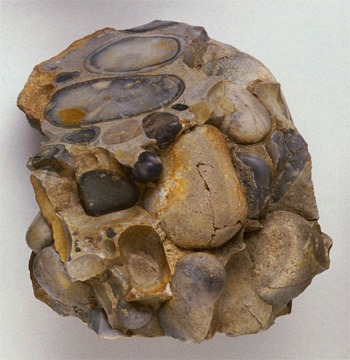
This rock formed when bits of other rocks became pressed into a solid. What type of rock is it?
a)
Sedimentary Rock
b)
Metamorphic Rock
c)
Igneous Rock
114.
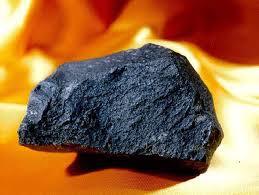
This rock was formed when magma cooled very slowly inside the Earth. What specific type of rock is it?
a)
Intrusive Igneous Rock
b)
Extrusive Igneous Rock
c)
Foliated Metamorphic Rock
d)
Clastic Sedimentary Rock
115.
This rock formed when lava cooled very quickly on Earth's surface. What specific type of rock is it?
a)
Extrusive Igneous Rock
b)
Intrusive Igneous Rock
c)
Non-Foliated Metamorphic Rock
d)
Biochemical Sedimentary Rock
116.
When you watch a volcano erupt molten rock, you are seeing _____
a)
Lava
b)
Magma
c)
Mineral Crystals
d)
Igneous Rocks
117.
When you are describing the sizes of the mineral grains in a rock, you are detailing the rock's _____
a)
Texture
b)
Composition
c)
Sedimentation
d)
Igneous-ness
118.
What are the 3 major types of rocks?
a)
Igneous, Metamorphic, Sedimentary
b)
Metamorphic, Igneous, Cementation
c)
Brown, Red, Gray
d)
Streak, Hardness, Breakage
119.
Two ways to describe types of igneous rocks are _____
a)
Extrusive and Intrusive
b)
Foliated and Non-Foliated
c)
Clastic and Biochemical
d)
Black and Gray
120.
What process is used to form sedimentary rocks?
a)
Lava cools and hardens to form a rock.
b)
Weathering, Erosion, Deposition, Compaction, Cementation
c)
Extreme heat and pressure from inside the Earth turn rocks into new rocks.
d)
Magma trapped under the Earth's surface cools and solidifies.
121.
Which of the words below describe broken up rock?
a)
stalactites
b)
magmas
c)
metamorphs
d)
sediments
122.
This rock was formed by smaller pieces of rock that settled at the bottom of a lake millions of years ago. What type of rock is this?
a)
Sedimentary
b)
Igneous
c)
Metamorphic
123.
This rock was found near the mouth of a volcano. What type of rock is this?
a)
Sedimentary
b)
Igneous
c)
Metamorphic
124.
When sediments are pressed together tightly, this is called ____________.
a)
Compaction
b)
Cementation
c)
Weathering
d)
Erosion
125.
The process in which sediment are fused or glued together.
a)
compaction
b)
deposition
c)
organic rock
d)
cementation
126.
What is deposition?
a)
Dropping off sediment
b)
Movement of sediment
c)
Breaking down of sediment 
127.
Which type of rock is formed from INTENSE heat and pressure?
a)
igneous
b)
sedimentary
c)
metamorphic
128.
Rock that forms when sediment from older rocks get pressed and cemented together.
a)
Sedimentary Rock
b)
Metamorphic Rock
c)
Igneous Rock
129.
The process by which igneous rocks are formed...
a)
heat and pressure
b)
melting and cooling
c)
weathering and erosion
130.
This rock was another type of rock that was heated and compressed over time. What type of rock is this?
a)
Sedimentary
b)
Igneous
c)
Metamorphic
131.
This rock started as molten magma. What type of rock is this?
a)
Sedimentary
b)
Igneous
c)
Metamorphic
132.
Cooling & crystalization produce
a)
igneous rocks
b)
metamorphic rocks
c)
sedimentary rocks
133.
True or False: Once a rock is sedimentary, it cannot become an igneous rock.
a)
True
b)
False
134.
What is the location on the surface, directly above the focus of an earthquake called?
a)
Epicenter
b)
Focus
c)
Centacenter
d)
Quintacenter
135.
What is the difference in aftershocks and foreshock?
a)
One comes before and one comes after
b)
Who is shock?
c)
One comes before the before
d)
One comes after the after
136.
The springing back of the rock into it's original place is known as...
a)
Kinetic Energy
b)
Potential Energy
c)
Elastic Rebound
d)
A Rupture
137.
Why is California so prone to Earthquakes?
a)
Its is along the San Andreas fault.
b)
There are a lot of people there.
c)
Greenhouse gases
d)
The Government
138.
What causes Earthquakes?
a)
Metamorphic rock composition
b)
Heat 
c)
Pressure along the Faults
d)
Aliens
139.
What is a P wave?
a)
Waves that bend matter, space and time.
b)
The 1st waves to arrive in an earthquake.
c)
Waves that form from tsunamis
d)
Waves that form from people
140.
The "S" in S wave means?
a)
Sight
b)
Superstitious
c)
Superposition
d)
Secondary
141.
What does a seismograph do?
a)
Measure the pressure along faults
b)
Measure the Force and Duration of earthquakes
c)
Measure the distances of faults
d)
A graph that shows all the earthquakes ever
142.
Tsunamis are caused by...
a)
Underwater Earthquakes
b)
Water vortexes that create waves
143.
A plane of weakness/a crack in the earth's surface
a)
Fault
b)
Crack
c)
Sever
d)
Opening
144.
Comes after Earthquakes
a)
Aftershocks
b)
Postshocks
c)
Secondary Shocks
d)
Immediateshocks
145.
Boundary created by two plates when they pull apart
a)
transform
b)
divergent
c)
convergent 
d)
epicenter
146.
Boundary when two plates slide against each other
a)
transform
b)
divergent
c)
convergent
d)
epicenter
147.
The bending or curving of earth's crust...
a)
folding
b)
bending
c)
curving
d)
sliding
148.
When a plate goes under another plate...
a)
subduction
b)
abduction
c)
suction
d)
transform
149.
The measurement of an earthquake's strength..
a)
magnitude
b)
focus
c)
seismograph
d)
epicenter
150.
What layer do earthquakes occur in?
a)
lithosphere
b)
mantle
c)
inner core
d)
outer core
151.
How old is the Earth?
a)
6.4 billion  years
b)
46 billion years
c)
64 billion years
d)
4.6 billion years
152.
What changes were caused by the break up of Pangaea?
a)
change in climates as landmasses moved closer or further from the equator
b)
new oceans formed
c)
new mountain ranges formed
d)
all of these were changes caused by the break up of Pangaea
153.
What is the Cenozoic Era often called?
a)
Age of mammals
b)
Age of dinosaurs
c)
Age of reptiles
d)
Age of fishes
154.
What type of animal lived ONLY during the Mesozoic Era?
a)
Mammals
b)
Birds and mammals
c)
Dinosaurs
d)
All of them
155.

First rock evidence of oxygen in the atmosphere?

a)

3.4 billion years ago

b)

2.4 billion years ago

c)

65 million years ago

d)

10 million years ago

156.
During the Paleozoic Era life exploded in what part of the Earth?
a)
Jungle
b)
Ocean
c)
Desert
d)
Rocks
157.
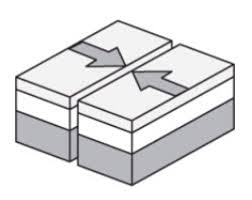
Name the boundary
a)
convergent boundary
b)
divergent boundary
c)
transform boundary
d)
sergent boundary
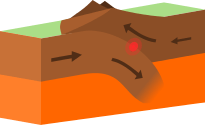
158.
Name the boundary
a)
convergent boundary
b)
divergent boundary
c)
transform boundary
d)
sergent boundary
159.
Name the boundary
a)
convergent boundary
b)
divergent boundary
c)
transform boundary
d)
sergent boundary
160.
Plate movement is caused by ______________.
a)
the rotation of the Earth
b)
ocean tides
c)
convection currents in the mantle
d)
the moon's gravity
161.
During sea floor spreading, molten material rises up from the mantle...
a)
along the continents
b)
at the mid ocean ridges
c)
at deep ocean trenches
d)
at north and south poles
162.
Which of the following occurs because of convection currents?
a)
Tectonic plates move.
b)
The mantle increases in size.
c)
Pressure in the crust increases.
d)
Pressure in the crust decreases.
163.
The mantle of Earth is made partly of magma. When magma rises and sinks, this is called ______________. 
a)
a conduction current
b)
a hot spot
c)
a volcanic eruption
d)
a convection current
164.
Which is true about hotter material in the mantle?
a)
more dense, sinks
b)
less dense, sinks
c)
less dense, rises
d)
more dense, rises
165.
The scientific theory that the Earth's crust is made of moving plates.
a)
quakes
b)
seismic
c)
plate tectonics
d)
rotation
166.
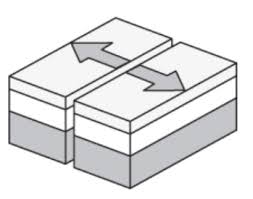
What type of plate boundary is this?
a)
Plate
b)
Divergent
c)
Convergent
d)
Transform
167.
Which of the following is NOT evidence to support the theory of plate tectonics?
a)
Fossils
b)
Mountains
c)
Glaciers
d)
Sand Erosion
168.
Oceanic Trenches are formed by _______ plate boundaries
a)
Convergent
b)
Transform
c)
Plate
d)
Divergent
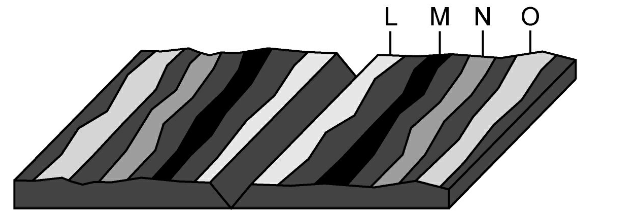
169.
Where would the oldest rock be found?
a)
L
b)
M
c)
N
d)
O
170.

What is the relative age of a rock?

a)

The age determined by the things around it.

b)

The age of an igneous rock.

c)

The age determined by radioactive dating.

d)

The time it takes for 1/2 of the radioactive atoms to decay in an element.

171.
As the Earth travels around the sun, this tilt causes different areas of the Earth’s surface to get different amounts of daylight at different times of the year. The angle of the Sun’s rays to the surface also causes areas to have more or less of the Sun’s energy. This causes the ________.
a)
months
b)
day and night
c)
seasons
d)
years
172.
Why does the area around the equator stay the same temperature all year?
a)
The equator rotates slower than the poles 
b)
The equator remains the same distance from the sun.
c)
The equator always receives direct sunlight.
d)
The equator has 18 hour days.
173.
What happens when the area in which you live tilts away from the sun?
a)
It is summer.
b)
It is spring.
c)
It is winter.
d)
It is fall.
174.
According to the law of superposition, the oldest fossils are found 
a)
At the top of the rock layers
b)
Near the bottom of the rock layers
c)
In the middle of the rock layers
d)
Somewhat near the surface
175.
What role do faults play in the Law of Superposition?
a)
Faults create new types of rock.
b)
Faults are younger than the layers they cut through.
c)
Faults are the same age as the layers they cut through.
176.

What are the four isotopes that allow the earth to have a slight simmer?

a)

uranium-200 (200U), uranium-5 (U), thor-232 (232Th), and potassium-40 (40K)

b)

uranium-238 (238U), uranium-235 (235U), thorium-232 (232Th)

c)

uranium-238 (238U), uranium-235 (235U), thorium-232 (232Th), and potassium-40 (40K)

d)

uranium-238 (238U), ura-235 (235U), thor-232 (232Th), and potassium-40 (40K)