
 Worksheets
Chromosomes, Cell Division, Mendelian Genetics
Total questions: 69
Worksheet time: 6hrs 21mins
Name
Class
Date
1.
Rod-shaped structures made up of proteins and DNA are called:
a)
Centromeres
b)
Chromosomes
c)
Histones
d)
DNA
2.

Number 2 is:
a)
Chromatid
b)
Chomatin
c)
Centrosome
d)
Centromere
3.
Number 1 is:
a)
Chromatid
b)
Chomatin
c)
Centrosome
d)
Centromere
4.
Sister chromatids mean:
a)
Chromatids are alike
b)
Chromatids are not alike
5.
Which of the following is NOT true about haploid cells.
a)
Haploid cells only have half of the chromosomes of an individual
b)
Haploid cells consist of sperm and egg cells
c)
A fertilized egg or zygote is an example of a haploid cell
d)
All sex cells are haploid
6.
Which of the following is NOT a correct relationship of DNA, Genes, and Chromosomes
a)
Chromosomes and genes make up DNA.
b)
DNA wraps around histones to make chromosomes
c)
Genes are segments found on chromsomes.
d)
Sections of DNA are called Genes
7.
The result of cell division is:
a)
2 genetically identical haploid cell
b)
2 genetically identical diploid cells
c)
2 genetically different haploid cells
d)
2 genetically different diploid cells
8.

The lines on the structure are:
a)
Chromosomes
b)
DNA
c)
Genes
d)
None of the above
9.
Your genes will come from
a)
Dad only
b)
Mom only
c)
Half from Dad, half from Mom
d)
Depends
10.

What is a gene?
a)
several chromosomes bonded together
b)
something inside the nucleus
c)
a piece of DNA that codes for a trait
d)
all of your DNA
11.
What are structures found in cells that are found as pairs and carry your genes?
a)
Chromosomes
b)
DNA
c)
Alleles
d)
RNA
12.
Humans have how many chromosomes in our body cells?
a)
2
b)
23
c)
46
d)
92
13.
Why are genes important to living organisms?
a)
They can be passed on to offspring
b)
They can code for how your body will function
c)
They will code for all of your inheritable traits
d)
All of the above
14.
What is one of the many versions of a gene known as?
a)
DNA
b)
Allele
c)
Chromosome
d)
Genome
15.
What is the end result of mitosis?
a)
2 genetically identical cells
b)
2 genetically similar cells
c)
4 genetically identical cells
d)
4 genetically similar cells
16.

Fruit fly body cells have 8 chromosomes. After mitosis, you would expect a resulting fruit fly daughter cell to have ...
a)
16 chromosomes.
b)
46 chromosomes.
c)
8 chromosomes.
d)
4 chromosomes.
17.

What process, and which type of resulting cells are represented?
a)
mitosis, sex cells (gametes)
b)
mitosis, body cells
c)
meiosis, sex cells (gametes)
d)
meiosis, body cells
18.
Why do we need meiosis?
a)
To double the number of chromosomes going into sex cells
b)
To halve the number of chromosomes going into sex cells
c)
To triple the number of chromosomes going into sex cells
d)
To not change the number of chromosomes going into sex cells
19.
How many daughter cells are produced at the end of meiosis?
a)
1
b)
2
c)
3
d)
4
20.
Meiosis makes sperm and egg cells. In humans, sperm and egg cells each have _____ chromosomes. Therefore a fertilized human egg cell (sperm and egg cell combined) would create a cell with _____ chromosomes.
a)
23, 46
b)
46, 23
c)
2, 4
d)
50, 100
21.

How many pairs of chromosomes does this dog have?
a)
37
b)
38
c)
39
d)
40
22.
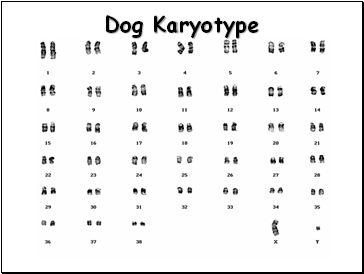
How many chromosomes would this dog have in a sex cell (gamete)?
a)
2
b)
39
c)
40
d)
not enough information given
23.
If a sexually reproducing organism has 28 chromosomes in its body cells, how many chromosomes did it inherit from each parent?
a)
7
b)
14
c)
16
d)
28
24.
Which statement correctly describes a type of cell division?
a)
Mitosis involves one cell division that produces four cells
b)
Meiosis involves one cell division that produces two cells
c)
Mitosis involves two cell divisions that produce two cells
d)
Meiosis involves two cell divisions that produce four cells
25.
Which of these choices describes a segment of DNA that determines a specific trait in a person, such as attached earlobes
a)
A gene
b)
A phenotype
c)
A chromosome
d)
A characteristic
26.
Which statement correctly describes a difference between asexual and sexual reproduction?
a)
Asexual reproduction increases genetic diversity, but sexual reproduction does not
b)
Asexual reproduction involves one parent, and sexual reproduction involves two parents
c)
Asexual reproduction increases a species chances of surviving unfavorable conditions, but sexual reproduction does not
d)
The offspring produced by asexual reproduction are not identical to each other, but those of sexual reproduction are identical to each other
27.
In what way are the processes of sexual and asexual reproduction alike?
a)
Both produce offspring
b)
Both require two parents
c)
Both produce genetically identical offspring
d)
Both require fertilization
28.
What mutation has occurred here?
T-G-A-C-C-A
T-G-A-G-C-A
T-G-A-C-C-A
T-G-A-G-C-A
a)
Substitution
b)
Deletion
c)
Insertion
d)
Frameshift
29.
Are all mutations bad?
a)
Yes
b)
No
30.
Any change in the sequence of DNA is...
a)
transgenic shift
b)
Single Genotype
c)
Monohybrid Trait
d)
Mutation
31.
DNA molecule segment is : TTACGCAAG
The mutated DNA segment is TTACGCAAC. This is an example of ___ mutation.
The mutated DNA segment is TTACGCAAC. This is an example of ___ mutation.
a)
Substitution
b)
Insertion
c)
Inversion
d)
Translocation
32.
Which organelle is DNA usually found in?
a)
cell membrane
b)
vacuole
c)
chloroplast
d)
nucleus
33.
What is a codon?
a)
It is a three letter section of bases that are read by ribosomes to stamp amino acids into a protein
b)
They are the codes on the DNA (hence "code-on"
c)
It is a type of mutation that occurs when there has been a substitution, deletion or insertion.
d)
It is a made up word for this quiz. Nice try, Wampler.
34.
What are the building blocks of proteins called?
a)
DNA
b)
RNA
c)
Ribosomes
d)
Amino Acids
35.
Why are insertion and deletion (frameshift) mutations so harmful?
a)
They change all of the codons from the mutation on down the line, which changes the amino acid sequence
b)
They insert things that an organism doesn't need.
c)
They often delete things that organisms need.
d)
Insertion and deletions are not any more harmful than substitution mutations.
36.
Why is the order of amino acids so important?
a)
The order of amino acids dictates what shape the protein will fold into.
b)
It is not important. The protein folding chamber will force the protein to fold into the correct shape.
37.
ATTTGAGCC- Original
ATTGAGCC - Mutated
The example above is an example of a
ATTGAGCC - Mutated
The example above is an example of a
a)
Insertion- Frameshift
b)
Deletion- Substitution
c)
Deletion -Frameshift
d)
All of the above
38.
DNA molecule segment is : TTACGCAAG
The mutated DNA segment is TTCGCAAG. This is an example of ___ mutation.
The mutated DNA segment is TTCGCAAG. This is an example of ___ mutation.
a)
Substitution
b)
Deletion
c)
Insertion
d)
Inversion
39.
DNA molecule segment is : TTACGCAAG
The mutated DNA segment is TTACGCAAC. This is an example of ___ mutation.
The mutated DNA segment is TTACGCAAC. This is an example of ___ mutation.
a)
Substitution
b)
Insertion
c)
Inversion
d)
Translocation
40.
In DNA, Adenine bonds with ______________.
a)
Guanine
b)
Thymine
c)
Cytosine
d)
Adenine
41.
Guanine bonds with ______________.
a)
Adenine
b)
Guanine
c)
Cytosine
d)
Thymine
42.

What molecule is shown in the double helix diagram shown?
a)
DAN
b)
RAN
c)
DNA
d)
RNA
43.
If you are a boy, what percent of your genes did you get from your dad?
a)
25%
b)
50%
c)
75%
d)
100%
44.
Would a mutation in the DNA of a skin cell be passed on to an organism's offspring?
a)
Yes, because any change to the DNA is passed on to the offspring
b)
Maybe. Sex cells only use half of the body's genetic code. It might get the copy of a gene that wasn't mutated.
c)
No. Only mutations that occur in the gametes (sex cells) are passed on to the offspring
d)
Without knowing the animal, it would be hard to tell whether or not the mutation would be passed on.
45.
Which of these bases does not exist in RNA?
a)
C
b)
T
c)
U
d)
A
46.
Which RNA bases would pair with TACGAA in transcription?
a)
AUGCUU
b)
ATGCTT
c)
GCATCC
d)
GCAUCC
47.

Which amino acid is made from the RNA codon ACC?
a)
Tyrosine
b)
Isoleucine
c)
Threonine
d)
Valine
48.

Using the codon chart here or at your table to identify the amino acid sequence:
AUG-CCA-GUA-GGG-UAA
AUG-CCA-GUA-GGG-UAA
a)
MET-HIS-ALA-GLY-STOP
b)
MET-PRO-GLY-VAL-STOP
c)
MET-PRO-VAL-GLY-STOP
d)
MET-THR-SER-ASP-STOP
49.
Who is considered the "Father of Genetics?"
a)
James Watson
b)
Francis Crick
c)
Gregor Mendel
d)
Albert Einstein
50.
Gregor Mendel's "P" Generation consisted of plants which were ______________ with opposite traits.
a)
Purebred
b)
Hybrid
c)
Heterozygous
d)
Incompletely Dominant
51.
All offspring plants in the F1 generation were purple because purple is the ______________ trait.
a)
Heterozygous
b)
Homozygous
c)
Dominant
d)
Recessive
52.
Gregor Mendel's "P" generation consisted of purple flower plants crossed with white flower plants. What were the results of this cross?
a)
All purple flower offspring
b)
All white flower offspring
c)
Some purple flowers and some white flowers
53.
Which of the following best explains the results of letting the F1 purple hybrids self pollinate?
a)
100% Purple
b)
100% White
c)
50% Purple, 50% White
d)
75% Purple, 25% White
54.
A __________ is a segment of DNA that codes for a particular protein, which leads to a particular trait.
a)
Gene
b)
Allele
c)
Codon
d)
Nucleotide
55.
The different forms of a gene are known as _____________.
a)
Codons
b)
Proteins
c)
Alleles
d)
Nucleotides
56.
How many alleles do you get from each parent?
a)
1
b)
2
c)
23
d)
46
57.
Which of Mendel's laws states that alleles are separated during meiosis?
a)
Law of Dominance
b)
Law of Segregation
c)
Law of Independent Assortment
d)
Law of Meiosis
58.
According to the Law of Segregation, alleles are separated during the process of _____________.
a)
Mitosis
b)
Meiosis
c)
Osmosis
d)
Translation
59.
Which of the following best describes a GENOTYPE?
a)
The allele/genetic makeup of an organism.
b)
The physical expression of a trait.
60.
Which of the following is an example of a GENOTYPE?
a)
25%
b)
Blue
c)
1:2:1
d)
Bb
61.
Which of the following is an example of a PHENOTYPE?
a)
25%
b)
Blue
c)
1:2:1
d)
Bb
62.
Which of the following is an example of a homozygous dominant genotype?
a)
RR
b)
Rr
c)
rr
63.
Which of the following is an example of a homozygous recessive genotype?
a)
RR
b)
Rr
c)
rr
64.
Which of the following is an example of a heterozygous genotype?
a)
RR
b)
Rr
c)
rr
65.

What is the FUNCTION of the visual tool seen in the image?
a)
Identifies the location of a gene.
b)
Determines the DNA sequence of an organism.
c)
Predicts the possible results of a genetic cross.
d)
Tests for the presence of dominant alleles.
66.

The letters on the TOP AND SIDE of a punnett square represent ______________.
a)
The combination of alleles in offspring.
b)
The possible alleles given by the parents following meiosis.
c)
The genotype and phenotype of offspring.
d)
The results of genetic mutations in offspring.
67.
Geneticists use ___________ to represent _____________, the different forms of a gene.
a)
Numbers ; Alleles
b)
Letters ; Factors
c)
Letters ; Alleles
d)
Numbers ; Factors
68.
If a person has a genotype of RR, what do you know about their gametes (sex cells)?
a)
They will all carry the R allele.
b)
They will all carry RR.
c)
Some will carry R, some will carry r.
d)
They will all carry the r allele.
69.
If a person has a genotype of Rr, what do you know about their gametes (sex cells)?
a)
They will all carry the R allele.
b)
They will all carry Rr.
c)
Some will carry R, some will carry r.
d)
They will all carry the r allele.
100 %

