Worksheets
Biological Classification
Total questions: 36
Worksheet time: 23mins

Which of the following lists linnaean taxa in the correct order from general to specific?
phylum, order, family, genus
class, order, species, genus
kingdom, order, class, phylum
family, phylum, genus, species

The name "Canis lupis" is an example of
kingdom and phylum
phylogeny
binomial nomenclature
a common name

Who is responsible for the first ever classification system?
Hooke
Linnaeus
Darwin
Aristotle

On the cladogram above, which letter represents the development of wings?
A
B
C
F
G

Which of the following organisms is most closely related to Panthera leo?
Canis familiaris
Ursus americanus
Felis domesticus
Panthera tigris

Animals in the same class MUST be in the same genus.
True
False

Animals in the same phylum MUST be in the same kingdom
True
False

Animals in the same family MUST be in the same class
True
False

Prokaryotic cells that are characterized by their ability to survive extreme conditions are classified as
eukaryotes
fungi
protists
archaea

One limitation of the Linnaean classification system is that it
does not use organisms' common names
is based on physical characteritics alone
allows scientists to discuss organisms
organizes organisms into groups

Which of the following taxa would generally contain the MOST members?
species
class
phylum
order

Which of the following list the 3 DOMAINS accepted by most scientists?
Archaea, Prokaryotes, Eukaryotes
Bacteria, Fungi, Protista
Eukarya, Archaea, Bacteria
Bacteria, Protista, Eukaryotes

Who created the classification system we still use today?
Linnaeus
Copernicus
Leeuwunhoek
Aristotle

Which statement best distinguishes eukaryotes from prokaryotes?
Eukaryotes all have cell walls.
Eukaryotes are photosynthetic.
Eukaryotes have a nucleus.
Eukaryotes may be uni-cellular.

The correct order for the levels of Linnaeus's classification system, from most general to most specific is
phylum, kingdom, family, class, order, genus, species
kingdom, phylum, class, order, family, genus, species
species, genus, kingdom, family, order, class, phylum
kingdom, species, class, order, family, genus, phylum

Scientific names are made up of the _________ and _________.
family and genus
genus and species
kingdom and phylum
class and order
The branch of Biology that studies the classification of living organisms is called
cytology
taxidermy
taxonomy
zoology

Organisms are named and classified based on physical characteristics from LEAST amount of characteristics to MOST amount of characteristics in what type of illustration?
cladogram
molecular clock
Linnaean taxonomy
evolutionary trees

Which of the following are not found in Domain Eukarya?
Protists like paramecium
mushrooms
streptococcus bacteria
oak trees

Animals, plants, protists and fungus are all found in Domain
Archaea
Bacteria
Eukarya

Which of the above images shows bacillus bacteria?
Left
Middle
Right
Which of the above images shows coccus bacteria?
Left
Middle
Right
If the above bacteria on the left was found in long chains, what prefix would be in front of the name?
diplo
staphylo
strepto
If the above bacteria on the left was found in clusters, what prefix would be in front of the name?
diplo
staphylo
strepto
Which of the above images shows spirillum bacteria?
Left
Middle
Right

Which of the following traits would you find at location A?
Wings
Antenna
Segments

Which of the following traits would you find at location B?
Wings
Antenna
Segments

Which of the following traits would you find at location C?
Wings
Antenna
Segments

Some orders of land and marine mammals are closely related. Molecular data recently collected from dolphins, camels, deer and hippopotamuses have shown that hippopotamuses are the closest living relatives of dolphins. Which cladogram in the image models this evolutinary relationship?


If the above bacteria on the left was found in clusters, what prefix would be in front of the name?
diplo
staphylo
strepto
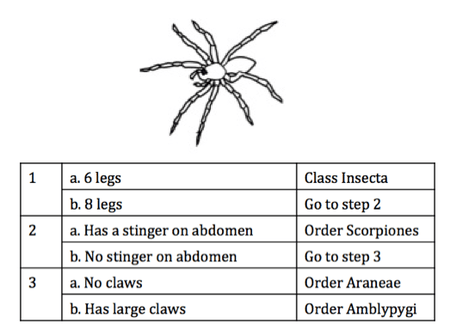

arachnids and insects?
following observations of the plant’s characteristics would be useful in determining its identity with a dichotomous key?