
 Worksheets
Quarter 1 Extra Credit
Total questions: 105
Worksheet time: 2hrs 47mins
Name
Class
Date
1.
Proteins are made of monomers called ___________
a)
Nucleotides
b)
Monosaccharides
c)
Amino Acids
d)
Glycerol and fatty acids
2.
_________ are composed out of carbon (C), hydrogen (H), oxygen (O), nitrogen (N), and phosphorus (P)
a)
Carbohydrates
b)
Lipids
c)
Proteins
d)
Nucleic Acids
3.
DNA and RNA are examples of
a)
Carbohydrates
b)
Lipids
c)
Proteins
d)
Nucleic Acids
4.
Nucleotides are monomers of
a)
Carbohydrates
b)
Lipids
c)
Proteins
d)
Nucleic Acids
5.
Monosaccharides are monomers of
a)
Carbohydrates
b)
Lipids
c)
Proteins
d)
Nucleic Acids
6.
Waxes, oils and fats are examples of
a)
Carbohydrates
b)
Lipids
c)
Proteins
d)
Nucleic Acids
7.

Which macromolecule is shown?
View Figure 2 (if not visible)
View Figure 2 (if not visible)
a)
lipid
b)
protein
c)
nucleic acid
d)
carbohydrate
8.

Which macromolecule is shown?
View Figure 3 (if not visible)
View Figure 3 (if not visible)
a)
lipid
b)
protein
c)
nucleic acid
d)
carbohydrate
9.

Which macromolecule is shown?
View Figure 4 (if not visible)
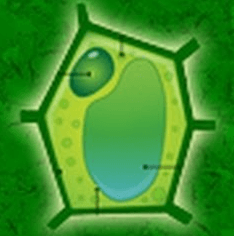
View Figure 4 (if not visible)
a)
lipid
b)
protein
c)
nucleic acid
d)
carbohydrate
10.

Photosynthesis involves the production of sugar and oxygen. Select the drawing that shows a carbohydrate that is formed in photosynthesis.
a)
A
b)
B
c)
C
d)
D
11.

Which macromolecule is shown?
View Figure 1 (if not visible)
View Figure 1 (if not visible)
a)
lipid
b)
protein
c)
nucleic acid
d)
carbohydrate
12.

A water strider can skate along the top of a pond because:
a)
covalent bonds result in water cohesion
b)
hydrogen bonds result in water cohesion (surface tension)
c)
water striders have adapted to take advantage of water cohesion
d)
low surface tension of water
13.
Water is polar because...
a)
The unequal sharing of electrons gives the water molecule a slight negative charge near its oxygen atom and a slight positive charge near its hydrogen atoms.
b)
The molecule has two poles, at which the it is colder than other regions of the molecule.
c)
The unequal sharing of electrons gives the water molecule a slight negative charge near its hydrogen atoms and a slight positive charge near its oxygen atom.
d)
The water molecule is neutral.
14.

Water is known as the universal solvent.
a)
True
b)
False
15.

tendency of molecules of the same kind to stick to one another
a)
cohesion
b)
adhesion
c)
solution
d)
polar molecule
16.

molecule in which opposite ends have opposite electric charges
a)
cohesion
b)
polar molecule
c)
hydrogen bond
d)
solution
17.

In Florida, daytime and nighttime temperatures usually only differ by 5 to 10°C, while temperatures in the desert often differ by as much as 40°C. What role does water play in keeping temperatures in Florida from fluctuating dramatically?
a)
Bodies of water store heat during the day and release it at night which keeps temperatures steady
b)
Humid air releases heat as it rises, keeping temperatures constant
c)
Evening rain brings heat from the upper atmosphere back to Earth
d)
Water cools the land around it so that it never gets as hot as a desert.
18.

What property of water allows water to travel up the stems of plants in a process called capillary action?
a)
Adhesion
b)
Cohesion
c)
Both
19.
Which of the following structure can be found in a plant cell but NOT an animal cell?
a)
vacuole
b)
nucleus
c)
chloroplast
d)
mitochondria
20.
Which of the following is a correct list of structures found in both plant AND animal cells?
a)
mitochondria, vacuole, nucleus, cell membrane, cytoplasm
b)
mitochondria, vacuole, nucleus, cell membrane, cytoplasm, cell wall, chloroplasts
c)
mitochondria, vacuole, nucleus, cell membrane, cell wall, chloroplasts
d)
mitochondria, vacuole, nucleus, cell membrane, cell wall
21.
Which of the following does a bacteria cell NOT have in common with a plant cell?
a)
cytoplasm
b)
cell membrane
c)
genetic material (DNA)
d)
nucleus
22.
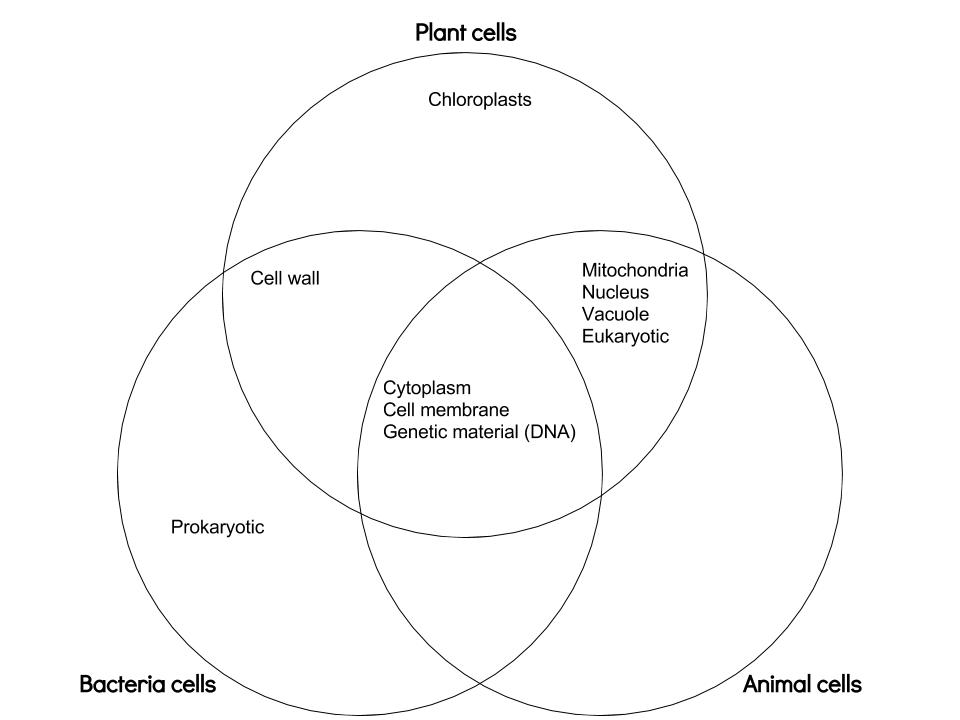
Observe the Venn diagram. Which structures do both prokaryotic and eukaryotic cells have in common?
a)
cell membrane, cytoplasm, genetic material (DNA)
b)
cell wall
c)
mitochondria, nucleus, vacuole
d)
chloroplasts
23.
gives support and shape to some cells
a)
Cell Wall
b)
Cytoskeleton
c)
Cell Membrane
d)
Nuclear Membrane
24.
Controls what passes in and out of the cell
a)
Cell Membrane
b)
Vacuole
c)
Ribosome
d)
Lysosome
25.

What is the main difference and function between the plant cell and animal cell?
a)
chloroplast vacuole and cell wall
b)
nucleus
c)
cytoplasm
d)
cell membrane
26.

Four students examined the cells and made the following observations:
Student 1: Cell 1 is a plant cell because it has a cell wall
Student 2: Cell 2 is an animal cell because it has a nucleus
Student 3: Cell 1 is a plant cell because it has chloroplasts
Student 4: Cell 2 is an animal cell because it has a cell membrane
Who is correct?
Student 1: Cell 1 is a plant cell because it has a cell wall
Student 2: Cell 2 is an animal cell because it has a nucleus
Student 3: Cell 1 is a plant cell because it has chloroplasts
Student 4: Cell 2 is an animal cell because it has a cell membrane
Who is correct?
a)
Student 1 and Student 2
b)
Student 2 and Student 3
c)
Student 1 and Student 3
d)
Student 2 and Student 4
27.
Makes proteins for the cell, can be found attached to the endoplasmic reticulum or free in the cytoplasm
a)
Cell Wall
b)
Golgi Body
c)
Ribosome
d)
Cytoplasm
28.
Which type of cell is bigger?
a)
Prokaryotic
b)
Eukaryotic
29.

Which type of cell?
a)
Prokaryote
b)
Eukaryote
30.

Which type of cell?
a)
Prokaryote
b)
Eukaryote
31.
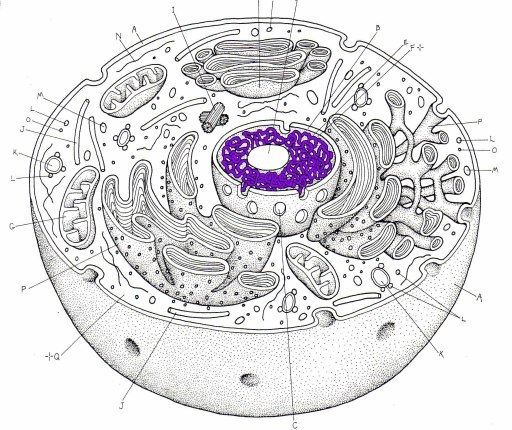
What kind of cell is this?
a)
Eukaryotic
b)
Prokaryotic
32.
Which of the following is a characteristic of both Eukaryotic and Prokaryotic cells?
a)
ribosomes
b)
nucleus
c)
membrane bound organelles
d)
simple
33.
Which of the following is NOT one of the three parts of Cell Theory?
a)
All living things are made of cells.
b)
The cell is the smallest living thing that can perform all the functions of life.
c)
Cells are too small to see without a microscope.
d)
All cells must come from pre-existing cells.
34.

A male shark has 40 chromosomes in each of its sperm. How many would be present in its sex cells?
a)
20
b)
40
c)
80
d)
160
35.

A male shark has 40 chromosomes in each of its sperm. How many would be present in its body cells?
a)
20
b)
40
c)
80
d)
160
36.

Meiosis makes sperm and egg cells. In humans, sperm and egg cells each have _____ chromosomes. Therefore a fertilized human egg cell (sperm and egg cell combined) would create a cell with _____ chromosomes.
a)
23, 46
b)
46, 23
c)
2, 4
d)
50, 100
37.
The purpose of meiosis is to form ________ cells.
a)
body
b)
sex
c)
somatic
d)
brain
38.
Crossing over helps promote
a)
male genotype
b)
genetic variation
c)
DNA replication
d)
mitosis
39.

When an area of a chromatid is exchanged with the matching area on a chromatid of its homologous chromosome, _________________ occurs
a)
crossing over
b)
mutagenesis
c)
hybridization
d)
fertilization
40.
Process needed for growth and injury repair
a)
Mitosis
b)
Meiosis
c)
Both Mitosis and Meiosis
41.
Diploid --> Diploid
a)
Mitosis
b)
Meiosis
c)
Both Mitosis and Meiosis
42.
If a parent cell has 88 chromosomes, following MEIOSIS, the daughter cells will have ___ chromosomes.
a)
42
b)
88
c)
Impossible to know
43.

Why would it be important to replicate DNA before a cell divides in mitosis or meiosis?
a)
In order for genetic information to be transferred into daughter cells.
b)
In order for the cell to be able to increase in size.
c)
In order for the DNA to be contained in the nucleus.
d)
In order for the cell to re-order the DNA sequencing in the new cells.
44.
Where does a cell contain it's genetic material?
a)
nucleus
b)
nucleolus
c)
cytoskeleton
d)
golgi
45.
What phase is a cell in if the chromosomes are moving away to opposite ends of the cell?
a)
Anaphase
b)
Metaphase
c)
Prophase
d)
Telophase
46.
The result of meiosis is:
a)
two diploid cells
b)
two haploid cells
c)
four diploid cells
d)
four haploid cells
47.
Human eggs and sperm are _____, and each has ____ chromosomes.
a)
diploid, 23
b)
diploid, 46
c)
haploid, 23
d)
haploid, 46
48.
type of reproduction of meiosis
a)
sexual
b)
asexual
49.
Goes through P.M.A.T two rounds
a)
Mitosis
b)
Meiosis
c)
Osmosis
d)
Transcription
50.

Fruit fly body cells have 8 chromosomes. After mitosis, you would expect a resulting fruit fly daughter cell to have ...
a)
16 chromosomes.
b)
46 chromosomes.
c)
8 chromosomes.
d)
4 chromosomes.
51.
Uncontrolled mitosis is
a)
cancer
b)
meiosis
c)
p53
d)
mitosis
52.

This picture shows which process?
a)
mitosis
b)
meiosis
c)
the cell cycle
53.
All cells are produced ____________.
a)
from nothing
b)
from other cells
54.
All organisms are made of:
a)
organelles
b)
cytoplasm
c)
DNA
d)
cells
55.
Those organisms that are made of more than 2 cells are referred to as ___________________.
a)
unicellular
b)
multicellular
c)
colonized
d)
Michael Jackson
56.
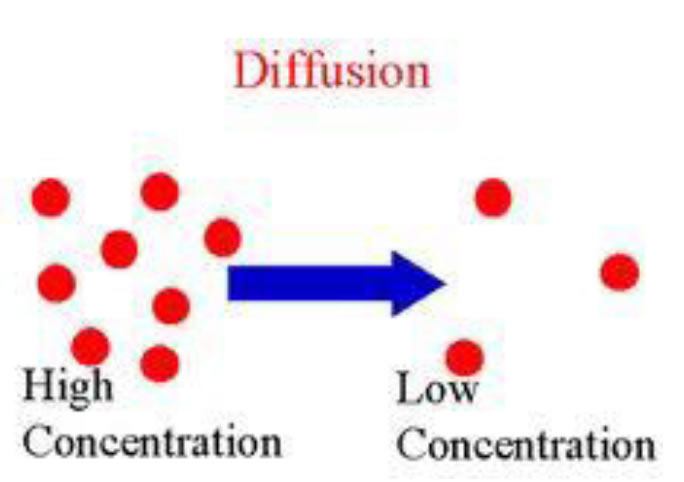
Movement of particles from high to low concentration.
a)
Passive Transport
b)
Active Transport
57.
Osmosis is a form of ______________.
a)
Passive Transport
b)
Active Transport
58.
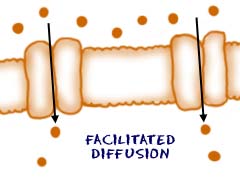
a)
Passive Transport
b)
Active Transport
59.
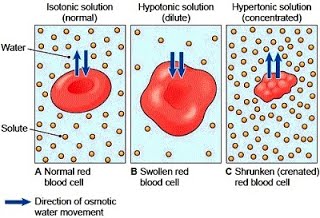
a)
Passive Transport
b)
Active Transport
60.
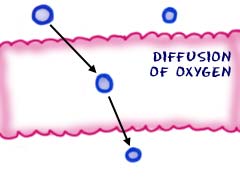
a)
Passive Transport
b)
Active Transport
61.
Solutes move with the concentration gradient, therefore no energy is used.
a)
Passive Transport
b)
Active Transport
62.

a)
Passive Transport
b)
Active Transport
63.
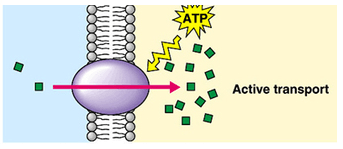
ATP is a form of energy.
a)
Passive Transport
b)
Active Transport
64.
Low to High
a)
Passive Transport
b)
Active Transport
65.
Uses ATP (energy)
a)
Passive Transport
b)
Active Transport
66.
What is it called when molecules move across the cell membrane from an area of high concentration to an area of low concentration through a carrier protein?
a)
Diffusion
b)
Osmosis
c)
Active Transport
d)
Facilitated Diffusion
67.

The cell below is in a _________ solution.
(Figure 5)
(Figure 5)
a)
Hypotonic
b)
Hypertonic
c)
Isotonic
68.

The cell below is in a _____________ solution.
(Figure 4)
(Figure 4)
a)
Hypertonic
b)
Hypotonic
c)
Isotonic
69.
A cell in an isotonic solution will
a)
swell
b)
shrink
c)
stay the same size
d)
impossible to tell
70.
A cell in a hypotonic solution will
a)
swell
b)
shrink
c)
stay the same size
d)
impossible to tell
71.
The most important organelle in cell transport
a)
E.R.
b)
cytoplasm
c)
nucleus
d)
cell membrane
72.
what are two types of passive transport?
a)
endo and exocytosis
b)
cookies and milk
c)
active and passive
d)
Osmosis and diffusion
73.

Protein...
a)
A
b)
B
c)
C
d)
D
74.

The picture below is an example of _________________.
a)
osmosis
b)
isotonic
c)
diffusion
d)
active transport
75.

A solvent is...
a)
substance into which the solute dissolves
b)
a compound being dissolved
c)
a substance that does not dissolve
d)
None of the above
76.
The chemical compound of water is
a)
HO
b)
H2O
c)
H3O
d)
HO2
77.

What two elements make up water?
a)
Helium and oxygen
b)
Hydrogen and oxygen
c)
helium and carbon
d)
oxygen and carbon
78.

What word describes when water is attracted to other substances?
a)
cohesion
b)
adhesion
c)
capillary action
d)
surface tension
79.
Water is known as the universal solvent.
a)
True
b)
False
80.

A molecule with electrically charged areas is called a _______________.
a)
magnet
b)
polar molecule
c)
solution
d)
electrical molecule
81.
tendency of molecules of the same kind to stick to one another
a)
cohesion
b)
adhesion
c)
solution
d)
polar molecule
82.
Many fish and aquatic plants can survive a cold winter because the layer of ice that forms at the top of the lake insulates the water below and prevents the lake from freezing solid. What unique property of water contributes to this effect?
a)
Water absorbs heat when it evaporates and forms a gas
b)
Water expands and becomes less dense when it freezes.
c)
Water molecules completely separate into ions in solutions.
d)
Water forms hydrogen bonds with ions and other polar substances.
83.
Water is often called the "universal solvent" because many substances can be dissolved in water. What property of water allows it to be such a versatile solvent?
a)
purity
b)
polarity and cohesion
c)
high heat capacity
d)
expansion upon freezing
84.
Water is essential for life. Its special properties make water the single most important molecule in plant life. Which of the following properties of water enables it to move from the roots to the leaves of plants?
a)
Water expands as it freezes.
b)
Water is an excellent solvent.
c)
Water exhibits cohesive behavior.
d)
Water is able to moderate temperature.
85.
In Florida, daytime and nighttime temperatures usually only differ by 5 to 10°C, while temperatures in the desert often differ by as much as 40°C. What role does water play in keeping temperatures in Florida from fluctuating dramatically?
a)
Bodies of water store heat during the day and release it at night which keeps temperatures steady
b)
Humid air releases heat as it rises, keeping temperatures constant
c)
Evening rain brings heat from the upper atmosphere back to Earth
d)
Water cools the land around it so that it never gets as hot as a desert.
86.
What property of water allows water to travel up the stems of plants in a process called capillary action?
a)
Adhesion
b)
Cohesion
c)
Both
87.

Using this image, what organelle is C?
a)
Cell Wall
b)
Mitochondria
c)
Large Cell Vacuole
d)
Chloroplast
88.

I store water in both plant and animal cells. What am I?
a)
cytoplasm
b)
ribosomes
c)
vacuole
d)
lysosomes
89.
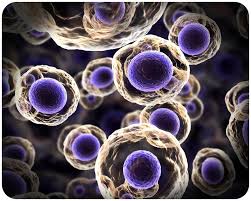
The two kinds of cells are Prokaryotes and Eukaryotes. How are they different?
a)
Prokaryotes have a nucleus.
b)
Eukaryotes have a nucleus.
c)
Prokaryotes are plant cells.
d)
There is no difference.
90.

What cell part is NOT found in all cells?
a)
Cell Wall
b)
Cell Membrane
c)
Cytoplasm
d)
Genetic Material
91.

Complex cell. Can be plant or animal. Contains membrane bound organelles.
a)
Eukaryotic Cell
b)
Prokaryotic Cell
c)
Bacteria
d)
Blood cell
92.
This organelle takes food and turns it into ENERGY for plant and animal cells.
a)
Chloroplast
b)
Mitochondria
c)
Lysosome
d)
Ribosome
93.

Which part of the cell is often called "the brain of the cell"?
a)
nuclear membrane
b)
endoplasmic reticulum
c)
nucleus
d)
mitochondria
94.
A rigid layer that lies outside the cell's membrane is...
a)
Cytoskeleton
b)
Cilia
c)
Cell Wall
d)
Flagella
95.
What organelle is called the "powerhouse" of a cell?
a)
Endoplasmic Reticulum
b)
Nucleus
c)
Mitochondria
d)
Nucleolus
96.

What is the chromosomal condition of the individual whose karyotype is seen in the image?
a)
Trisomy 21 (Down's Syndrome)
b)
Trisomy 13 (Patau Syndrome)
c)
Trisomy 18 (Edward's Syndrome)
d)
XXY Sex Chromosomes (Klinefelter's Syndrome)
97.

a)
This karyotype shows Trisomy 21
b)
This karyotype has no abnormality
c)
This karyotype is missing a sex chromosome
d)
This karyotype is from a gamete
98.

Which process and type of resulting cells are represented?
a)
mitosis, gametes
b)
mitosis, body cells
c)
meiosis, gametes
d)
meiosis, body cells
99.
Which of these cells would be produced through meiosis?
a)
skin cells
b)
liver cells
c)
brain cells
d)
sperm cells
100.
Which sex chromosomes would indicate a typical human male?
a)
XX
b)
X
c)
XY
d)
XXY
101.

Fruit fly body cells have 8 chromosomes. After meiosis, you would expect a resulting fruit fly daughter cell to have ...
a)
16 chromosomes.
b)
46 chromosomes.
c)
8 chromosomes.
d)
4 chromosomes.
102.

The stages of mitosis in order
a)
Metaphase, Anaphase, Prophase, Telophase
b)
Prophase, Anaphase, Metaphase, Telophase
c)
Prophase, Metaphase, Anaphase, Telophase
d)
Anaphase, Prophase, Telophase, Metaphase
103.
90% of the cell's life is spent during what stage?
a)
Prophase
b)
Anaphase
c)
Metaphase
d)
Interphase
104.
Chormatids are found in
a)
Meiosis I
b)
Meiosis II
105.
Homologous Chromosomes are found in
a)
Meiosis I
b)
Meiosis II
100 %

