
NEW
Font size
S
M
L
XL
 Worksheets
Chapter 4 Atomic Hist, Struct, Electron Config, Valence, Quantum
Total questions: 73
Worksheet time: 3575secs
Name
Class
Date
1.
Which particle has a positive charge?
a)
electron
b)
orbital
c)
proton
d)
neutron
2.
Choose the particle that has no charge.
a)
nucleus
b)
neutron
c)
proton
d)
electron
3.
This particle determines what element you have - the elements identity.
a)
electron
b)
proton
c)
neutron
d)
valence shell
4.
What is the mass of a proton and a neutron?
a)
1amu
b)
2grams
c)
13amu
d)
10cm
5.
This causes the mass of the nucleus to increase.
a)
adding an electron
b)
adding a neutron
c)
more orbitals
d)
adding negatively charged particles
6.
An electron has a _____ charge.
a)
negative
b)
positive
c)
neutral
7.
Describe an Electron Cloud?
a)
the mist outside of an atom
b)
home of the protons
c)
where electrons are located
d)
nucleus
8.
What are the maximum number of electrons that go on the first 3 energy levels?
a)
2,4,16
b)
2,8,18
c)
4,8,12
d)
3,4,6
9.
What are valence electrons?
a)
electrons on the first orbital always
b)
nucleus
c)
the outermost shell
d)
the number of electrons on the outermost orbital
10.
Which particles make up the nucleus of an atom?
a)
protons and neutrons
b)
electrons and protons
c)
electrons, protons, and neutrons
d)
electrons and neutrons
11.
The subatomic particle that determines the identity of an element.
a)
neutron
b)
proton
c)
electron
d)
outer shell
12.
What charge does the nucleus have and why?
a)
positive - the neutrons do not have a charge
b)
positive - the neutrons and protons are positively charged particles
c)
neutral - the neutral charge dominates the positive charge
d)
neutral - electrons cancel out the positive charge of the atom
13.
What is the mass number and name of an element with 8 protons and 8 neutrons?
a)
16 - Carbon
b)
16 - Oxygen
c)
24 - Oxygen
d)
8 - Neon
14.
An element with a mass number of 10 and an atomic number of 6 has how many protons?
a)
5
b)
8
c)
6
d)
10
15.
Matter that cannot be broken down into a simpler substance – building blocks of life.
a)
neutron
b)
atom
c)
electron
d)
quarks
16.
Elements on the periodic table increase by...
a)
atomic mass
b)
size
c)
mass number
d)
atomic #
17.
What is the difference between the atomic mass and the mass number?
a)
the atomic mass is always a whole number
b)
the atomic mass equals the atomic #
c)
mass number is the rounded atomic mass - always a whole number
d)
electrons
18.

CARBON
a)
C
b)
Ca
c)
Cl
d)
Cu
19.

COPPER
a)
C
b)
Ca
c)
Cu
d)
Cl
20.

SILVER
a)
Au
b)
Ag
c)
Al
d)
Ar
21.

SILICON
a)
S
b)
Si
c)
Su
d)
Sc
22.

SODIUM
a)
S
b)
So
c)
N
d)
Na
23.

IRON
a)
I
b)
Ir
c)
F
d)
Fe
24.
ZINC
a)
Zn
b)
Z
c)
Zi
d)
Zc
25.

NICKEL
a)
N
b)
Ni
c)
Nc
d)
Nl
26.

FLUORINE
a)
F
b)
Fl
c)
Fu
d)
Fe
27.

ALUMINUM
a)
Al
b)
Au
c)
Ag
d)
Am
28.

NEON
a)
N
b)
Ne
c)
No
d)
Nn
29.

POTASSIUM
a)
P
b)
Ka
c)
K
d)
Pt
30.

GOLD
a)
Al
b)
Ag
c)
Ar
d)
Au
31.
How many orbitals in the d subshell?
a)
1
b)
7
c)
3
d)
5
32.
How many quantum numbers are needed to describe the energy state of an electron in an atom?
a)
1
b)
2
c)
3
d)
4
33.
What atom matches this electron configuration?
1s22s22p63s2
1s22s22p63s2
a)
Neon
b)
Magnesium
c)
Aluminum
d)
Potassium
34.
How many electrons can the first energy level hold?
a)
1
b)
2
c)
8
d)
0
35.
What atom matches this electron configuration?
1s22s22p63s23p64s23d10
1s22s22p63s23p64s23d10
a)
Zinc
b)
Copper
c)
Nickel
d)
Germanium
36.
What electron configuration matches an oxygen atom?
a)
1s22s22p63s2, 3p64s23d104p5
b)
1s22s22p4
c)
1s22s22p6
d)
1s22s22p63s23p64s23d1
37.
What do you start electron configuration with?
a)
1s2
b)
1d10
c)
1f14
d)
1p6
38.
Electrons occupy orbitals of lowest energy first is part of what electron configuration rule?
a)
Hund’s Rule
b)
Aufbau Principle
c)
Pauli Exclusion Principle
39.
Sublevel with single orbital shaped like a sphere.
a)
s
b)
p
c)
d
d)
f
40.
Sublevel with 7 orbitals
a)
s
b)
p
c)
d
d)
f
41.
According to the Aufbau Principle, which sublevel should starting filling with electrons before the 3p sublevel?
a)
3s
b)
2p
c)
4s
d)
4p
42.
What is the electron configuration for Bromine (Br)
a)
1s2, 2s2, 2p6, 3s2, 3p6, 4s2, 3d1
b)
1s2, 2s2, 2p4
c)
1s2, 2s2, 2p6, 3s2, 3p6, 4s2, 3d10, 4p5
d)
1s2, 2s2, 2p6
43.
What is the Pauli Exclusion Principle?
a)
An atomic orbital can only hold a maximum of 2 electrons, each with opposite spins
b)
An atomic orbital can hold a minimum of 6 electrons, each with opposite spins
c)
An atomic orbital can hold a maximum of 6 electrons, each with the same spin
d)
An atomic orbital can hold a minimum of 2 electrons, each with opposite spins
44.

How many electrons does Si contain? (click to see image)
a)
14
b)
28
c)
2
d)
4
45.
The electron configuration of an atom is 1s22s22p6. The number of electrons in the atom is
a)
3
b)
6
c)
8
d)
10
46.
Which of the following is a p block element?
a)
Ca
b)
Ar
c)
Re
d)
Au
47.

Which element is pictured?
a)
neon
b)
fluorine
c)
magnesium
d)
argon
48.
How many unpaired electrons would lithium have?
a)
1
b)
2
c)
3
d)
0
49.
What is the maximum capacity for an orbital?
a)
2
b)
8
c)
6
d)
10
50.

What is incorrect about this orbital diagram?
a)
Both arrows in the 2p box should be pointing up
b)
There is nothing incorrect with this diagram
c)
In the 2p box there should only be 1 electron in the first 2p box and one in the 2nd 2p box
d)
All the arrows should be pointing up.
51.
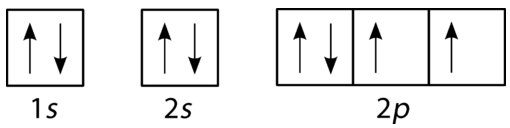
This orbital diagram represents:
a)
C
b)
B
c)
N
d)
O
52.
The maximum number of electrons that can be placed in an p orbital.
a)
2
b)
6
c)
10
d)
14
53.

This is a correct dot diagram for neon (Ne)
a)
true
b)
false
54.

Bromine (Br)
a)
1s2, 2s2, 2p6, 3s2, 3p6, 4s2, 3d1
b)
1s2, 2s2, 2p4
c)
1s2, 2s2, 2p6, 3s2, 3p6, 4s2, 3d10, 4p5
d)
1s2, 2s2, 2p6
55.
Which of the following elements will NOT be surrounded by an octet of electrons in a correctly drawn Lewis structure?
a)
carbon
b)
oxygen
c)
chlorine
d)
hydrogen
56.
Who was the first person to study atomic theory?
a)
Dalton
b)
Democritus
c)
Chadwick
d)
Miller
57.
What was the name of J.J Thomsons' model of atomic structure.
a)
Electron Cloud Model
b)
Electron Sea Model
c)
Plum Pudding Model
d)
Bohr Model
58.
What does the Bohr model suggest?
a)
Atoms are small, hard, indivisible objects.
b)
That protons in the nucleus are attracted to electrons in the electron clouds.
c)
That electrons travel around the nucleus of an atom in orbits or definite paths.
59.
Who proposed that the atom consists mostly of empty space?
a)
Bohr
b)
Dalton
c)
Rutherford
d)
Chadwick
60.
Which model suggested that: Atoms mostly consist of positively charged material with negatively charged particles (electrons) located throughout the positive material.
a)
Bohrs Model
b)
Plum Pudding Model
c)
Democritus Model
d)
Our current model
61.

Believed that atoms are small, hard particles that were "indivisible"
a)
Democritus
b)
Aristotle
c)
Schrodinger
d)
Greek Philosophers
62.

Believed that all atoms of the same element would be the same.
a)
John Dalton
b)
JJ Thomson
c)
Niels Bohr
d)
Modern Atomic Theory
63.
An ion forms when an atom gains or loses
a)
Protons
b)
Neutrons
c)
Electrons
64.
A positively charged ion is formed when
a)
A neutron is lost
b)
An electron is lost
c)
A neutron is gained
d)
An electron is gained
65.
An ion that has a negative charge is formed when an atom
a)
Loses neutrons
b)
Loses electrons
c)
Gains neutrons
d)
Gains electrons
66.
How are Protons and Neutrons similar
a)
Both are in the nucleus of the atom and they both have the relative mass of 1
b)
They both have alpha particles and have the relative mass of 2
c)
They both have 1 high-energy electron and different elements
67.
Which of the following is an example of a diatomic molecule?
a)
CaCl2
b)
Mg
c)
O2
d)
NaCl
68.
If an atom of oxygen has a charge of -2, how many electrons does the atom have?
a)
18
b)
6
c)
8
d)
10
69.

How many protons does this isotope of titanium have?
a)
48
b)
22
c)
26
d)
70
70.
Cations are
a)
positive
b)
negative
c)
on the right side of the periodi table.
d)
nonmetals
71.

What is the element name of the atom pictured?
a)
Fluorine
b)
Neon
c)
Argon
d)
Potassium
72.
What is true about a neutral atom?
a)
The number of protons equal the number of neutrons
b)
The number of protons equal the number of electrons
c)
The number of neutrons equal the number of electrons
d)
The number of protons, neutrons, and electrons are all different
73.

What does the 1.00794 stand for?
a)
Hydrogen
b)
atomic number
c)
atomic mass
d)
atomic explosion
Reset

