wayground logo

Free Printable Worksheets

Font size

S
M
L
XL
Worksheets

Exam #3 REVIEW QUIZ

Total questions: 98

Worksheet time: 1hrs 4mins

Name
Class
Date
1.
Which sequence of DNA bases would pair with this partial strand
ATG TGA CAG
a)
ATG TGA CAG
b)
TAC ACT GTC
c)
GTA AGT GAC
d)
CAT TCA CTG
2.
Which of the following best describes a DNA molecule?
a)
double helix
b)
contains ribose
c)
made of amino acids
d)
contains Uracil
3.
Which of the following units are repeatedly joined together to form a strand of DNA?
a)
amino acids
b)
nucleotides
c)
fatty acids
d)
polysaccharides
4.
In a molecule of double-stranded DNA, the amount of Adenine present is always equal to the amount of
a)
cytosine
b)
guanine
c)
thymine
d)
uracil
5.
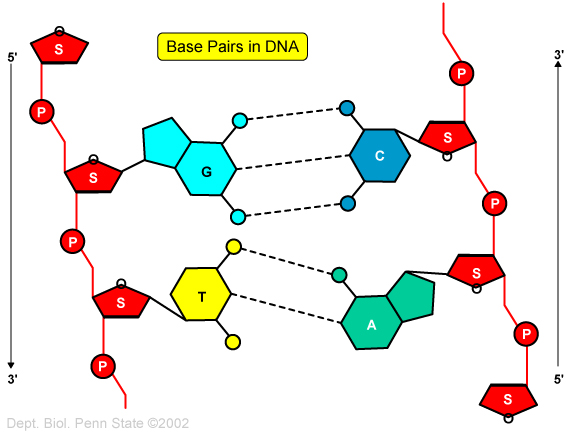
Guanine bonds with ______________.
a)
Adenine
b)
Guanine
c)
Cytosine
d)
Thymine
6.
Adenine bonds with ______________.
a)
Guanine
b)
Thymine
c)
Cytosine
d)
Adenine
7.
What determines the code, or information, of a DNA molecule?
a)
the shape (structure) of the nitrogen bases
b)
the order (sequence) of the nitrogen bases
c)
the color of the nitrogen bases
d)
the frequency (number) of nitrogen bases
8.
Which 2 molecules form the sides (backbone) of the DNA ladder?
a)
deoxyribose sugar and adenine
b)
deoxyribose sugar and a hydrogen bond
c)
deoxyribose sugar and the nucleus
d)
deoxyribose sugar and phosphate
9.
Nitrogenous bases are joined by which type of bond?
a)
polar bonds
b)
ionic bonds
c)
covalent bonds
d)
hydrogen bonds
10.
The enzyme that unzips the DNA to prepare for replication
a)
helicase
b)
replicase
c)
polymerase
d)
synthase
11.
DNA replication results in two DNA molecules,
a)
each one with two original strands
b)
each one with two new strands
c)
each one with one new strand and one original strand
d)
one with two new strands and the other with two original strands
12.

A process in which DNA has the unique ability to make an exact copy of itself.

a)

Replication

b)

Translation

c)

Transcription

d)

Duplication

13.
What are the three components of a nucleotide?
a)
sugar, hydrogen, nitrogen base
b)
sugar, oxygen, nitrogen base
c)
sugar, phosphate, nitrogen base
d)
sugar, phosphate, protein
14.

Where does transcription take place?

a)

Cytoplasm

b)

Nucleus

c)

Nucleolus

d)

Ribosome

15.
The process of making mRNA from DNA is called.
a)
Replication
b)
Transcription
c)
Translation
d)
Protein synthesis
16.
Which represents the correct order of "the central dogma of molecular biology"?
a)
protein to DNA to mRNA to trait
b)
DNA to mRNA to protein to trait
c)
DNA to protein to mRNA to trait
d)
trait to DNA to protein to mRNA
17.

Transcribe this DNA sequence to mRNA: AUGCCGGCC

a)

UUCGGCCGC

b)

TTTGGCGGG

c)

TTTGGCCGG

d)

UACGGCCGG

18.
What are the monomers of proteins?
a)
glycerol
b)
monosaccharides
c)
amino acids
d)
fatty acids
19.
Which of the following is NOT a difference between RNA and DNA?
a)
RNA is single stranded while DNA is double stranded
b)
RNA has uracil while DNA has thymine
c)
RNA has ribose while DNA has deoxyribose
d)
RNA is a nucleic acid while DNA is a protein
20.
The main function of tRNA is to...
a)
carry a message that, when translated, forms proteins
b)
form a portion of ribosomes
c)
string together complementary RNA and DNA strands
d)
bring amino acids from the cytoplasm to the ribosomes
21.
This molecule carries genetic information from the nucleus to the ribosomes in the cytoplasm.
a)
rRNA
b)
tRNA
c)
mRNA
d)
DNA
22.
Each codon codes for a particular __.
a)
amino acid
b)
anti-codon
c)
nucleotide
d)
protein
23.
Translation occurs at the __.
a)
ribosome
b)
nucleus
c)
DNA
d)
polymerase
24.
What is the central dogma of biology?
a)
Proteins are made from RNA that assembles amino acids through DNA ribosomes.
b)
RNA copies all information for an organism onto DNA which assembles ribosomes, and creates amino acids from proteins
c)
DNA is the blueprint for an organism. RNA copies specific sections that need to be built and transfers that information to a ribosome which assembles proteins out of amino acids.
d)
RNA is the blueprint for an organism. It copies its information onto DNA, which takes amino acids (like lego building blocks) and assembles those acids into proteins.
25.
What mutation has occurred here? 
T-G-A-C-C-A
T-G-A-G-C-A
a)
Substitution
b)
Deletion
c)
Insertion
d)
Frameshift 
26.
Are all mutations bad?
a)
Yes
b)
No
27.

Mutations can be caused by:

a)

cigarette smoke

b)

radiation

c)

viruses

d)

All of the above

28.
Why are insertion and deletion mutations so harmful?
a)
They change all of the codons from the mutation on down the line, which changes the amino acid sequence
b)
They insert things that an organism doesn't need.
c)
They often delete things that organisms need.
d)
Insertion and deletions are not any more harmful than substitution mutations.
29.
Why is the order of amino acids so important?
a)
The order of amino acids dictates what shape the protein will fold into.
b)
It is not important. The protein folding chamber will force the protein to fold into the correct shape.
30.

What is it called when body cells grow uncontrollably

a)

Spinal Stenosis

b)

Anemia

c)

Cancer

d)

Apoptosis

31.
Identify the SUBSTITUTION mutation from the following DNA sequence: 
ATG CCA AAT
a)
ATG TCA AAT
b)
ATG CCT AAA T
c)
ATC CA  AT
d)
ATG CCA AAT
32.

Identify the DELETION mutation from the following DNA sequence:

ATG CCA AAT

a)

ATG TCA AA

b)

ATG CCT ATT

c)

ATC CA AT

d)

AG CAA AAT

33.

Germ line cells give rise to ___________________

a)

body cells

b)

eggs and sperm

c)

immune response cells

d)

basal cells

34.

Mutations in somatic cells are passed to offspring

a)

TRUE

b)

FALSE

c)

What even is a somatic cell?

35.

A _______________ signals the beginning of transcription and a _________________ signals the end of transcription

a)

Cap, Promoter

b)

Promoter, Germ cell

c)

Promoter, Terminator

d)

Initiator, Cap

36.

Spontaneous mutations occur naturally while induced mutations are caused by environmental agents

a)

TRUE

b)

FALSE

37.

Radiation and viruses are types of physical mutagens

a)

TRUE

b)

FALSE

38.

______________ are agents that increase the likelihood of developing cancer

a)

Carcinogens

b)

Atlerogens

c)

Bronchogens

d)

Carcotronitrogens

39.

Genes whose over activity promotes uncontrolled cell division:


They also encode proteins that promote cell division and prevent apoptosis

a)

Oncodialators

b)

Cancogenes

c)

Carcinogens

d)

Oncogenes

40.
Autosomes are
a)
chromosomes found in autotrophs, only
b)
chromosomes that automatically correct all errors in the DNA
c)
chromosomes that determine traits other than sex
d)
chromosomes that determine the sex of the individual
41.
A pair of chromosomes that consists of  XX is  a __________________.
a)
Male
b)
Female
42.
The structures labeled B are
a)
centrioles
b)
chromatids
c)
centromeres
d)
chromopheres
43.
chromosomes that have the same sequence of genes and the same structure
a)
homologous chromosomes
b)
alleles
c)
phenotypes
d)
genotypes
44.
Which of the following would be categorized as a gamete?
a)
skin cell
b)
blood cell
c)
sperm cell
d)
liver cell
45.

1n = haploid

2n = ?

a)

autosome

b)

sex chromsome

c)

double haploid

d)

diploid

46.
What are the 5 steps of the cell cycle?
a)
1. Cytokinesis 
2. Mitosis
3. G1
4. G2
5. S
b)
1. G1
2. G2
3. S
4. Mitosis
5. Cytokinesis
c)
1. S
2. G1
3. Mitosis
4. G2
5. Cytokinesis
d)
1. G1
2. S
3. G2
4. Mitosis
5. Cytokinesis
47.
G1, S, and G2 are all steps in
a)
interphase
b)
prophase
c)
metaphase
d)
cytokinesis
48.
Before a cell can ever divide
a)
the cell must have a nucleus
b)
the cell must be healthy
c)
the cell's DNA must be copied
d)
the cell must be fully grown
49.
Step one in Mitosis is
a)
metaphase
b)
interphase
c)
prophase
d)
telophase
50.
During prophase
a)
chromosomes line up at the cell's equator
b)
nuclear envelope reappears at each end of the cell
c)
chromosomes are pulled apart into chromatids towards opposite ends of the cell
d)
chromosomes become visible and the nuclear envelope dissolves
51.
Step two in mitosis is
a)
metaphase
b)
anaphase
c)
telophase
d)
prophase
52.

Identify this phase of Mitosis.

HINT: chromatids align in the middle of the cell (equator)

a)

prophase

b)

metaphase

c)

anaphase

d)

telophase

53.
Which of the following is NOT a somatic cell?
a)
sperm
b)
skin cell
c)
blood cell
d)
bone cell
54.

Identify this phase of mitosis. HINT- chromatids separate and chromosomes move to opposite ends

a)

prophase

b)

metaphase

c)

anaphase

d)

telophase

55.

What occurs during telophase?

a)

the cell splits in half

b)

2 nuclei re-form at opposite poles of the cell

c)

the chromatids begin to pull apart

d)

nuclear envelope disappears

56.
What is cytokinesis?
a)
final division of the cytoplasm 
b)
splitting of the cell into two new cells
c)
the final stage in the cell cycle
d)
all of the above
57.
This produces 2 identical cells.
a)
mitosis
b)
meiosis
58.
Meiosis makes sperm and egg cells. In humans, sperm and egg cells each have _____ chromosomes. Therefore a fertilized human egg cell (sperm and egg cell combined) would create a cell with _____ chromosomes.
a)
23, 46
b)
46, 23
c)
2, 4
d)
50, 100
59.
What causes genetic variation in meiosis?
a)
chromosomes lining up
b)
crossing over of chromosomes
c)
separation of chromosomes
d)
chromosomes pulling apart
60.
Unlike mitosis, meiosis in male mammals results in the formation of
a)
one haploid gamete
b)
three diploid gametes
c)
four diploid gametes
d)
four haploid gametes
61.
When an area of a chromatid is exchanged with the matching area on a chromatid of its homologous chromosome, _________________ occurs
a)
crossing over
b)
mutagenesis
c)
hybridization
d)
fertilization
62.
Goes through P.M.A.T two rounds 
a)
Mitosis
b)
Meiosis
c)
Osmosis
d)
Transcription
63.
Which process and type of resulting cells are represented?
a)
mitosis, gametes
b)
mitosis, body cells
c)
meiosis, gametes
d)
meiosis, body cells
64.
The process of crossing over occurs in what phase of meiosis?
a)
anaphase 1
b)
prophase 1
c)
prophase 2
d)
telophase 1
65.
Polyploidy is most commonly seen in
a)
Plants
b)
Animals
c)
Humans
d)
It's not technically possible
66.

What does a Euploid genetic variation imply?

a)

it means that crossing over never occurred

b)

correct # of chromosomes occurring in sets

c)

3 or more sets of chromosomes

d)

abnormal # of chromosomes

67.
What are small stretches of DNA that code for traits
a)
Nucleus
b)
Chromosomes
c)
Gene
d)
Centromeres
68.
Where is all the genetic information in a cell?
a)
Nucleus
b)
Nucleotides
c)
Chromosomes
d)
Cytoplasm
69.
Which of the following genotypes is homozygous recessive?
a)
RR
b)
Rr
c)
rr
d)
None of the Above
70.
True/False: Different genotypes can code for the same phenotype.
a)
True
b)
False
71.
What does a Punnett Square help you do?
a)
Determine the ratio of phenotypes
b)
Determine the ratio of genotypes
c)
Predict possible traits the offspring will have
d)
All of the above
72.
A phenotype is the...
a)
letter combination
b)
dominant gene
c)
recessive gene
d)
physical appearance
73.
Tt is-
a)
homozygous dominant
b)
homozygous recessive
c)
heterozygous
d)
none of these
74.
Purple is dominant to white. A heterozygous purple flower is crossed with a white flower. What are the genotypes and phenotypes of the offspring?
a)
100% Pp (purple)
b)
50% Pp (purple); 50% pp (white)
c)
75% Pp (purple); 25% pp (white)
d)
25% PP, 50% Pp, 25% pp
75% purple, 25% white
75.
Which is the correct phenotype for this organism?
a)
BB
b)
blue
c)
green
d)
bb
76.
B - black, b - brown.  Two black mice mate and have some black and some brown mice.  What is the genotype of the parents?
a)
BB x Bb
b)
BB x bb
c)
Bb x Bb
d)
Bb x bb
77.
A person who is heterozygous for a trait but does not display the recessive trait.
a)
Carrier
b)
Complete dominance
c)
Hybrid
d)
Homozygous
78.
A heterozygote that shows a phenotype between that of the homozygotes.
For example, a Red and White homozygous dragonsnap makes a heterozygous Pink dragonsnap offspring.
a)
Complete dominance
b)
Incomplete dominance
c)
Co-Dominance
d)
Homozygous advantage
79.

Males are homozygous for x-linked genes and are more affected than females

a)

TRUE

b)

FALSE

80.

Temperature affecting the variation on a phenotype (like height) would be an example of

a)

environmental feeback

b)

natural occurrence

c)

codominance

d)

norm of reaction

81.

Which of the following defines Epistasis

a)

death of cell nucleus

b)

genes are chosen and set apart so that crossing over can reoccur

c)

alleles of one gene mask the expression of the alleles of another gene

d)

the desolation of the intermediate phenotype

82.

In humans, mitochondria are inherited from the

a)

Mother

b)

Father

83.

Which of the following is the type of inheritance where only the egg contributes to the inheritance of chloroplasts

a)

Maternal

b)

Paternal

c)

Biparental

d)

Nosocomial

84.

Epigenetic inheritance modifies genes during gamete formation to change gene expression in a way that becomes permanent

a)

TRUE

b)

FALSE

85.
What pattern of inheritance is shown in this image?
a)
Codominance
b)
Incomplete dominance
c)
Polygenic traits
86.
If a gene is found only on the X chromosome and not the Y chromosome, it is said to be what?
a)
sex-linked trait
b)
polygenic trait
c)
codominant trait
d)
incomplete dominance trait
87.
What do you call the non-Mendelian inheritance pattern where both traits are dominant and both appear in the organism with heterozygous genotype?
a)
Codominance
b)
Incomplete dominance
c)
Polygenic traits
88.

What caused the Calico cat's patchy pattern?

a)

mutation during gamete formation

b)

carcinogen exposure during gamete formation

c)

inactivation of one x chromosome in each skin cell

d)

inactivation of two x chromosomes in each skin cell

89.

What are Barr bodies?

a)

old genomes

b)

y chromosomes that have been recycled

c)

masses of cells in the chromosome

d)

extra x chromosomes that were converted

90.

DNA has directionality which means...

a)

it makes new proteins

b)

it is efficient

c)

the nucleotide sequence is written 5' to 3' (antiparallel)

d)

it always goes backwards

91.

If you have 20% A how much G do you have?

a)

40%

b)

30%

c)

20%

d)

10%

92.

DNA polymerase covalently links nucleotides together to form DNA strands and can only add nucleotides in the

a)

3' to 5' direction

b)

5' to 3' direction

93.

Telomeres (choose all that apply)

a)

add nucleotides to the lagging strand

b)

"delete" unwanted genetic material

c)

prevent loss of genetic material

d)

prevent shortening of DNA strand

94.

Euchromatin- regions of less compacted DNA that contain ___________ genes

a)

active

b)

inactive

95.

A promoter would ..

a)

start transcription

b)

stop transcription

96.

Alternative splicing allows different proteins to be produced from the same gene

a)

TRUE

b)

FALSE

97.

How many codons exist in the strand below:


AUGGGTCCATGATAA

a)

15

b)

10

c)

5

d)

3

98.

The genetic code is ________________ which means the same amino acid can be encoded by more than one codon

a)

bigenerate

b)

degenerate

c)

modifiable

d)

intricate