Wayground logo

Free Printable Worksheets

Font size

S
M
L
XL
Worksheets

Hydrosphere

Total questions: 40

Worksheet time: 55mins

Name
Class
Date
1.
How much of Earth's water is unavailable for humans to consume due to its high salinity? 
a)
3%
b)
23%
c)
77%
d)
97%
2.

How does the amount of water circulating in the water cycle change?

a)

The amount of water remains constant

b)

The amount of water increases each time it rains

c)

The amount of water decreases and then increases each day

d)

The amount of water decreases every time evaporation occurs

3.
Why is such a small amount of freshwater available for humans to readily use?
a)
Majority of freshwater is mixed in with the ocean water
b)
Most of fresh water is frozen in glaciers and polar ice caps
c)
Most of freshwater found in the gas form in the atmosphere
d)
Most of freshwater is liquid in lakes, rivers , & aquifers
4.
All the water on, in , and surrounding the earth
a)
Atmosphere
b)
Hydrosphere
c)
Biosphere
d)
Lithosphere
5.

What are the 2 energy sources for the water cycle?

a)

the sun & gravity

b)

the earth's rotation & moon

c)

water & gravity

d)

the moon & sun

6.
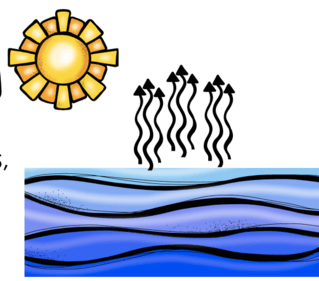
What part of the water cycle does this picture show?
a)
condensation
b)
precipitation
c)
evaporation
7.
What is evaporation?
a)
The part of the water cycle when the sun heats up water, turning it from a liquid into water vapor or steam. It rises from the ground into the air.
b)
The part of the water cycle when the water vapor in the air gets cold. The water turns back into a liquid and forms clouds.
c)
The part of the water cycle when clouds get heavy and can no longer hold the liquid water. This causes the water to fall from the sky to the earth as rain, snow, sleet, or hail.
8.
What is condensation?
a)
The part of the water cycle when the sun heats up water, turning it from a liquid into water vapor or steam. It rises from the ground into the air.
b)
The part of the water cycle when the water vapor in the air gets cold. The water turns back into a liquid and forms clouds.
c)
The part of the water cycle when clouds get heavy and can no longer hold the liquid water. This causes the water to fall from the sky to the earth as rain, snow, sleet, or hail.
9.
What is precipitation?
a)
The part of the water cycle when the sun heats up water, turning it from a liquid into water vapor or steam. It rises from the ground into the air.
b)
The part of the water cycle when the water vapor in the air gets cold. The water turns back into a liquid and forms clouds.
c)
The part of the water cycle when clouds get heavy and can no longer hold the liquid water. This causes the water to fall from the sky to the earth as rain, snow, sleet, or hail.
10.

A scientist recorded this data at an ocean beach. Which conclusion should the scientist make?

a)

Faster winds make lower waves.

b)

Faster winds make taller waves.

c)

Warmer air makes lower waves.

d)

Warmer air makes taller waves.

11.
What do we use water for the most? 
a)
mining
b)
agriculture
c)
drinking water
d)
transportation
12.
The ability of a material to transmit water through interconnected pores is called
a)
capacity
b)
competence
c)
permeability
d)
porosity
13.
An area of land that drains into a body of water.
a)
mouth
b)
point-source pollution
c)
watershed
d)
headwaters
14.
How much of the earth's water is freshwater?
a)
50 %
b)
3 %
c)
97 %
d)
93 %
15.
Aquifers store ____ water.
a)
ground
b)
lake 
c)
ocean
d)
glacier
16.
Two types of water currents are
a)
local and global
b)
sea and land
c)
surface and deep
d)
warm and cold
17.
Surface currents are caused by ________ and deep currents are caused by __________. 
a)
wind, density
b)
density, wind
c)
whales, Earth's rotation
d)
tides, wind
18.
How does the warm waters of the Gulf Stream affect the climate in North Carolina? 
a)
It makes it colder and drier
b)
It makes it warmer and wetter
c)
It makes it colder and wetter
d)
It makes it warmer and drier
19.
Because they have large connected pores, materials such as sand and gravel allow water to pass through.  This is known as 
a)
Permeable
b)
Impermeable
20.
The land around these rivers is known as the ________________.
a)
tributary
b)
divide
c)
water system
d)
watershed
21.
Placement of the aquifer between impervious rock layers can "squeeze" the groundwater, placing it under pressure, forming a or an ______________ aquifer.
a)
Confined
b)
Unconfined
c)
Artesian
d)
Karst
22.
Thermohaline circulation is caused by 
a)
density
b)
nutrients
c)
coastal upwelling
d)
equatorial upwelling
23.
Why are surface currents at the surface of the ocean?
a)
colder temperature
b)
colder temperature & more salinty
c)
warmer temperature & less salinty
d)
less salinty
24.
The large, circular surface-current pattern found in each ocean.
a)
California Current
b)
Surface Current
c)
Gyre
d)
Global Conveyor Belt
25.
Which of the following is true?
a)
A) The majority of Earth's fresh surface water is found in rivers.
b)
B) Most of Earth's fresh water would require desalination in order to make it suitable for consumption.
c)
C) Most of Earth's fresh water is found within 100 miles of densely populated areas.
d)
D) Most of Earth's fresh water is frozen.
26.

Trees and plants releasing water vapor into the air is called

a)

Evaporation

b)

Condensation

c)

Precipitation

d)

Transpiration

27.

The process that cycles water around Earth and it's atmosphere is called

a)

Hydrogen cycle

b)

Carbon cycle

c)

Hydrologic cycle

d)

Water cycle

28.

What does the term fresh water mean?

a)

water with very little salt dissolved in it.

b)

water with a lot of salt dissolved in it.

c)

ocean water; has salt in it; most land animals can not drink it.

d)

a mix of fresh and saltwater.

29.

What does the term hydrologic cycle mean?

a)

the constant movement of water from Earth’s surface to the atmosphere and back to Earth’s surface.

b)

the gas form of water.

c)

the process by which a liquid changes into a gas.

d)

the process by which a gas changes into a liquid.

e)

a pipe or channel that is used to transport water

30.

A local farmer uses a well to get water for irrigating his crops. What will happen if he pumps more water out of the aquifer than what is being replaced?

a)

the level of the water table will sink

b)

an artesian well will form

c)

the level of the water table will rise

d)

nothing will happen

31.
Which of the following causes the Coriolis Effect?
a)
Earth's Revolution
b)
Earth's Rotation
c)
Earth's Temperature
d)
Earth's Core
32.
Because of the Coriolis effect, ocean currents in the Northern Hemisphere are deflected...
a)
clockwise
b)
counter clockwise
c)
north
d)
south
33.
Ocean currents that move toward the poles are
a)
warm
b)
cold
c)
warm in the N Hemisphere cold in the S Hemisphere
d)
cold in the N Hem. warm in the S Hem.
34.
What is the name of the current along the east coast of the US?
a)
West Wind
b)
Canary
c)
California
d)
Gulf Stream
35.
What force guides the movement of deep currents?
a)
density differences
b)
wind
c)
Coriolis Effect
d)
continental barriers
36.

Water is considered a "Universal Solvent" this is only true with substances that also have covalent bonds like water. This is called ______________________.

a)

Hydrophilic

b)

Hydrophobic

c)

Hydraulic

d)

Hydroelectric

37.

Oil and water do not mix. Why?

a)

Because oil is Hydrophilic

b)

Because oil is Hydrophobic

c)

Because oil has the same type bonding as water.

d)

Because oil and water have the same density.

38.

Density is calculated as the Mass divided by the Volume. Water has a density of 1g/ml or 1. If an object has a density greater than 1 it will be where in the water column?

a)

Float to the top

b)

Sink towards the bottom

c)

Be suspended in the middle of the water column

d)

Dissolve in the water column.

39.

Identify the part of the watershed at label A.

a)

Source

b)

Flood Plane

c)

Delta

d)

Watershed Boundary

40.

Identify the part of the watershed at label D.

a)

Tributary

b)

Flood Plane

c)

Delta

d)

Lake