
 Worksheets
Unit 4: Chemical Reactions
Total questions: 35
Worksheet time: 2hrs 13mins
In a reaction A + B --> C, there are 5g of reactant A and product C has a mass of 9g. How many grams of reactant B have to be present?
4g
5g
9g
14g
The number in front of a compound or element is a?
Subscript
Coefficient
Superscript
Charge
The number to the lower, right side of an element is a?
Subscript
Superscript
Coefficient
Charge
Which Chemical Equation is Balanced?
CH₄+O₂------CO₂+2H₂O
H₂+O₂-----2H₂O₄
4Al+3O₂-----2Al₂O₃
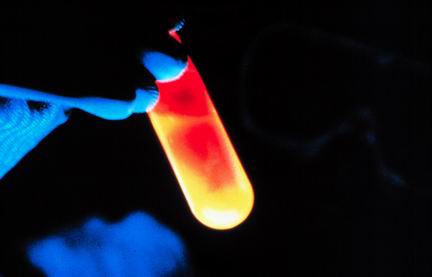
Identify the reaction type: H2O2 --> H2O + O2
decomposition
synthesis
single replacement
double replacement
Identify the reaction type: Fe + O2 ---> Fe2O3
decomposition
combustion
synthesis
single replacement
Identify the reaction type: Al + CuCl2 ----> Cu + AlCl3
combustion
synthesis
double replacement
single replacement
Identify the reaction type: AgNO3 + NaCl ---> AgCl + NaNO3
double replacement
single replacement
combustion
decompostion
Identify the reaction type: C3H8 + O2 ---> CO2 + H2O
single replacement
double replacement
combustion
decomposition
Predict the products of this single displacement reaction:
Mg+ AgNO3-->
Mg(NO3)2 + Ag
MgNO3 + Ag
MgAg + NO3
Mg+ AgNO3
Predict the products of this single displacement reaction:
K + HCl -->
KCl + H2
KHCl
KH + Cl2
KCl + H
Predict the products of this reaction:
AgNO3 + KCl -->
AgCl + KNO3
AgK + ClNO3
AgNO3 + KCl
KAg + NO3Cl
In the equation, Mg + O2 ---> MgO, what are the reactants?
Mg and O2
MgO
Mg and MgO
O and MgO
Balance this equation, __Al2O3 ---> __Al + __O2
Cannot be balanced
2Al2O3 ---> 2Al + 3O2
2Al2O3 ---> 4Al + 3O2
3Al2O3 ---> 2Al + O2
Balance this equation: __H2 + __N2 → __NH3
H2 + 4N2 → NH3
H2 + 3N2 → 2NH3
3H2 + N2 → 2NH3
2H2 + 2N2 → 2NH3
Balance this equation: ___C3H8 +___O2 --> ___CO2 + ___H2O
1,5,3,4
2,8,6,8
already balanced
1,5,5,4
What are the units for molar mass?
grams
amu
grams per mole
amu per mole
The number 6.02 x 10²³, which is the number of particles found in a mole, is also known as what?
molar mass
atomic mass
Avogadro's number
molecular mass
The word equation "magnesium reacts with chlorine to produce magnesium chloride" is best represented by which of the following formula equations?
Mg -->Cl2 + MgCl2
MgCl2 --> Mg + Cl2
MgCl2 + Mg --> Cl2
Mg + Cl2 --> MgCl2
(s), (l), (g) and (aq) represent what information about the chemicals involved in a reaction?
Size
Quantity
State of Matter
Color
In writing an equation that produces hydrogen gas, the correct formula for hydrogen gas is?
HH
H2
2H
Hg
What happens in ALL chemical changes?
Change in state of matter
A new chemical substance is formed
Bubbles are produced
An explosion
Which of the following is evidence that a chemical reaction has occurred?
change in shape
melting
formation of a gas
dissolving

What is the mass of one mole of Nitrogen N2?
14.01 amu
14.01 g
28.02 g
28.02 amu
How many moles are 6.02 x 10²³ molecules of H2O?
1
18
22.4
10
A mole of carbon dioxide contains 6.02 x 10²³ _____.
atoms
grams
ions
molecules
What is the molar mass of MgCl2?
24.31 g/mol
95.21 g/mol
59.76 g/mol
70.90 g/mol
What are the products of combustion?
Carbon monoxide and water
Carbon dioxide and water
Oxygen and water
Oxygen and carbon dioxide
If a chemical is dissolved in water, it will be written with a ____.
(s)
(l)
(g)
(aq)

