wayground logo

Free Printable Worksheets

Font size

S
M
L
XL
Worksheets

Chapter 7 Quiz

Total questions: 56

Worksheet time: 37mins

Name
Class
Date
1.

If fossil fuels are burnt what are the products formed?

a)

Water vapour

b)

Oxygen Gas

c)

Carbon Dioxide

d)

Methane

2.

What do most most metals have to be exposed to, to be able to corrode?

a)

Fossil Fuels

b)

Water

c)

Air

d)

Hydrogen

3.

A rusting reaction is best known as a...

a)

Oxidation Reaction

b)

Corrosive Reaction

c)

Exothermic Reaction

d)

Combustion Reaction

4.

Why does sherbet leave your tongue cold?

a)

Because it is cold

b)

An exothermic reaction has occurred

c)

Oxygen gas absorbs the heat

d)

An endothermic reaction absorbs the heat

5.

What is a burning reaction?

a)

Corrosion Reaction

b)

Oxidation Reaction

c)

Exothermic Reaction

d)

Combustion Reaction

6.

What substance is needed for combustion to occur?

a)

Oxygen

b)

Hydrogen

c)

Chemicals

d)

Acid

7.

What is anodising?

a)

When metal starts to rust

b)

Putting on a layer of protective oxide

c)

A bright blueish-greenish formed on copper or brass

d)

Loss of lustre

8.
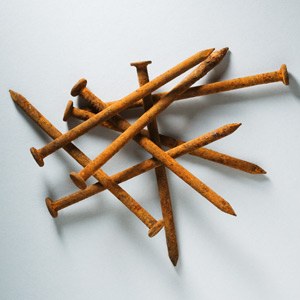
Is this an example of corrosion?
a)
Yes
b)
No
9.

Finish the sentence


During photosynthesis, plants take in...

a)

glucose, oxygen and water.

b)

sunlight, carbon dioxide and water.

c)

sunlight, oxygen and carbon dioxide.

10.

Finish the sentence:


During photosynthesis, plants give off...

a)

sunlight, water and carbon dioxide.

b)

glucose and carbon dioxide.

c)

glucose and oxygen.

11.

Fill in the blanks:


Aerobic respiration:


oxygen + ____________ = energy + carbon dioxide + water

a)

glucose

b)

photosynthesis

c)

carbon dioxide

12.

Fill in the blanks:


Aerobic respiration:


oxygen + glucose = ____________ + carbon dioxide + water

a)

water

b)

energy

c)

minerals

13.

Finish the sentence:


Plants absorb a gas called...

a)

oxygen.

b)

carbon dioxide.

c)

glucose.

14.

This process occurs in the chloroplasts of plant cells

a)

ATP

b)

Respiration

c)

Photosynthesis

d)

Calvin Cycle

15.

Photosynthesis creates

a)

Water

b)

Carbon Dioxide

c)

Glucose

d)

Chloroplasts

16.

In photosynthesis, what do carbon dioxide and water yield?

CO2 + H2O ->

a)

Glucose (C6H12O6)

b)

Water (H2O)

c)

Oxygen (O2)

d)

ATP

17.

In Respiration what do Glucose and Oxygen yield?

<- C6H12O6 + O2

a)

Glucose

b)

Oxygen

c)

Carbon Dioxide

d)

Water

e)

ATP

18.

Where does respiration occur within the cell?

a)

Mitochondria

b)

Guard Cell

c)

Stomata

d)

Chloroplasts

19.
All living things do which of the following?
a)
Chemosynthesis
b)
Respiration
c)
photosynthesis
d)
all of the answers
20.
Aerobic respiration is different from anaerobic respiration in that aerobic respiration needs...
a)
chlorophyll
b)
carbon dioxide
c)
glucose
d)
oxygen
21.
you breathe in oxygen for
a)
photosynthesis
b)
anaerobic respiration
c)
 fermentation
d)
aerobic respiration
22.
In which eukaryotic organelles does photosynthesis occur?
a)
mitochondria
b)
stomata
c)
xylem
d)
chloroplast
23.
Which gas is removed from the atmosphere during photosynthesis?
a)
hydrogen
b)
oxygen
c)
nitrogen
d)
carbon dioxide
24.
The main source of energy for all life comes from ____.
a)
the Earth
b)
the moon
c)
the sun
d)
the food we eat/make
25.
Photosynthesis and respiration are essentially the opposite of each other.
a)
True
b)
False
26.
Is burning wood a chemical or physical change?
a)
chemical
b)
physical
27.
Is glass breaking a chemical or phyiscal change?
a)
chemical
b)
physical
28.
Is hammering wood together to build a house a chemical or physical change?
a)
chemical
b)
physical
29.
Is a a rusting bicycle a chemical or physical change?
a)
chemcial
b)
physical
30.
Is melting butter for popcorn a chemical or physical change?
a)
chemical
b)
physical
31.
Is spoiling food a physical or chemical change?
a)
phyiscal
b)
chemical
32.
Is mixing lemonade powder with water a physical or chemical change?
a)
physical
b)
chemical
33.
Is corroding metal a chemical or physical change?
a)
physical
b)
chemical
34.
Are fireworks exploding a physical or chemical change?
a)
phyiscal 
b)
chemical
35.
Is sqeezing organges to make orange juice a phyical or chemcial change?
a)
physical
b)
chemical
36.
Is frying an egg a physical or chemical change?
a)
chemical
b)
physical
37.
Is burning toast a chemical or physical change?
a)
physical
b)
chemical
38.
Salt dissolves in water.
a)
Physical
b)
Chemical
39.
HCl (acid) reacts with NaOH (base) to produce NaCl (salt), H2O (water) and heat.
a)
Physical
b)
Chemical
40.
Water is heated and evaporates.
a)
Physical
b)
Chemical
41.
The change from liquid to solid, or the reverse of melting, is called:
a)
freezing
b)
condensation
c)
boiling
d)
sublimation
42.
The faster an object moves, the ________ kinetic energy it has. 
a)
more
b)
less
c)
none of the above
d)
all of the above 
43.
The change of state from a gas to a liquid
a)
condensation
b)
deposition
c)
evaporation
d)
sublimation
44.
Temperature at which matter changes from liquid to solid
a)
freezing point
b)
melting point
c)
boiling point
d)
absolute zero
45.
What is an example of sublimation?
a)
Ice cream melting
b)
Dry ice
46.
What is the definition of sublimation?
a)
a chemical process where a solid turns into a gas without going through a liquid stage
b)
the process of a liquid changing into a gas
47.
What happens when liquid water evaporates?
a)
Water molecules break apart into atoms
b)
The molecules bump past each other
c)
The molecules move faster and become gas
d)
The water increases in mass
48.
Why does hot water evaporate faster than room temperature water?
a)
Hot water molecules are lighter
b)
More water molecules move fast enough to break attractive forces
c)
Room temperature water has more mass
d)
The water molecules spread further apart
49.
What happens when water vapor condenses?
a)
Cooling water vapor causes molecules to move further apart
b)
Molecules slow down and their attractions bring them closer
c)
Colder temperatures speed up the molecules
d)
Water vapor is less dense than liquid water
50.
When water freezes, liquid water turns to solid ice because...
a)
Water molecules get harder
b)
Molecules move slowly enough that their attractions keep them fixed
c)
All liquid water eventually becomes ice
d)
Ice can float on water
51.
True or False: Adding energy has no effect on evaporation.
a)
True
b)
False
52.
What is the process that causes a substance to change from liquid to solid?
a)
Melting
b)
Freezing
c)
Evaporation
d)
Condensation
53.
True or False: Making water vapor colder increases the rate of condensation.
a)
True
b)
False
54.

What happens to a puddle of water on a hot, sunny day?

a)

It freezes.

b)

It condenses.

c)

It evaporates.

d)

It melts.

55.

A foggy mirror is an example of what process?

a)

Freezing

b)

Condensation

c)

Evaporation

d)

Melting

56.
A combination of particles of one or more substance that are distributed uniformly throughout another substance is a/an
a)
Mixture 
b)
Substance
c)
Solution