wayground logo

Free Printable Worksheets

Font size

S
M
L
XL
Worksheets

Honors Biology First Semester Review

Total questions: 145

Worksheet time: 2hrs 58mins

Name
Class
Date
1.
This variable in an experiment is the one being deliberately changed by the scientist. 
a)
dependent variable
b)
independent variable
c)
data
d)
control group
2.
In a controlled experiment, how many variables can be worked with at a time? 
a)
one
b)
none
c)
two or more
d)
how ever many makes sense.
3.

Mrs. Mack sets up an experiment to see how the mass of a ball affects the distance it rolls off a ramp. Identify the independent variable:

a)

distance traveled by the ball

b)

height of the ramp

c)

mass of the ball

d)

weight of the ball

4.
A student is planning an experiment to find out how the height from which he drops a ball affects how high the ball bounces. The dependent variable is the _____.
a)
Diameter of the ball
b)
Force acting on the ball
c)
Height that the ball bounces
d)
Height from which the ball is dropped
5.
When experimenting with the growth of a plant, a scientist uses three (of the same type of) plants, two different fertilizers, equal light, and equal water. What type of variable is the fertilizer?
a)
Dependent
b)
Independent
c)
Control
d)
Compound
6.
A series of steps used by scientists to solve a problem or answer a question. 
a)
scientific method
b)
recipe
c)
data collection
d)
metric system
7.
A testable explanation to a problem that has not yet been tested. 
a)
data
b)
theory
c)
hypothesis
d)
fact
8.

Testing a hypothesis often involves a(n):

a)

answer

b)

controlled experiment

c)

problem

d)

safety check

9.
Which of the following would be considered quantitative data?
a)
Color
b)
Smell
c)
6.84 cm
d)
texture
10.

Explaining the color of a chemical would be what kind of observation?

a)

Qualitative data

b)

Quantitative data

11.
What skill is a scientist using when she listens to the sounds that an elephant makes?
a)
drawing conclusions
b)
making observations
c)
interpreting data
d)
making a hypothesis
12.
An organism that needs to eat other organisms to obtain energy is known as a:
a)
Autotroph
b)
Producer
c)
Consumer
d)
Mutualist
13.
Consumer that eats plants
a)
heterotroph
b)
herbivore
c)
producer
d)
community
14.
What does a food web represent?
a)
All connections of energy flow throughout all organisms in a habitat.
b)
The specific ways that mutualism is carried out.
c)
A single pathway or energy flow between organisms. 
d)
How carnivores get their food. 
15.
relationship in which two species live closely together
a)
resource
b)
mutualism
c)
succession
d)
symbiosis
16.
The rabbit in this food web would be considered a:
a)
Decomposer
b)
Producer
c)
Secondary Consumer
d)
Primary Consumer
17.
Where an organism lives
a)
habitat
b)
niche 
c)
heterotrogh
d)
biosphere
18.
In this Food Web Pyramid Which type of consumer gets only 10% of the energy stored in plants?
a)
Herbivore
b)
Carnivore
c)
Omnivore
d)
Secondary Consumer
19.
What is the term for each step in the transfer of energy and matter within a biological community?
a)
energy path
b)
food web
c)
trophic level
d)
food pyramid
20.
The image provided is an example of a(n):
a)
Carnivore
b)
Herbivore
c)
Producer
d)
Autotroph
21.
The living portions of the ecosystem.
a)
Biotic factors
b)
Abiotic factors
22.
A collection of organisms that make up a community as well as all of the nonliving aspects of the environment.
a)
Population
b)
Community
c)
Habitat
d)
Ecosystem
23.
As you move upward, from level to level, in an energy pyramid, energy _____.
a)
increases
b)
decreases
c)
stays the same
d)
increases exponentially
24.

plants that convert energy from the sun

a)

decomposer

b)

primary consumer

c)

secondary consumer

d)

photoautotroph

25.
What are the Abiotic factors in this image? 
a)
water, sunlight, dirt, air
b)
birds and plants
c)
birds, water, dirt
d)
plants, water
26.
Organisms that feed on both living producers and other consumers.
a)
Carnivores
b)
Omnivores
c)
Herbivores
d)
Detritivores
27.

A living relationship between two species in which one organism is helped and the other is harmed is called...

a)

mutualism

b)

commensalism

c)

parasitism

d)

niche

28.
symbiotic relationship in which both organisms benefit
a)
competition
b)
Mutualism
c)
nitrogen fixation
d)
energy pyramid
29.
What is the original source of almost all energy in most ecosystems?
a)
carbohydrates
b)
sunlight
c)
water
d)
carbon
30.
When a population grows past the ecosystem's carrying capacity, what happens to the population?
a)
Continues to grow
b)
The population starts to die off to return to carrying capcity
c)
The population will go extinct due to lack of resources
d)
The population grows then finds a new carrying capacity
31.

Which factor may cause the population of a certain species to increase?

a)

increase of food supply

b)

removal or decrease in number of predators

c)

elimination of disease

d)

all of these

32.
Any thing or organism that regulates the size of a population is known as __________.
a)
a limiting measure
b)
a limiting factor
c)
carrying capacity
d)
biodiversity
33.
A species that is not native to an area is called: 
a)
Native Species
b)
Natural Species
c)
Invasive Species
d)
Symbiotic Species
34.
Why do the populations of invasive species grow so quickly? 
a)
Invasive Species are native to an area. 
b)
Invasive species are prey to many animals.
c)
Invasive species have no predators.
d)
Invasive species keep the ecosystems in equilibrium.
35.
The maintenance of an organism’s internal environment is called:
a)
compensating
b)
homeostasis
c)
balancing
d)
routine
36.
Which of the following is the correct order of organization in living things from most basic (simple) to most complex?
a)
a.  Organism, cell, tissue, organ, organ system
b)
a.  Organ system, organ, tissue, cell, organism
c)
a.  Cell, tissue, organ, organ system, organism
d)
a.  Cell, organ, tissue, organ, organism, organ system
37.
When you step out into the cold, your body shivers in order to keep its temperature at 98.6F.
a)
All living things use energy
b)
All living things contain cells
c)
All living things maintain homeostasis
d)
All living things grow
38.

Green plants produce their own food through the process of photosynthesis exhibits which characteristic of life?

a)

All living things use energy

b)

All living things contain cells

c)

All living things maintain homeostasis

d)

All living things grow

39.

A baby song bird hatches from its egg with both parent songbirds watching exhibits which characteristic of life?

a)

All living things reproduce

b)

All living things maintain homeostasis

c)

All living things use energy

d)

All living things grow

40.

A camel has eyelashes that work to keep the dust and sand out of its eyes exhibits which characteristic of life?

a)

All living things adapt to their environment

b)

All living things grow

c)

All living things have cells

d)

All living things use energy

41.

A caterpillar hibernates in a cocoon and emerges as a butterfly exhibits which characteristic of life?

a)

All living things adapt to their environment

b)

All living things use energy

c)

All living things respond to their environment

d)

All living things grow and develop

42.
An amoeba is a unicellular organism. Which characteristic of life is this?
a)
All living things use energy
b)
All living things contain cells
c)
All living things respond to their environment
d)
All living things grow
43.

A tulip opens in the morning at sunrise and closes in the evening at sunset. Which characteristic of life does this exhibit?

a)

All living things have cells

b)

All living things use energy

c)

All living things respond to their environment

d)

All living things grow

44.

A cat is an organism that has a respiratory system that contains lungs and a trachea. Which characteristic of life does this exhibit?

a)

All living things contain cells

b)

All living things maintain homeostasis

c)

All living things have different levels of organization

d)

All living things grow

45.

Over many hundreds of years, a population of rabbits living in the woods adapts to its surrounding with brown fur. Which characteristic of life does this exhibit?

a)

All living things adapt to their environment

b)

All living things grow

c)

All living things use energy

d)

All living things have cells

46.
What is a similarity between photosynthesis and chemosynthesis?
a)
Both are metabolic processes which produce energy for living things
b)
Both use sunlight
c)
Both are performed by bumblebees
d)
Both produce Carbon Dioxide
47.

What are the four most commonly occurring elements in living things?

a)

Copper, Nickel, Calcium, Zinc

b)

Carbon, Hydrogen, Nitrogen, Oxygen

c)

Helium, Silicon, Silver, Gold

d)

Magnesium, Phosphorous, Nickel, Sodium

48.

Organic compound who helps in chemical signaling, works with the immune system, is a structural component of cell membranes, and regulates chemical reactions:

a)

carbohydrate

b)

nucleic acid

c)

lipid

d)

protein

49.

An organic compound used for short term energy:

a)

carbohydrate

b)

nucleic acid

c)

protein

d)

lipid

50.

An organic compound used for long term energy, protection, and insulation.

a)

carbohydrate

b)

nucleic acid

c)

lipid

d)

protein

51.

An organic compound responsible for storing and transmitting heredity information:

a)

carbohydrate

b)

nucleic acid

c)

protein

d)

lipid

52.

Carbohydrates are made up of:

a)

amino acids

b)

glycerol and fatty acids

c)

monosaccharides

d)

nucleotides

53.

Proteins are made up of:

a)

amino acids

b)

monosaccharides

c)

glycerol and fatty acids

d)

nucleotides

54.

Nucleic acids are made up of:

a)

monosaccharides

b)

glyerol and fatty acids

c)

amino acids

d)

nucleotides

55.

Nutrients move through ecosystems in

a)

biogeochemical cycles

b)

water cycles

c)

energy pyramids

d)

ecological pyramids

56.

What is the most important role bacteria play in the nitrogen cycle?

a)

break down nitrogen compounds into nitrogen gas

b)

denitrify nitrogen compounds

c)

change nitrogen gas into plant proteins

d)

change nitrogen gas into ammonia

57.

What is the only form of nitrogen that is usable by plants?

a)

nitrites

b)

ammonia

c)

nitrates

d)

nitrogen gas

58.

What process removes carbon dioxide from the atmosphere?

a)

respiration

b)

combustion

c)

volcanic activity

d)

photosynthesis

59.

What process returns carbon dioxide to the atmosphere?

a)

combustion

b)

photosynthesis

c)

respiration

d)

both respiration and combustion

60.

Cellular respiration is a ____ reaction

a)

synthesis

b)

decomposition

61.

Photosynthesis is a ____ reaction:

a)

synthesis

b)

decomposition

62.

Which of the following best represents parasitism?

a)

+,+

b)

+,-

c)

-,-

d)

+.=

63.

Which of the following best represents mutualism?

a)

+,+

b)

+,-

c)

-,-

d)

+,=

64.

Which of the following best represents commensalism?

a)

+,+

b)

+,-

c)

-,-

d)

+,=

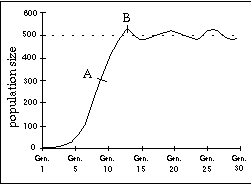
65.
What is the carrying capacity of the graph?
a)
around 500
b)
more than 500
c)
less than 500
d)
around 600
66.
Limiting factors which impact the size of a population no matter how large that population is.
a)
Density Independent Limiting Factors
b)
Density Dependent Limiting Factors
c)
Carrying Capacity
d)
Exponential Growth
67.
An environmental factor such as storms and extreme heat or cold that decrease a population are considered to be. 
a)
density- dependent factor
b)
population density
c)
dispersion
d)
density- independent factor
68.

A lion and a cheetah attempt to occupy the same niche. The more aggressive lion survives; the cheetah does not.

a)

Density-Dependent: Competition

b)

Density-Independent: Competition

c)

Density-Dependent: Predator-Prey

d)

Density-Independent: Predator-Prey

69.

Since lynx prey on hares, an increase in the hare population causes an increase in the lynx population.

a)

Density-Dependent: Competition

b)

Density-Independent: Competition

c)

Density-Dependent: Predator-Prey

d)

Density-Independent: Predator-Prey

70.
The number of individuals per unit area is the definition of which?
a)
Population distribution
b)
Population density
c)
Survivorship type 1
d)
Survivorship type 2
71.
A community is defined as
a)
All the different species that live in an ecosystem
b)
All the members of the same species
c)
All the non-living things in an ecosystem
d)
the average number of species in an ecosystem
72.
Competition between members of different species in a community
a)
Interspecific 
b)
Intraspecific
c)
Conterspecific
d)
Aspecific
73.
Competition between members of the same species
a)
Interspecific
b)
Intraspecific
c)
Conterspecific
d)
Aspecific
74.
Which is an example of interspecific competition 
a)
Trees in the rainforest competing for light
b)
tadpoles in a pond competing for food
c)
big horn sheep competing for mates
d)
Wolves competing for food in the pack
75.
Which is an example of intraspecific competition
a)
2 types of bacteria competing for food
b)
Big horn sheep competing for mates
c)
Trees in the rain forest competing for light
d)
Lions and leopards competing for food 
76.

An organisms Niche can be defined as

a)

The role its plays in the ecosystem

b)

It's physical and biological requirements

c)

the interactions between it and the water cycle

d)

What it feeds on

77.

The idea that no 2 organisms can have an identical niche and coexist in an ecosystem

a)

Generalists principle

b)

Competitive exclusion principle

c)

Specialist principle

d)

Wild Urban principle

78.
What relationship does this graph represent?
a)
Mutualism
b)
Commensalism
c)
Symbiotic
d)
Predator/Prey
79.
The number f births in a population during a certain amount of time
a)
changes in population
b)
birth rate
c)
births
d)
population density
80.
When part of a population leaves an enviroment
a)
changes in population
b)
carrying capacity
c)
emigration
d)
immigration
81.
When organisms move in from another environment
a)
changes in population
b)
immigration
c)
emigration
d)
limiting factors
82.
What is diffusion?
a)
when molecules move from a low concentration to a high concentration 
b)
when molecules move from a high concentration to a low concentration.
c)
no movement 
d)
molecules move everywhere
83.
What is the definition of  Selective Permeability?
a)
The movement of materials across the cell membrane that requires NO ENERGY from the cell.
b)
The movement of materials through (or across) the cell membrane
c)
The ability of the cell membrane to allow some things to pass through while preventing other things from passing through.
d)
The movement of molecules from an area of high concentration (where the molecules are more crowded together) to a area of low concentration (where molecules are more spread apart)
84.
Osmosis
a)
diffusion of water molecules through a semi-permeable mebrane from an area of low concentration to an area of high concentration
b)
the diffusion of particles from an area of high concentration to an area of low concentration
c)
diffusion of water molecules through a semi-permeable membrane from an area of high concentration to an area of low concentration
d)
the diffusion of particles from an area of low concentration to an area of high concentration
85.
What is the definition of Equilibrium?
a)
the process that brings LARGE particles INTO the cell through the cell membrane
b)
The movement of molecules from an area of high concentration (where the molecules are more crowded together) to a area of low concentration (where molecules are more spread apart)
c)
the state where molecules are equally concentrated (balanced) on both sides of the cell membrane.
d)
the movement of WATER molecules across the cell membrane.
86.
In the given scenario what will happen to the organism: salt is poured onto eggplant.
a)
Water will move out of the eggplant cells and the cells will shrink.
b)
Water will move out of the eggplant cells and the cells will swell.
c)
Water will move into the eggplant cells and the cells will swell.
87.
In the given scenario what will happen?  An egg is placed in pure water for 48 hours.
a)
The egg will gain water and swell.
b)
Water will move in and out of the cell equally, and the cell with neither shrink nor swell.
c)
The egg will lose water and shrink.
88.
A balance that an organism maintains by regulating what goes into and out of the cell.
a)
Hypertonic
b)
Homeostasis
c)
Plasmolysis
d)
Hypotonic
89.
The type of cellular transport that requires no energy.
a)
Active Transport
b)
Protein Pumps
c)
Passive Transport
d)
Endocytosis
90.
What condition occurs when too much water moves into the cell and the cell membrane bursts?
a)
Plasmolysis
b)
Exocytosis
c)
Endocytosis
d)
Cytolysis
91.
Which of the following modes of cellular transport does NOT require energy?
a)
Facilitated Diffusion
b)
Protein Pumps
c)
Endocytosis
d)
Exocytosis
92.
The process of engulfing food or liquid particles into the cell.
a)
Osmosis
b)
Exocytosis
c)
Endocytosis
d)
Diffusion
93.
The release of large particles, often waste materials from the inside of the cell to the outside of the cell.
a)
Osmosis
b)
Exocytosis
c)
Endocytosis
d)
Diffusion
94.
Condition that occurs if too much water leaves the cell and cell collapses.
a)
Plasmolysis
b)
Osmosis
c)
Cytolysis
d)
Exocytosis
95.
What type of transport uses transport (channel) proteins to help molecules move from higher to lower concentrations?
a)
Protein Pumps
b)
Diffusion
c)
Facilitated Diffusion
d)
Osmosis
96.
What happens to a plant cell that is placed into a hypotonic solution?
a)
It shrinks
b)
Plasmolysis
c)
It swells
d)
Cytolysis
97.
A phospholipid has 2 parts. What are they called? 
a)
Hydrophilic Head, Hydrophobic Tail 
b)
Hydrophobic Head, Hydrophilic Tail 
98.
"Water Loving"
a)
Hydrophobic
b)
Hydrophilic 
c)
Hydroelectric 
d)
Hydroloric
99.
"Water Fearing" 
a)
Hydrophobic
b)
Hydrophilic 
c)
Hydroelectric 
d)
Hydroloric
100.
___________ strengthens and stabilizes the cell membrane.
a)
Carbohydrates 
b)
Proteins 
c)
Phospholipids 
d)
Cholesterol
101.
___________ have 2 functions in the cell membrane.
1.) They act like gatekeepers, only let certain things in. 
2.) Enzyme receptors embedded in the membrane.
a)
Carbohydrates 
b)
Proteins 
c)
Phospholipids 
d)
Cholesterol
102.
Something is ___________ ____________
when some molecules can cross the membrane while others cannot. 
a)
Selectively (or Semi) Permeable 
b)
Totally Transparent
c)
Liquid Licorice 
d)
Heavily Patrolled 
103.
What type of transport requires energy? 
a)
Active Transport
b)
Facilitated Diffusion
c)
Simple Diffusion
d)
Passive Transport
104.
The cell below is in a _________ solution.
a)
Hypotonic
b)
Hypertonic
c)
Isotonic
105.
The cell below is in a _____________ solution.
a)
Hypertonic
b)
Hypotonic
c)
Isotonic
106.
An ISOTONIC solution has a(n) ______________ concentration of solute (dissolved stuff) than inside the cell.
a)
lower
b)
equal
c)
higher
107.

Where is chlorophyll found in a plant cell?

a)

Nucleus

b)

Cytoplasm

c)

Chloroplasts

d)

Cell wall

108.

Which wavelengths of light do chlorophyll absorb the best

a)

Green and red

b)

Green and blue

c)

Red and blue

d)

Red green and blue

109.

What waste gas is produced by photosynthesis?

a)

Carbon Dioxide

b)

Nitrogen

c)

Argon

d)

Oxygen

110.
Which of the following is the correct equation for PHOTOSYNTHESIS?
a)
CO+ light + H2O --> O+ Sugar
b)
CO+ sugar + H2O --> O+ light
c)
O2 + light + H2O --> CO+ Sugar
d)
CO+ O2 + H2O --> Light+ Sugar
111.
Which gas is removed from the atmosphere during photosynthesis?
a)
hydrogen
b)
oxygen
c)
nitrogen
d)
carbon dioxide
112.
What are the products of photosynthesis?
a)
water and carbon dioxide
b)
oxygen and glucose
c)
oxygen and carbon dioxide
d)
oxygen and water
113.
What is one of the reactants of cellular respiration?
a)
energy
b)
glucose
c)
carbon dioxide
d)
water
114.
What is the correct equation for cellular respiration?
a)
6O2 + C6H12O6 -> 6CO2 + 6H2O + Energy
b)
6O2 + C6H12O6 + Energy -> 6CO2 + 6H2O
c)
6CO2 + 6H2O -> 6O2 + C6H12O6 + Energy
d)
6CO2 + 6H2O + Energy -> 6O2 + C6H12O6
115.
Cellular Respiration's goal is to
a)
make water
b)
make ATP
c)
make glucose
d)
make  oxygen
116.
This is referred to as the energy currency of the cell
a)
ADP
b)
ATP
c)
Mitochondria
d)
Nucleus
117.
This molecule contains two phosphate groups
a)
ADP
b)
ATP
c)
Mitochondria
d)
Nucleus
118.
Cellular respiration takes place in the
a)
nucleus
b)
cytoplasm
c)
ribosomes
d)
mitochondria
119.
Glucose is broken down during which process
a)
Krebs cycle
b)
Calvin cycle
c)
Glycolysis
d)
Photosynthesis
120.
What is the net gain of ATP during glycolysis?
a)
1
b)
2
c)
3
d)
4
121.
This process produces molecules that carry energy to the second part of cellular respiration
a)
Photosynthesis
b)
Kreb's Cycle
c)
Glycolysis
d)
Electron Transport Chain
122.

Up to how many ATP molecules are made from the breakdown of one glucose molecule?

a)

2

b)

24

c)

36

d)

45

123.
This process does not make ATP alone, but it allows glycolysis to continue making ATP when oxygen is unavailable for cellular respiration.
a)
Fermentation
b)
Electron Transport Chain
c)
Glycolysis
d)
Kreb's cycle
124.
This means that oxygen is needed
a)
anaerobic 
b)
aerobic
125.
This means that oxygen is not needed
a)
anaerobic 
b)
aerobic
126.
What are the products of aerobic respiration?
a)
Glucose and oxygen
b)
Carbon dioxide and water
c)
Lactic acid
d)
Carbon monoxide
127.
In which way are photosynthesis and cellular respiration different?
a)
Cellular respiration stores ATP, while photosynthesis releases ATP.
b)
Cellular respiration produces oxygen, while photosynthesis uses oxygen.
c)
Photosynthesis releases energy, while cellular respiration stores energy.
d)
Photosynthesis used carbon dioxide, while cellular respiration produces carbon dioxide.
128.
What is the correct equation for cellular respiration?
a)
6O2 + C6H12O6 -> 6CO2 + 6H2O + Energy
b)
6O2 + C6H12O6 + Energy -> 6CO2 + 6H2O
c)
6CO2 + 6H2O -> 6O2 + C6H12O6 + Energy
d)
6CO2 + 6H2O + Energy -> 6O2 + C6H12O6
129.
The energy in ATP is stored 
a)
in the bond between the second and third phosphate
b)
in the bond between the first and second phosphate
c)
in the bond between the adenosine and the first phosphate
d)
I like turtles
130.
 The expression "feel the burn" means that a person exercising is doing 
a)
lactic acid fermentation
b)
alcoholic fermentation
c)
photosynthesis
d)
aerobic respiration
131.

The Calvin Cycle takes place in the:

a)

Stroma

b)

Thylakoid

c)

Grana

d)

Stomata

132.
The main advantage of C4 Photosynthesis is the ability to avoid:
a)
Transpiration
b)
Photorespiration
c)
Photosynthesis
d)
Signal Transduction
133.
The main advantage of CAM Photosynthesis is the ability to avoid:
a)
Transpiration
b)
Photorespiration
c)
Photosynthesis
d)
Signal Transduction
134.
Carbon fixation in CAM plants occurs during the:
a)
Day
b)
Night
135.
The main problem encountered by C3 plants in hot conditions is:
a)
Transpiration
b)
PhotoRespiration
c)
Dehydration
d)
Starvation
136.

What is common between the two types of fermentation?

a)

Formation of O2

b)

Energy released

c)

Regeneration of NAD+

137.

The products of Alcoholic Fermentation are....

a)

Glucose, O2, Ethyl alcohol

b)

Ethanol, CO2

c)

ATP, CO2, H2O

138.

Fermentation recycles ________ back to glycolysis

a)

NADH

b)

NADP

c)

ATP

d)

NAD+

e)

ADP

139.
Lactic acid fermentation occurs in your muscles after a workout because your cells are struggling to get...
a)
Glucose
b)
Sunlight
c)
Oxygen
d)
Water
140.
The process carried out by yeast that causes bread to rise is
a)
alcoholic fermentation
b)
lactic acid fermentation
c)
cellular respiration
d)
yeast mitosis
141.

Plants did not grow well in what color light?

a)

Red

b)

Green

c)

Orange

d)

Violet

142.

Increasing the intensity of light had what effect on photosynthesis?

a)

It slowed it down

b)

It sped up

c)

It stayed the same

143.

Increasing the amount of CO2 did what to the rate of photosynthesis?

a)

Increased

b)

Decreased

c)

Stayed the same

d)

increased then leveled off

144.

Once a plant has reached its saturation point of light intensity, what danger could exist for the plant?

a)

Photosynthesis rate will increase indefinitely

b)

byproducts of photo inhibition like OH- and H2O2 will damage the chloroplast

c)

a plant can never have too much light

d)

a plant will lose all of its leaves

145.

Which of the following will trigger leaves to change color?

a)

cooler temperatures

b)

shorter days

c)

warmer temperatures

d)

both cooler temperatures and shorter days