wayground logo

Free Printable Worksheets

Font size

S
M
L
XL
Worksheets

BI55 Final Exam Review

Total questions: 152

Worksheet time: 2hrs 15mins

Name
Class
Date
1.
Which is NOT a step in the scientific method?
a)
Make observation
b)
Form a theory
c)
Collect data
d)
Form a hypothesis
2.
A testable explanation to a problem that has not yet been tested. 
a)
data
b)
theory
c)
hypothesis
d)
fact
3.
An experiment is performed on plants to see how different liquids affect plant growth. Each plant in the experiment is given a different liquid; water, apple juice, or milk. Each plant has the same amount of soil, sunlight, and listens to the same music. In this investigation, the independent variable is ...
a)
The type of plant
b)
The amount of sunlight
c)
The type of music
d)
The type of liquid
4.
If you increase the amount of spinach you eat, then you will increase the iron in your blood. 
What's the dependent variable?
a)
increase the amount of iron in your blood
b)
spinach you eat
5.
Will a construction paper air plane fly faster than an airplane made from notebook paper? Choose the best hypothesis.
a)
If I make a paper airplane from notebook paper, then it will fly faster than construction paper.
b)
Yes.
c)
No.
d)
I think the construction paper air plane will fly faster.
6.
Write 7.113 x 10⁷ in standard form.
a)
71,130,00
b)
7,113,000
c)
0.0000007113
d)
7,113
7.
Write 0.00000707 in scientific notation.
a)
7.07 x 10⁻⁶
b)
7.07 x 10⁶
c)
707 x 108
d)
707 x 10-8
8.
Convert from meters to cm:  9 meters
a)
900 cm
b)
90 cm
c)
0.9 cm
d)
0.09 cm
9.
648 g = ____ mg
a)
6,480
b)
64,800
c)
648,000
d)
64.8
10.
42 L = ___mL
a)
4,200
b)
.0042
c)
4.20
d)
42,000
11.
The basic units of structure and function within the human body.
a)
Cells
b)
Organs
c)
Systems
d)
Tissues
12.
A neuron is this kind of cell.
a)
Bone
b)
Muscle
c)
Nerve
d)
Skin
13.
A group of specialized cells that work together to perform the same function.
a)
Organ
b)
Organism
c)
System
d)
Tissue
14.
Which of the following is the correct order of organization in living things from most basic (simple) to most complex?
a)
a.  Organism, cell, tissue, organ, organ system
b)
a.  Organ system, organ, tissue, cell, organism
c)
a.  Cell, tissue, organ, organ system, organism
d)
a.  Cell, organ, tissue, organ, organism, organ system
15.
A group of similar cells that come together to perform a specific function is a/an
a)
organ
b)
organism
c)
organ system
d)
tissue
16.
When a group of organs work together to perform a particular function they create a/an
a)
organ system
b)
organism
c)
tissue
d)
organ
17.
If the environment gets cold, we will often shiver in order to:
a)
keep body temperature the same as the external temperature
b)
decrease body temperature
c)
increase body temperature
d)
regulate blood pressure
18.
The maintenance of an organism’s internal environment is called:
a)
compensating
b)
homeostasis
c)
balancing
d)
routine
19.
chemical made by glands that tell cells to make something or respond in some way.
a)
acid
b)
enzyme
c)
perspiration
d)
hormone
20.
What is another word that can be used to describe "homeostasis"?
a)
STABLE
b)
EQUAL
c)
COMPLETE
d)
CORRECT
21.
What are the nucleotides made of?
a)
Sugar, Phosphate, nitrogen base
b)
Phosphate, Adenine, nitrogen base
c)
Thymine, Adenine, Cytomine
d)
Phosphate, Nitrogen, Adenine
22.
Which of the following best describes a DNA molecule?
a)
double helix
b)
contains ribose
c)
made of amino acids
d)
contains Uracil
23.
Which of the following units are repeatedly joined together to form a strand of DNA? (This is the MONOMER of DNA.) 
a)
amino acids
b)
nucleotides
c)
fatty acids
d)
polysaccharides
24.
Adenine bonds with ______________.
a)
Guanine
b)
Thymine
c)
Cytosine
d)
Adenine
25.
Which organelle is DNA usually found in?
a)
cell membrane
b)
vacuole
c)
chloroplast
d)
nucleus
26.
Which sequence of DNA bases would pair with this partial strand
ATG TGA CAG
a)
ATG TGA CAG
b)
TAC ACT GTC
c)
GTA AGT GAC
d)
CAT TCA CTG
27.
Replicate the following strand of DNA: 
AATCATGGA
a)
AATCATGGA
b)
TTAGTACCT
c)
UUAGUACCU
d)
GGATAUCUA
28.
The enzyme that unzips the DNA to prepare for replication
a)
helicase
b)
replicase
c)
polymerase
d)
synthase
29.
order of replication
a)
3, 2, 1, 4
b)
2, 1, 4, 3
c)
2, 3, 1, 4
d)
3, 4, 1, 2
30.
Why is DNA important?
a)
it is very small and very complicated
b)
it's in everything
c)
it serves as the blueprint for traits of all living things
d)
because we eat it every day for energy
31.
Which 2 molecules form the sides (backbone) of the DNA ladder?
a)
deoxyribose sugar and adenine
b)
deoxyribose sugar and a hydrogen bond
c)
deoxyribose sugar and the nucleus
d)
deoxyribose sugar and phosphate
32.
In order for a mutation to be passed on from parent to offspring, the mutation must occur in...
a)
somatic cells
b)
gametes
c)
brain cells
d)
any cell of the body
33.
If a mutation only changes the nucleotide sequence for a single protein, then it is known as a
a)
gene mutation
b)
chromosomal mutation
c)
translocation
d)
nondisjunction mutation
34.
What kind of mutation occured in the sex chromosome of an individual with the genotype XXY?
a)
base deletion 
b)
inversion
c)
base insertion
d)
nondisjunction
35.
What mutation has occurred here? 
T-G-A-C-C-A
T-G-A-G-C-A
a)
Substitution
b)
Deletion
c)
Insertion
d)
Frameshift 
36.
What is the difference between DNA and RNA in terms of bases?
a)
RNA contains uracil in place of thymine
b)
RNA contains uracil in place of adenine
c)
RNA contains uracil in place of guanine
d)
RNA contains uracil in place of  cytosine
37.
What will be the resulting mRNA from this DNA sequence:
GAT-TAC-AGA-TTA-CAT?
a)
CTA-ATG-TCT-AAT-GTA
b)
GAU-UAG-UGA-UUA-GUT
c)
CUA-AUG-UCU-AAU-GUA
d)
CAT-ACA-TAC-ATA-TAG
38.
Nucleotides are made up of a sugar, phosphate, and..?
a)
nitrogenous base
b)
nucleic acid
c)
cholesterol
d)
fatty acid
39.

What does mRNA do?

a)

carry info from genes to ribosomes

b)

carry amino acids to ribosomes

c)

help with RNA splicing

d)

make up ribosomes

40.
What is an exon?
a)
section of mRNA that codes for protein
b)
section of mRNA that does not code for protein
c)
section of tRNA that codes for protein
d)
section of rRNA that codes for protein
41.
Which RNA bases would pair with TACGAA in transcription
a)
AUGCUU
b)
ATGCTT
c)
GCATCC
d)
GCAUCC
42.
Which is NOT required to make proteins
a)
DNA
b)
RNA
c)
Ribosomes
d)
lysosomes
43.

What is the building block of proteins?

a)

Monosacchrides

b)

Polysaccharides

c)

amino acids

d)

Triglycerides

44.

The enzyme required for transcription is

a)

DNA polymerase

b)

RNA polymerase

c)

RNAse

d)

Restriction Enzyme

45.
RNA is read in sections called:
a)
Triplets
b)
Genes
c)
Codons
d)
Genes
46.
Translation is a process in eurkaryotic cells takes place in the:
a)
Cytoplasm
b)
Nucleus
c)
Nucleolus
d)
Golgi Bodies
47.
tRNA molecules match the mRNA codons with a(n):
a)
Codon
b)
Anti-Codon
c)
Intron
d)
Methylated Cap
48.
The positive particles of an atom are 
a)
electrons 
b)
positrons 
c)
neutrons 
d)
protons 
49.
an atom with atomic number 6 would have how many protons 
a)
6
b)
12
c)
3
d)
cannot be determined 
50.
Particles in an atom that are neutral and have no charge are 
a)
negatrons 
b)
electrons 
c)
neutrons 
d)
protons 
51.
What is the atomic number for an element with three protons?
a)
2
b)
1
c)
3
d)
6
52.
What is the mass number?
a)
the number of protons
b)
the number of protons and neutrons
c)
the number of neutrons
d)
the number of protons and electrons
53.
Ions are: 
a)
atoms with a positive or negative charge
b)
atoms with no charge
c)
atoms with ONLY a positive charge
d)
atoms with ONLY a negative charge
54.
Two atoms of the same element but with different mass numbers are called________
a)
electrons
b)
isotopes
c)
variables
d)
electron cloud
55.
How many neutrons does the isotope of lithium have?
a)
8
b)
3
c)
4
d)
5
56.
How many protons does this isotope of titanium have?
a)
48
b)
22
c)
26
d)
70
57.
a)
2
b)
8
c)
3
d)
13
58.
What element in period 2 has 7 valence electrons?
a)
Beryllium
b)
Chlorine
c)
Magnesium
d)
Fluorine
59.
Valence electrons are: 
a)
Electrons farthest away from the nucleus
b)
Electrons closest to the nucleus
c)
Electrons that just come and go - they don't stay with the atom
d)
Electrons in the second shell
60.

This is a correct dot diagram for nitrogen (N)

a)

true

b)

false

61.
Isotopes have different numbers of
a)
protons
b)
neutrons
c)
electron
d)
properties
62.
How many valence electrons does Sulfur have?
a)
16
b)
32
c)
6
d)
3
63.
Hydrogen bonding occurs in molecules when ___________________.
a)
a hydrogen atom forms a covalent bond with another atom.
b)
a hydrogen atom in a molecule forms a bond with any atom.
c)
a hydrogen atoms form an ionic bond with another atom on an adjacent molecule.
d)
a hydrogen atom bonded to F, O or N is attracted to an electron pair on a F, O or N atom on an adjacent molecule.
64.
What is the maximum number of hydrogen bonds one molecule of water can form?
a)
1
b)
2
c)
3
d)
4
65.
Made of monomers of amino acids
a)
Carbohydrates 
b)
Lipids
c)
Proteins 
d)
Nucleic Acids
66.
Made of glycerol and fatty acids
a)
Carbohydrates
b)
Lipids
c)
Proteins
d)
Nucleic Acids
67.
Include sugars (ex. glucose) and starches
a)
Carbohydrates
b)
Lipids
c)
Proteins
d)
Nucleic Acids
68.
Include waxes, oils, steroids (hormones)
a)
Carbohydrates
b)
Lipids
c)
Proteins
d)
Nucleic Acids
69.
Speed up chemical reactions, protects against infections, and structural component of hair, skin, and muscles
a)
Carbohydrates
b)
Lipids
c)
Proteins
d)
Nucleic Acids
70.
The elements found in proteins but not carbohydrates and lipids are __________________________.
a)
nitrogen and sulfur
b)
nitrogen and phosphorus
c)
carbon and hydrogen
d)
iron
71.
Organic or Inorganic? 
a)
Organic
b)
Inorganic
72.
Enyzmes are a very important type of protein used to
a)
Build bones in skeleton
b)
Send hormonal signals throughout body
c)
Speed up chemical reactions
d)
Photosynthesize glucose in plants
73.
What type of transport is this?
a)
facilitated diffusion
b)
active transport
c)
diffusion
d)
osmosis
74.
The most important organelle in cell transport is the.....
a)
E.R.
b)
cytoplasm
c)
nucleus 
d)
cell membrane
75.
Special proteins help move particles, but NO energy is needed. This is..
a)
facilitated diffusion
b)
exocytosis
c)
active transport
d)
equilibrium
76.
When something is 'water fearing' it is....
a)
Hydrophobic
b)
Hydrophilic 
c)
Hydroelectric 
d)
Hydrochloric
77.
Which part of this phospholipid is hydrophobic?
a)
fatty lipid tails
b)
head
c)
all of it is hydrophobic
d)
none of it is hydrophobic
78.
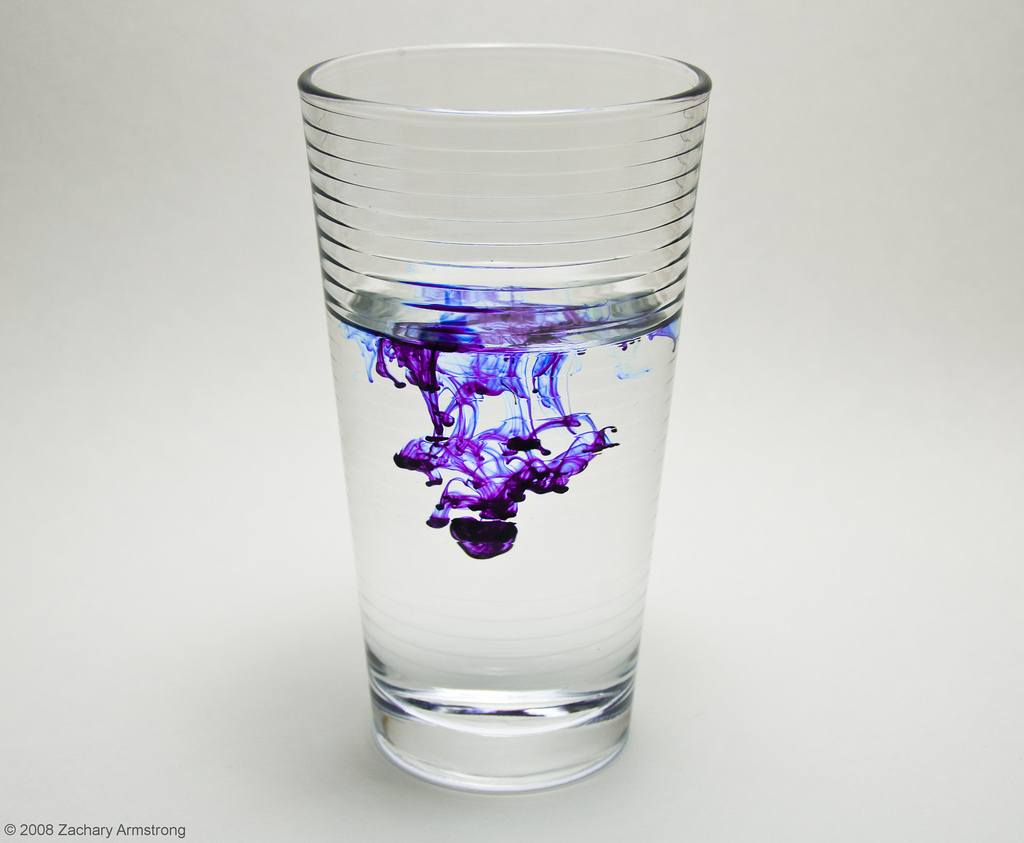
Where is there a low concentration of dye?
a)
at the bottom of cup
b)
in the color
c)
at the top of cup 
d)
no concenteraion gradient
79.
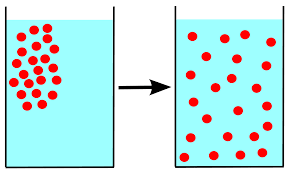
The picture below is an example of _________________.
a)
osmosis
b)
isotonic
c)
diffusion
d)
active transport
80.
Osmosis is the movement of _____ across a membrane.
a)
food
b)
energy
c)
oxygen
d)
water
81.
A person would never have pure water put into their veins in a hospital because their cells would...
a)
Shrink/Dehydrate
b)
Expand
82.
A person should never drink salty water because their cells would
a)
shrink
b)
expand
83.
If there is 5 percent water inside a cell and 5 percent water outside a cell
a)
more water will move inside the cell
b)
more water will move outside the cell
c)
There will be no movement of water cells
84.
Passive transport requires no
a)
concentration gradients
b)
osmosis
c)
motion
d)
energy
85.
The movement of molecules against a concentration gradient
a)
simple diffusion
b)
facilitated diffusion
c)
active transport
d)
osmosis
86.
What is a solute?
a)
The substance that does the dissolving in a solution.
b)
The substance that is dissolved into the solution.
c)
The mixing of different substances.
d)
The process in which neutral molecules lose or gain electrons
87.
What is a solvent?
a)
The substance that does the dissolving in a solution.
b)
The substance that is being dissolved in a solution.
c)
The mixing of different substances.
d)
The process in which neutral molecules lose or gain electrons
88.
Which is an example of a solute?
a)
Egg whites
b)
Sugar
c)
Water
d)
Acetone
89.
Which of the following is the most important buffer system in the human body?
a)
plasma protein
b)
phosphate
c)
hemoglobin 
d)
bicarbonate 
90.
Which of the following word pairs correctly completes the sentence below?
_______ are corrosive substances characterized as having a strong smell, a sour taste, and a _______.
a)
Acids; pH less than 7
b)
Acids; pH greater than 7
c)
Bases; pH greater than 7
d)
Bases; pH less than 7
91.
The esophagus is the tube that connects the mouth to the stomach. Heartburn occurs when some of the stomach juices flow backwards up the esophagus. To help relieve heartburn, a person should take medicine that is
a)
neutral
b)
basic
c)

acidic or basic.
d)
acidic
92.
Under a microscope, what kind of cells lack membrane-bound internal organelles?
a)
Prokaryotes
b)
Eukaryotes
c)
Plants
d)
Animals
93.
The picture illustrates a
a)
Prokaryotic Plant Cell
b)
Prokaryotic Animal Cell
c)
Eukaryotic Plant Cell
d)
Eukaryotic Animal Cell
94.
releases energy for cells to use, most common in animal cells
a)
mitochondria
b)
ribosomes
c)
lysosomes
d)
nucleolus
95.
Amino acids link together to form proteins. In which organelle would this process occur?
a)
Lysosome
b)
Ribosome
c)
Centriole
d)
Mitochondria
96.
packages proteins for delivery
a)
Endoplasmic reticulum
b)
ribosomes
c)
golgi apparatus
d)
lysosomes
97.
collect sunlight which it converts to sugars
a)
chloroplasts
b)
cytoplasm
c)
cell wall
d)
mitochondria
98.
hold/store water, mainly found in plant cells
a)
nuclolus
b)
ribosomes
c)
golgi bodies
d)
vacuoles
99.
break down (digest) worn out cell parts, mostly in animal cells
a)
cytoplasm
b)
lysosomes
c)
mitochondria
d)
vacuoles
100.
This is the cell's "control center."
a)
Endoplasmic Reticulum
b)
Golgi Body
c)
Nucleus
d)
Cell Wall
101.
What does this organism use for movement?
a)
Pseudopod
b)
Cilia
c)
Flagella
d)
legs
102.
Exocytosis is the movement of
a)
any type of substance from outside the cell to the inside of the cell. 
b)
very large substances from outside the cell to the inside of the cell. 
c)
any type of substance from inside the cell to the outside.
d)
very large substances from inside the cell to the outside.
103.
Endocytosis is defined as
a)
the movement of large molecules from the inside of the cell to the outisde of the cell using channel proteins. 
b)
the movement of large molecules from the inside of the cell to the outisde of the cell membrane vesciles. 
c)
 the movement of large molecules from the outside of the cell to the inside of the cell using membrane vesciles.
d)
the movement of large molecules from the outside of the cell to the inside of the cell using channel proteins. 
104.
This type of endocytosis is used by the cell to take in large molecules or tiny organisms. 
a)
Pinocytosis 
b)
Protein pumps
c)
Phagocytosis
d)
Exocytosis
105.
__________ is stored energy. 
a)
Potential
b)
Kinetic
c)
None of the above 
d)
All of the above 
106.
What kind of energy is in a moving skateboard?
a)
Potential
b)
Kinetic
c)
Both potential and kinetic energy
d)
none of the above
107.
ATp gives us?
a)
Sunlight 
b)
Energy
c)
Chemicals
d)
Sun 
108.
Enzymes are considered to be 
a)
Lipids
b)
Carbohydrate
c)
Protein
d)
Nucleic Acid
109.
What is the purpose  of an enzyme?
a)
give permission for the reaction
b)
raise activation energy
c)
speed up reactions
d)
control how many reactions occur
110.
Where do substrates bind on an enzyme?
a)
voltage-gated channels
b)
surface receptor
c)
calcium channels
d)
active site
111.
Changes in pH and temperature can damage an enzymes active site.  What is this called?
a)
reusable
b)
catalyst
c)
specific
d)
fragile
112.
Once a new product leaves an enzyme, the enzyme is unchanged and ready for the next substrate.  What is this called?
a)
reusable
b)
catalyst
c)
specific
d)
fragile
113.
What are the products of cellular respiration?
a)
Energy (ATP), Water, and Carbon DIoxide.
b)
Water and Oxygen
c)
Oxygen and Carbon Dioxide
d)
Water and Energy (ATP)
114.
Lactic acid fermentation occurs in your muscles after a workout because your cells are struggling to get...
a)
Glucose
b)
Sunlight
c)
Oxygen
d)
Water
115.
Where does the Krebs Cycle take place?
a)
mitochondria
b)
chloroplast
c)
cytoplasm
d)
nucleus
116.
What gas is needed for respiration?
a)
Carbon dioxide
b)
nitrogen
c)
Oxygen
d)
hydrogen
117.
The first step in the break down of glucose is
a)
light reactions
b)
glycolysis
c)
Kreb's cycle
d)
Calvin Cycle
118.
Which structures shown in the Figure make up the ADP molecule?
a)
A and B
b)
A, B and C
c)
A, B, C, and D
d)
C and D
119.
What enzyme in the ETC is responsible for generating the ATP molecules?
a)
acetyl-CoA
b)
ATP synthase
c)
hexokinase
d)
none of the above
120.
What are the three stages that make up cellular respiration?
a)
light reactions, calvin cycle and electron transport
b)
glycolysis, kreb's cycle and Calvin cycle
c)
Glycolysis, Kreb's cycle and electron transport
d)
Light Reactions, Calvin Cycle and Glycolysis
121.
How many NADH molecules are produced by a molecule of glucose through the Krebs' Cycle?
a)
2
b)
3
c)
4
d)
6
122.
Where does glycolysis take place in cells?
a)
Cytoplasm
b)
Mitochondrion
c)
Endoplasmic Reticulum
d)
Ribosomes
123.
What is a series of events a cell goes through as they grow and divide?
a)
Cell Division
b)
Cell Cycle
c)
Cytokinesis
d)
Mitosis
124.
What is the longest stage of the cell cycle called?
a)
Cytokinesis
b)
M phase
c)
Interphase
d)
G1 Phase
125.
During what phase of the cell cycle is DNA replicated?
a)
G1 phase
b)
S phase
c)
G2 phase
d)
M phase
126.
During what phase of the cell cycle does the cell grow?
a)
G1 phase
b)
S phase
c)
M phase
d)
Cytokinesis
127.
What process does a multi-cellular organism use to replace its damaged body cells?
a)
mitosis
b)
meiosis
c)
replication
d)
transcription
128.
Which of these lists presents the stages of the cell cycle in the correct order?
a)
interphase, mitosis, cytokinesis
b)
cytokinesis, mitosis, interphase
c)
mitosis, interphase, cytokinesis
d)
interphase, cytokinesis, mitosis
129.
Matt uses a microscope to look at slides of plant cells.  He sees a cell with two nuclei that have visible chromosomes. In which stage of cell division is this cell?
a)
anaphase
b)
prophase
c)
telophase
d)
interphase
130.
Identify the stage of mitosis.
a)
interphase
b)
prophase
c)
metaphase
d)
anaphase
131.
Identify the stage of mitosis.
a)
interphase
b)
prophase
c)
anaphase
d)
cytokinesis
132.
Identify the stage of mitosis. 
a)
interphase
b)
prophase
c)
anaphase
d)
cytokinesis
133.
What do viruses need to reproduce?
a)
they need genetic material
b)
They need a host cell
c)
They need  bacteria
d)
They need insulin
134.
What part of the phage is the DNA?
a)
A
b)
B
c)
C
d)
D
135.
True or False
The flu is caused by a virus.
a)
true
b)
false
136.
Antibiotics kill viruses
a)
True
b)
False
137.

A female (girl) cell nucleus has two large "XY' sex chromosomes.

a)

True.

b)

False.

138.

In the following structure, the circled item is a

a)

chromosome

b)

chromatid

c)

centromere

d)

chromatin

139.

Bacterial cells have a double stranded DNA molecule

a)

True

b)

False

140.

Which is NOT a characteristic of bacteria?

a)

single-celled

b)

prokaryotic (no nucleus)

c)

decomposer

d)

multi-celled

141.

What's the difference between archaea and bacteria?

a)

There is no difference.

b)

Archaea is single celled and bacteria is multi-celled.

c)

Archaea is less common and bacteria is found everywhere

142.

Identify 1

a)

Ventral cavity

b)

Dorsal cavity

c)

Cranial cavity

d)

Abdominopelvic cavity

143.

Identify 2

a)

Spinal cavity

b)

Dorsal cavity

c)

Orbital cavity

d)

Cranial cavity

144.

Identify 3

a)

Spinal cavity

b)

Abdominal cavity

c)

Cranial cavity

d)

Thoracic cavity

145.

Identify 7

a)

Ventral cavity

b)

Abdominal cavity

c)

Thoracic cavity

d)

Pelvic cavity

146.
__Al + __Fe3N2 -->__AlN + __Fe
a)
already balanced
b)
4,2,4,6
c)
2,1,2,3
d)
1,2,1,3
147.

What are the products of the chemical reaction pictured?

a)

CH4 and CO2

b)

CH4 and O2

c)

CO2 and H2O

d)

O2 and H2O

148.
Consider the chemical equation CH4 + 2 O2 → CO2 + 2 H2O. In this equation, CH4 is a
a)
product
b)
reactant
c)
displacement
149.
Is calcium oxidized or reduced in the following reaction? 
2CaO--> 2Ca + O2
a)
Oxidized
b)
Reduced
150.
     In the reaction Zn + H2O --> ZnO2 + H2
 which element, if any, is oxidized? 
a)
Zinc
b)
Hydrogen
c)
Oxygen
d)
None
151.
What group is 1A
a)
atoms form 1 cations
b)
atoms form 1- anions
c)
atoms form 2- anions
d)
atoms form 2+ cations
152.
What's the difference between a Cation and a Anion?
a)
They are the same
b)
The net electrical charge of the ion