wayground logo

Free Printable Worksheets

Font size

S
M
L
XL
Worksheets

SJS Earth Science Exam Review December 2018

Total questions: 109

Worksheet time: 1hrs 20mins

Name
Class
Date
1.
What kind of weather is usually associated with a high pressure system?
a)
Sunny weather
b)
Precipitation (rain, snow, etc.)
2.

What is weather?

a)

rain and snow

b)

the daily condition of the atmosphere

c)

the average weather in a place over a long time

d)

how hot it is

3.

What does a barometer measure?

a)

air pressure

b)

relative humidity

c)

temperature

d)

wind speed

4.

Is this weather or climate? It's raining today, so I need an umbrella.

a)

weather

b)

climate

5.

Is this weather or climate? The weather in December tends to be cold and snowy.

a)

weather

b)

climate

6.

Is this weather or climate? The fog kept the plane from taking off.

a)

weather

b)

climate

7.

Is this weather or climate? We had record rainfall last week.

a)

weather

b)

climate

8.

Which is NOT an example of extreme weather?

a)

blizzard

b)

tornado

c)

flooding

d)

rain

9.

Which statement best describes the difference between weather and climate?

a)

Weather is what you expect; climate is what you get.

b)

Weather and climate are the same thing.

c)

Climate is what you expect; weather is what you get.

d)

Weather happens in the atmosphere and climate happens on the ground.

10.
Which of the following statements about air pressure is true?
a)
Air pressure increases as altitude increases.
b)
Air pressure decreases as altitude increases.
c)
The atmosphere's air pressure does not vary
d)
Warm air tends to have higher air pressure than cold air
11.
Which accurately describes the atmosphere?
a)
Composed of masses of air particles that are constantly circulating.
b)
Composed entirely of nitrogen and oxygen which react to form ozone.
c)
Comoposed of masses of air particles that move very little, if at all.
d)
Composed of several layers that increase in density as altitude increases.
12.
The graph shows how temperature changes with altitude in the Earth's atmosphere. In the troposphere...
a)
Temperature decreases as altitude increases
b)
Temperature increases as altitude increases
c)
Temperature alternately increases and decreases as altitude increases
d)
Temperature stays the same as altitude increases
13.
Which of the choices below is one of the primary gases found in the atmosphere?
a)
Oxygen
b)
Argon
c)
Carbon Dioxide
d)
Helium
14.
The hydrosphere is predominately made of
a)
liquid water
b)
frozen water
c)
solid rock
d)
gaseous air
15.
Earth's atmosphere is made up of four different layers. In which of the following layer does virtually all of Earth's weather take place?
a)
Stratosphere
b)
Mesosphere
c)
Thermosphere
d)
Troposphere
16.

What would happen to temperatures on Earth if the atmosphere did not exist?

a)

Nothing would happen to change the temperatures.

b)

All temperatures would decrease.

c)

All temperatures would increase.

d)

Temperatures would become more extreme.

17.
The rock, dust, soil, and minerals of the Earth's solid crust and outer mantle make up the ____
a)
Biosphere
b)
Geosphere
c)
Cryosphere
d)
Atmosphere
18.

What keeps the molecules of gases around Earth?

a)

Earth's size

b)

Earth's gravity

c)

Earth's inner core

d)

Earth's magnetic field

19.

If you climbed a mountain, how you you expect the temperature to change as you climbed higher?

a)

Temperature would increase

b)

Temperature would decrease

c)

Temperature would not change

20.
What is the greenhouse effect?
a)
The warming of a planet due to trapped radiation.
b)
The cooling of Earth due to air pollution.
c)
The heating of a solid, such as a rock.
21.
What happens to the temperature if more greenhouse gases are released into the atmosphere?
a)
Temperature goes up
b)
Temperature goes down
22.
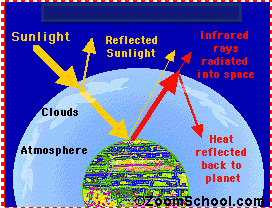
What does this diagram illustrate?
a)
Ozone Layer
b)
The Greenhouse Effect
c)
Ultraviolet Radiation
d)
Layers of the atmosphere
23.
Which of the following is NOT a greenhouse gas?
a)
Oxygen
b)
Carbon Dioxide
c)
Methane
d)
Nitrous Oxide
24.
The Earth's axis is tilted _____ degrees.
a)
23.5
b)
25.3
c)
30.2
d)
24
25.
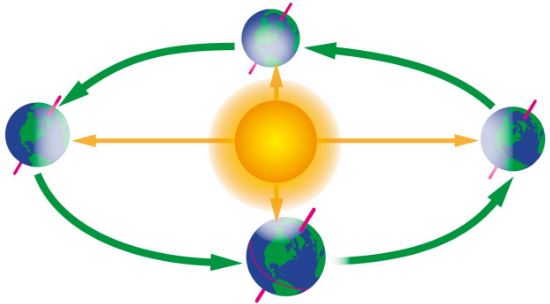
At position A, which hemisphere would have summer?
a)
Northern hemisphere
b)
Southern hemisphere
26.
What happens when the area in which you live tilts away from the sun?
a)
It is summer.
b)
It is spring.
c)
It is winter.
d)
It is fall.
27.
The term equinox means....
a)
equal amount of day light and equal amount of night
b)
Equal amount of winter and summer
c)
Equal amounts of hot dogs for everyone
d)
The longest day of the year
28.
What do June 21 and December 21 have in common?
a)
equinox dates
b)
the moon is full
c)
solstice dates
d)
the cold fronts blow in
29.
What is the longest day of the year?
a)
winter solstice
b)
summer solstice
c)
fall equinox
d)
spring equinox
30.
Why do we experience the changing of the season on the earth?
a)
distance from the sun
b)
rotation of the earth
c)
change in solar output
d)
tilt of the earth's axix
31.
Why is the Equator warmest?
a)
Because it is closest to the sun.
b)
Because it receives the most direct sunlight
c)
Because no clouds form here.
d)
Because it is far from the sun
32.
In spring/summer, the axis of the earth is pointed away or toward the sun?
a)
towards
b)
Neither away or toward
c)
away
33.
Which season is taking place in the Northern Hemisphere in Position 1?
a)
Winter
b)
Spring
c)
Summer
d)
Fall
34.
Which season is taking place in the Northern Hemisphere in Position 2?
a)
Winter
b)
Spring
c)
Summer
d)
Fall
35.
Which season is taking place in the Northern Hemisphere in Position 3?
a)
Winter
b)
Spring
c)
Summer
d)
Fall
36.
Which season is taking place in the Northern Hemisphere in Position 3?
a)
Winter
b)
Spring
c)
Summer
d)
Fall
37.
Which season is taking place in the Northern Hemisphere in Position 4?
a)
Winter
b)
Spring
c)
Summer
d)
Fall
38.
The spinning of an object on its axis is called______
a)
orbit
b)
rotation
c)
revolution
d)
tide
39.
Day and night is caused by the _____________ of earth on its axis.
a)
revolution
b)
orbit
c)
rotation
40.
The earth orbits around...
a)
the sun.
b)
the moon
c)
other planets
d)
the Milky Way
41.
What are the reasons for the seasons?
a)
Earth's tilt and rotation.
b)
Earth's rotation and revolution.
c)
Earth's tilt and revolution.
d)
Earth's tilt and resolution
42.
When the Northern Hemisphere of Earth is Leaning away from the Sun, What season is the Southern Hemisphere experiencing?
a)
Summer
b)
Winter
c)
Spring
d)
Fall
43.
How long does it take the Earth to make one REVOLUTION around the Sun?
a)
12 hours
b)
24 hours
c)
365 days
d)
29.5 days
44.
What season is letter A?
a)
Winter
b)
Summer
c)
Spring
d)
Fall
45.
When experimenting with the growth of a plant, a scientist uses three (of the same type of) plants, two different fertilizers, equal light, and equal water. What type of variable is the fertilizer?
a)
Dependent
b)
Independent
c)
Control
d)
Compound
46.
Research Question: Does the type of gasoline put in a car effect how fast the car can drive. What is the independent variable?
a)
Type of gasoline
b)
which car the gas is put into
c)
how fast the car can drive
d)
how much gas is put into the car
47.
What would the INDEPENDENT variable be in an experiment testing which types of paper airplane goes furthest?
a)
the paper used
b)
the type of paper airplane
c)
the distance of each plane's flight
d)
how hard the plane is thrown
48.
Ms. S set up an experiment to see how the mass of a ball affects the distance it rolls off a ramp. What is the dependent variable?
a)
Distance traveled by the ball
b)
Height of the ramp
c)
Mass of the ball
d)
Where the experiment took place.
49.
Tiffany was investing how fast it took Hayden to react to different sounds. Identify the independent variable.
a)
How fast Hayden reacted
b)
different sounds
c)
types of music
d)
Hayden
50.
The independent variable is the ONE thing you _____.
a)
change
b)
keep the same
c)
experiment with
d)
investigate
51.
 In a controlled experiment, the variable that is changed to test the hypothesis is called the –
a)
Controlled Variable
b)
Responsive Variable
c)
Dependent Variable
d)
Independent Variable
52.
The measurable factor in an experiment is known as the: 
a)
Control
b)
Independent Variable
c)
Constant
d)
Dependent Variable
53.
 A comprehension test was given to students after they had studied textbook material either in silence or with the television turned on. What is the dependent variable?
a)
silence
b)
television turned on
c)
score on test
d)
textbook material
54.
What always has the highest angle of insolation?
a)
the north pole
b)
45 degrees north
c)
the south pole
d)
the equator
55.
Which process is responsible for the greatest loss of energy from Earth’s surface into space on a clear night?
a)
Condensation
b)
Conduction
c)
Radiation
d)
Convection
56.
If the tilt of Earth’s axis were increased from 23.5° to 30°, summers in New York State would become
a)
Cooler, and winters would become cooler
b)
Cooler, and winters would become warmer
c)
Warmer, and winters would become cooler
d)
Warmer, and winters would become warmer
57.
Equal areas of which surface will absorb the most insolation?
a)
Partially melted snowfield
b)
Blacktop parking lot
c)
White sand beach
d)
Lake surface
58.
In a well designed experiment, you should change how many variables?
a)
only one
b)
no more than two
c)
none at all
d)
as many as are needed
59.
Everything you want to remain the same or unchanged is called are called  the ___________ variables.
a)
independent
b)
dependent
c)
controlled
60.
What is the definition of CONDUCTION?
a)
When heat is transferred from objects like rays of light or electromagnetically.
b)
a  hot liquid or air that  expands, becomes less dense, and rises or becomes more dense, and sinks.
c)
When heat transfers from objects that are touching.
d)
When heat transfers through the heater or AC in your house.
61.
What is the definition of CONVECTION
a)
When heat transfers through waves.
b)
When heat transfers from objects that are touching.
c)
a  hot liquid or air that  expands, becomes less dense, and rises or becomes more dense, and sinks.
d)
Heat traveling from the sun
62.
What kind of heat transfer happens when the sun is heating your body?
a)
Conduction
b)
Radiation
c)
Convection
d)
Density
63.
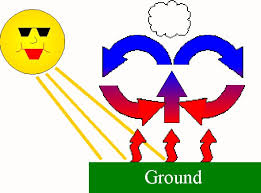
Which of the following is an example of convection?
a)
A hair dryer is drying up your hair.
b)
When the AC or heater changes the temperature.
c)
When a car engine turns hot after being turned on.
d)
When you are making soup and the water is rising and lowering.
64.
What heat transfer happens when you burn your hand by touching a fire?
a)
Radiation
b)
Conduction
c)
Convectio
d)
I don't know!!!!!!!!!!!
65.
Which of the following is needed for convection to happen?
a)
Fluid/s
b)
Light in the form or rays
c)
Electromagnetic waves
d)
Fire
66.
When a pot is  touching a stove that is on, what heat transfer is happening?
a)
I don't know??????
b)
Radiation
c)
Conduction
d)
Convection
67.
The way the heat is moving from the hot coffee is called...
a)
convection
b)
radiation
c)
insulation
d)
conduction
68.
Warm air rises and the cool air sinks demonstrates this type of heat transfer. 
a)
conduction
b)
convection
c)
radiation
d)
Insolation 
69.
The baby chickens are kept warm from the heat lamps demonstrates this type of heat transfer. 
a)
conduction
b)
convection
c)
radiation
70.
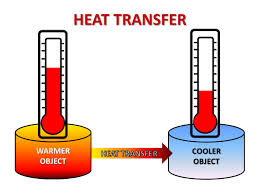
Heat transfers from an area of ____temperature to an area of ___ temperature.
a)
high to low
b)
low to high
c)
high to high
d)
It can travel high to low and low to high. 
71.
Walking on the warm sand sand with your bare feet demonstrates this type of heat transfer. 
a)
conduction
b)
convection
c)
radiation
72.
The Gulf Stream is a current that brings warm ocean water from the south to the north. What type of heat transfer is this?
a)
conduction
b)
convection
c)
radiation
d)
Insolation 
73.
Ironing a shirt is an example of...
a)
condensation
b)
conduction
c)
convection
d)
radiation
74.
Warm air is __________ dense than cold air and rises creating convection currents.
a)
more
b)
less
75.
A group of friends gather around a fire to stay warm.
a)
conduction
b)
convection
c)
radiation
76.
Transfer of thermal energy through "space"
a)
conduction
b)
convection
c)
radiation
77.
When I cold front is approaching, what happens?
a)
warm air is pushing under cold air causing humid weather and lower temperatures
b)
warm air is pushing under cold air causing humid weather and higher temperatures
c)
warm air rises, cools, and causes rain and thunderstorms
d)
cold air is pushed over warm air causing rain and thunderstorms
78.
When a warm front is approaching, what happens?
a)
advancing cold air pushes up and over retreating warm air causing warm temperatures and mild rain
b)
advancing warm air pushes up and over retreating cold air causing warm temperatures and mild rain
79.
The symbol on a weather map for a cold front is what?
a)
a line with triangles on it
b)
a line with semi-circles on it
c)
a line with squares on it
d)
a line with circles on it
80.
The symbol on a weather map for a warm front is what?
a)
a line with triangles on it
b)
a line with circles on it
c)
a line with semi-circles on it
d)
a line with circles on it
81.
If an air mass is rising, it must be
a)
cold and less dense
b)
cold and more dense
c)
warm and more dense
d)
warm and less dense
82.
If an air mass is sinking, it must be
a)
cold and less dense
b)
cold and more dense
c)
warm and more dense
d)
warm and less dense
83.
In a high pressure area, the weather will likely be
a)
warmer and clear skies
b)
warm but cloudy
c)
cold and rainy
d)
cold and clear
84.
In a high pressure area
a)
the winds will be moving clockwise
b)
the winds will be moving counter-clockwise
c)
the winds will be calm
d)
the air will be rising
85.
In a high pressure systems
a)
there are few clouds because the air in moving downward
b)
there are many clouds because the air is very humid
c)
there are few clouds because the air is moving outward
d)
there are many clouds because the air is moving upward
86.
A front is
a)
where warm air is cooling at earth's surface
b)
a line where hot and cold air are separating
c)
a line where two different air masses meet
d)
where cold air is rising and forming rain clouds
87.
A severe storm that involves strong winds and forms over warm water is:
a)
tornado
b)
thunderstorm
c)
hurricane
d)
blizzard
88.
A severe storm which involves a funnel cloud forming from a cumulonimbus cloud:
a)
hurricane
b)
tornado
c)
thunderstorm
d)
blizzard
89.
This severe weather involves lightning, rain, and forms from a cumulonimbus cloud.
a)
thunderstorm
b)
tornado
c)
hurricane
d)
blizzard
90.
What is the most abundant gas found in the atmosphere?
a)
Carbon Dioxide
b)
Nitrogen
c)
Oxygen
d)
Water Vapor
91.
Which weather tool measures air pressure?
a)
thermometer
b)
barometer
c)
anemometer
d)
psychrometer
92.
Humidity is the...
a)
Amount of Water Vapor in the Air
b)
Amount of Wind in the Air
c)
Amount of Precipitation in the Air
d)
Amount of Pressure in the Air
93.
________________ are made of water vapor that condenses in the troposphere.
a)
dew
b)
clouds
c)
evaporation
d)
transpiration
94.
Warm air near the Earth’s surface rises and then cools and drops, this creates a _________________ in the atmosphere.
a)
run-off
b)
Greenhouse Effect
c)
convection current
d)
water cylce
95.
Because the earth is spinning on its axis, the global winds appear to curve. This is known as the __________ ________.
a)
Coriolis Effect
b)
Greenhouse Effect
c)
Climate Effect
d)
Atmosphere Effect
96.
Where does a hurricane form?
a)
Over a cold body of water
b)
Over a warm body of water
c)
Over cold land
d)
Over warm land
97.
What kind of weather is usually associated with a low pressure system?
a)
Sunny weather
b)
Precipitation (rain, snow, etc.)
98.
What layer does weather occur in?
a)
mesosphere
b)
troposphere
c)
thermosphere
d)
stratosphere
99.
Where is the ozone layer located?
a)
Thermosphere
b)
Troposphere
c)
Stratosphere
d)
Mesosphere
100.
The blanket of gases that surrounds the Earth
a)
Lithosphere
b)
Atmosphere
c)
Hydrosphere
d)
Green House Effect
101.
Does Tide laundry detergent clean better than others?
a)
Testable Question
b)
Not a Testable Question
102.
How does changing to Tide laundry detergent affect the number of stains left on my clothes?
a)
Testable Question
b)
Not a Testable Question
103.
Which soda tastes better?
a)
Testable Question
b)
Not a Testable Question
104.
Does changing tire size affect how fast my bike will ride?
a)
Testable Question
b)
Not a testable question
105.
Does Tide laundry detergent clean better than others?
a)
Testable Question
b)
Not a Testable Question
106.
If I tested to see if changing the size of bike tire will affect the bike's speed, then I think large wheels will go faster because they cover more ground.
a)
Testable Question
b)
Hypothesis
107.
How does changing my breakfast from cereal to eggs affect how many snacks I have in the morning?
a)
Testable Question
b)
Not a testable question
108.
If I tested to see if diet soda tastes better than regular soda, then I think regular soda will taste better because it has more sugar than diet soda.
a)
Testable Question
b)
Hypothesis
109.
I think regular soda will taste better than diet soda.
a)
Hypothesis
b)
Not a hypothesis