wayground logo

Free Printable Worksheets

Font size

S
M
L
XL
Worksheets

2020 Fall Semester Exam

Total questions: 65

Worksheet time: 55mins

Name
Class
Date
1.

1 A single-celled organism can be classified as a prokaryote based on the absence of —

a)

a cell memebrane

b)

ribosome

c)

chromosome

d)

a nucleus

2.

Which phase of the cell cycle is most affected by a drug that inhibits the synthesis or Replication of DNA?

a)

G1 phase

b)

S phase

c)

G2 phase

d)

M phase

3.

A photomicrograph of a cell dividing during mitosis is shown above. Which phase of mitosis is visible in the picture?

a)

Prophase

b)

Metaphase

c)

Anaphase

d)

Telophase

4.

Which cellular process takes place in the ribosomes that are bound to the endoplasmic reticulum?

a)

The breakdown of waste material

b)

The conversion of radiant energy to glucose

c)

The synthesis of new proteins

d)

The replication of nucleic acids

5.
Proteins are composed of what smaller subunits?
a)
amino acids
b)
nucleic acids
c)
fatty acids
d)
nucleotides
6.
What are the monomers of DNA?
a)
glycerols
b)
amino acids
c)
fatty acids
d)
nucleotides
7.
What are lipids composed of? 
a)
Monosaccharides
b)
Amino Acids
c)
Fatty Acids
d)
Nucleotides
8.
Which of the following is NOT a biomolecule?
a)
Water
b)
Nucleic Acid
c)
Protein
d)
Lipid
9.
Round seeds (R) are dominant over wrinkled seeds (r). What percentage of the offspring will be round from the following cross?
Rr X Rr
a)
100%
b)
75%
c)
50%
d)
25%
10.
Round seeds (R) are dominant over wrinkled seeds (r). What percentage of the offspring will be round from the following cross?
RR X Rr
a)
100%
b)
75%
c)
50%
d)
25%
11.
A heterozygous round seeded plant (Rr) is crossed with a homozygous dominant round seeded plant (RR). What percentage of the offspring will be homozygous dominant?
a)
100%
b)
75%
c)
50%
d)
25%
12.
A homozygous round seeded plant is crossed with a homozygous wrinkled seeded plant. What percentage of the offspring will be homozygous recessive?
R = round
r = wrinkled
a)
75%
b)
50%
c)
25%
d)
0%
13.
In pea plants, purple flowers are dominant to white flowers. If two white flowered plants are crossed, what percentage of their offspring will have white flowers?
a)
100%
b)
75%
c)
25%
d)
0%
14.

Which structure brings in the correct amino acid to the ribosome?

a)

RNA polymerase

b)

DNA

c)

tRNA

d)

mRNA

15.

What type of biomolecule does DNA provide the instructions for building?

a)

proteins

b)

carbohydrates

c)

lipids

d)

all of the above

16.

What type of bond holds the nitrogen bases together in DNA?

a)

weak nitrogen bonds

b)

weak hydrogen bonds

c)

strong hydrogen bonds

d)

strong nitrogen bonds

17.

How does the genetic information from DNA travel outside of the nucleus?

a)

Information cannot travel outside of the nucleus

b)

Information is attached to a carrier protein to get across the nuclear membrane

c)

Information is copied onto a tRNA molecule and travels through a nuclear pore

d)

Information is copied onto a mRNA molecule and travels through a nuclear pore

18.

What enzyme unzips the DNA

a)

DNA Helicase

b)

DNA Polymerase

c)

tRNA

d)

peptase

19.

What are the differences between DNA and RNA? (check all that apply)

a)

DNA stay in the nucleus; RNA travels to the cytoplasm

b)

DNA has base Uracil; RNA has base Thymine

c)

DNA is double stranded; RNA is single stranded

d)

DNA has base Thymine; RNA has base Uracil

20.

What is the purpose of the diagram?

a)

To replicate DNA before cell division

b)

To assemble nucleotides into mRNA

c)

To synthesize amino acids

d)

To translate the genetic code into a specific sequence of amino acids

21.

What type of mutation is shown here?

a)

Substitution

b)

Insertion

c)

Deletion

d)

Point mutation

22.

What would be the correct mRNA strand produced from this DNA strand?


TAGACT

a)

ATCTGA

b)

UAGACU

c)

TUCTGA

d)

AUCUGA

23.

What part of the DNA molecule is responsible for specific traits in an organism?

a)

number of hydrogen bonds that hold the nitrogen bases together

b)

number of carbons in DNA

c)

sequence of nucleotide bases

d)

sequence of phosphates

24.

What type of mutation is this?


Original DNA;

TATGAACTGGAA


Mutated DNA;

TATGAATTGAA

a)

Substitution

b)

Insertion

c)

Deletion

d)

Frameshift

25.
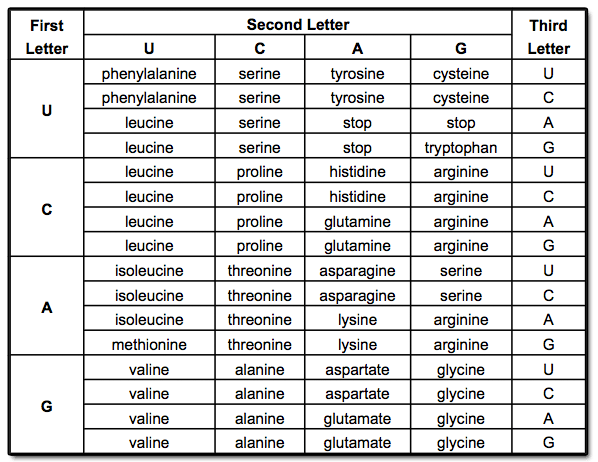
What is the correct amino acid sequence for the mRNA code AUGCCAGUAUGA
a)
Met-Pro-Ala-Val
b)
Met-Pro-Val
c)
Tyr-Gly-His
d)
Tyr-Gly-Arg-His
26.

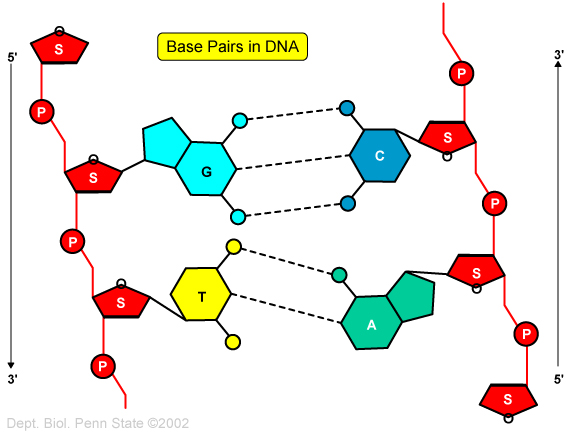
The structure in the diagram is a repeating unit called a nuleotide, what is it the monomer for?

a)

Carbohydrate

b)

Lipid

c)

Protein

d)

Nucleic Acid

27.
What is structure A?
a)
Substrate
b)
Active site
c)
Enzyme
d)
Products
28.
What is structure D?
a)
Substrate
b)
Active site
c)
Enzyme
d)
Products
29.

The picture shows an Enzyme Substrate Complex, what is the main function of an Enzyme?

a)

To remove waste

b)

To speed up chemical reactions

c)

To provide structure for a cell

30.
Which of the following conclusions can be drawn from this graph?
a)
The optimum pH of the enzyme is 6.6.
b)
The optimum pH of the enzyme is 5.8
c)
The enzyme’s activity increases as pH increases 5.0 to 9.0
d)
The enzyme’s activity is greater around pH of 8.0 .
31.

Different types of mutations can occur in DNA. The diagram represents a type of mutation. Which statement describes the mutation in the diagram?

a)

A silent mutation results in the insertion of a different amino acid.

b)

A substitution occurs with the adenine base.

c)

A deletion of a cytosine base occurs.

d)

A base is inserted into one strand of the DNA

32.
Unlike mitosis, meiosis results in
a)
one haploid gamete
b)
two diploid gametes
c)
four diploid gametes
d)
four haploid gametes
33.
Replicate the following strand of DNA: 
AATCATGGA
a)
AATCATGGA
b)
TTAGTACCT
c)
UUAGUACCU
d)
GGATAUCUA
34.

Photosynthesis and cellular respiration both involve the use and release of gases. Which statement correctly identifies the role of gases in the two processes?

a)

Photosynthesis and cellular respiration both use carbon dioxide and release oxygen.

b)

Photosynthesis and cellular respiration both use oxygen and release carbon dioxide.

c)

Cellular respiration uses oxygen and releases carbon dioxide, while photosynthesis uses carbon dioxide and releases oxygen.

d)

Cellular respiration uses carbon dioxide and releases oxygen, while photosynthesis uses oxygen and releases carbon dioxide.

35.

What equation describes the process of cellular respiration?

a)

H2O + CO2 + Energy → C6H12O6 + H2O

b)

H2O + CO2 → C6H12O6 + O2 + Energy

c)

H2O + O2 + Energy → C6H12O6 + CO2

d)

O2 + C6H12O6 → H2O + CO2 + Energy

36.

What equation best describes the process occurring at A?

a)

H2O + CO2 + Energy → C6H12O6 + O2

b)

H2O + CO2 → C6H12O6 + H2O + Energy

c)

O2 + C6H12O6 + Energy → H2O + CO2

d)

H2O + O2 → C6H12O6 + CO2 + Energy

37.

Which statement best describes the relationship between the products of photosynthesis and the reactants in cellular respiration?

a)

The products of photosynthesis serve as the reactants in cellular respiration to provide chemical energy

b)

The products of photosynthesis combine with the reactants in cellular respiration to remove ATP from the cells

c)

The products of photosynthesis inhibit the reactants in cellular respiration in the presence of light

d)

The products of photosynthesis change the structure of the reactants in cellular respiration in the presence of light.

38.

Where does the synthesis of new molecules take place during cellular respiration?

a)

Chloroplast

b)

Mitochondria

c)

Cytoplasm

d)

Thyakaloid memebrane

39.
Which of the following units are repeatedly joined together to form a strand of DNA?
a)
amino acids
b)
nucleotides
c)
fatty acids
d)
polysaccharides
40.
Why is DNA important?
a)
it is very small and very complicated
b)
it's in everything
c)
it serves as the blueprint for traits of all living things
d)
because we eat it every day for energy
41.
What determines the code, or information, of a DNA molecule?
a)
the shape (structure) of the nitrogen bases
b)
the order (sequence) of the nitrogen bases
c)
the color of the nitrogen bases
d)
the frequency (number) of nitrogen bases
42.
Which organelle is DNA usually found in?
a)
cell membrane
b)
vacuole
c)
chloroplast
d)
nucleus
43.
Nitrogenous bases are joined by which type of bond?
a)
polar bonds
b)
ionic bonds
c)
covalent bonds
d)
hydrogen bonds
44.
What are the three components of a nucleotide?
a)
sugar, hydrogen, nitrogen base
b)
sugar, oxygen, nitrogen base
c)
sugar, phosphate, nitrogen base
d)
sugar, phosphate, protein
45.
What are the phases of mitosis IN ORDER?
a)
Metaphase, Anaphase, Prophase, Telophase
b)
Prophase, Metaphase, Anaphase, Telophase
c)
Prophase, Metaphase, Telophase, Anaphase
d)
Telophase, Prophase, Anaphase, Metaphase
46.
Which is Metaphase?
a)
A
b)
E
c)
C
d)
F
47.
In mitosis, the two resulting cells are
a)
different from the starting cell and identical to each other.
b)
different from the starting cell and different from each other.
c)
identical to the starting cell and different from each other.
d)
identical to the starting cell and identical to each other.
48.
The cell spends most of its time in (in between) which phase?
a)
anaphase
b)
interphase
c)
prophase
d)
metaphase
49.
Replicate the following strand of DNA: 
AATCATGGA
a)
AATCATGGA
b)
TTAGTACCT
c)
UUAGUACCU
d)
GGATAUCUA
50.

What disorder is the result of human cells losing their ability to regulate signals that control cell growth.

a)

cellulitis

b)

diabetes

c)

hemophilia

d)

cancer

51.
I include the bases Guanine, Cytosine, Adenine and Uracil .
a)
DNA
b)
RNA
52.
Which of the following is the correct order of molecules?
a)
DNA -> RNA -> Proteins
b)
Proteins -> DNA -> RNA
c)
RNA -> DNA -> Proteins
d)
There is no specific order of these molecules
53.
Why is DNA important?
a)
it is very small and very complicated
b)
it's in everything
c)
it serves as the blueprint for traits of all living things
d)
because we eat it every day for energy
54.
The process by which the nuclear material is divided equally between two new cells
a)
mitosis
b)
cancer
c)
spindle
d)
centromere
55.
An allele that is masked when a dominant allele is present. The "weaker" gene. 
a)
Dominant Allele
b)
Recessive Allele
56.
An allele whose trait always shows up in the organism when the allele is present. The "stronger" gene. 
a)
Dominant Allele
b)
Recessive Allele
57.
An organism’s genetic makeup or allele combination.
a)
Genotype
b)
Phenotype
c)
Beanotype
d)
Notype
58.
An organism’s physical appearance, or visible traits. 
a)
Genotype
b)
Phenotype
c)
Beanotype
d)
Notype
59.
What is called when a organism has  two different alleles for a trait. Tt or Rr
a)
Heterozygous
b)
Homozygous
c)
Domozygous
d)
Thermozygous
60.
What is called when a organism has two identical alleles for a trait. TT or tt. RR or rr
a)
Heterozygous
b)
Homozygous
c)
Domozygous
d)
Thermozygous
61.
What is the probability of heterozygous offspring?
a)
25%
b)
50%
c)
0%
d)
100%
62.
What allele combination should go in the missing box?
a)
AA
b)
Aa
c)
aa
d)
none of these
63.
How many daughter cells are produced from meiosis ?
a)
10
b)
6
c)
4
d)
2
64.
Humans have how may chromosomes ?
a)
112
b)
46
c)
8
d)
67
65.
What causes genetic variation in meiosis?
a)
chromosomes lining up
b)
crossing over of chromosomes
c)
separation of chromosomes
d)
chromosomes pulling apart