wayground logo

Free Printable Worksheets

Font size

S
M
L
XL
Worksheets

Biology Mid Term Review 2018

Total questions: 112

Worksheet time: 2hrs 29mins

Name
Class
Date
1.
Osmosis is the movement of _____ across a membrane.
a)
food
b)
energy
c)
oxygen
d)
water
2.
The diffusion of water through a semi-permeable membrane is called?
a)
Osmosis
b)
Cell wall
c)
Diffusion
d)
Respiration
3.
During osmosis
a)
water moves from high to low concentration
b)
large or oddly shaped molecules move across a cell membrane
c)
water moves when energy is used
d)
proteins are built
4.
What is the definition of  Selective Permeability?
a)
The movement of materials across the cell membrane that requires NO ENERGY from the cell.
b)
The movement of materials through (or across) the cell membrane
c)
The ability of the cell membrane to allow some things to pass through while preventing other things from passing through.
d)
The movement of molecules from an area of high concentration to a area of low concentration 
5.
A person should never drink salty water because their cells would
a)
shrink
b)
expand
6.
You put a cell into a solution, the cell grows. Is the solution hypotonic or hypertonic to the cell? 
a)
hypertonic
b)
hypotonic
c)
isotonic
d)
not enough information
7.
This egg has shrunk, what type of solution was it placed in?
a)
hypotonic solution
b)
hypertonic solution
c)
isotonic solution
d)
active transport
8.
What type of solution allows water to enter the plant cell?
a)
hypotonic solution
b)
hypertonic solution
c)
isotonic solution
d)
active transport
9.
An ISOTONIC solution has a(n) ______________ concentration of solute (dissolved stuff) than inside the cell.
a)
lower
b)
equal
c)
higher
10.
What type of solution is this cell in?
a)
Isotonic
b)
Hypertonic
c)
Hypotonic
d)
diffused
11.
What type of solution is this cell in?
a)
Isotonic
b)
Hypertonic
c)
Hypotonic
d)
diffused
12.
What type of solution is this cell in?
a)
Isotonic
b)
Hypertonic
c)
Hypotonic
d)
diffused
13.
Has membrane bound organelles
a)
Prokaryote
b)
Eukaryote
c)
both
14.
Oldest type of cell
a)
Prokaryote
b)
Eukaryote
c)
both
15.
Bacteria
a)
Prokaryote
b)
Eukaryote
c)
both
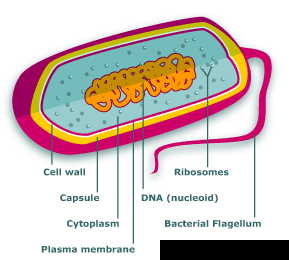
16.
Which type of cell?
a)
Prokaryote
b)
Eukaryote
17.

The function of chloroplasts is

a)

Intracellular transport of proteins

b)

Intracellular digestion

c)

Lipid synthesis

d)

Photosynthesis

e)

Cellular respiration

18.

In eukaryotic cells, internal membranes

a)

provide additional area where many metabolic process occur.

b)

form membranous compartments called organelles.

c)

contain proteins essential for metabolic processes.

d)

greatly increase a cell's total membrane area.

19.

Which one of the following is not found in prokaryotic cells?

a)

ribosomes

b)

membrane-bound nucleus

c)

cell wall

d)

a capsule

20.

Check all of the following statements that would be considered similarities between prokaryotic and eukaryotic cells.

a)

Both have a need for producing/using energy.

b)

Both evolved from the same common ancestor.

c)

Both have many membrane-bound organelles inside of them.

d)

Both have ribosomes.

21.
What type of cell am I?
a)
I am eukaryotic because I have a nucleus and other membrane bound organelles.
b)
I am prokaryotic because I have no nucleus and other membrane bound organelles.
22.
A bacteria is a prokaryote.
a)
True
b)
False
23.
Cells with a nucleus and membrane-bound organelles are called ____________________.
a)
prokaryotes
b)
eukaryotes
c)
bacteria
d)
protists
24.
Which of the following is not a characteristic of a Prokaryotic cell?
a)
unicellular
b)
floating DNA
c)
very small
d)
complex
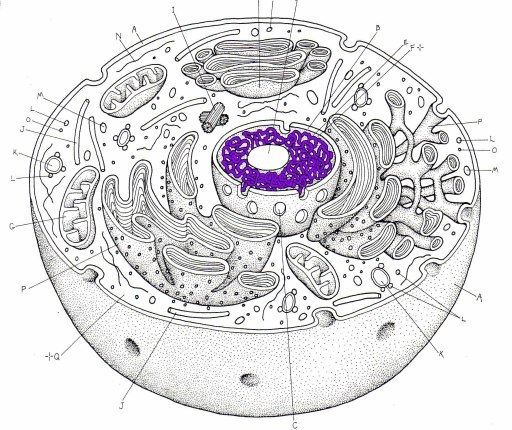
25.
What kind of cell is this?
a)
Eukaryotic
b)
Prokaryotic
26.
Prokaryote are?
a)
simple, mostly single-celled organism that lacks a nucleus, or any other membrane-bound organelle.
b)
have a peptidoglycan cell wall and many have polysaccharide capsules.
c)
have a true nucleus, which means the cell's DNA is surrounded by a membrane.
d)
contain membrane-bound organelles, such as the nucleus
27.
Which of the following in NOT a characteristic of eukaryotic cells?
a)
DNA is separated from the cytoplasm by a nuclear membrane
b)
Large
c)
Complex 
d)
Lack membrane-bound organelles
28.
CELLS SUCH AS ANIMAL, PLANT, PROTIST, AND FUNGAL CELLS ARE __________.
a)
PROKARYOTES
b)
EUKARYOTES
29.
Prokaryotic cells do not have
a)
Cell Membrane
b)
Cytoplasm
c)
Nucleus
30.
Which type of cell has membrane bound organelles?
a)
Prokaryotic Cells
b)
Bacteria Cells
c)
Eukaryotic Cells
31.
Prokaryotic cells reproduce
a)
sexually
b)
asexually
32.
What type of cell has a nucleus? 
a)
eukaryotic
b)
prokaryotic 
33.
What type of cell does not have a nucleus?
a)
eukaryotic 
b)
prokaryotic 
34.
Which of the following is found inside both prokaryotic and eukaryotic cells?
a)
ribosome
b)
nucleus
c)
chloroplast
d)
mitochondrion
35.
What can only be found in plant cells?
a)
Cell membrane
b)
Vacuole
c)
Chloroplast
d)
Mitochondrion
36.
Cell membranes are found in
a)
Only animal cells
b)
Only plant cells
c)
Some plant and animal cells
d)
All plant and animal cells
37.
Controls what enters/leaves a cell
a)
cell membrane
b)
Nuclear membrane
c)
cell wall
d)
cytoplasm
38.
releases energy for cells to use, most common in animal cells
a)
mitochondria
b)
ribosomes
c)
lysosomes
d)
nucleolus
39.
collect sunlight which it converts to sugars
a)
chloroplasts
b)
cytoplasm
c)
cell wall
d)
mitochondria
40.
This organelle takes food and turns it into ENERGY for plant and animal cells.
a)
Chloroplast
b)
Mitochondria
c)
Lysosome
d)
Ribosome
41.
The site of photosynthesis
a)
ribosome
b)
mitochondria
c)
chloroplast
d)
nucleus
42.
What does this organism use for movement?
a)
Pseudopod
b)
Cilia
c)
Flagella
d)
legs
43.

Long, thin, threadlike structures that some unicellular organisms use to move are _________________________.

a)

pseudopod

b)

algae

c)

flagella

d)

protozoan

44.

How are bacteria different from the cells of other organisms?

a)

They are basically unicellular

b)

They have no nucleus

c)

They are basically multi-cellular

d)

they have tiny brains

45.
long-whip like structures on the protist euglena that allow them to move and capture food 
a)
flagella
b)
psuedopod
c)
cilia
d)
spirilla
46.

Which of the following molecules would NOT be found in animal plasma membranes?

a)

proteins

b)

phospholipids

c)

cholesterols

d)

nucleic acids

47.

Which of the following does NOT expend energy

a)

Diffusion

b)

Endocytosis

c)

Active transport

d)

A sodium-potassium pump

48.

A cell membrane is_________

a)

Permeable

b)

Semipermeable

c)

Non Permeable

d)

None of the above

49.
Which is true about active transport?
a)
It requires energy
b)
it does not require energy
c)
It moves substances down the concentration gradient
d)
it moves material from high to low concentration
50.
A molecule that diffuses down a concentration gradient goes from an area of ______ concentration into an area of ______ concentration.
a)
high, low
b)
low, high
c)
passive, active
d)
active, passive
51.
Controlling what goes into or out of the cell with the help of energy is called
a)
active transport
b)
endocytosis
c)
passive transport
d)
exocytosis
52.

A major function of the cell membrane is to

a)

hold the cytoplasm inside of the cell

b)

control what enter and leaves the cells

c)

both choices are correct

d)

neither choice is correct

53.
This is a picture of the......
a)
cell membrane
b)
phospholipid bilayer
c)
plasma membrane
d)
all of these
54.

The function of the plasma membrane (made of phospholipids) is

a)

to regulate what enters and leaves the cell.

b)

fight bacteria and viruses that enter the cell.

c)

provide rigid support and protection to the cell.

d)

make sure each cell can move.

55.
Passive transport requires no
a)
concentration gradients
b)
osmosis
c)
motion
d)
energy
56.
This example of passive transport is the diffusion of water.
a)
osmosis
b)
endocytosis
c)
isotonic
d)
facilitated diffusion
57.
Two examples of passive transport are
a)
Active Transport and Facilitated Diffusion
b)
Facilitated Diffusion and Osmosis
c)
Protein Channels and Active Transport
d)
Osmosis and Endocytosis
58.
What is the difference between active and passive transport?
a)
Active does not need energy and passive uses ATP (energy)
b)
Active uses ATP (energy) and passive does not need energy
c)
Active stores transport proteins and passive releases 
d)
Active uses hormones and passive does not 
59.
Proteins are made of monomers called ___________
a)
Nucleotides
b)
Monosaccharides
c)
Amino Acids
d)
Glycerol and fatty acids
60.
DNA and RNA are examples of 
a)
Carbohydrates
b)
Lipids
c)
Proteins
d)
Nucleic Acids
61.
What type of macromolecule are enzymes?
a)
Protein
b)
Carbohydrate
c)
Lipid
d)
Nucleic Acid
62.

Monomer is to Macrocolecule like ___ is to ____

a)

Building is to Bricks.

b)

Brick is to Building.

c)

Carpenter is to Building.

d)

Building is to Carpenter.

63.
DNA and RNA are examples of...
a)
proteins
b)
nucleic acids
c)
carbohydrates
d)
lipids
64.
Which macromolecule is made of simple and complex sugars?
a)
lipids
b)
proteins
c)
carbohydrates
d)
nucleic acids
65.
A monosaccharide is a subunit of a:
a)
nucleic acid
b)
lipid
c)
carbohydrate
d)
protein
66.

Which macromolecule stores energy, insulates us, and makes up the cell membrane?

a)

lipids

b)

proteins

c)

carbohydrates

d)

nucleic acids

67.
Controls what enters and leaves the cell
a)
Mitochondria
b)
Cell Membrane
c)
Cell Wall
d)
Nucleus
68.
What word means to change the shape of a protein or enzyme?
a)
Denature
b)
Enlarge
c)
Peptide bond
d)
Engorge
69.
What is the monomer of proteins?
a)
amino acids
b)
polypeptides
c)
nucleotides
d)
monosaccharides
70.
What are the products of photosynthesis?
a)
water and carbon dioxide
b)
oxygen and glucose
c)
oxygen and carbon dioxide
d)
oxygen and water
71.
What are the products of photosynthesis?
a)
Carbon dioxide and water
b)
Carbon dioxide and oxygen
c)
Glucose and oxygen
d)
Glucose and water
72.
Which statement about photosynthesis is correct?
a)
Plants get the energy they need for photosynthesis from water.
b)
Plants get the energy they need for photosynthesis from soil.
c)
Plants get the energy they need for photosynthesis from sunlight.
d)
Plants do not require energy to perform photosynthesis.
73.
The raw materials or reactants of photosynthesis are
a)
sugar and water.
b)
sugar and oxygen.
c)
carbon dioxide and water.
d)
carbon dioxide and oxygen.
74.
Where does photosynthesis occur?
a)
mitochondria
b)
stomata
c)
xylem
d)
chloroplast
75.
Which of the following is the correct equation for PHOTOSYNTHESIS?
a)
6CO2 + 6H2O --> 6O+ C6H12O6
b)
6CO+ C6H12O6 + 6H2O --> O
c)
6O2 + 6H2O --> 6CO+ C6H12O6
d)
C6H12O6 + 6O2 ---> 6H2O + 6CO2 
76.
What chemical reaction has almost the same products and reactants as cellular respiration but reversed?
a)
Rusting
b)
Photosynthesis
c)
Combustion
d)
Symphonies
77.
Where does cellular respiration take place in the cell?
a)
Cell Membrane
b)
Nucleus
c)
Mitochondria
d)
Vacuole
78.
What is one of the reactants of cellular respiration?
a)
energy
b)
glucose
c)
carbon dioxide
d)
water
79.
______________ produces the most ATP.
a)
photosnthesis
b)
aerobic respiration
c)
anaerobic respiration
d)
glycolysis
80.
What are the reactants in the equation for cellular respiration?
a)
oxygen and lactic acid
b)
carbon dioxide and water
c)
glucose and oxygen
d)
water and glucose
81.
What is the correct equation for cellular respiration?
a)
6O2 + C6H12O6 -> 6CO2 + 6H2O + Energy
b)
6O2 + C6H12O6 + Energy -> 6CO2 + 6H2O
c)
6CO2 + 6H2O -> 6O2 + C6H12O6 + Energy
d)
6CO2 + 6H2O + Energy -> 6O2 + C6H12O6
82.
What is cellular respiration?
a)
the breakdown of glucose  to release ATP
b)
the breakdown of glucose to release NADH
c)
the breakdown of glucose to release FADH
d)
the breakdown of glucose to release carbon
83.
The purpose of photosynthesis is ...
a)
to make glucose
b)
to break glucose
c)
to capture energy from the sun
d)
to change carbon dioxide
84.
The mitochondria is responsible for ...
a)
photosynthesis
b)
anaerobic respiration
c)
aerobic respiration
d)
fermentation
85.
Before cells can divide, what must be copied?
a)
mitochondria
b)
cytoplasm
c)
DNA
d)
Cell Wall
86.
The division of the nucleus is known as:
a)
Synthesis
b)
Mitosis
c)
G1
d)
G2
87.
The stages of mitosis in order
a)
Metaphase, Anaphase, Prophase, Telophase
b)
Prophase, Anaphase, Metaphase, Telophase
c)
Prophase, Metaphase, Anaphase, Telophase
d)
Anaphase, Prophase, Telophase, Metaphase
88.
The time between cell divisions in the life cycle of the cell is called
a)
anaphase
b)
interphase
c)
prophase
d)
metaphase
89.
Why do we need meiosis?
a)
To double the number of chromosomes going into sex cells
b)
To halve the number of chromosomes going into sex cells
c)
To triple the number of chromosomes going into sex cells
d)
To not change the number of chromosomes going into sex cells
90.
Meiosis makes sperm and egg cells. In humans, sperm and egg cells each have _____ chromosomes. Therefore a fertilized human egg cell (sperm and egg cell combined) would create a cell with _____ chromosomes.
a)
23, 46
b)
46, 23
c)
2, 4
d)
50, 100
91.
Interphase is when a cell is growing, replicating its DNA, and carrying out cell processes. Which of these is correct regarding its occurence?
a)
It occurs once before mitosis and once before meiosis.
b)
It occurs once before mitosis and twice before meiosis.
c)
It occurs once before mitosis and does not occur before meiosis.
d)
It does not occur before mitosis and occurs once before meiosis.
92.
In mitosis, the two resulting cells are
a)
different from the starting cell and identical to each other.
b)
different from the starting cell and different from each other.
c)
identical to the starting cell and different from each other.
d)
identical to the starting cell and identical to each other.
93.
Fruit fly body cells have 8 chromosomes. After mitosis, you would expect a resulting fruit fly daughter cell to have -
a)
16 chromosomes.
b)
46 chromosomes.
c)
8 chromosomes.
d)
4 chromosomes.
94.
I am a single strand.
a)
DNA
b)
RNA
95.
I am arranged as a double helix or "twisted ladder".
a)
DNA
b)
RNA
96.
I include the bases Guanine, Cytosine, Adenine and Thymine.
a)
DNA
b)
RNA
97.
I include the bases Guanine, Cytosine, Adenine and Uracil .
a)
DNA
b)
RNA
98.
I travel outside of the nucleus.
a)
DNA
b)
RNA
99.
In RNA, adenine goes with __________.
a)
adnine
b)
cytosine
c)
thymine
d)
uracil
100.
Lactic acid fermentation occurs in your muscles after a workout because your cells are struggling to get...
a)
Glucose
b)
Sunlight
c)
Oxygen
d)
Water
101.
If your body runs out of oxygen, it will begin to perform ______.
a)
alcohol fermentation
b)
photosynthesis
c)
cellular respiration
d)
lactic acid fermentation
102.
The maintenance of an organism’s internal environment is called:
a)
compensating
b)
homeostasis
c)
balancing
d)
routine
103.
Homeostasis
a)
allows for a wildly fluctuating internal environment
b)
is impossible in vertebrates
c)
is the maintenance of a relatively stable internal environment and often incorporates a form of feedback regulation
d)
is the maintenance of a relatively stable external environment and often incorporates a form of feedback regulation
104.

The type of cells that are made during mitosis

a)

Gametes

b)

Sperm Cell

c)

Egg Cells

d)

Somatic Cells (body cells)

105.
What is the purpose  of an enzyme?
a)
give permission for the reaction
b)
raise activation energy
c)
speed up reactions
d)
control how many reactions occur
106.
Where do substrates bind on an enzyme?
a)
voltage-gated channels
b)
surface receptor
c)
calcium channels
d)
active site
107.
Enzymes are capable of increasing the rate of a chemical reaction within a living cell.  Enzymes accomplish this through which of the following means?
a)
reducing the number of products   
b)
reducing the activation energy
c)
increasing the temperature of the cell
d)
increasing the concentration of reactants 
108.
What is a substance called if it speeds up a chemical reaction?
a)
reusable
b)
catalyst
c)
specific
d)
fragile
109.
An enzyme speeds up a chemical reaction in the cell but can only be used once.  True or False? 
a)
true
b)
false
110.

What are the products of the chemical reaction pictured?

a)

CH4 and CO2

b)

CH4 and O2

c)

CO2 and 2 H2O

d)

O2 and H2O

111.
Consider the chemical equation CH4 + 2 O2 → CO2 + 2 H2O. In this equation, CH4 is a
a)
product
b)
reactant
c)
displacement
112.
What is the right part of a chemical equation called?
H2 + O H2O
a)
Reactants
b)
Products 
c)
Yields 
d)
Chemical Equation