
 Worksheets
ACHS Physics Sem One Final
Total questions: 65
Worksheet time: 2hrs 41mins
Name
Class
Date
1.

At which point is potential energy greatest?
a)
W
b)
X
c)
Y
d)
Z
2.
__________ is stored energy.
a)
Potential
b)
Kinetic
c)
None of the above
d)
All of the above
3.
The faster an object moves, the ________ kinetic energy it has.
a)
more
b)
less
c)
none of the above
d)
same
4.

What kind of energy is in a moving skateboard?
a)
Potential
b)
Kinetic
c)
Both potential and kinetic energy
d)
none of the above
5.

What kind of energy is in a rock at the edge of a cliff?
a)
Potential
b)
Kinetic
c)
Both potential and kinetic energy
d)
none of the above
6.
Which is the best example that something has kinetic energy?
a)
a. a car parked on a steep hill
b)
b. a tennis ball rolling across the court
c)
c. a picture hanging on the wall
d)
d. a piece of coal before it's burned
7.
Energy due to motion is ____________ energy.
a)
Potential
b)
Energy
c)
Kinetic
d)
Friction
8.
Gravitational potential energy depends on the ________ and ________ of the object.
a)
Height and mass
b)
Friction and movement
c)
Mass and Movement
d)
Height and Friction
9.

What kind of energy is in a person climbing a ladder?
a)
Potential
b)
Kinetic
c)
Both
10.
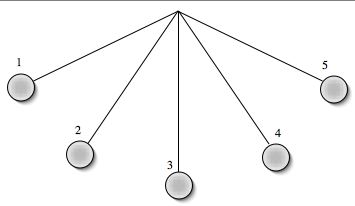
When a pendulum swings, at which point is kinetic energy highest?
a)
1
b)
2
c)
3
d)
4
11.
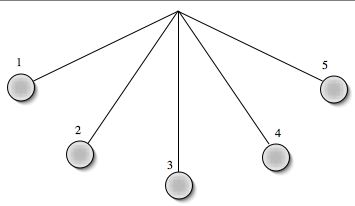
When a pendulum swings, at which point is potential energy at its greatest?
a)
1
b)
2
c)
3
d)
4
12.
Energy can be _____________ or changed from one type to another.
a)
destroyed
b)
transferred
c)
created
d)
ignored
13.
What are the two factors that affect kinetic energy?
a)
time and energy
b)
power and mass
c)
mass and speed
d)
time and work
14.
What is the unit of measurement for kinetic energy
a)
Newton
b)
Joule
c)
Watt
d)
Kilogram
15.
What is speed?
a)
how far you go
b)
how much distance is covered over a period of time
c)
how fast you accelerate
d)
the change in the location of a object
16.
What is the formula to calculate speed?
a)
Speed = time/distance
b)
Speed = distance/time
c)
Speed = distance x time
d)
Speed = time x distance
17.
A runner races in the 100 meter dash. It takes her 10 seconds to finish. What is her average speed?
a)
10 m/s
b)
1000 m/s
c)
100 seconds
d)
10 seconds
18.

According to the graph how far does the person travel in the first 5 seconds?
a)
2 m
b)
10 m
c)
0 m
d)
5 m
19.

What is the person doing from 5 seconds to 10 seconds?
a)
Walking
b)
Running
c)
Standing Still
d)
Walking Fast
20.

What is the average speed of the person during the first 5 seconds?
a)
0 m/s
b)
1 m/s
c)
3 m/s
d)
6 m/s
21.
What is velocity?
a)
the quickness of an object
b)
the location of an object
c)
acceleration
d)
speed in a specific direction
22.

At 60 seconds, how far had this object traveled?
a)
0 m
b)
10 m
c)
20 m
d)
40 m
23.
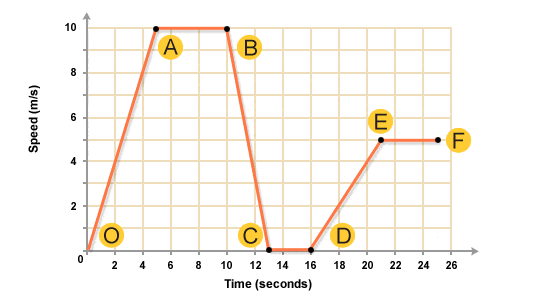
What is happening in this graph from point B to C?
a)
The object is going down a hill.
b)
The object is returning to its starting location.
c)
The object is slowing down.
d)
The object is staying still.
24.
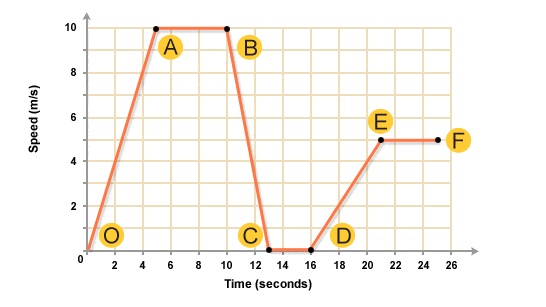
What is happening in this graph from point A to B?
a)
The object is accelerating.
b)
The object is not moving.
c)
The object is decelerating.
d)
The object is moving at a constant speed.
25.

What does this graph represent?
a)
Constant speed
b)
Acceleration
c)
Not moving
26.

What does this graph represent?
a)
Constant Speed
b)
Acceleration
c)
Not moving
27.

What is happening at E?
a)
Stationary
b)
Accelerating
c)
Fast steady speed; moving away from the starting position
d)
Steady speed; returning to start position
28.

What is happening at D?
a)
Stationary
b)
Accelerating
c)
Fast steady speed; moving away from the starting position
d)
Slower steady speed; moving away from the starting position
29.

Which runner won the race?
a)
A
b)
B
c)
C
30.
When an unbalanced force acts on an object, the force ______________________.
a)
changes the motion of the object
b)
is cancelled by another force
c)
does not change the motion of an object
d)
is equal to the weight of the object
31.
When two equal forces act in opposite directions on an object, they are called ______________________.
a)
frictional force
b)
balanced force
c)
centripetal force
d)
gravitational force
32.
The resistance of an object to any change in its motion is called ______________________.
a)
inertia
b)
friction
c)
gravity
d)
weight
33.
According to Newton’s second law of motion, force is equal to mass times ______________________.
a)
inertia
b)
weight
c)
acceleration
d)
direction
34.

"For every action, there is an equal and opposite reaction."
a)
Newton's 1st Law
b)
Newton's 2nd Law
c)
Newton's 3rd Law
d)
Newton's 4th Law
35.

Force = Mass x Acceleration
a)
Newton's 1st Law
b)
Newton's 2nd Law
c)
Newton's 3rd Law
d)
Newton's 4th Law
36.

"An object in motion (or at rest) will to stay in motion (or at rest) until an outside force acts upon it."
a)
Newton's 1st Law
b)
Newton's 2nd Law
c)
Newton's 3rd Law
d)
Newton's 4th Law
37.

Any push or pull on an object.
a)
force
b)
velocity
c)
inertia
d)
momentum
38.

The force that opposes motion between two surfaces in contact with each other.
a)
inertia
b)
friction
c)
momentum
d)
gravity
39.

The force of attraction between all matter.
a)
inertia
b)
friction
c)
net force
d)
gravity
40.
A Newton is a unit of...
a)
force
b)
inertia
c)
acceleration
d)
velocity
41.

When all the forces on an object are equal and opposite, & the net force is zero, that's...
a)
balanced forces
b)
unbalanced forces
c)
terminal velocity
d)
reaction forces
42.

The combination of all the forces acting on an object is the...
a)
net force
b)
action force
c)
reaction force
d)
balance force
43.

An archer pulls the bowstring back, then releases the string and the arrow flies forward. Pulling the string back is the...
a)
action force
b)
reaction force
c)
net force
d)
inertia
44.

An archer pulls the bowstring back, then releases the string and the arrow flies forward. The arrow flying forward is the...
a)
action force
b)
reaction force
c)
net force
d)
inertia
45.

A cannonball with a mass of 0.5 kg is flying at an acceleration of 10 m/sec/sec. What is it's force?
a)
50 Newtons
b)
5 Newtons
c)
20 Newtons
d)
9.5 Newtons
46.

Gravity is increased with...
a)
greater mass & shorter distance
b)
greater mass & farther distance
c)
lower mass & shorter distance
d)
lower mass & farther distance
47.

What kind of acceleration is shown here?
a)
positive
b)
negative
c)
none
d)
varies
48.

What kind of acceleration is shown here?
a)
positive
b)
negative
c)
none
d)
varies
49.

What kind of acceleration is shown here?
a)
none
b)
positive
c)
negative
d)
varies
50.

What is the velocity?
a)
not moving
b)
increasing
c)
positive
d)
negative
51.

What is the velocity?
a)
positive
b)
negative
c)
decreasing
d)
increasing
52.

What is the velocity?
a)
0 m/s
b)
positive m/s
c)
negative m/s
d)
decreasing
53.

Is the speed constant or non-constant?
a)
constant
b)
non-constant
54.

Is the speed constant or non-constant?
a)
constant
b)
non-constant
55.

Is the speed constant or non-constant?
a)
constant
b)
non-constant
56.

Which section of the graph shows decreasing velocity?
a)
CD
b)
DE
c)
EF
d)
GH
57.

What is happening in this graph from point A to B?
a)
The object is accelerating.
b)
The object is not moving.
c)
The object is decelerating.
d)
The object is moving at a constant speed.
58.

What is happening in this graph from point B to C?
a)
The object is going down a hill.
b)
The object is returning to its starting location.
c)
The object is slowing down.
d)
The object is staying still.
59.

What does this graph represent?
a)
Constant speed
b)
Acceleration
c)
Not moving
60.

What is happening at C?
a)
Stationary
b)
Accelerating
c)
Fast steady speed; moving away from the starting position
d)
Slower steady speed; moving away from the starting position
61.

What is happening at D?
a)
Stationary
b)
Accelerating
c)
Fast steady speed; moving away from the starting position
d)
Slower steady speed; moving away from the starting position
62.

What is happening at A?
a)
Stationary
b)
Accelerating
c)
Slower steady speed; moving away from the starting position
d)
Steady speed; returning to start position
63.

How long did it take this object to travel 10 m?
a)
0 s
b)
10 s
c)
15 s
d)
20 s
64.
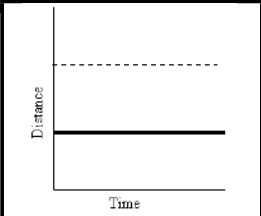
What does this graph represent?
a)
Constant speed
b)
Acceleration
c)
Not moving
65.

What is happening at B?
a)
Stationary
b)
Accelerating
c)
Slower steady speed; moving away from the starting position
d)
Steady speed; returning to start position
100 %

