wayground logo

Free Printable Worksheets

Font size

S
M
L
XL
Worksheets

Ultimate Science test

Total questions: 125

Worksheet time: 2hrs 13mins

Name
Class
Date
1.
Report accidents to your _____ at once.
a)
friend
b)
neighbor
c)
teacher
d)
no one
2.
While working in the lab, the lab table should ALWAYS be kept clear of:
a)
lab equipment
b)
books, purses and jewelry
c)
writing utensils
d)
lab worksheets
3.
Long hair in the laboratory must be 
a)
tied back or kept entirely out of the way with a hair band, hairpins, or other confining device
b)
always neatly groomed
c)
held away from the experiment with one hand
d)
cut short
4.

Safety glasses are worn during science experiments -

a)

only if you don't have glasses

b)

to improve vision

c)

any time chemicals, heat, or sediments are used to protect your eyes

d)

to avoid eye strain

5.

Horseplay or practical joking in the lab are

a)

okay

b)

always against the rules

c)

not dangerous

d)

okay if you are working alone

6.
Which type of rock results from melting and cooling of magma?
a)
Igneous
b)
Metamorphic
c)
Sedimentary
d)
Extrusive
7.
Which type of rock forms from extreme heat and pressure?
a)
Igneous
b)
Sedimentary
c)
Organic
d)
Metamorphic
8.
A metamorphic rock changes into an igneous rock by what two processes?
a)
Melting and cooling
b)
Extreme heat and pressure
c)
Compaction and cementation
d)
Weathering and erosion
9.
When sediments are pressed together tightly, this is called ____________.
a)
Compaction
b)
Cementation
c)
Weathering
d)
Erosion
10.
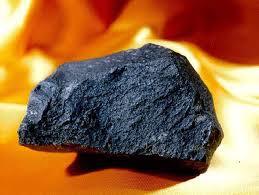
This rock was found near the mouth of a volcano. What type of rock is this?
a)
Sedimentary
b)
Igneous
c)
Metamorphic
11.
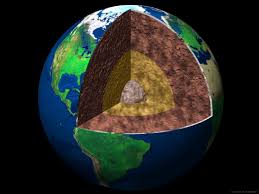
Which layer of Earth is located above the outer core?
a)
crust
b)
inner core
c)
mantle
d)
lithosphere
12.
Which of these two layers is a solid?
a)
innercore
b)
Outercore
13.
Which layer of Earth is located above the outer core?
a)
crust
b)
inner core
c)
mantle
d)
lithosphere
14.
Which layer of the earth is rock made mostly of iron?

a)
Lithosphere
b)
Core
c)
Asthenosphere
d)
Mantle
15.
Temperature _____________________ as you go deeper into the earth.
a)
increases
b)
decreases
c)
goes up and down depending on the layer
d)
stays the same
16.
The natural chemical or physical processes that breaks down rock on Earth's surface.
a)
weathering
b)
erosion
c)
deposition
d)
jackhammering
17.
The process by which water, ice, wind or gravity moves weathered rock and soil from one place to another.
a)
weathering
b)
erosion
c)
deposition
d)
dumptruck
18.
This type of weathering occurs when rock is physically broken down into smaller pieces of rock.
a)
mechanical weathering
b)
chemical weathering
c)
erosion weathering
d)
deposition
19.
This type of weathering occurs when rocks weaken then break down due to chemical changes in the composition of the rock.
a)
mechanical weathering
b)
chemical weathering
c)
erosion weathering
d)
deposition
20.
How is mechanical weathering different from chemical weathering?
a)
Chemical weathering happens over much shorter time frame than mechanical weathering.
b)
Chemical weathering changes the chemical composition of rocks; mechanical weathering does not.
c)
Chemical weathering occurs only in tropical climates; mechanical weathering occurs only in cool climates.
d)
Chemical weathering occurs only in the mountains; mechanical weathering occurs only on flat land.
21.

the general terms for the movement of sediment by wind, water, glaciers

a)

weathering

b)

erosion

c)

deposition

22.
the part of the erosion process in which sediment travels to a new location and is laid down or dropped off
a)
chemical weathering
b)
mechanical weathering
c)
erosion
d)
deposition
23.
Roots grow into cracks of a rock and pry them apart
a)
mechanical weathering
b)
chemical weathering
c)
erosion
d)
deposition
24.
animals break up the ground by burrowing
a)
mechanical weathering
b)
chemical weathering
c)
erosion
d)
deposition
25.
carbon dioxide dissolves in water then weathers marble and limestone
a)
chemical weathering
b)
mechanical weathering
c)
erosion
d)
deposition
26.
What land form is this?
a)
valley
b)
canyon
c)
mountain
d)
plain
27.
Wind blowing sand from one location to another
a)
Weathering
b)
Erosion
c)
Deposition
28.
A flat area or land.
a)
Ocean
b)
Island
c)
Peninsula
d)
Plain
29.
Name this landform:
a)
mountain
b)
hill
c)
peninsula
d)
island
30.

Which process would probably create the most rapid change in Earth's surface?

a)

Erosion

b)

Heating

c)

Volcanic eruption

d)

Weathering

31.
What type of plate boundary is this?
a)
Plate
b)
Divergent
c)
Convergent
d)
Transform
32.
What type of event will occur at this boundary?
a)
Earthquake
b)
Volcano Eruption
c)
Tornado
d)
Mountain Building
33.
The theory that says Earth's continents once made up an ancient supercontinent, and have been drifting apart ever since, is called the theory of...
a)
Pangea
b)
Plate Tectonics
c)
Natural Selection
d)
Gravity
34.
Oceanic Trenches are formed by _______ plate boundaries
a)
Convergent
b)
Transform
c)
Plate
d)
Divergent
35.
A fault is formed by the movement of a __________ plate boundary
a)
Transform
b)
Convergent
c)
Divergent
36.
What is the water cycle?
a)
the 3 forms of water
b)
the movement of water on, above, or below the surface of the Earth
c)
when water melts
d)
when clouds form
37.
What part of the water cycle does this picture show?
a)
condensation
b)
precipitation
c)
evaporation
38.
Which best explains why runoff is important?
a)
It returns water to other locations on Earth
b)
It increases the chance of flooding
c)
It makes evaporation occur faster
d)
It increases condensation
39.
What is it called when WATER is FORMED from an LIQUID to a WATER VAPOR Oor an [GAS]?
a)
EVAPORATION
b)
PRECIPITATION
c)
TRANSPIRATION
40.
After the rain falls down onto Earth's surface, what most likely happens? What is it called?
a)
1. The remains of the water is soaked into the ground.
2.Groundwater
b)
1. Groundwater
2. The remains of the water is soaked into the ground.
c)
1. Groundwater
2. Transpiration happens to the plants.
d)
1. The liquid turns into an gas or an water vapor
2. Evaporation
41.
A giant landmass that existed 200 million years ago
a)
Wegener
b)
Pangaea
c)
Archyopteryx
d)
Ammonite
42.
The Theory of Continental Drift states that Pangaea broke apart and the continents "drifted" away from each other
a)
True
b)
False
43.
What does the theory of continental drift state?
a)
The continents were once joined in a super-continent and have moved over time
b)
Continents are stationary and do not move
c)
The Earth is broken into lithospheric plates that move due to convection currents
d)
none of the above
44.
The Theory of Continental Drift states that the continents drifted together to form Pangaea
a)
True
b)
False
45.
Name the boundary
a)
convergent boundary
b)
divergent boundary
c)
transform boundary
d)
sergent boundary
46.
Name the boundary
a)
convergent boundary
b)
divergent boundary
c)
transform boundary
d)
sergent boundary
47.
What is represented by the picture? 
a)
Sea-floor spreading
b)
Pangea
c)
How the continents are arranged today
d)
Volcanoes
48.
Who is the person credited with developing the theory of continental drift?
a)
Harry Hess
b)
Galileo
c)
Alfred Wegener
d)
Newton
49.
What evidence did Wegener use in his theory?
a)
Continents and fossils fitting together/matching-up like puzzle pieces 
b)
glacier scars and evidence from temperature
c)
mountain ranges and coal deposits line up across continents
d)
all of the above
50.
How long ago is Pangea believed to have existed?
a)
200-300 million years ago
b)
1000-2000 years ago
c)
10,000-20,000 years ago
d)
20-30 billion years ago
51.
What is the definition of CONDUCTION?
a)
When heat is transferred from objects like rays of light or electromagnetically.
b)
a  hot liquid or air that  expands, becomes less dense, and rises or becomes more dense, and sinks.
c)
When heat transfers from objects that are touching.
d)
When heat transfers through the heater or AC in your house.
52.
What is the definition of CONVECTION
a)
When heat transfers through waves.
b)
When heat transfers from objects that are touching.
c)
a  hot liquid or air that  expands, becomes less dense, and rises or becomes more dense, and sinks.
d)
Heat traveling from the sun
53.
The way the heat is moving from the hot coffee is called...
a)
convection
b)
radiation
c)
insulation
d)
conduction
54.
The baby chickens are kept warm from the heat lamps demonstrates this type of heat transfer. 
a)
conduction
b)
convection
c)
radiation
55.
Transfer of thermal energy through "space"
a)
conduction
b)
convection
c)
radiation
56.
What kind of heat transfer happens when the sun is heating your body?
a)
Conduction
b)
Radiation
c)
Convection
d)
Density
57.
What is the elevation of point B?
a)
800 ft
b)
850 ft
c)
900 ft
d)
1000 ft
58.

The curved lines on a topographic map

a)

contour lines

b)

longitude lines

c)

latitude lines

d)

map scale

59.

Which side is steeper?

a)

The left side of the hill

b)

The right side of the hill

60.
What is a watershed?
a)
Land that collects and channels water froma small body of water to a larger body of water
b)
the shape of the land determined by elevation
c)
A natural stream of water of considerable  volume
d)
a river and all its tributaries
61.
Why is gravity a factor in watersheds? 
a)
it causes the water to flow away from a watershed
b)
it causes the water to flow down towards a watershed
62.
Which is a layer of permeable rock that allows water to flow?
a)
aquifer
b)
porosity
c)
groundwater
d)
watershed
63.
What collects in cracks and pores in underground soil and rock layers?
a)
porosity
b)
runoff
c)
surface water
d)
groundwater 
64.
When fertilizers enter surface water, they cause problems in 
the watershed by -
a)
increasing the amount of nutrients available to fish in lakes and streams.
b)

clogging narrow streams and preventing water from flowing properly.
c)
raising the water level in nearby rivers to levels leading to flooding.
d)
causing rapid algal growth that decrease oxygen levels and choke aquatic life.
65.
Which would increase the amount of runoff you get?
a)
Vegetation
b)
More plants
c)
Urban Development
66.
Wastes produced by agriculture, households, industry, mining, and other human activities can end up in ______________.
a)
groundwater
b)
streams and rivers
c)
oceans
d)
All of these choices
67.
How does freezing water cause the weathering of rocks?  The freezing water—
a)
keeps the rocks in place
b)
makes the rocks last longer
c)
expands cracks and breaks rocks
d)
causes rocks to fall in landslides
68.
The process that breaks down rocks and other materials on Earth's surface is called
a)
weathering
b)
erosion
c)
soil conservation
d)
decomposition
69.
The diagrams  shows a natural process that weathers rock.
 Which statement best explains why this process results in weathering?
a)
frozen water acts as a solute
b)
water expands when it freezes
c)
the mass of water increases when it freezes
d)
frozen water dissolves most types of rock
70.
Chemical weathering is the other important type of weathering. Chemical weathering may change the size of pieces of rock materials, but definitely changes the composition. So one type of mineral changes into a different mineral. Chemical weathering works through chemical reactions that cause changes in the minerals.
True or false: chemical weathering causes rocks to change into new types of rocks.
a)
True
b)
False
71.
The moon is a natural  ______ of Earth.
a)
comet
b)
axis
c)
satellite
d)
space probe
72.
Earth and the other planets closest to the Sun are made mostly of _______
a)
gas
b)
metal
c)
water
d)
rock
73.
The __________ has planets, moons, comets, and asteroids.
a)
solar system
b)
earth
c)
rotation
d)
United States
74.
One of the main differences between the outer and inner planets is __________.
a)
The inner planets all have water
b)
the inner planets are much bigger than the outer planets
c)
the outer planets are gas planets
d)
the outer planets have rings, and the inner planets don't
75.
The GAS GIANTS or Outer planets are:
a)
Mercury, Earth, Jupiter, Saturn
b)
Saturn, Neptune, Pluto, Mars
c)
Saturn, Jupiter, Uranus, Neptune
d)
Earth, Mars, Saturn, Neptune
76.
The four terrestrial planets all have
a)
Rocky surfaces
b)
Hot temperatures
c)
Deep atmospheres
d)
Large size
77.
What holds the moon, the planets, and all other objects in orbit around the sun?
a)
ocean tides
b)
magnetism
c)
gravity
d)
the sun's heat and light
78.
A ball of ice and dust with a tail of gas and dust pointing away from the sun.
a)
Asteroid
b)
Comet
c)
Moon
d)
Meteor
79.

a small rocky body orbiting the sun, ranging from the size of a small house to dust particles

a)

nebula

b)

terrestrial planets

c)

collision

d)

asteroids

80.

This table shows the rotation period and revolution period for 6 planets, and Earth’s moon, all relative to Earth’s periods. Which 2 planets have shorter days than Earth?

a)

Jupiter and Saturn

b)

Venus and Mercury

c)

Mars and Jupiter

d)

Saturn and Moon

81.
The order of the planets is:
a)
Mars,Venus,Earth,
Mercury,Saturn
Jupiter, Uranus, Neptune
b)
Earth,Venus,Mars
Jupiter, Neptune,
Mercury,Saturn,
Uranus
c)
Mercury,Venus,Earth
Mars,Jupiter,
Saturn,Uranus
Neptune
82.
When the Northern Hemisphere of Earth is Leaning away from the Sun, What season is the Southern Hemisphere experiencing?
a)
Summer
b)
Winter
c)
Spring
d)
Fall
83.
What moon phase would be seen from Earth when the moon is at position 1? 
a)
new moon
b)
first quarter
c)
third quarter 
d)
full moon
84.
Name the moon phase that would come AFTER this moon.
a)
waning crescent
b)
waxing crescent
c)
waning gibbous
d)
waxing gibbous
85.
What moon phase came right BEFORE this one?
a)
First Quarter
b)
Last Quarter
c)
New Moon
d)
Full Moon
86.
Phases of the moon in which the moon appears to be getting larger are referred to as _.
a)
waxing
b)
waning
c)
new
d)
eclipse
87.
How many phases does the moon have?
a)
7 phases
b)
5 phases
c)
I do not know
d)
8 phases
88.
The cycle of the moon lasts about a _.
a)
day
b)
year
c)
week
d)
month
89.
Our galaxy is called the
a)
Earth Nebula
b)
The Hubble Galaxy
c)
The Milky Way
d)
The Snickers
90.
Galaxies are composed of (best answer)
a)
stars
b)
stars and gas
c)
stars, dust, and gas
d)
stars, dust, and gas held together by gravity
91.
The Milky Way Galaxy is a 
a)
spiral
b)
lenticular
c)
elliptical 
d)
irregular
92.
All existing matter and space considered as a whole is called what?
a)
Galaxy
b)
Planet
c)
Universe
d)
Milky Way
93.

Most scientists believe the Big Bang Theory explains which of the following questions?

a)

How our planets and moons formed

b)

How our universe began

c)

How the sun turns hydrogen into helium

d)

How fast light travels through space

94.

Which statement is true?

a)

The galaxies are moving toward us.

b)

The galaxies are moving away from us.

c)

The universe remains static or unchanged in motion.

d)

None of the above

95.
Which space equipment transports humans into space from Earth?
a)
space shuttle
b)
space prove
c)
satellite
96.

Which of these is an unpiloted space ship designed to gather information on planets other than Earth?

a)

space probe

b)

space schuttle

c)

space station

d)

space telescope

97.

Spacewalkers wear space suits to keep them from _______ and from _______________.

a)

freezing; boiling

b)

suffocating; drowning

c)

floating; swelling up

d)

sweating; getting smelly

98.
Who was the first man to walk on the moon?
a)
Neil Armstrong
b)
Buzz Aldrin
c)
Yuri Gagarin
d)
John Glenn
99.

To which planet do NASA scientists hope to send humans next?

a)

Mars

b)

Vensus

c)

Jupiter

d)

Mercury

100.

The Hubble Space Telescope was launched into space in 1990. Scientist preferred to use this telescope because:

a)

It is good for predicting a solar eclipses.

b)

It is good for investigating faraway galaxies.

c)

It is good for investigating the size of Venus.

d)

It is good for predicting the phases of the moon.

101.
Which statement describe parts of the water cycle and how clouds form? 1. Water evaporates from the earth's surface as it changes from a liquid to a gas. 2. Water vapor rises with rising, warm air. 3. At higher altitudes, where temperatures are cool, vapor (along with dust particles) condenses into drops of water that form clouds. 4. Low-pressure conditions also help clouds form. 
a)
1 and 2
b)
1, 2, 4
c)
1 and 3
d)
all of the above
102.
Which statement best describes the difference between weather and climate?
a)
Weather is the conditions when you look outside while climate is the conditions you can expect for the next 6 months.
b)
Climate is the current condition outside while weather is what you can expect for the next 6 months.
103.
Rain, sleet, hail, and freezing rain are all...
a)
precipitation
b)
condensation
c)
evaporation
d)
perspiration
104.
____________ air sinks/falls because it is ____________dense.
a)
Cold, More
b)
Warm, Less
c)
Cold, Less
d)
Warm, More
105.
____________ air rises because it is ____________dense.
a)
Cool, Less
b)
Warm, Less
c)
Cold, More
d)
Warm, More
106.
What is the weather conditions in an area over a long period of time?
a)
climate
b)
temperature
c)
elevation
d)
precipitation
107.
Changes from minute-to-minute, hour-to-hour, day-to-day
a)
Climate
b)
Weather
108.
What does this symbol indicate on a weather map? 
a)
High pressure system
b)
Low pressure system
c)
Cold front
d)
Warm front
109.
What symbol is this?
a)
warm front
b)
cold front
c)
stationary front
d)
occluded front
110.

Objects in the SOUTHERN Hemisphere deflect to which direction due to the Coriolis Effect?

a)

Left

b)

Up

c)

Down

d)

Right

111.

The driving force of the Water Cycle is?

a)

The troposphere

b)

The Sun

c)

The oxygen

d)

The clouds

112.
What is the Coriolis Effect and how does it effect global winds?
a)
Curving of winds due to rotation of earth curves wind counterclockwise in Northern Hemisphere and clockwise in the Southern Hemisphere
b)
Movement of ocean currents caused by earth rotation' counterclockwise in Northern Hemisphere and clockwise in Southern Hemisphere
c)
curve of global winds caused by global rotation clockwise in Northern Hemisphere and counterclockwise in Southern Hemisphere
113.
In the Northern Hemisphere, hurricane winds blow
a)
harder than in the Southern Hemisphere
b)
counterclockwise
c)
clockwise
d)
less than in the Southern Hemisphere
114.
Convection takes place because
a)
warm air is more dense than humid air
b)
warm and cold air have the same density
c)
cold air is less dense than warm air
d)
cold air is more dense than warm air
115.

The transfer of heat through the circulation of a liquid or a gas.

a)

convection

b)

radiation

c)

conduction

116.
What season is the Northern Hemisphere experiencing at position 3?
a)
summer
b)
winter
c)
spring
d)
fall
117.
What season is the Southern Hemisphere experiencing at position C?
a)
winter
b)
spring
c)
summer
d)
fall
118.
What type of geological feature will be found at a divergent boundary in the ocean?
a)
valley
b)
volcanic islands
c)
trench
d)
mid ocean ridge
119.
An object in motion will stay in motion, and an object at rest will stay at rest unless acted upon by an outside force is Newton's law of __________
a)
force and acceleration
b)
inertia
c)
action-reaction
120.
Tectonic plates are:
a)
largest section of Earth's layers - composed of three layers
b)
Earth's crust and part of the upper  mantle that are broken into sections
c)
lowest or deepest layer of the mantle - semi rigid
d)
landmass in which all continents were once joined together
121.
What makes it possible for you to see the surface of the moon from Earth?
a)
 The moon gives off its own light.
b)
Light from Earth is reflected by the moon's surface.
c)
Light from Sun is reflected by the moon's surface.
d)
The moon absorbs sunlight during the day and glows at night.
122.

The moon reflects different amounts of sunlight onto Earth at different times. This reflected sunlight is commonly called moonlight. The graph shows the intensity of moonlight at different times in a lunar cycle. Which moon phase most likely occurs at the time in the cycle represented by an X on the graph?

a)
b)
c)
d)
123.

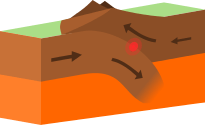
The diagram shows a model of the movement of two tectonic plates. When the plates collide, one plate often moves below the other plate. The rising magma that can result from this type of plate movement may produce--

a)

fossil layers

b)

volcanic islands

c)

deep-sea sediment

d)

seafloor spreading

124.
Which of the following pictures is an example of a chemical change? 
a)
Wood burning in a fireplace
b)
ice melting in water in a beaker
c)
a cracked rock
d)
boiling water on a hotplate
125.
Which statement is most likely true in explaining the difference in these two pennies? 
a)
The penny on the left has collected dirt on its surface. 
b)
The penny on the right is not made of copper. 
c)
Each penny was minted in a different location using different metal alloys. 
d)
The penny on the left has undergone a chemical change on its surface.