
 Worksheets
7th Grade Midterm REVIEW
Total questions: 130
Worksheet time: 3hrs 54mins
Which of the following is a chemical change?
Melting of ice
Rusting of iron
Boiling of water
Breaking a glass
What is the main difference between a chemical change and a physical change?
Chemical changes are reversible, while physical changes are not.
Physical changes involve the formation of new substances, while chemical changes do not.
Chemical changes result in new substances, while physical changes do not.
Physical changes always involve a change in temperature.
Which of the following is an example of a physical change?
Burning wood
Dissolving sugar in water
Baking a cake
Digesting food
Identify the state of matter for water at 0°C.
Solid
Liquid
Gas
Plasma
Which process represents a change of state from liquid to gas?
Freezing
Condensation
Evaporation
Sublimation
Which of the following is a sign of a chemical change?
Change in shape
Change in color
Change in size
Change in state
What happens to the molecules of a substance during a physical change?
They form new chemical bonds.
They change their arrangement or state.
They are destroyed.
They become charged.
Which of the following is an example of a chemical change?
Freezing water
Cutting paper
Cooking an egg
Mixing sand and salt
What is the state of matter characterized by having a definite shape and volume?
Solid
Liquid
Gas
Plasma
Which of the following processes is a physical change?
Burning a candle
Fermenting grapes
Melting butter
Rusting a nail
What is the term for the change of state from solid directly to gas?
Melting
Freezing
Sublimation
Condensation
Which of the following is a characteristic of a chemical change?
It is always reversible.
It involves a change in state only.
It results in the formation of new substances.
It does not involve energy changes.
Which state of matter has particles that are tightly packed and only vibrate in place?
Solid
Liquid
Gas
Plasma
What is the process called when a gas changes into a liquid?
Evaporation
Condensation
Sublimation
Freezing
Which of the following is NOT a sign of a chemical change?
Production of gas
Change in temperature
Change in state
Formation of a precipitate

Cooking an egg

A nail rusting

Wood Burning
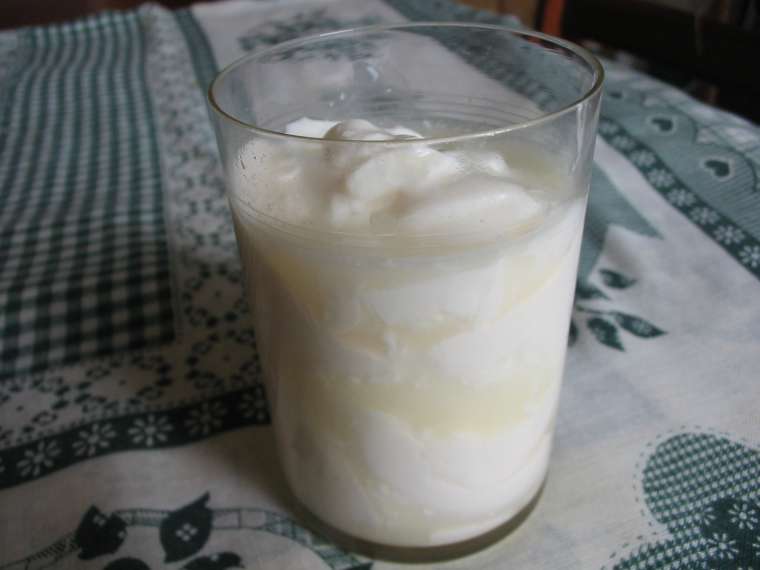
Milk curdling/souring.

Copper tarnishing.

Methane burns with a blue flame
A solution that contains all of the solute that it can hold at a given temperature.
unsaturated solution
homogeneous solution
In Michael's science experiment with salt water, NaCl (salt) would be considered the ______.
Solution
Solute
Solvent
Solvation
You can make a solution more concentrated by adding more __________.
solution
Avery is conducting a science experiment. When water is added to a solution it is called a ______________
dilution
concentration
heterogeneous solution
dissociation
A solution that contains all of the solute that it can hold at a given temperature.
unsaturated solution
homogeneous solution
What happens to the concentration of a solution when more solvent (water) is added?
It increases
It decreases
It remains the same
It doubles
Which factor does NOT affect the rate of dissolution of a solid solute in an aqueous solution?
Temperature
Surface area
Agitation
Color of the solute
If you increase the temperature of a solution, what generally happens to the rate of dissolution of a solid solute?
It decreases
It increases
It remains the same
It doubles
How does increasing the surface area of a solid solute affect its rate of dissolution?
It increases the rate
It decreases the rate
What is the effect of stirring (agitation) on the rate of dissolution of a solid solute in an aqueous solution?
It decreases the rate
It increases the rate
Which of the following is an example of a solvent in an aqueous solution?
Sugar
Water
Salt
Sand
What is the process of reducing the concentration of a solute in a solution called?
Saturation
Dilution
Evaporation
Precipitation
Which of the following best describes an aqueous solution?
A solution where water is the solute
A solution where water is the solvent
A solution with no water
A solution with only solid components
If a solid solute is broken into smaller pieces, how does this affect its dissolution rate?
It decreases the rate
It increases the rate
How does temperature generally affect the solubility of a solid solute in water?
Solubility decreases with increasing temperature
Solubility increases with increasing temperature
Which of the following actions would decrease the concentration of a solution?
Adding more solute
Adding more solvent

This chart shows how far a car traveled during different sections of a road trip.
What is the average speed of this car for this entire trip?
(pay attention to your units!)
25 mph
0.41 mph
26.5 mph
30 mph
A windup toy walks for 25 seconds over 2 meters.
What is the average speed of the toy car?
12.5 m/s
50 m/s
0.08 m/s
27 m/s

What is the average speed of the object during segment A?
15 km/hr
0 km/hr
60 km/hr
2.7 km/hr
What is the average speed of the object during segment B?
15 km/hr
0 km/hr
60 km/hr
2 km/hr
What is the average speed of the object during segment C?
5 km/hr
0 km/hr
60 km/hr
120 km/hr
What is the average speed of the object during segment D?
4 km/hr
0 km/hr
60 km/hr
40 km/hr
What is the average velocity of the object over this entire trip?
28.75 km/hr
zero
24 km/hr
-24 km/hr
What is the average speed of the object over this entire trip?
28.75 km/hr
zero
24 km/hr
-24 km/hr
During which segment was the object moving the fastest?
segment A
segment B
segment C
segment D
During which segment was the object moving the slowest?
segment A
segment B
segment C
segment D
During which segment was the object not moving at all?
segment A
segment B
segment C
segment D
Velocity is a measure of _____ and _____.
force
speed
acceleration
direction
Speed or Velocity:
An airplane travels north at 890 km/h.
Speed
Velocity
Speed or Velocity:
A man walks east with his dog at 1.42 m/s.
Speed
Velocity
Speed or Velocity:
A horse ran 27 km/h to win the race.
Speed
Velocity
Speed or Velocity:
A train travels at 160 km/h.
Speed
Velocity
A train travels 100 km south in 2 hours.
Which of the following accurately describes it's velocity?
50 km/hr
200 km/hr
50 km/hr south
200 km/hr south
True or False:
The velocity of an object changes if the direction of motion changes.
True
False
True or False:
The velocity of an object is zero if the displacement is zero.
True
False
True or False:
Velocity is the same as direction.
True
False
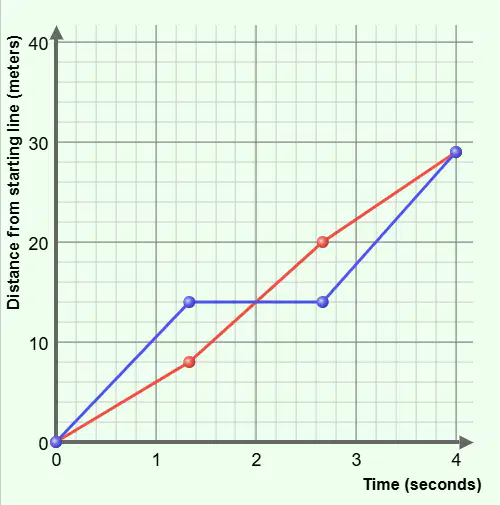
Two runners are running a race. Which of the statements are true about these runners according to the graph?
The runners began the race at different times.
The runners took the same time to finish the race.
The runners ran the race on different tracks.
The runners returned to the starting point at the end of the race.
One runner stopped in the middle of the race.
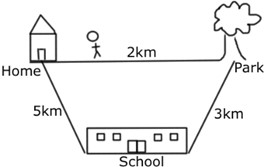
Jerry walked from home to school, then from the school to the park. What is his total displacement?
2 km
5 km
8 km
10 km
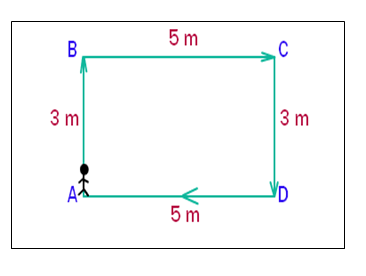
Sara walks from Point A to Point B. Which is true?
Distance is greater than displacement
Sara walks from Point A to Point B then to Point C. Which is true?
Distance is greater than displacement
Distance is less than displacement

Two people walk across a parking lot. Their paths are shown in the image. Who had a larger displacement?
Person A
Person B
They both had the same displacement.
Two people walk across a parking lot. Their paths are shown in the image. Who traveled a shorter distance?
Person A
Person B
They both had the same distance.

Describe the motion in the graph:
Constant Speed (positive slope)
Stopped (at rest)
Acceleration (increasing speed)
Return Home (negative slope)

Describe the motion in the graph:
Constant Speed (positive slope)
Stopped (at rest)
Acceleration (increasing speed)
Return Home (negative slope)

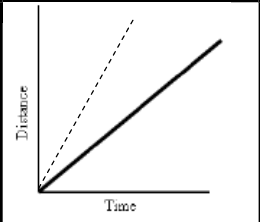
constant speed moving away from the reference point
(the dotted line shows a faster speed)
both lines shows increasing speed
(the dotted line is speeding up faster)
Newton's first law is also called the Law of ...
Friction
Inertia
Unbalanced forces
Newtons
Newton's first law applies
to both moving and nonmoving objects
only to moving objects
only to objects that are not moving


A bowling ball is rolled across the parking lot. Which statement about it is true?
the bowling ball will only stop if it strikes something
the bowling ball will never stop
the bowling ball will eventually stop because of friction
the bowling ball will eventually stop because of inertia
What occurs when thermal equilibrium is reached within a system?
The system cools down rapidly.
Heat transfer stops completely.
All substances within the system have the same temperature.
Thermal energy flows in the opposite direction.
If you heat one end of a metal rod, how does the thermal energy move through the rod to reach thermal equilibrium?
Through radiation only.
Through convection only.
Through conduction only.
Through a combination of conduction and convection.
What term describes the transfer of thermal energy from warmer objects to cooler objects when they come into contact?
Conduction
Radiation
Convection
Insulation
If you place a hot cup of coffee on a cold kitchen counter, which process allows the coffee to cool down as it transfers heat to the counter?
Conduction
Radiation
Convection
Insulation

Radiators are heading devices that are commonly found in older homes. When water in the radiator is heated, the surrounding air is also heated. In a closed room with a hot radiator, how does the thermal energy move to reach equilibrium within the room?
Through conduction
Through radiation
Through convection
Through insulation
In a well-insulated house on a hot summer day, what happens to the thermal energy inside the house?
It escapes to the outside.
It stays in the same place without moving.
It moves from cooler rooms to warmer rooms.
It moves from warmer rooms to cooler rooms until equilibrium is reached.
When you place an ice cube in a glass of warm water, how does the thermal energy transfer occur to reach thermal equilibrium?
Through conduction only.
Through convection only.
Through radiation only.
Through a combination of conduction and convection.
In a house, what is the purpose of insulation in terms of thermal energy transfer?
To promote rapid heat loss.
To enhance radiation.
To minimize heat transfer.
To encourage conduction.
If you added a can of Coke (20oC) to a fridge (5oC), at what temperature would heat stop moving?
when the coke is at 10 degrees and the fridge is at 5 degrees.
When the coke is at at 6 degrees and the fridge is at 6 degrees
When the coke is at at 5 degrees and the fridge is at 15 degrees
When the coke is at at 20 degrees and the fridge is at 5 degrees
If you added ice (0oC) to a glass of water (15oC) how would the heat move between the ice & water?
from the ice to the water
from the water to the ice
Two objects have different temperatures. Object A has a temperature of 42 degrees and Object B is 37 degrees. Which direction should the energy transfer between Objects A and B?
From Object A to Object B
From Object B to Object A
Energy will not transfer
Energy will transfer both directions
The kinetic energy of particles affects how warm an object feels by:
Increasing the temperature as kinetic energy increases.
Decreasing the temperature as kinetic energy increases.
Having no effect on the temperature.
Only affecting the temperature at absolute zero.
The temperature of an object is a measure of:
the amount of heat energy in the object
the speed of the particles in the object
the potential energy of the object
the kinetic energy of the particles in the object
Which temperature scale uses 'kelvins' as its unit?
Celsius
Fahrenheit
Kelvin
Rankine
Fill in the blank: On the Celsius and Fahrenheit scales, whole units are called _______.
degrees
units
points
marks
The thermal energy of an object is:
the total kinetic energy of its particles
the total potential energy of its particles
the sum of its kinetic and potential energy
the energy required to change its temperature
The thermal energy of an object increases if the temperature of the object rises.
True
False
Fill in the blank: Thermal energy also depends on the total amount of _______ in the object.
mass
volume
temperature
pressure
The thermal energy of a tank of compressed air depends on:
the volume of the tank.
the pressure of the air.
the temperature of the air.
the type of gas used.
Thermal expansion is the tendency of matter to:
contract when heated
expand when heated
remain the same when heated
change color when heated
When a cold basketball is brought into a warm gym, it might seem 'flat' and not bounce well on the floor. What causes this change?
The air inside the basketball contracts in the cold, reducing pressure.
The air inside the basketball expands in the cold, increasing pressure.
The material of the basketball becomes more elastic in the cold.
The material of the basketball becomes less elastic in the cold.
Liquid thermometers work on the principle of thermal expansion. True or False?
True
False
Fill in the blank: A trapped liquid gains or loses thermal energy based on the ______ of the surrounding environment.
the temperature
the color
the pressure
the volume
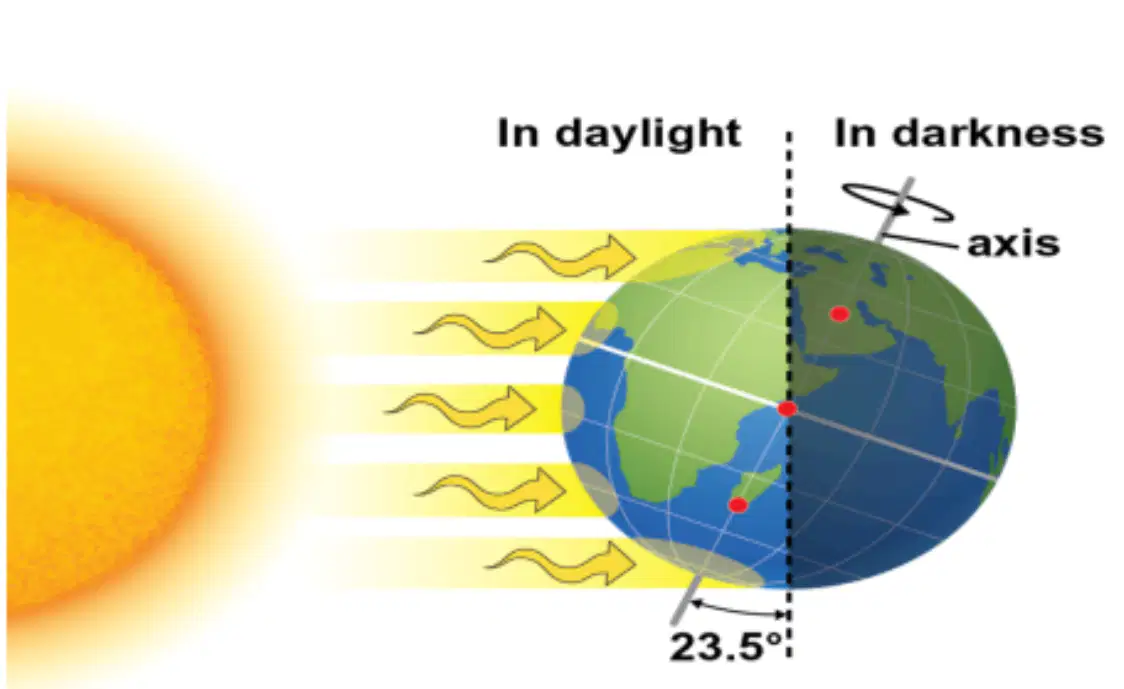
Imagine you’re an astronaut hovering above Earth, observing how its 23.5-degree tilt
affects our planet. Which of the following statements is true about Earth's tilt and its
orbit around the Sun?
A. The Earth's tilt is responsible for the different phases of the Moon.
B. The Earth's tilt causes certain areas to experience more daylight during each season.
C. The Earth's tilt causes the planet's surface to heat evenly all year round.
D. The Earth's tilt has no effect on the lengths of days and nights.
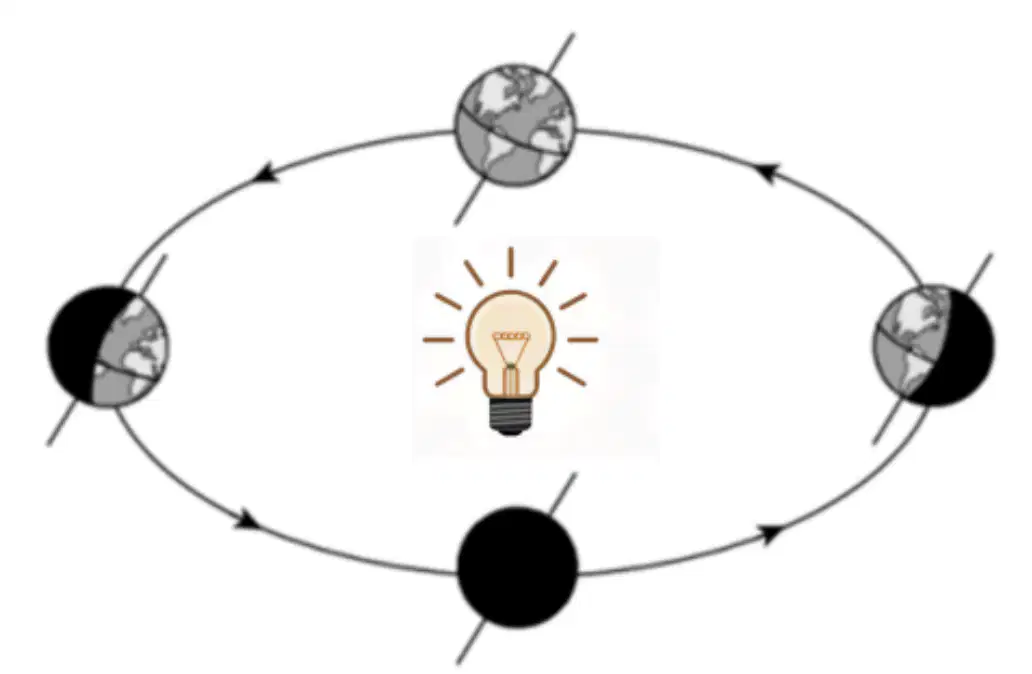
2. A student creates a model of Earth using a globe with a light source representing the sun.
When modeling summer in Australia, which is in the southern hemisphere.
Which direction should Earth's axis tilt relative to the
light source?
A. The Southern Hemisphere should tilt away from the light
B. The axis should point directly at the light
C. The axis should be vertical with no tilt
D. The Southern Hemisphere should tilt toward the light

3. Students are using a model to understand seasonal changes. In a model using a lamp
and globe, how should they move the globe to show one complete year?
A. Spin it in place while keeping the axis vertical
B. Move it around the lamp while keeping the axis pointed in the same direction
C. Rotate it while changing the tilt angle
D. Move it closer to and farther from the lamp

4. Given the list of facts about Earth's movement and orientation.
Which three (3) facts from the list, when combined, provide the clearest explanation for why we
experience seasons on Earth?
(choose 3 answers)
1, 3, 4
2, 4, 5
1, 2, 4
3, 5, 6
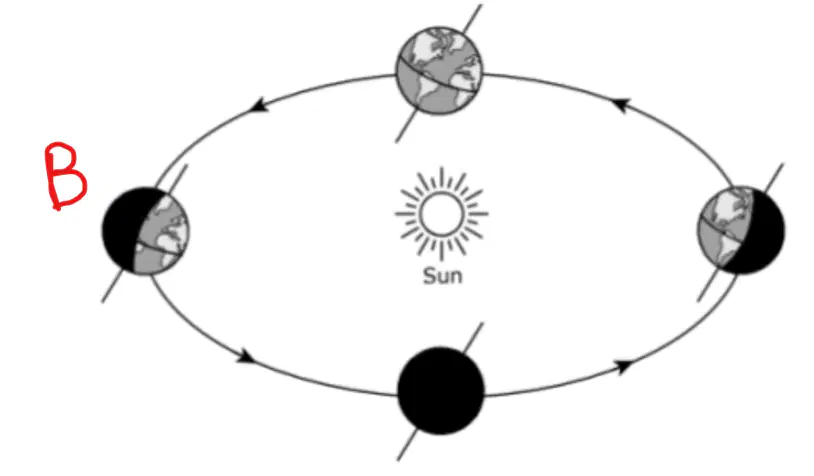
Using this model, explain why summer occurs in the Northern Hemisphere when Earth is in Position B.
Earth is closest to the Sun at Position B
Earth's tilt causes the Northern Hemisphere to receive more direct sunlight at Position B
The Sun produces more energy when Earth is at Position B
Earth moves slower in its orbit at Position B

Why does the area around the equator stay the same temperature all year?
The equator rotates slower than the poles.
The equator remains the same distance from the sun.
The equator always receives direct sunlight.
The equator has 18 hour days.

What season is it at position 3 in the northern hemisphere?
Summer
Fall
Winter
Spring


Wha type of tide would this arrangement of earth-moon-sun create?
full moon tide
new moon tide
neap tide
spring tide

What is the tide that occurs during a first quarter and a third quarter moon?
neap tide
low tide
spring tide
high tide
Neap tides are the ________ tides.
strongest
weakest
What is the tide that occurs during a full moon and a new moon.
spring tide
low tide
high tide
neap tide
What is the rise and fall of the level of the water in the ocean?
tides
waves
tsunamis
hurricanes
During which if these moon phases are we going to see the strongest tide?
full moon
3rd quarter
waxing crescent
waning gibbous
The moon is mainly responsible for the tides on Earth because it is _________ _________.
much closer
far away
behind the sun

The tidal bulge follows the movement of the _____.
moon
sun
Earth
ocean

The _____ _____ is the difference between the levels of ocean water at high tides and low tides. That range depends on the sun-Earth-moon;s position.
ocean waves
mountain level
sea level
tidal range
Which of the following images shows revolution or orbiting?


Which direction does the moon revolve around Earth?
Clockwise
Counterclockwise

