wayground logo

Free Printable Worksheets

Font size

S
M
L
XL
Worksheets

Final Exam Review Part 1

Total questions: 94

Worksheet time: 2hrs 49mins

Name
Class
Date
1.
Located at the leading edge of a temperature drop off. Bring heavy thunderstorms, rain, and hail. Cool, fair weather is likely to follow.  
a)
Warm Front
b)
Cold Front
c)
Occluded Front
d)
Stationary Front 
2.
Located at the leading edge of a warm air mass. Brings gentle rain or light snow, followed by warmer, milder weather.  
a)
Warm Front
b)
Cold Front 
c)
Occluded Front 
d)
Stationary Front 
3.
Where the warm and cold air meet and stall, clouds and fog form, and it may rain or snow.  It could bring many days of clouds and precipitation.  
a)
Warm Front
b)
Cold Front
c)
Occluded Front 
d)
Stationary Front 
4.
When a cold front overtakes a warm front, the temperature drops as the warm air mass is cut off from the ground and pushed upward.  It can bring strong winds and heavy precipitation. 
a)
Warm Front
b)
Cold Front
c)
Occluded Front
d)
Stationary Front 
5.
This is the symbol for a... 
a)
Cold Front
b)
Warm Front
c)
Stationary Front
d)
Occluded Front 
6.
This is the symbol for a... 
a)
Cold Front
b)
Warm Front
c)
Stationary Front
d)
Occluded Front 
7.
This is the symbol for a... 
a)
Occluded Front
b)
Stationary Front
c)
Warm Front
d)
Cold Front 
8.
This is the symbol for a... 
a)
Stationary Front
b)
Occluded Front
c)
Cold Front
d)
Warm Front
9.
This is the symbol for a... 
a)
Stationary Front
b)
Occluded Front
c)
Cold Front
d)
Warm Front 
10.
Identify the type of front that is shown in the image.
a)
Occluded Front
b)
Cold Front
c)
Stationary Front
d)
Warm Front
11.
Identify the type of front that is shown in the image.
a)
Occluded Front
b)
Cold Front
c)
Stationary Front
d)
Warm Front
12.
Identify the type of front that is shown in the image.
a)
Occluded Front 
b)
Cold Front
c)
Stationary Front
d)
Warm Front
13.
Identify the type of front that is shown in the image.
a)
Occluded Front
b)
Cold Front
c)
Stationary Front
d)
Warm Front
14.
A severe storm that involves strong winds and forms over warm water is:
a)
tornado
b)
thunderstorm
c)
hurricane
d)
blizzard
15.
What is the most abundant gas found in the atmosphere?
a)
Carbon Dioxide
b)
Nitrogen
c)
Oxygen
d)
Water Vapor
16.
Which weather tool measures air pressure?
a)
thermometer
b)
barometer
c)
anemometer
d)
psychrometer
17.
This weather tool measures wind speed 
a)
thermometer
b)
barometer
c)
anemometer
d)
psychrometer
18.
Humidity is the...
a)
Amount of Water Vapor in the Air
b)
Amount of Wind in the Air
c)
Amount of Precipitation in the Air
d)
Amount of Pressure in the Air
19.
Warm air near the Earth’s surface rises and then cools and drops, this creates a _________________ in the atmosphere.
a)
run-off
b)
Greenhouse Effect
c)
convection current
d)
water cylce
20.
Because the earth is spinning on its axis, the global winds appear to curve. This is known as the __________ ________.
a)
Coriolis Effect
b)
Greenhouse Effect
c)
Climate Effect
d)
Atmosphere Effect
21.
Where does a hurricane form?
a)
Over a cold body of water
b)
Over a warm body of water
c)
Over cold land
d)
Over warm land
22.
What kind of weather is usually associated with a low pressure system?
a)
Sunny weather
b)
Precipitation (rain, snow, etc.)
23.
What kind of weather is usually associated with a high pressure system?
a)
Sunny weather
b)
Precipitation (rain, snow, etc.)
24.
In what direction do winds always blow?
a)
From areas of high pressure to areas of low pressure
b)
From areas of low pressure to areas of high pressure
25.
What layer does weather occur in?
a)
mesosphere
b)
troposphere
c)
thermosphere
d)
stratosphere
26.
Where is the ozone layer located?
a)
Thermosphere
b)
Troposphere
c)
Stratosphere
d)
Mesosphere
27.
The blanket of gases that surrounds the Earth
a)
Lithosphere
b)
Atmosphere
c)
Hydrosphere
d)
Green House Effect
28.
What measures temperature?
a)
barometer
b)
anemometer
c)
thermometer
d)
psychrometer
29.
Rain, snow, sleet, and hail are all forms of _____.
a)
precipitation
b)
condensation
c)
evaporation
d)
climate
30.
A violently rotating column of air called a _____ when it comes in contact with the ground.
a)
hurrican
b)
tornado
c)
trade wind
d)
local wind
31.
A(n) _____ is a large body of air that has properties similar to the part of Earth's surface over which it depends.
a)
tornado
b)
pressure system
c)
front
d)
air mass
32.
When two air masses meet, there is a _____, or boundary.
a)
thunderstorm
b)
watch
c)
front
d)
cloud
33.
A _____ is a large, swirling, low-pressure system that forms over the Atlantic Ocean.
a)
blizzard
b)
cold front
c)
tornado 
d)
hurricane
34.
what kind of pressure predicts good weather?
a)
high
b)
low
c)
cold
d)
stationary
35.
Which condition usually means cloudy, stormy weather?
a)
high pressure
b)
low pressure
36.
What part of the illustration shows Evaporation? 
a)
1
b)
2
c)
3
d)
4
37.
Which number illustrates Condensation?
a)
1
b)
2
c)
3
d)
4
38.
What kind of weather is usually associated with a high pressure system?
a)
Sunny weather
b)
Precipitation (rain, snow, etc.)
39.
What does this symbol on a weather map indicate? 
a)
High pressure system
b)
Low pressure system
c)
Cold front
d)
Warm front
40.
What role do oceans play in hurricane formation?
a)
they provide cool, dense water
b)
warm water supplies energy to hurricanes
c)
warm ocean water slows hurricane formation
d)
cold ocean water supplies energy to hurricanes
41.
Hot air (RISES / FALLS) __________.
a)
RISES
b)
FALLS
42.
Cold air (RISES/ FALLS)  _________.
a)
RISES
b)
FALLS
43.
Changes from minute-to-minute, hour-to-hour, day-to-day
a)
Climate
b)
Weather
44.
Meteorologists forecast this.
a)
Climate
b)
Weather
45.
Air pressure is greatest:
a)
closer to Earth
b)
farther from Earth
46.
A severe storm that involves winds over 119mph and forms over water is:
a)
tornado
b)
thunderstorm
c)
hurricane
d)
blizzard
47.
A severe storm which involves a funnel cloud forming over land is:
a)
hurricane
b)
tornado
c)
thunderstorm
d)
blizzard
48.
Warm air moving upwards from the Gulf of Mexico is:
a)
continental tropical
b)
continental polar
c)
maritime tropical
d)
maritime polar
49.
Warm air mass that does not carry water:
a)
continental tropical
b)
continental polar
c)
maritime tropical
d)
maritime polar
50.
Where weather occurs.
a)
stratosphere
b)
thermosphere
c)
troposphere
d)
mesosphere
51.
Where we live.
a)
stratosphere
b)
thermosphere
c)
troposphere
d)
mesosphere
52.
Where you will find the ozone layer.
a)
stratosphere
b)
thermosphere
c)
exosphere
d)
mesosphere
53.
The hottest layer.
a)
troposphere
b)
thermosphere
c)
exosphere
d)
mesosphere
54.
Which order is correct from the earth to space?
a)
thermosphere
 troposphere
 exosphere
mesosphere
stratosphere
 ionosphere
b)
thermosphere
 troposphere
 stratosphere
 exosphere
mesosphere
 ionosphere
c)
exosphere
ionosphere
thermosphere
mesosphere
 stratosphere
troposphere
d)
troposphere
thermosphere
 troposphere
 stratosphere
 exosphere
mesosphere
55.
What two gases are found throughout all layers of the atmosphere?
a)
Nitrogen and carbon dioxide
b)
Nitrogen and oxygen
c)
Oxygen and carbon dioxide
d)
Trace gases and water vapor
56.
What does the earth's atmosphere do?
a)
help to regulate the temperature on Earth
b)
Help UV rays to reach the Earth's surface
c)
Creates meteors in the sky
d)
Keep ocean waters cold
57.
As you go higher in the troposphere, the temperature _______________.
a)
decreases
b)
increases
c)
stays the same
d)
gets very hot
58.
What is the function of the ozone layer?
a)
to allow UV rays to get to Earth
b)
to block UV rays from getting to Earth
c)
To keep oxygen in
d)
to allow meteors to get to Earth
59.
Where I find clouds.
a)
thermosphere
b)
stratosphere
c)
troposphere
d)
ionosphere
60.
Which layer is the outermost layer?
a)
troposphere
b)
thermosphere
c)
exosphere
d)
mesosphere
61.
This is the layer where most commercial jet airliners fly.
a)
Troposphere
b)
Stratosphere
c)
Mesosphere
d)
Thermosphere
62.
The higher you go, the air becomes _____ _____.
a)
More dense
b)
Less dense 
63.
This is the layer where meteors, or shooting stars, burn up.
a)
Troposphere
b)
Stratosphere
c)
Mesosphere
d)
Thermosphere
64.
What happens to the density (thickness)/air pressure of the air as you increase in altitude?
a)
density increases
b)
density decreases
c)
density stays the same
d)
density disappears
65.
The most common gas in the atmosphere (78%).
a)
Nitrogen
b)
Oxygen
c)
Carbon Dioxide
d)
Trace gases
66.
Which of these layers is closest to Earth?
a)
thermosphere
b)
stratosphere
c)
mesosphere
d)
ionosphere
67.
Which of these layers is farthest from Earth?
a)
thermosphere
b)
stratosphere
c)
mesosphere
d)
exosphere
68.

The layer name that means "middle sphere" is the

a)

troposphere

b)

stratosphere

c)

mesosphere

d)

thermosphere

69.

The moon is in our atmosphere.

a)

True

b)

False

70.
This gas makes up 21% of the atmosphere
a)
ozone
b)
oxygen
c)
nitrogen
d)
water vapor
71.
What is the greenhouse effect?
a)
The warming of a planet due to trapped radiation.
b)
The cooling of Earth due to air pollution.
c)
The heating of a solid, such as a rock.
72.
This is an image demonstrating...
a)
Tornado Formation
b)
The Greenhouse Effect
c)
Hurricane Formation
73.
Things you can do to help decrease global warming include:
a)
Eat more ice cream.
b)
Keep your freezer door open.
c)
Keep your air conditioner on high.
d)
Turn off your lights when you’re not using them.
74.
1.  Too many greenhouse gasses in the atmosphere may block heat from escaping into space and trap too much heat next to the Earth’s surface causing: ____________. 
a)
A.  another ice age 
b)
A.  global warming 
c)
A.  earthquakes 
d)
A.  volcanic eruptions
75.
Which lists some effects of El Niño?
a)
warmer temperatures and more rain
b)
warmer temperatures and less rain
c)
cooler temperatures and less rain
76.
Which weather conditions are associated with El Niño?
a)
increased temperature, increased precipitation
b)
decreased temperature, increased precipitation
c)
increased temperature, decreased precipitation
d)
decreased temperature, decreased precipitation
77.
GWhich way to the global winds blow in each hemisphere?
a)
east to west in Northern Hemisphere and west to east in the Southern Hemisphere
b)
west to east in Northern Hemisphere and east to west in Southern Hemisphere
c)
North to south in the Northern Hemisphere and south to north in Southern Hemisphere
d)
south to north in the Northern Hemisphere and north to south in the Southern Hemisphere
78.
How is wind named?
a)
From the direction which they blow to.
b)
From the direction which they come from.
c)
From the Department of Atmospheric Affairs 
d)
By the amount of air pressure. 
79.
When the water is cooler than the land at day, what kind of local wind do you have? 
a)
Land breeze
b)
Sea Breeze
80.

The transfer of heat through the circulation of a liquid or a gas.

a)

convection

b)

radiation

c)

conduction

81.
What is the Coriolis Effect and how does it effect global winds?
a)
Curving of winds due to rotation of earth curves wind counterclockwise in Northern Hemisphere and clockwise in the Southern Hemisphere
b)
Movement of ocean currents caused by earth rotation' counterclockwise in Northern Hemisphere and clockwise in Southern Hemisphere
c)
curve of global winds caused by global rotation clockwise in Northern Hemisphere and counterclockwise in Southern Hemisphere
82.
Convection takes place because
a)
warm air is more dense than humid air
b)
warm and cold air have the same density
c)
cold air is less dense than warm air
d)
cold air is more dense than warm air
83.
What Causes differences in air pressure around earth ? 
a)
Warm air rises at the equator, and cold air sinks at the poles.
b)
Equator gets over heated 
c)
Snow 
84.
Uneven heating of Earth's surface by the sun causes which of these?
a)
wind patterns
b)
cloud formation
c)
volcanic activity
d)
nutrient cycling
85.
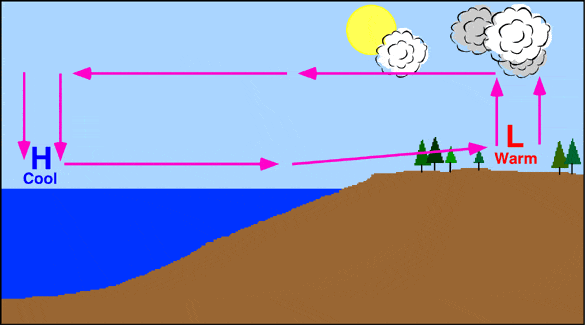
Is this a land or a sea breeze?
a)
land breeze
b)
sea breeze
86.
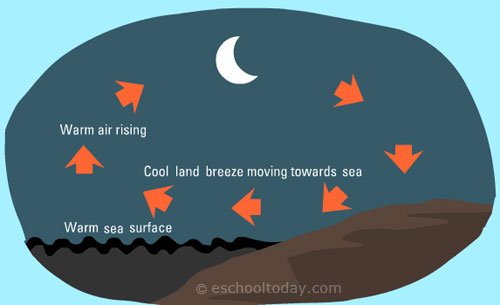
Is this a land or a sea breeze?
a)
land breeze
b)
sea breeze
87.
How does the air move in a land breeze?
a)
From east to west
b)
From west to east
c)
From the land to the ocean
d)
From the ocean to the land
88.
Why do land breezes occur at night?
a)
Land cools off slower than water, so the air above water is cooler.
b)
Water cools off faster than land, so the air above land is warmer.
c)
Land heats up slower than water, so the air stays cooler during the day.
d)
Water cools off slower than land, so the air above water is warmer.
89.
Which term best describes how the earth's atmosphere is heated?
a)
Spirally
b)
Unevenly
c)
Circularly
d)
Kinetically
90.

Sea breezes take place during the ________ because the warmer land temperature results in a warmer air mass above the land compared to the cooler air mass over the surface of water.

a)

day

b)

night

91.

Land breeze and sea breezes are caused by the different _________ between land and water surfaces.

a)

rotations

b)

temperatures

c)

gases

d)

solids

92.

What is the main cause of winds?

a)

amount of trees

b)

the moon's gravity

c)

amount of animals

d)

uneven heating of Earth's surface

93.

The Coriolis Effect influences wind direction around the world due to the ______ of Earth cause the winds to curve.

a)

tilt

b)

shift

c)

height

d)

rotation

94.

Air moves from _______ pressure to ________ pressure.

a)

high to low

b)

low to high

c)

high to high

d)

low to low