
 Worksheets
Second Semester Final 2024
Total questions: 90
Worksheet time: 3hrs 49mins

What process of the water cycle would allow your hair to dry outside after swimming?
condensation
evaporation
precipitation
collection

You grab a bottle of water from the fridge and set it on the counter. When you come back for it 2 hours later, water droplets have formed on the outside of the water bottle. What is this an example of?
Condensation because the temperature of the air nearest the bottle has increased causing water droplets to form .
Condensation because the temperature of the air nearest the bottle has decreased causing water droplets to form.

Which process of the water cycle requires temperature to decrease?
evaporation
precipitation
condensation

Students want to model the water cycle. They conduct an experiment. Which statement below correctly explains How they would show condensation and evaporation?
Evaporation would have to be shown with an ice cube to decrease the temperature and condensation would have to be shown with hot water to increase the temperature
Condensation would have to be shown with an ice cube to decrease the temperature and evaporation would have to be shown with hot water to increase the temperature

Sarah needs her Dunkin Donuts coffee in the morning. She brews a cup of coffee into her travel mug and places a lid on it. When she gets to work, she takes off the lid and notices little drops of water are on the lid. What is this an example of?
Evaporation
Condensation
Precipitation
Collection

Which of the following is a correct reason why we should conserve fresh water? (Hint: there may be more than one correct answer)
As the world's population is increasing so is our need for clean drinking water
We need more water for home consumption than agricultural purposes

What is A?
Evaporation
Condensation
Precipitation
Runoff


Label E
Evporation
Condensation
Collection/Accumulation
Precipitation

Label D
Evaporation
Condensation
Collection/Accumulation
Precipitation


What happens in a convection current?
cold air and warm air both rise
cold air and warm air both sink
cold air rises and warm air sinks
cold air sinks and warm air rises
Which loses and absorbs heat faster?
land
water
Which part of the world receives direct sunlight?
The equator
The poles

Which is an accurate description to match the data table?
The soil temperature will reach the highest temperature
The water temperature will reach the highest temperature
The soil and water temperature will reach the same temperature

Which station receives the most light?
Station A
Station B
Station C
Station D

Which will heat the quickest?
Water
Light soil
Dark soil

Which statement below is accurate/correct?
Water warms and cools much more slowly than land or air, insulating the land on the coasts.
Land warms and cools much more slowly than water or air, insulating the land on the coasts.
Which diagram below BEST represents the correct path of a convection current that has formed?


Land absorbs radiation from the Sun
slower than water.
faster than water.
the same rate as water.
twice as slow as water.

What is the most likely reason why sand at the beach heats up faster than the ocean water?
The sand absorbs the heat faster than the water.
The sand reflects the heat more than the water.
The water absorbs the heat faster than the sand.
The water reflects the heat more than the sand.
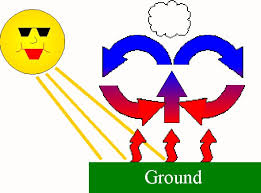


What happens in a convection current?
cold air and warm air both rise
cold air and warm air both sink
cold air rises and warm air sinks
cold air sinks and warm air rises

How would you label the diagrams below?
Diagram X- Land Breeze and Diagram Y-sea breeze
Diagram X- Sea Breeze and Diagram Y- Land Breeze

Where does the energy that powers a hurricane originate?
from funnel clouds
outside a stationary front
protein bars
from warm and moist air

What characteristic do thunderstorms, hurricanes, and tornadoes all share?
They all form over dry and hot desert regions.
They are all easily predicted by weather forecasters.
They are all formed when warm and moist air rapidly rises.
They always cause severe damage to land and property.

On the coast of Georgia, warm air usually picks up water vapor over the Atlantic Ocean. What will happen when the warm, moist air moves inland over hot, dry land?
The warm air will become cool, causing water vapor to evaporate and be absorbed by the land.
The warm air will rise, causing water vapor to evaporate from the air and generate winds.
The warm air will rise, causing water vapor to condense and form clouds.
The warm air will sink, causing water vapor to condense and form snow.

Which of the following is true of hurricane formation over the ocean?
Hurricanes are more likely to form where water is cold and precipitation is high.
Hurricanes are more likely to form where water is warm and evaporation is high.
Hurricanes are more likely to form where gravity is highest and tides pull air up.
Hurricanes are more likely to form over areas where the salinity is highest.

The graph shows the relationship between the surface temperature of the sea and the intensity of a hurricane. Which BEST describes the relationship shown in the graph?
Cooler ocean water can create less powerful hurricanes due to increased evaporation.
Cooler ocean water can create more powerful hurricanes due to decreased evaporation.
Warmer ocean water can create less powerful hurricanes due to decreased evaporation.
Warmer ocean water can create more powerful hurricanes due to increased evaporation.

Hurricanes build over warm ocean water. What else has to be present for a hurricane to form?
an increase in salinity of the ocean water
low pressure that pulls in warm surface air
a cold front that cools the surface of the ocean
a swell under the water that causes a large wave

The graph shows the water temperature along the west coast of the United States in places like San Diego, CA. According to the graph, which time of year would the sea water temperature be LEAST likely to help develop thunderstorms?
August, because the sea temperature is warmest and warm water absorbs energy from a system.
November, because the sea temperature saw the biggest month to month drop causing instability.
December, because the sea temperature is approximately 60°F.
February, because the sea temperature is coldest and storms develop best with the energy of warm water.

What happens to a hurricane when it hits a coastal area?
It gains energy and delivers high winds, heavy rain, and storm surges to the area.
It loses energy quickly and causes little damage.
Its high winds and storm surges destroy all structures in its path.
It delivers high winds, heavy rains, and storms surges, but then it loses energy as it passes over land.

What is the main source of a hurricane’s energy?
warm water evaporating from the sea
cool water evaporating from the sea
warm water condensing from the sea
cool water condensing from the sea

Use the map to help you answer the question. At what point on the map does this projected hurricane’s path begin to lose strength?
A
B
C
D

Look at the diagram below of the Earth, Moon, and Sun. Which phase of the Moon would be seen by people on Earth?
full moon
new moon
waxing gibbous
waning gibbous

The model above shows the Moon at four different positions as it revolves around the Earth. Position A occurred on April 1, 2017. Students were asked to predict which position and moon phase would be viewed on April 8, 2017. Which student has made a correct prediction and supported it with a correct justification?
Student 1: The moon would be in position B, a 1st Quarter moon, because the moon revolves counterclockwise around Earth about once every 28 days.
Student 2: The moon would be in position B, a 3rd Quarter moon, because the moon revolves counterclockwise around Earth about once every 7 days.
Student 3: The moon would be in position C, a full moon, because the moon revolves counterclockwise around Earth about once every 28 days.
Student 4: The moon would be in position C, a new moon moon, because the moon revolves counterclockwise around Earth about once every 7 days.
Use the diagram to help you answer the question. The diagram shows the Moon at four positions in its orbit around Earth as viewed from the North Pole. Which is the correct sequence (order) of Moon phases that would be seen by an observer beginning with the position X (the New Moon phase)?


Why are people on Earth able to see the Moon?
The Moon orbits Earth and reflects light from the Sun back to Earth.
The Moon orbits Earth and makes its own light that is sent back to Earth.
The Earth orbits the Moon and reflects the light from the Sun back to Earth.
The Earth orbits the Moon and reflects the light from Earth back to the Moon.

What is the correct series of phases from a full moon to a new moon?
waxing gibbous, third quarter, waxing crescent
waning gibbous, first quarter, waxing crescent
waning gibbous, third quarter, waning crescent
waxing gibbous, third quarter, waning crescent

Which statement best explains why the Moon appears to have phases?
As the Moon revolves around Earth, the illuminated side of the Moon is not always fully visible from Earth.
As Earth revolves around the Moon, the illuminated side of the Moon is not always fully visible from Earth.
As the Moon revolves around the Sun, the Sun blocks the light created the Moon.
As the Sun revolves around the Moon, the Sun blocks the light created the Moon.

Which phases occur at points 1 and 5?
A third quarter occurs at point 1, and a first quarter occurs at point 5.
A first quarter occurs at point 1, and a third quarter occurs at point 5.
A full moon occurs at point 1, and a new moon occurs at point 5.
A new moon occurs at point 1, and a full moon occurs at point 5.
Which of these would be best to use to model the Moon's phase changes?
two different sized foam balls to represent Earth and the Moon and a light source to represent the Sun
a marshmallow for the Moon and a cup for Earth
a photograph of the Moon
glowing star stickers placed against a black background

The model shows positions and movements of Earth, the Sun, and the Moon. What do the arrows around X show?
the Moon's monthly orbit around the Sun
the Moon's daily orbit around Earth
Earth's monthly rotation on its axis
Earth's daily rotation on its axis

The picture below shows the different phases of the Moon as it orbits around Earth. Which moon is a first-quarter moon?
Q
R
S
T
What is the smallest planet?
Venus
Pluto
Jupiter
Mercury
What is the hottest planet?
Venus
Mercury
Earth
Jupiter
What planets are IN FRONT OF the asteroid belt?
Inner planets
Outer planets
Both
None
Select all that apply to the GAS GIANTS
They all have rings
They are all made of gas
They have a rocky surface
They are very small
Which planets are BEHIND the asteroid belt?
Inner planets
Outer planets
Both
None
Select all that apply to the ROCKY or TERRESTRIAL planets
They are small
They are made of gas
They have a rocky surface
They are closer to the sun
Which of the gas giants has the largest rings?
Jupiter
Saturn
Mercury
Neptune
The asteroid belt is located between the orbits of Jupiter and Saturn.
True
False
The outer planets have solid, rocky surfaces.
True
False
The inner planets consist of Mercury, Venus, Earth, and Mars.
True
False
The outer planets are larger in size than the inner planets.
True
False

What is the largest planet in our solar system?
Saturn
Neptune
Uranus
Jupiter

The Outer Planets are extremely
Cold
Hot
What planet is no longer a planet?
Jupiter
Neptune
Pluto
Saturn

Which two inner planets are known as "twin planets?"
Venus and Mars
Mars and Earth
Venus and Earth
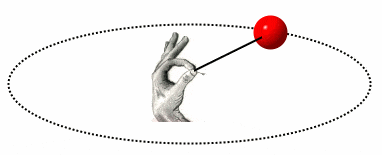
Which force in the Solar System is similar to the tension in the string?
Why do the planets in our solar system orbit the sun?
because the sun is the brightest object
because the sun was there first
because the sun has the most mass
because nothing can orbit planets
What would happen to Earth if there were no inertia?
Earth would crash into the sun
Earth would fly out to space
Earth would collapse
Earth would orbit the moon
What would happen to Earth if there were no gravity?
Earth would crash into the sun
Earth would fly out to space
Earth would collapse
Earth would orbit the moon

