wayground logo

Free Printable Worksheets

Font size

S
M
L
XL
Worksheets

Earth Fall review

Total questions: 81

Worksheet time: 1hrs 19mins

Name
Class
Date
1.
What does the luster of a mineral describe?
a)
color
b)
density
c)
ability to resist being scratched
d)
way it reflects light
2.
Where do extrusive igneous rocks form?
a)
in the water
b)
deep within earth
c)
at Earth's surface
d)
from other rocks
3.
What are the two most abundant elements in Earth's crust?
a)
silicon and oxygen
b)
silicon and hydrogen
c)
oxygen and chlorine
d)
oxygen and alumin
4.
What is the name for sedimentary rocks that are formed when minerals are precipitated from solution?
a)
clastic
b)
chemical
c)
organic
d)
foliated
5.

What is a mineral

a)

rocks in a bedrock

b)

Strata in sedimentary rocks

c)

solid, naturally occurring inorganic substances

d)

None of the above

6.

What are the two most abundant elements that make up minerals

a)

Oxygen and Iron

b)

Iron and Magnesium

c)

Oxygen and Magneisium

d)

Oxygen and Silicon

7.

What is the least effective way to identify a mineral

a)

Streak

b)

Color

c)

Hardness

d)

Luster

8.

How does one test the streak of a mineral

a)

Scratch it with a penny

b)

Look at it's color

c)

Check to see if it has cleavage or fracture

d)

rub mineral on porcelain plate

9.

What does it mean to have a metallic luster

a)

Shiny

b)

Soft

c)

Hard

d)

None of the above

10.

What mineral fizzes when HCL is poured onto it

a)

Calcite

b)

Magnetite

c)

Gold

d)

All of the above

11.
Why is coal not a mineral?
a)
It is not a solid
b)
It is man-made
c)
It is not inorganic
d)
It is made of carbon
12.
What does inorganic mean?
a)
Something that is living
b)
Something that is dead, but was once living
c)
Something that was never living
13.
Measure of how easily a mineral can be scratched
a)
fracture
b)
cleavage
c)
hardness
d)
streak
14.
Ratio of a mineral's weight compared with the weight of an equal volume of water
a)
specific gravity
b)
physical property
c)
luster
d)
cleavage
15.
What mineral is known as "fools gold"?
a)
graphite
b)
quartz
c)
galena
d)
pyrite
16.
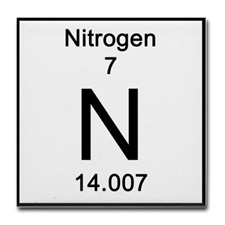
What is the number of protons that the element in this image contain?
a)
14
b)
7
c)
15
d)
18
17.
The positive particles of an atom are 
a)
electrons 
b)
positrons 
c)
neutrons 
d)
protons 
18.
an atom with atomic number 6 would have how many protons 
a)
6
b)
12
c)
3
d)
cannot be determined 
19.
Particles in an atom that are neutral and have no charge are 
a)
negatrons 
b)
electrons 
c)
neutrons 
d)
protons 
20.
An atoms overall charge is 
a)
positive 
b)
depends on its mood 
c)
neutral 
d)
negative 
21.
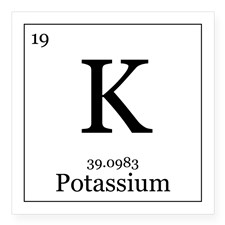
How many neutron are in the atom "K"?
a)
7
b)
2
c)
39
d)
12
22.
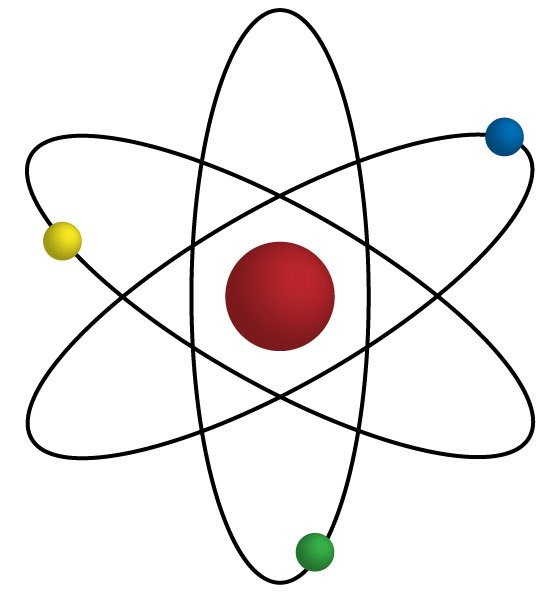
What are the 3 particles that make-up the atom?
a)
protons, neutrons, and isotopes
b)
neutrons, isotopes, and electrons
c)
positives, negatives, and electrons
d)
protons, neutrons, and electrons
23.
What is a closed system?
a)
a system in which energy and matter are exchanged with the surroundings 
b)
an open system 
c)
a system in which energy, but not matter, is exchanged with the surroundings
24.
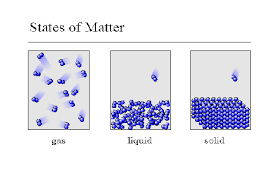
What three states can matter occur on Earth?
a)
clouds, stones, water
b)
plastic, paper, air
c)
solid, liquid, gas
25.
The mostly solid, rocky part of Earth that extends from the center of the core to the surface of the crust is called ___________.
a)
geosphere
b)
hydrosphere
c)
biosphere
26.
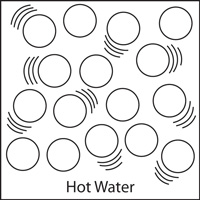
At higher temperatures
a)
particles in an object have less energy
b)
particles in an object move faster
c)
a gas contracts
27.
The state of matter that has no definite size or shape is
a)
Solid
b)
Liquid
c)
Gas
28.
What is condensation?
a)
gas to solid
b)
gas to liquid
c)
liquid to solid 
d)
solid to liquid 
29.
The speed of the molecules determines the _____.
a)
volume
b)
density
c)
pressure
d)
temperature
30.
The ability to do work?
a)
force
b)
energy 
c)
matter 
d)
system
31.
How are matter and energy exchanged between spheres?
a)
physical reactions
b)
H2O
c)
chemical reactions 
d)
heat waves
32.
Convection is?
a)
friction between two objects sliding past each others and causing heat
b)
material is heated, the materia's density decreases, and the hot material rises and releases heat; cooler, denser material sinks and displaces the hot material
c)
wind that comes from the equator 
d)
heat that comes from the sun and stays near the surface
33.
Parallel means
a)
Lines that cross at 90 degrees
b)
Lines that never cross
c)
Something that is not important
d)
Lines that cross twice
34.
The 0 degree line of latitude is the ___________.
a)
Equator
b)
Prime Meridian
c)
International Date Line
d)
Contour line
35.
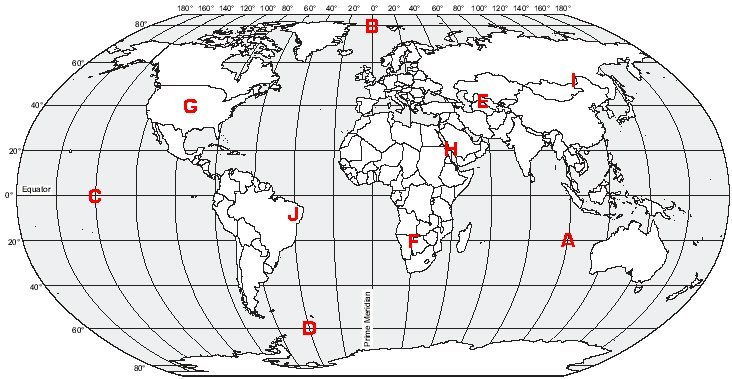
What is the approximate location of letter B?
a)
80oN, 0o
b)
0o, 80oW
c)
80oS, 0o
d)
0o, 80oE
36.
Which letter would you find at 15oS, 60oW?
a)
A
b)
C
c)
L
d)
H
37.
Imaginary lines that run from the north pole to the south pole are...
a)
lines of latitude
b)
time zones
c)
lines of longitude
d)
parallels
38.
To locate exact places on the earth, one must look at
a)
the intersecting lines of latitude and longitude
b)
the lines of latitude only
c)
the lines of longitude only
d)
a neighboring area to describe the location
39.
Earths Circumference is about 40,000KM and its shape is
a)
an oval
b)
an oblate spheroid
c)
a perfect sphere
d)
a perfect circle
40.
Which statement best explains the apparent sinking of this sailboat?
a)
The sailboat appears smaller as it moves farther away.
b)
The change in density of the atmosphere is causing refraction of light rays.
c)
The sailboat is moving around the curved surface of Earth.
d)
The tide is causing an increase in the depth of the ocean.
41.
What is the GOLDEN RULE?
a)
The altitude of Polaris equals your elevation
b)
The altitude of Polaris equals your Longitude
c)
The altitude of Polaris equals your Latitude
d)
The altitude of Polaris equals your distance to the Equator
42.
Latitude lines are measures in 
a)
degrees/minutes
b)
inches/feet
c)
centimeters/meters
43.
When working with latitude lines, 1 degree equals how many minutes?
a)
10
b)
15
c)
30
d)
60
44.

Definition for map scale

a)

Ratio between the distances shown on a map and the actual distances on Earth's surface.

b)

An average of the distance of two places.

c)

The total of things show on a map from one place to another.

45.

Latitude is the distance in degrees north and south of the

a)

equator.

b)

Oceans.

c)

meridian.

46.

A map legend is

a)

a key that explains what the symbols on a map represent.

b)

An answer key to a map.

c)

A bunch of stuff to confuse you.

47.

What is a contour line?

a)

A line on a topographic map that connects points of equal elevation.

b)

A line on a map that tells you height of land.

c)

A line that show you what the lines are.

48.

Which type of rock is formed by magma cooling underground ?

a)

sedimentary

b)

intrusive igneous

c)

extrusive igneous

49.

The diagram represents areas below the surface of Earth in which fossils have been found. The fossil located in which labeled area is most likely the oldest

a)

4

b)

1

c)

3

50.

Measuring the volume of an irregularly shaped solid object requires the use of a graduated cylinder. You fill up the cylinder with water and measure its volume. Next, you place the solid object in the water and measure the new volume. If the volume of the water alone is 200 liters and the volume of the water and the solid object is 250 liters, what is the volume of the solid object?

a)

150 L

b)

50 L

c)

200 L

51.

The space an object occupies is called volume. The amount of “stuff” in an object is called

a)

mass

b)

energy

c)

density

52.
what are the cardinal directions?
a)
North, South, East, West
b)
latitude lines
53.
What is the latitude and longitude of position E?
a)
10N, 90o
b)
10S, 90o W
c)
10S, 80o W
d)
10N, 80o W
54.

Coordinates can be written like this:

a)

20 degrees S, 140 degrees W

b)

120 degrees E, 25 degrees S

c)

120 degrees E, 25 degrees S

d)

all of the above

55.

The reason why the Earth has different time zones is because

a)

The Earth rotates at 15 degrees each hour

b)

The Greenwich observatory came up with the rules of time

c)

The Earth is revolving around the Sun

d)

The entire Earth cannot be in the same time at the same time

56.
What is map projection?
a)
when a map on the computer is projected onto the screen
b)
when an image is put onto a piece of paper
c)
when a round object is represented on a flat surface
d)
when you launch a projectile in the air
57.
The prime meridian goes through which city?
a)
Boston, Massachusetts
b)
Greenwich, England
c)
Glasgow, Scotland
d)
Belfast, Ireland
58.

What is the goal of science?

a)

collect data.

b)

understand the natural world.

c)

provide answers to all questions.

d)

all of the above.

59.

What are factors that must remain the same in an experiment called?

a)

controls.

b)

independent variables.

c)

dependent variables.

d)

conclusions.

60.

The age of Earth is approximately

a)

10,000 years

b)

1.1 billion years

c)

2.3 billion years

d)

4.6 billion years

61.

What is the source of water vapor, carbon dioxide, and small amounts of nitrogen in the early atmosphere?

a)

meteorites

b)

volcanic outgassing

c)

oceans

d)

earthquakes

62.

Why is ozone important?

a)

It is needed for photosynthesis in phytoplankton.

b)

It is needed for cellular respiration in animals.

c)

It stops high energy ultraviolet radiation from reaching the surface.

d)

none of these.

63.
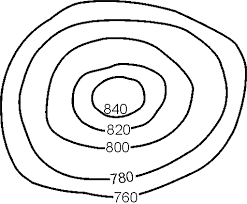
Determine the contour interval:
a)
5 m
b)
10 m
c)
15 m
d)
20 m
64.
What is the map symbol (darker lines)?
a)
roads
b)
index contour
c)
contour interval
d)
waves
65.
Wind, water, and ice breaking down rock is called
a)
Erosion
b)
Deposition
c)
Compaction
d)
Weathering
66.
What is the MAIN way rocks are classified?
a)
Their color and shapes
b)
How they form
c)
Mineral bands
d)
Where they form
67.
The process in which dissolved minerals crystallize and glue sediment together.
a)
compaction
b)
deposition
c)
organic rock
d)
cementation
68.
This rock started as molten magma. What type of rock is this?
a)
Sedimentary
b)
Igneous
c)
Metamorphic
69.
Rock that forms when minerals form from solutions or sediment from older rocks get pressed and cemented together.
a)
Sedimentary Rock
b)
Metamorphic Rock
c)
Igneous Rock
70.
Which would be considered the best index fossil?
a)
A
b)
B
c)
C
d)
D
71.
A bone sample contains only 1of its original radioactive C14 content. How old is the bone sample?
a)
1 C14 half-life
b)
2 C14 half-lives
c)
4 C14 half-lives
d)
8 C14 half-lives
72.
Which geologic event occurred most recently?
a)
deposition of sediments for rock layer A
b)
formation of the fault
c)
intrusion of the igneous material E
d)
cementation of sediments for rock layer D
73.
Why should an experiment be repeated?
a)
to form a hypothesis
b)
to reduce the chance of error
c)
to change controls
d)
to identify the problem
74.
What is the first thing you should do in order to conduct the experiment safely?
a)
obtain and open the materials described in the experiment
b)
mix your materials
c)
read over the lab and be sure you understand the directions.
d)
begin to work right away
75.
What skill are you using when you see a red spot on a desk.
a)
observation
b)
posing a question
c)
classifying
d)
hypothesis
76.
A testable idea or explanation that leads to a scientific investigation is called (can be stated as an if/ then statement)
a)
conclusion
b)
experiment
c)
hypothesis
77.
The variable that stays the same
a)
independent
b)
dependent
c)
control
78.
Weather, climate, and the atmosphere are studied in this branch of Earth Science.
a)
Astronomy
b)
Meteorology
c)
Cartography
d)
Geology
79.
Using the 5 senses to understand what is happening around you is called
a)
experimenting
b)
observing
c)
hypothesizing
d)
sensing
80.
What is an inference? 
a)
Just a guess.
b)
A statement based off of your observations. 
c)
The same as an observation. 
d)
Examples of something. 
81.

The scientific (blank) is a well-tested explanation for a wide range of observations

a)

inquiry

b)

hypothesis

c)

theory

d)

law