wayground logo

Free Printable Worksheets

Font size

S
M
L
XL
Worksheets

Water Test Review

Total questions: 100

Worksheet time: 2hrs 34mins
Name
Class
Date
1.
What is the energy source for the water cycle?
a)
the sun
b)
the earth
c)
water
d)
the moon
2.
Which of these is an example of precipitation?
a)
snow
b)
air
c)
clouds
d)
vapor
3.
Which is the opposite of condensation?
a)
runoff
b)
evaporation
c)
precipitation
d)
transpiration
4.
Which best explains why runoff is important?
a)
It returns water to other locations on Earth
b)
It increases the chance of flooding
c)
It makes evaporation occur faster
d)
It increases condensation
5.
Snow, sleet, hail, and rain are all examples of  ________________. 
a)
evaporation
b)
condensation
c)
accumulation
d)
precipitation
6.
What happens after groundwater at the very end/beginning of the water cycle?
a)
Evaporation
b)
Transpiration
c)
Condensation
d)
Groundwater
7.
What is it called when plants give off water vapor as a waste product?
a)
condensation
b)
evaporation
c)
sublimation
d)
transpiration
8.
When water _________, dew forms.
a)
Melts
b)
Evaporates
c)
Condenses
d)
Precipitates
9.
What is the water cycle?
a)
the 3 forms of water
b)
the movement of water on, above, or below the surface of the Earth
c)
when water melts
d)
when clouds form
10.
During which stage do clouds form?
a)
condensation
b)
evaporation
c)
precipitation
11.
Which stages does liquid water from the ocean turn into water vapor?
a)
condesantion
b)
evaporation
c)
precipitation
d)
run off
12.
Which stage does ground water try to return to the ocean or soak into the ground?
a)
condensation
b)
evaporation
c)
precipitation
d)
run off
13.
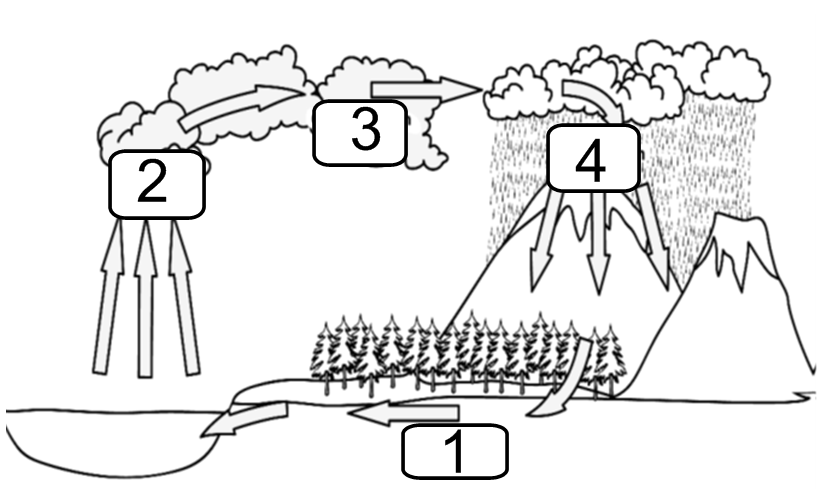
Which stage does the #2 show in the diagram?
a)
condensation
b)
evaporation
c)
precipitation
d)
run off
14.
Which stage does the #3 show in the diagram?
a)
condensation
b)
evaporation
c)
precipitation
d)
run off
15.
what does the #4 show in the diagram?
a)
condensation
b)
evaporation
c)
precipitation
d)
run off
16.
This is what heats up the water to start the  water cycle. 
a)
sun
b)
moon
c)
stars
d)
Mars
17.
Dew also forms directly onto items, as water droplets.  What part of the water cycle is this?
a)
run-off 
b)
condensation
c)
evaporation
d)
precipitation
18.
What is water doing when it is changed to water vapor?
a)
evaporating
b)
condensing
c)
transpiring
d)
freezing
19.
On which kind of day would you expect the most evaporation from the surface of a  pond?
a)
sunny and hot
b)
sunny and cold
c)
rainy and hot
d)
rainy and cold
20.
When humans burn fossil fuels, most of the carbon quickly enters the                       as carbon dioxide.
a)
Water
b)
Atmosphere
c)
Sun
d)
Air
21.
Which one of these does not add CO2 to the atmosphere?
a)
cooking with gas
b)
planting trees
c)
burning wood
d)
riding in a bus
22.
Combustion is another word for _______________.
a)
a train
b)
a bus
c)
a dog
d)
burning
23.
What does not produce carbon dioxide?
a)
Photosynthesis
b)
Burning Fossil Fuels
c)
Animal respiration
d)
Plants decaying
24.
How do living organisms return carbon to the atmosphere in the carbon cycle?
a)
respiration and photosynthesis
b)
 decomposition and respiration
25.
How does the carbon in grass become part of a lion?
a)
The lion eats the grass
b)
Carbon from grass doesn't end up in a lion. 
c)
The carbon ends up in the lion's food chain. 
d)
The lion breathes in carbon given out by the plant
26.
All of the carbon in existence is continually recycled in the carbon cycle
a)
True
b)
False
27.
oxygen is a gas produced by _ and used by  _ 
a)
plants and animals 
b)
photosynthesis and carbon dioxide 
c)
animals and plants 
d)
carbon dioxide and photosynthesis
28.
Which of the following removes carbon from the atmosphere?
a)
Combustion
b)
Respiration
c)
Photosynthesis
d)
Death
29.
Organisms that do not decompose can be buried and become what?
a)
water
b)
nutrients
c)
air
d)
fossil fuels
30.
If the plant population decreased, the amount of carbon would _________.
a)
Stay the same
b)
Increase
c)
Decrease
31.
Why is the ocean important to the carbon cycle?
a)
It keeps sediment containing carbon underwater for millions of years
b)
The ocean gives out more carbon then it takes in (increases global warming)
c)
The ocean isn't important to the carbon cycle.
32.
Carbon can be found in...?
a)
The atmosphere
b)
Inside of the Earth
c)
Fossil fuels
d)
All of the above!
33.
Carbon dioxide is produced by the burning of fossil fuels
a)
True
b)
False
34.

A water molecule has the chemical formula H2O. This means that the water molecule is made up of

a)

a) Two hydrogen atoms and one oxygen atom

b)

b) Two oxygen atoms and one hydrogen atom

c)

c) Two hydrogen atoms and two oxygen atoms

d)

d) Two molecules of water

35.

Water molecules are attracted to each other because

a)

a) They are all positively charged

b)

b) Each water molecule has the same number of protons as electrons

c)

c) The positive area of one water molecule is attracted to the negative area of another

d)

d) All water molecules are neutral

36.

A paper clip can stay on the surface of a sample of water because of water’s strong surface tension. Water’s surface tension is mostly a result of

a)

a) Water’s temperature

b)

b) The motion of water molecules

c)

c) The attraction of water molecules

d)

d) The impurities in the water

37.

Water is not a good dissolver of oil mainly because

a)

a) Oil is also a liquid

b)

b) Oil is thicker than water

c)

c) Oil molecules are non-polar

d)

d) Oil is colder than water
38.
This is useful to plants, Adhesion to the walls of a vessel will cause an up ward force on the liquid. This is an example of what?  
a)
Surface Tension 
b)
Meander 
c)
Specific Heat 
d)
Capillary Action 
39.
The _____ end of the molecule has a slight negative charge and ____ has a slight positive charge.
a)
Helium and Oxygen 
b)
Oxygen and Hydrogen 
c)
Surface and Tension 
d)
Hydrogen and Helium 
40.
Water is referred as the? 
a)
Specific Heat 
b)
Heat Source 
c)
Universal Solvent
d)
Oxygen 
41.
_____ _____ is the tightness across the surface of water.
a)
Capillary Action 
b)
Fall Line
c)
Surface Tension.
d)
Electric Heat 
42.
__ hydrogen atoms bonded to an oxygen atom. 
a)
1
b)
2
c)
4
d)
5
43.
The amount of heat needed to increase the temperature of a certain mass of a substance by 1 degree Celsius. 
a)
Surface tension 
b)
Specific Heat  
c)
Capillary action 
d)
Oxygen 
44.
___ any substance that dissolves another substance  
a)
Solvent 
b)
Height 
c)
Atoms 
d)
Oxygen 
45.
What word describes when water is attracted to other substances?
a)
cohesion
b)
adhesion
c)
capillary action
d)
surface tension
46.
The attraction that causes water and other liquids to form drops on thin films is called ________________. This is also water’s ability to be attracted to other water molecules.
a)
adhesion
b)
capillary action
c)
cohesion
d)
surface tension
47.
tendency of molecules of the same kind to stick to one another
a)
cohesion
b)
adhesion
c)
solution
d)
polar molecule
48.
molecule in which opposite ends have opposite electric charges
a)
cohesion
b)
polar molecule
c)
hydrogen bond
d)
solution
49.
Why does ice float?
a)
As water freezes, it expands and its density decreases.
b)
As water freezes, it takes up more hydrogen from the atmosphere, causing it to have a greater buoyancy.
c)
As water freezes, air becomes trapped between the hydrogen bonds of water molecules.
d)
As water freezes, it takes up more oxygen from the atmosphere, causing it to have a greater buoyancy.
50.
Water droplets take a spherical shape (as pictured) because of ____________
a)
adhesion
b)
cohesion
c)
capillary action
d)
solubility
51.
Water is a universal solvent because it...
a)
It can be found anywhere
b)
It freezes when it gets cold
c)
floats when frozen
d)
Dissolves most substances
52.
Water beads up on the surface of a penny because of this property.
a)
Adhesion
b)
High Surface Tension
c)
Universal Solvent
d)
Changes in Density
53.
The fact that ice floats on liquid water is due to the fact that water's solid is ___________ than it's liquid form
a)
less polar
b)
more polar
c)
less dense
d)
more dense
54.
Water striders can walk across the surface of calm water. Their feet push the surface of the water down slightly, but they do not break the surface. Why?
a)
The insects are light enough so they do not break the hydrogen bonds holding the water molecules together
b)
The insects actually use their wings to hover slightly above the water’s surface and they only skim it with their feet.
c)
The insect’s feet are non-polar, so they are repelled by the polar water molecules and are pushed away from the water’s surface.
d)
The insects are small enough to see the individual water molecules, so they are able to step carefully from one molecule to the next
55.
A general definition of cohesion is the attraction of:
a)
particles of the same substance
b)
particles of a different substance
c)
particles of both the same and different substances
d)
particles of neither the same or different substances
56.
Which term refers to water having partial positive and a partial negative charge?
a)
cohesion
b)
surface tension
c)
polarity
d)
adhesion
57.
A high specific heat means...
a)
It heats up quickly with energy added
b)
It requires more energy to change temperature
58.
What word describes when water is attracted to other substances?
a)
cohesion
b)
adhesion
c)
capillary action
d)
surface tension
59.
Why does water move from the roots to the leaves of plants?
a)
Water is pushed by solutes
b)
Capillary action pulls the water molecules like a chain
c)
Water is pulled by gravity
d)
Water’s cohesion causes it to “pull” towards the leaves
60.
What property of water helps to moderate earth's temperature?
a)
adhesion
b)
chohesion
c)
Specific heat capacity
d)
Latent heat of vaporization
61.
The chemical compound of water is
a)
HO
b)
H2O
c)
H3O
d)
HO2
62.
The natural chemical or physical processes that breaks down rock on Earth's surface.
a)
weathering
b)
erosion
c)
deposition
d)
jackhammering
63.
The process by which water, ice, wind or gravity moves weathered rock and soil from one place to another.
a)
weathering
b)
erosion
c)
deposition
d)
dumptruck
64.
This type of weathering occurs when rock is physically broken down into smaller pieces of rock.
a)
mechanical weathering
b)
chemical weathering
c)
erosion weathering
d)
deposition
65.
This type of weathering occurs when rocks weaken then break down due to chemical changes in the composition of the rock.
a)
mechanical weathering
b)
chemical weathering
c)
erosion weathering
d)
deposition
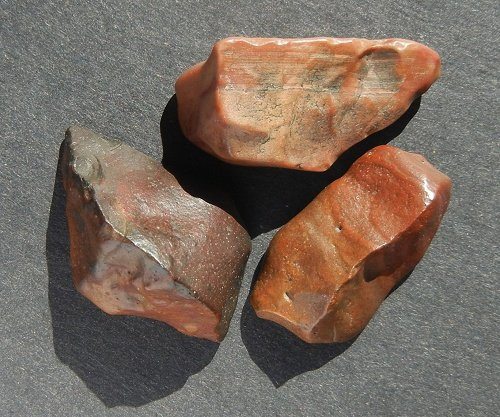
66.
These rocks were made smooth by wind blowing smaller rock particles across their surface.  This is an example of:
a)
ice wedging
b)
chemical weathering
c)
acid rain
d)
abrasion
67.
These rocks were broken apart from the continuous freeze/thaw of water in the cracks of the rocks. This is an example of:
a)
ice wedging
b)
acid rain
c)
permeability
d)
abrasion
68.
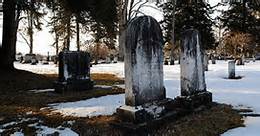
These gravestones have slowly broken down and turned a blackish color due to the action of:
a)
ice wedging
b)
abrasion
c)
acid rain
d)
mechanical weathering
69.
How might a weathered mountain appear different than an unweathered mountain?
a)
Weathered mountain would be taller.
b)
Weathered mountain would be rounder and less jagged.
c)
Weathered mountain would be more jagged and less rounded.
d)
Weathered mountain would have no trees.
70.
How is mechanical weathering different from chemical weathering?
a)
Chemical weathering happens over much shorter time frame than mechanical weathering.
b)
Chemical weathering changes the chemical composition of rocks; mechanical weathering does not.
c)
Chemical weathering occurs only in tropical climates; mechanical weathering occurs only in cool climates.
d)
Chemical weathering occurs only in the mountains; mechanical weathering occurs only on flat land.
71.
Weeds growing into the cracks in a sidewalk and the sidewalk begins to crumble is an example of:
a)
mechanical weathering
b)
chemical weathering
72.
Potholes forming in the road after a cold winter is an example of:
a)
mechanical weathering
b)
chemical weathering
73.
A metal statue slowly turning green after years of being outside is an example of:
a)
mechanical weathering
b)
chemical weathering
74.
Rocks along a riverbed that are smoothed from continuously moving water and sediment rubbing against them is an example of:
a)
mechanical weathering
b)
chemical weathering
75.
A piece of sandstone changing color (from brown to rusty red) from exposure to water and air is an example of:
a)
mechanical weathering
b)
chemical weathering
76.
The formation of stalactites and stalagmites in a cave as water mixed with carbon dioxide creates carbonic acid, which dissolves away the limestone, is an example of:
a)
mechanical weathering
b)
chemical weathering
77.
The formation of large cracks in the face of a mountain from ice wedging is an example of:
a)
mechanical weathering
b)
chemical weathering
78.
Acid rain wearing away the face of a marble gravestone or statue is an example of?
a)
mechanical weathering
b)
chemical weathering
79.
Exposure to rain and oxygen causes the metal minerals in rocks to rust and fall apart.  This is an example of:
a)
mechanical weathering
b)
chemical weathering
80.
Lichens (small green plants) growing on a large boulder release enzymes and other acids that slowly break the rock apart. This is an example of:
a)
mechanical weathering
b)
chemical weathering
81.

Which is NOT one of the ways we use water?

a)

farming

b)

material goods

c)

recreation

d)

school work

82.

True or False: Streams/creeks, Rivers, Lakes, springs, and oceans are places we get our water from.

a)

True

b)

False

83.

The earth is made up of ______% salt water

a)

3

b)

71

c)

83

d)

97

84.

We have _____________ 1% usable freshwater on Earth.

a)

less than

b)

more than

c)

equal to

85.
Low turbidity means what
a)
Clear water
b)
cloudy water
c)
smelly water
d)
witch water
86.
high turbidity means what
a)
smelly water
b)
clear water
c)
cloudy water
d)
witch water
87.

movement of water makes dissolved oxygen....

a)

Increase

b)

Decrease

88.

photosynthesis makes dissolved oxygen

a)

increase

b)

decrease

89.

What does the process of filtration do to the water?

a)

pollutes it

b)

increases the amount of water

c)

purifies it

d)

makes it unsafe for human use

90.

The measure of biological, physical and chemical characteristics of water is called...

a)

surface runoff

b)

watershed

c)

filtration

d)

water quality

91.

How could pesticides get into lakes and streams?

a)

it could be washed down a storm drain

b)

it could be sprayed too close to a stream

c)

rain could cause it to runoff into a stream

d)

all of the above

92.

Measure of water clarity

a)

Eutrophication

b)

Turbidity

c)

pH

d)

Bioindicators

93.

Organisms that indicate the health of an aquatic environment.

a)

Non-Point Source Pollution

b)

Point Source Pollution

c)

pH

d)

Biotic factors

94.

A measure of acidity/alkalinity

a)

Turbidity

b)

Eutrophication

c)

pH

d)

Point Source Pollution

95.

Ranges from 0 to 14; Less than 7 is acidic & greater than 7 is alkaline(basic)

a)

turbidity

b)

pH

c)

dissolved oxygen

d)

eutrophication

96.
measure of that saltiness and is expressed in parts impurity per thousand parts water
a)
Conductivity
b)
pH
c)
Salinity
d)
Turbidity
97.
Water with high turbidity 
a)
is cloudy and hard to see through
b)
is clear
98.
Which of the following is an effect of excess fertilizer washing into streams and lakes?
a)
the pH is too low for plants and animals
b)
cooler water holds more oxygen
c)
increased sediment reduces oxygen
d)
algae "blooms", leading to lower oxygen
99.
High turbidity indicates poor water quality because
a)
it clogs the gills of aquatic animals and makes it difficult to breathe
b)
it makes it hard for sun to get to the aquatic plants
c)
it makes it hard for aquatic animals to find their food
d)
all are reasons high turbidity indicates poor water quality
100.

Which two things cause the weather of a coastal town to be warmer during the winter and cooler during the summer?

a)

Dissolved oxygen and salinity

b)

Water and carbon cycles

c)

Cohesion and adhesion

d)

Specific heat and heat capacity