wayground logo

Free Printable Worksheets

Font size

S
M
L
XL
Worksheets

Semester Exam Review- Waves & Astronomy Pt. 1

Total questions: 86

Worksheet time: 53mins

Name
Class
Date
1.
Our galaxy is called the
a)
Earth Nebula
b)
The Hubble Galaxy
c)
The Milky Way
d)
The Snickers
2.
Galaxies are composed of (best answer)
a)
stars
b)
stars and gas
c)
stars, dust, and gas
d)
stars, dust, and gas held together by gravity
3.
The Milky Way Galaxy is a 
a)
spiral
b)
lenticular
c)
elliptical 
d)
irregular
4.
What type of galaxy is this?
a)
Spiral
b)
Elliptical
c)
Irregular
d)
Irrational
5.
What type of galaxy is this?
a)
Spiral
b)
Elliptical
c)
Irregular 
d)
Irrational
6.
Distance measurement used by astronomers for distant objects.
a)
Kilometers
b)
Light Years
c)
Miles
d)
Light Seconds
7.
How many stars are in a galaxy.
a)
millions or billions
b)
thousands
c)
hundreds
d)
Ten
8.
Place these objects in order from smallest to largest.
a)
Planets, solar system, universe, galaxy
b)
Solar system, planets, galaxy, universe
c)
Planets, solar system, galaxy, universe
d)
Galaxy, solar system, planets, universe
9.
Our sun is located on one of the Spiral Galaxy arms.  
a)
True
b)
False
10.
What type of galaxy is this?
a)
Spiral
b)
Elliptical
c)
Irregular
d)
Irrational
11.
What type of galaxy has no defined pattern or shape?
a)
Spiral 
b)
Elliptical
c)
Irregular
d)
Constellation
12.
All existing matter and space considered as a whole is called what?
a)
Galaxy
b)
Planet
c)
Universe
d)
Milky Way
13.
Light Years are a measure of:
a)
time
b)
speed
c)
distance
d)
light
14.
A light year is...
a)
The speed light travels
b)
How long it takes light to get to you from the sun
c)
The distance light can travel in a year
d)
How many years it takes light to be emitted
15.

Why is it considered inappropriate to use light years to measure distances within our solar system?

a)

The light year is too big

b)

The solar system is to small

c)

light doesn't travel in our solar system

d)

We only use light years to measure sizes, not distances

16.

The number of minutes it takes light to travel from the Sun to Earth

a)

300,000

b)

eight

c)

Light year

d)

astronomical unit

17.
Proxima Centauri is the closest star to Earth after the Sun and is located 4.3 light years away from Earth. How long does it take light from Proxima Centauri to reach Earth?
a)
1 year
b)
4.3 years
c)
43 years
d)
10 trillion years
18.

How long would it take light from the Sun to reach Mizar?

a)

73 light years

b)

73 years

c)

73 billion years

d)

7.3 years

19.
When we look at the sun, what layer are we viewing?
a)
photosphere
b)
chromosphere
c)
corona
d)
convection zone
20.
What layer of the sun's atmosphere gives the sun its "white halo" during a solar eclipse?
a)
chromosphere
b)
photosphere
c)
corona
d)
atmosphere
21.
Areas of gas on the sun's surface that are cooler than gases around them are called:
a)
corona
b)
prominences
c)
sunspots
d)
solarspots
22.
The number of sunspots on the sun varies in a cycle that is about how long?
a)
6-8 years
b)
10-11 years
c)
12-15 years
d)
365 days
23.
Huge loops of reddish gas that connect sunspots are called:
a)
prominences
b)
solar flares
c)
coronal loops
d)
solar wind
24.
When prominences erupt into space releasing gas and energy we call this: 
a)
solar winds
b)
coronal outburst
c)
solar flares
d)
auroras
25.
Why does the sun look bigger and brighter than other stars?
a)
It is the furthest star from Earth
b)
It is next to the Earth
c)
It is the nearest star to Earth
d)
It is behind the Earth 
26.
The sun is a _______ sized star.
a)
small
b)
medium
c)
large
d)
gigantic 
27.
A large cloud of gas and dust in space 
a)
Universe 
b)
Galaxy 
c)
Protostar
d)
Nebula
28.
When light or other electromagnetic radiation from an object is increased in wavelength, or shifted to the red end of the spectrum which implies light source moving away from an observer.
a)
Blue Shift 
b)
Red Shift
c)
Purple Shift
d)
Solar Shift
29.
Used to gather/focus light from the visible light part of the EM spectrum
a)
Radio Telescope 
b)
Optical Telescope 
c)
Satellite 
d)
Space probe
30.
An instrument that collects light from distant stars and separates the light into the different colors of the visible light spectrum.
a)
Telescope 
b)
Satellite 
c)
Space Probe 
d)
Spectroscope
31.
Storms caused by the increased number of particles in the solar wind due to solar flares and prominence.
a)
Solar Wind 
b)
Solar Flare
c)
Magnetic Storm 
d)
Aurora
32.
When the charged particles come in contact with the Earth’s atmosphere, the sky glows, usually near the poles
a)
Solar Flare 
b)
Magnetic Storm
c)
Solar Wind 
d)
Aurora 
33.

A tool that makes faraway objects seem brighter and closer than they really are.

a)

astrolabe

b)

compass

c)

sextant

d)

telescope

34.
A refracting telescope uses: 
a)
Lens
b)
Mirrors
c)
Lens and mirrors
d)
Transmitters
35.

Which is NOT a space tool?

a)

Refracting telescope

b)

Reflecting telescope

c)

Spectroscopes

d)

Prisms

36.
What are the two types of optical telescopes? 
a)
Reflecting/Rarefaction
b)
Compressional/Longitudinal
c)
Reflecting/Longitudinal
d)
Refracting/Reflecting
37.
The telescopes that receive long wavelengths from space. 
a)
Space probes
b)
Space satellites
c)
Space landers
d)
Radio 
38.
The best thing about radio telescopes is: 
a)
They can receive data any time of day and in any weather
b)
They can receive very high frequency signals
c)
They receive gamma rays
d)
They can intercept signals between planets 
39.

Spectroscopes use bands of color to identify:

a)

Mass of star

b)

The elements in the star

c)

The weight of the star

d)

The sounds the star makes

40.
An object that orbits another object in space is a: 
a)
Space probe
b)
Space lander
c)
Space invader
d)
Satellite
41.
Space observatories are used to:
a)
Collect data
b)
Take pictures
c)
All answers
d)
Transmit information
42.
The space instrument that travels beyond our solar system are:
a)
Space probes
b)
Satellites
c)
Observatories
d)
Telescopes
43.
Unmanned space probes are used to explore outer space because: 
a)
They are inexpensive
b)
They are extremely large
c)
It's too dangerous for humans
d)
It's too hard to see things far away
44.

A small spacecraft, with no one traveling in it, sent into space to make measurements and send back information to scientists on earth about the sun, planets, comets, and asteroids close up.

a)

Rover

b)

Lander

c)

International Space Station

d)

Space Probe

45.
This is a large telescope that was put in the orbit of the Earth in 1990. 
a)
Hubble Space Telescope
b)
Mission Space probe
c)
Satellite In My Eye
d)
Space Shuttle Shuffle
46.

When a wave strikes an object and bounces off of it

a)

Absorption

b)

Diffraction

c)

Refraction

d)

Reflection

47.
a)

absorption

b)

diffraction

c)

reflection

d)

refraction

e)

transmission

48.
What is a medium?
a)
something between a small and a large?
b)
the substance through which a wave can travel
c)
a pattern of vibration that simulates when a wave is standing still
d)
the distance from any point on a wave to an identical point on the next wave
49.
When a wave passes from one medium to another, the ________ may change.
a)
speed
b)
frequency
c)
wavelength
d)
speed, frequency, and wavelength
50.
Prisms separate light into the colors of the rainbow using what behavior of waves?
a)
Reflection
b)
Refraction
c)
Absorption
d)
Transmission
51.
The combination of two or more waves that result in a single wave
a)
A. diffraction
b)
B. resonance
c)
C. reflection
d)
D. interference
52.
When the crests of one wave overlap the crests of another wave or waves, this occurs.
a)
A. diffraction
b)
B. destructive interference
c)
C. constructive interference
d)
D. resonant frequencies
53.
a)
Constructive Interference
b)
Destructive Interference
c)
Refraction
d)
Diffraction
54.
Which wave behavior do noise cancelling headphones use?
a)
diffraction
b)
refraction
c)
constructive interference
d)
destructive interference
55.

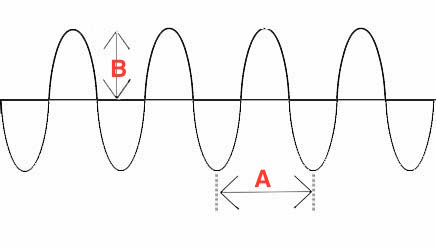
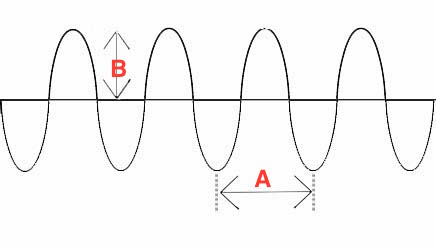
What property of this wave is represented by the letter "A"

a)

amplitude

b)

crest

c)

trough

d)

wavelength

56.
What property of the wave is represented by the letter "B"?
a)
amplitude
b)
crest
c)
trough
d)
wavelength
57.
The highest point on a wave is:
a)
the crest
b)
the trough
c)
the top
d)
the coast 
58.
The lowest point on a wave is the:
a)
Amplitude
b)
Crest
c)
Trough
d)
Wavelength
59.
The number of wavelengths that pass a point each per second is:
a)
frequency
b)
period
c)
longitudinal 
d)
transverse wave 
60.
The type of waves that require medium to pass:
a)
Mechanical Waves
b)
Electromagnetic Waves
61.
When the frequency of a wave increases, what happens to the wavelength?
a)
The wavelength is not directly affected by the frequency of a wave.
b)
The wavelength increases.
c)
The wavelength decreases.
d)
More specific information is needed to form a conclusion about the wavelength.
62.
A mechanical wave cannot travel through...
a)
a vacuum(empty space).
b)
water.
c)
air. 
d)
glass.
63.
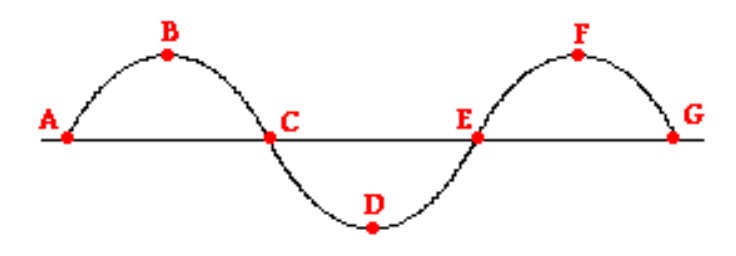
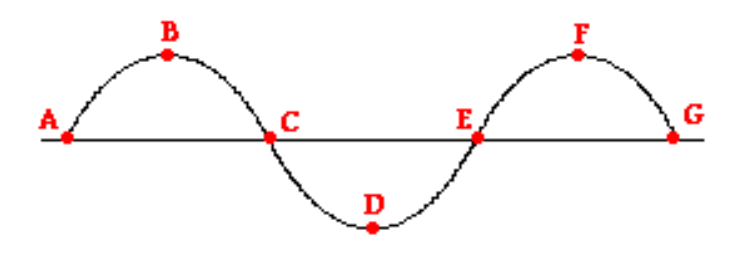
Which letter(s) represent the trough of the wave?
a)
A
b)
B & D
c)
D
d)
C & G
64.
Which letter(s) represent the crest of the wave?
a)
A
b)
B & D
c)
B & F
d)
F
65.
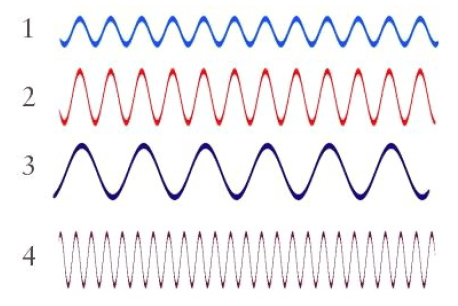
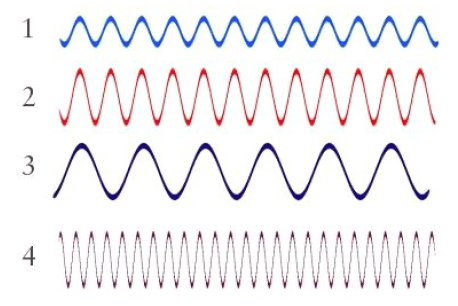
Which wave in the diagram has the greatest frequency?
a)
1
b)
2
c)
3
d)
4
66.
Which wave in the diagram has the greatest wavelength?
a)
1
b)
2
c)
3
d)
4
67.
Which of the following can sound travel through?
a)
solid
b)
liquid
c)
gas
d)
all of the above
68.
Electromagnetic waves include the following except
a)
radio waves
b)
X-rays
c)
doing the wave at a football game
d)
microwaves
69.
which material does sound travel the fastest?
a)
solid 
b)
liquid 
c)
gases
70.
A wave carries...?
a)
energy only
b)
matter only
c)
energy and matter
d)
neither
71.

The color with the longest wavelength is...

a)

Blue

b)

Red

c)

Green

d)

Yellow

72.

If you see a green leaf on a tree, that means...

a)

Green is the color being reflected off the leaf.

b)

Green is the color being absorbed by the leaf.

c)

All the colors are being reflected off the leaf.

d)

All the colors are being absorbed by the leaf.

73.

Which of the following terms describes what happens as light passes through a prism?

a)

reflection

b)

refraction

c)

absorption

74.
Why do we see objects as white?
a)
They absorb all light
b)
They reflect all light
c)
They absorb some light and reflect some light
75.
Opaque means...
a)
No light passes through it
b)
All light passes through it
c)
Some light passes through it
76.
The color you see is the color that is ___.
a)
reflected
b)
absorbed
77.
What part of the visible spectrum has the highest energy? 
a)
Red
b)
Orange
c)
Green
d)
Violet
78.

The colored area of your eye is called

a)

retina

b)

iris

c)

pupil

d)

sclera

79.

It is a hole in the middle of the iris that takes in light.

a)

retina

b)

iris

c)

pupil

d)

sclera

80.

If it's dark in the room your pupil will ______

a)

become smaller

b)

become larger

c)

stay the same

d)

disappear

81.

It focuses the light that comes into the pupil

a)

retina

b)

iris

c)

pupil

d)

lens

82.

It turns the light into electrical pulses that will get sent to the brain.

a)

iris

b)

lens

c)

pupil

d)

retina

83.
What part of your eye sends the messages to and from your brain?
a)
retina
b)
optic nerve
c)
iris
d)
vitreous humor
84.
What is the function of the retina?
a)
bend light so that our eyes are able to adjust in various settings.
b)
control the movement of our eyes. 
c)
sends impulses to the brain for visual recognition. 
d)
protect the eye from bacteria and debris. 
85.
What is letter E?
a)
Vitreous humor
b)
Retina
c)
Cornea
d)
Optic nerve
86.
What is letter G?
a)
Sclera
b)
Retina
c)
Lens
d)
Vitreous humor