wayground logo

Free Printable Worksheets

Font size

S
M
L
XL
Worksheets

Sci 10 Unit 1 Bio Review

Total questions: 164

Worksheet time: 3hrs 39mins
Name
Class
Date
1.
Complex molecule that carries genetic information that defines an organism's traits. It is stored in the nucleus.
a)
DNA
b)
protein
c)
RNA
d)
glucose nucleic acid (GNA)
2.
Dominant alleles are represented by a:
a)
Male gene
b)
lowercase letter
c)
recessive trait
d)
capital letter
3.
Aa, DD, bB, yy are all examples of
a)
genotypes
b)
phenotypes
4.
In a heterozygous genotype, the ___________ allele takes over in the phenotype.
a)
recessive
b)
dominant
c)
lower case letter
d)
both 
5.
What you see, or the physical appearance.
a)
Genotype
b)
Phenotype
c)
Homozygous
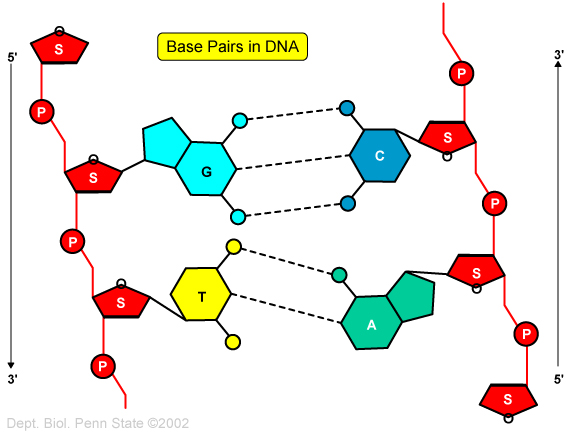
d)
Heterozygous
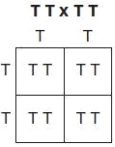
6.
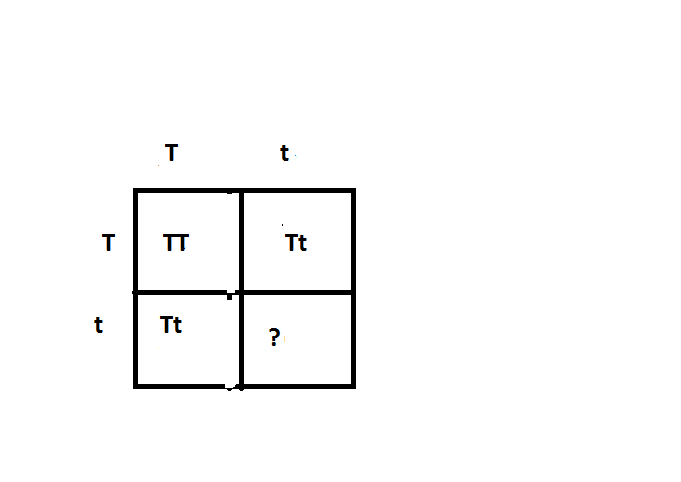
T - tall and t = short
In the punnett square below, what belongs in the missing square
a)
tt
b)
Tt
c)
Bb
d)
TT
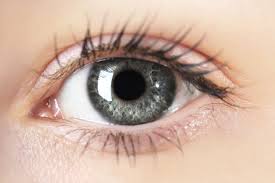
7.
B = brown eyes
b = blue eyes
What is true about these two brothers that have brown eyes?
One has genotype BB the other Bb.
a)
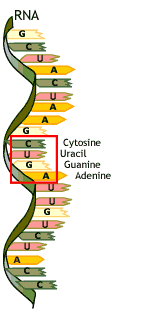
they have same phenotype and genotype
b)
they have different genotypes and phenotypes
c)
they have same phenotype but different genotypes
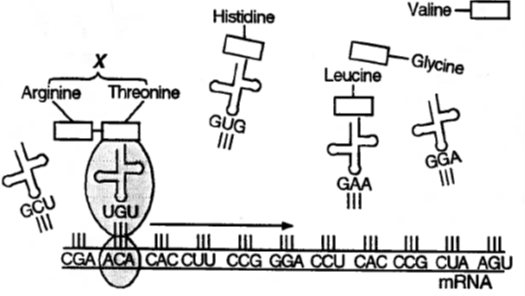
d)
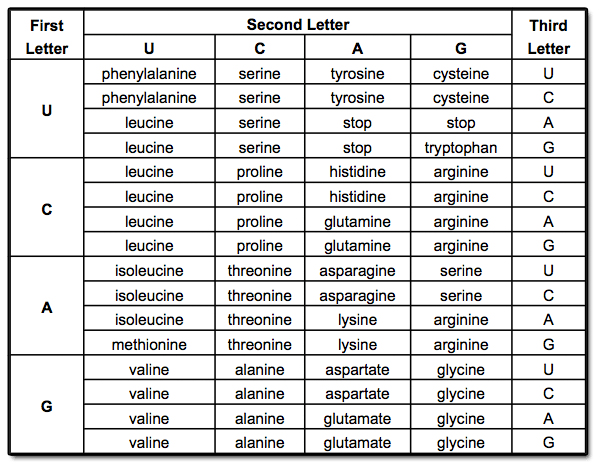
they have same genotype but different phenotypes
8.
aa always shows up as
a)
dominant
b)
recessive
9.
Aa is
a)
homozygous
b)
heterozygous
10.
Which of the following is a phenotype?
a)
Aa
b)
red hair
c)
heterozygous
d)
DNA
11.
What ratio of the offspring from the cross shown will be homozygous recessive for the  trait of tallness? 
a)
0 in 4
b)
1 in 4
c)
2 in 4
d)
4 in 4
12.
Which of the following genotypes is homozygous dominant?
a)
A
b)
Aa
c)
AA
d)
aa
13.
Which of the following genotypes is heterozygous?
a)
Bb
b)
BB
c)
bb
d)
B
14.
Which of the following is homozygous dominant?
a)
Yy
b)
Y
c)
yy
d)
YY
15.
Which of the following is homozygous recessive?
a)
Tt
b)
tt
c)
TT
d)
T
16.
Which of the characteristics is a lion least likely to pass on to its offspring?
a)
fur color
b)
length of tail
c)
scars on leg
d)
body size
17.
In a pedigree, what shape represents a male?
a)
circle
b)
square
c)
triangle
d)
diamond
18.
What gender has an X and a Y chromosome?
a)
male
b)
female
c)
transgender 
d)
all of the above
19.
Heterozygous is when...
a)
the alleles are the same
b)
the alleles are different
c)
the alleles are absent
d)
the alleles are present
20.
B = brown fur  b = white fur
In the punnett square, what is the probability for white fur? 
a)
0%
b)
25%
c)
50%
d)
75%
21.
In plants, tall (T) is dominant to short (t). Perform the following cross: Tt x Tt. What is the probability of producing a short plant?
a)
0%
b)
25%
c)
50%
d)
75%
22.
Which of the following is NOT a genotype?
a)
heterozygous
b)
a trait
c)
Bb
d)
homozygous recessive
23.
What is a punnett square?
a)
graph used to predict the possible genotypes of offspring in a given cross
b)
a graph used to predict the possible birth rate of offspring.
c)
a graph used to predict the possible behavioral characteristics an offspring could have
d)
None of the above
24.
Each one of the boxes on the Punnett Square represents what probability of an offsprings' genotype?
a)
25%
b)
1%
c)
10%
d)
0%
25.
when one allele is not completely dominant over the other - blending of two traits
a)
Codominance
b)
Complete dominance
c)
incomplete dominance
d)
none of these
26.
condition in which both alleles for a gene are expressed when present - both traits are visible
a)
Codominance
b)
Dominance
c)
Complete dominance
d)
Incomplete dominance
27.
traits you are born with - passed down from your parents
a)
acquired traits
b)
inherited traits
c)
dominant traits
d)
recessive traits
28.
traits you are born with - passed down from your parents
a)
acquired traits
b)
inherited traits
c)
dominant traits
d)
recessive traits
29.
a trait that is learned or developed over time 
a)
inherited trait
b)
acquired trait
c)
dominant trait
d)
recessive trait
30.
this image is an example of
a)
codominance
b)
dominance
c)
incomplete dominance
31.
this image is an example of
a)
codominance
b)
dominance
c)
incomplete dominance
32.
Hair color is an inherited or acquired trait?
a)
inherited
b)
acquired
33.
Glasses is an inherited or acquired trait?
a)
inherited
b)
acquired
34.
inherited or acquired trait?
a)
inherited
b)
acquired
35.
the characteristics of a trait that you can see
a)
genotype
b)
phenotype
36.
A calico cat shows both the traits for orange fur and black fur. What kind of allele expression is this?
a)
Incomplete Dominance
b)
Co dominance
c)
Independent assortment
d)
Recessive inheritance
37.
The different forms of a gene are called
a)
traits
b)
pollinators
c)
alleles
d)
hybrids
38.
A breed of chicken shows codominance for feather color. One allele codes for black feathers, another codes for white feathers. The feathers of heterozygous chickens of this breed will be:
a)
all black
b)
all white
c)
all gray
d)
speckled black and white
39.
An allele whose trait only shows up when no dominant allele is present.
a)
hidden allele
b)
dominant allele
c)
recessive allele
d)
present allele
40.
This type of inheritance pattern shows BOTH traits in possible offspring
a)
complete dominance
b)
incomplete dominance
c)
co-dominance
d)
dominant pattern
41.
Hemophilia is a x-linked disorder.  A woman is a carrier for the disorder.  Which is the correct genotype?
a)
Hh
b)
XHXh
c)
hh
d)
XhXh
42.
What percentage of the offspring will have this recessive disease?
a)
0%
b)
25%
c)
50%
d)
75%
43.
What percentage of the female offspring will be a carrier for this recessive disease?
a)
0%
b)
50%
c)
100%
d)
25%
44.
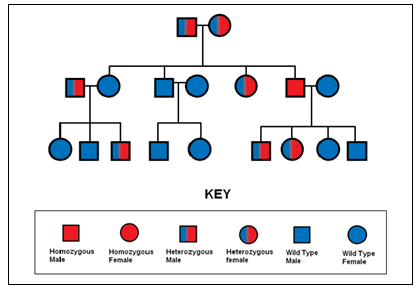
Looking at this pedigree, how many female family members are carriers?
a)
1
b)
3
c)
10
d)
7
45.
How many PAIRS of chromosomes do humans have?
a)
23
b)
46
c)
1
d)
2
46.
How many PAIRS of sex chromosomes do humans have?
a)
23
b)
46
c)
1
d)
2
47.
I have 2 X chromosomes. What am I?
a)
Male
b)
Female
48.
I have 1 X chromosome and 1 Y chromosome. What am I?
a)
Male
b)
Female
49.
The visual representation of an individual's chromosomes is a 
a)
phenotype
b)
genotype
c)
karyotype
d)
stereotype
50.
Why are men 16 times more likely to be color-blind than women?
a)
to be color-blind, you must have a Y chromosome
b)
to be color-blind, all of your X chromosomes must have the gene
c)
color-blindness is caused by testosterone
d)
color-blindness is caused by the same gene as baldness
51.
If a gene is found only on the X chromosome and not the Y chromosome, it is said to be 
a)
sex-linked trait
b)
polygenic trait
c)
codominant trait
d)
incomplete dominance trait
52.
Hemophilia is a recessive x-linked disorder.
Which genotype represents a female who is a carrier for hemophilia?
a)
XHXh
b)
XhXh
c)
XHXH
d)
XhY
53.
Hemophilia is a recessive x-linked disorder.
Which genotype represents a male with hemophilia?
a)
XHXh
b)
XhXh
c)
XHY
d)
XhY
54.
Which of the following genotypes belongs in the red box in the Punnett square?
a)
XBXB
b)
XbXb
c)
XbY
d)
XBY
55.
In fruit flies, red eye color (R) is a sex-linked trait that is dominant over white eye color (r).
According to the Punnett square, what percentage of female offspring will have red eyes?
a)
75%
b)
25%
c)
0%
d)
100%
56.
Duchenne muscular dystrophy is a recessive x-linked disorder.
According to the Punnett square, what percentage of male offspring will have the disorder?
a)
0%
b)
25%
c)
50%
d)
100%
57.
Hemophilia is a recessive x-linked disorder. According to the Punnett square, what percentage of offspring will have the disorder?
a)
0%
b)
25%
c)
50%
d)
100%
58.
What are the nucleotides made of?
a)
Sugar, Phosphate, nitrogen base
b)
Phosphate, Adenine, nitrogen base
c)
Thymine, Adenine, Cytomine
d)
Phosphate, Nitrogen, Adenine
59.
Which of the following best describes a DNA molecule?
a)
double helix
b)
contains ribose
c)
made of amino acids
d)
contains Uracil
60.
Which of the following units are repeatedly joined together to form a strand of DNA? (This is the MONOMER of DNA.) 
a)
amino acids
b)
nucleotides
c)
fatty acids
d)
polysaccharides
61.
Adenine bonds with ______________.
a)
Guanine
b)
Thymine
c)
Cytosine
d)
Adenine
62.
Guanine bonds with ______________.
a)
Adenine
b)
Guanine
c)
Cytosine
d)
Thymine
63.
Why is DNA important?
a)
it is very small and very complicated
b)
it's in everything
c)
it serves as the blueprint for traits of all living things
d)
because we eat it every day for energy
64.
What are the 4 nitrogen bases?
a)
adenine, thymine, cytoplasm, and guanine
b)
adenine, thymine cytosine, and guanine
c)
adenine, thymine, cytosine, and gylcerol
d)
adenine, thymine, cytosine, and glucose
65.
Which 2 molecules forms the sides (backbone) of the DNA ladder?
a)
deoxyribose and adenine
b)
deoxyribose and a hydrogen bond
c)
sugar and the nucleus
d)
deoxyribose (sugar) and phosphate
66.
Which organelle is DNA usually found in?
a)
cell membrane
b)
vacuole
c)
chloroplast
d)
nucleus
67.
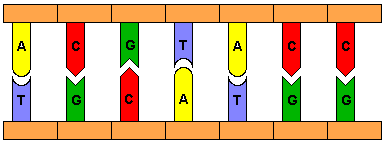
Which sequence of DNA bases would pair with this partial strand
ATG TGA CAG
a)
ATG TGA CAG
b)
TAC ACT GTC
c)
GTA AGT GAC
d)
CAT TCA CTG
68.
Which sequence of DNA bases would pair with this partial strand
ATG TGA CAG
a)
ATG TGA CAG
b)
TAC ACT GTC
c)
GTA AGT GAC
d)
CAT TCA CTG
69.
What determines the code, or information, of a DNA molecule?
a)
the shape (structure) of the nitrogen bases
b)
the order (sequence) of the nitrogen bases
c)
the color of the nitrogen bases
d)
the frequency (number) of nitrogen bases
70.
Which 2 molecules form the sides (backbone) of the DNA ladder?
a)
deoxyribose sugar and adenine
b)
deoxyribose sugar and a hydrogen bond
c)
deoxyribose sugar and the nucleus
d)
deoxyribose sugar and phosphate
71.
Nitrogenous bases are joined by which type of bond?
a)
polar bonds
b)
ionic bonds
c)
covalent bonds
d)
hydrogen bonds
72.
Replicate the following strand of DNA: 
AATCATGGA
a)
AATCATGGA
b)
TTAGTACCT
c)
UUAGUACCU
d)
GGATAUCUA
73.
The enzyme that unzips the DNA to prepare for replication
a)
helicase
b)
replicase
c)
polymerase
d)
synthase
74.
DNA replication results in two DNA molecules,
a)
each one with two original strands
b)
each one with two new strands
c)
each one with one new strand and one original strand
d)
one with two new strands and the other with two original strands
75.
order of replication
a)
3, 2, 1, 4
b)
2, 1, 4, 3
c)
2, 3, 1, 4
d)
3, 4, 1, 2
76.
A process in which DNA has the unique ability to make an exact copy of itself.
a)
Replication
b)
Translation
c)
Transcription
77.
In RNA, Uracil pairs with ______. 
a)
cytosine
b)
adenine
c)
guanine
d)
thymine
78.
The process to go from DNA to mRNA is _______
a)
translation
b)
transcription
c)
replication
79.
The process to go from mRNA to a protein is called ____
a)
transcription
b)
rRNA
c)
replication
d)
translation
80.
DNA holds the code for
a)
lipids
b)
carbohydrates
c)
protein
d)
sugar
81.
Choose the nucleotide sequence of the RNA strand that would be complementary to the following strand: 
GTAGTCA
a)
UATUAGA
b)
ACGACTG
c)
CAUCAGU
d)
CATCAGT
82.
The main function of tRNA is to...
a)
carry a message that, when translated, forms proteins
b)
form a portion of ribosomes
c)
string together complementary RNA and DNA strands
d)
bring amino acids from the cytoplasm to the ribosomes
83.
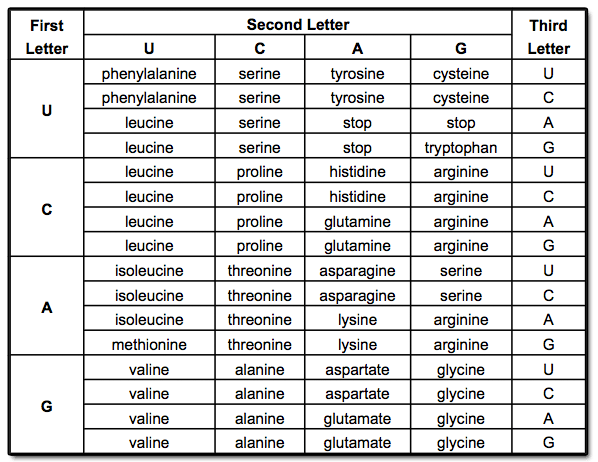
What amino acid is represented by the codon UUA?
a)
Phenylalanine
b)
Tyrosine
c)
Leucine
d)
Stop codon
84.
What process is going on in this photo? 
a)
Transcription 
b)
Translation 
c)
Replication 
d)
All the above 
85.
Which component of DNA determines the traits of an organism? 
a)
Nitrogen Bases
b)
Sugar-Phosphate Backbone
c)
Hydrogen bonds
86.
What is the location in the cell for translation?
a)
nucleus
b)
mitochondria
c)
ribosome
d)
chloroplast
87.
What is the three base sequence of mRNA that codes for a single amino acid?
a)
Anticodon
b)
Codon
c)
Protein
88.
What are the backbones (sides) of the DNA structure made up of?
a)
repeating phosphates and sugars
b)
nitrogen bases
c)
nucleotides
d)
adenine and thymine
89.
What is the location in the cell for transcription?
a)
nucleus
b)
cytoplasm
c)
ribosome
d)
mitochondria
90.
Which is the mRNA molecule that would be transcribed from this DNA template:
TGGCAAGTACGT
a)
ACCGTTCATGCA
b)
UGGCAAGUACGU
c)
UCCGUUCUUGCU
d)
ACCGUUCAUGCA
91.
In DNA, Adenine pairs with ___________. 
a)
Guanine
b)
Cytosine
c)
Thymine
d)
Uracil
92.
Translation is the process where
a)
mRNA is created in the Nucleus
b)
mRNA is decoded to form a protein 
c)
glucose molecules are made
d)
is where lipids are synthesised
93.
Does the order of amino acids in a protein matter?
a)
YES!
b)
NO!
94.
What is the correct amino acid sequence for the mRNA code AUGCCAGUAUGA
a)
Met-Pro-Ala-Val
b)
Met-Pro-Val
c)
Tyr-Gly-His
d)
Tyr-Gly-Arg-His
95.
How many amino acids are coded for by this sequence of nucleotides:
ATG GGA ACT CCA
a)
4
b)
2
c)
6
d)
12
96.

What type of bond holds together the two strands of the DNA double helix?

a)

covalent

b)

ionic

c)

hydrogen

d)

metallic

97.

How do the two strands of a DNA molecule compare to each other?

a)

identical

b)

opposite

c)

the same

d)

complementary

98.

The monomers that make up DNA and RNA are called?

a)

amino acids

b)

monosaccharides

c)

nucleotides

d)

fatty acids

99.

The process of DNA copying itself is

a)

conservative - one original and one new DNA molecule

b)

semi-conservative - 2 DNA molecules with one new and one original strand

c)

dispersive - 2 DNA molecules with each strand consisting of alternating segments of new and original DNA parts

d)

partial - one complete DNA molecule and one partial DNA molecule

100.

The segment of DNA that has the directions for making a protein is called?

a)

chromosome

b)

strand

c)

gene

d)

nucleotide

101.

Which of the following is a correct statement about mutations?

a)

They are a source of variation for evolution

b)

Ther drive evolution by creating mutation pressures

c)

They are irriversible

d)

They occur in germ cells but not in somatic cells

e)

They are most often beneficial to the organisms in which they occur.

102.
 A frameshift mutation could result from 
a)
a base insertion only.
b)
a base deletion only. 
c)
a base substitution only. 
d)
either an insertion or a deletion of a base.
103.
DNA molecule segment is : TTACGCAAG
The mutated DNA segment is TTCGCAAG. This is an example of ______ mutation.
a)
Substitution
b)
Deletion
c)
Insertion
d)
Inversion
104.
Are all mutations bad?
a)
Yes
b)
No
105.
Where do mutations occur?
a)
DNA and RNA
b)
DNA 
c)
RNA
d)
mRNA and tRNA
106.
Any change in the sequence of DNA is...
a)
transgenic shift
b)
Single Genotype
c)
Monohybrid Trait
d)
Mutation
107.
What mutation has occurred here? 
T-G-A-C-C-A
T-G-A-G-C-A
a)
Substitution
b)
Deletion
c)
Insertion
d)
Frameshift 
108.
Identify the SUBSTITUTION mutation form the following: 
ATG CCA AAT
a)
ATG TCA AAT
b)
ATG CCT AAA T
c)
ATC CA  AT
d)
ATG CCA AAT
109.
Identify the DELETION mutation form the following: 
ATG CCA AAT
a)
ATG TCA AAT
b)
ATG CCT AAA T
c)
ATC CA  AT
d)
ATG CCA AAT
110.
A chromosome is -
a)
tightly packaged DNA
b)
a mutation in the nucleus
c)
tightly packaged RNA
d)
used for the synthesis of proteins in the ribosome
111.
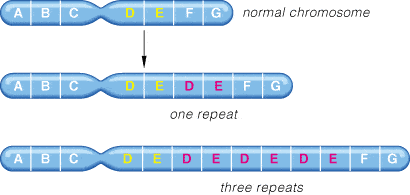
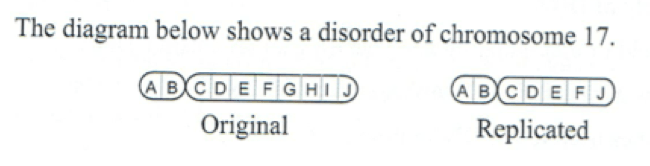
Identify the mutation in the picture.
a)
Inversion
b)
Deletion
c)
Duplication
d)
Translocation
112.
Identify the mutation in the picture.
a)
Inversion
b)
Duplication
c)
Deletion
d)
Translocation
113.
Identify the mutation in the picture.
a)
Deletion
b)
Inversion
c)
Duplication
d)
Translocation
114.
When can a mutation be passed on to offspring?
a)
only when the mutation is present during or occurs during mitosis
b)
only when the mutation is present during or occurs during meiosis
c)
when the mutation occurs during mitosis or meiosis
d)
when the mutation occurs in somatic cells
115.
What type of chromosomal mutation has occurred?
a)
substitution
b)
insertion
c)
deletion
d)
nondisjunction
116.
What do experts say is the most common form of Down Syndrome?
a)
Trisomy 47
b)
Trisomy 46
c)
Trisomy 21
d)
Trisomy 23
117.
Trisomy 21 means you have what?
a)
Three copies of chromosome 21
b)
Twenty one copies of chromosome 3
c)
Three omies and 21 means
d)
Two copies of chromosome 21
118.
A human usually has xx amount of chromosomes.
a)
6
b)
22
c)
4
d)
46
119.
a)

Deletion

b)

Inversion

c)

Translocation

d)

Duplication

120.
a)

Deletion

b)

Inversion

c)

Translocation

d)

Duplication

121.
How do doctors name what type of cancer someone has? 
a)
Where it begins
b)
Where it ends
c)
The area that has the most cancer
d)
The area that has the least cancer
122.
What is cancer?
a)
The heart does not receive enough blood.
b)
Sudden disruption of blood flow to part of the brain.
c)
Blood filled weak spot.
d)
Uncontrolled growth and spread of abnormal cells.
123.
Which phrase best describes a common characteristic of all cancers?
a)
absence of cyclins
b)
damaged DNA
c)
uncontrolled cell growth
d)
inherited from parents
124.
An abnormal mass of cancer cells is called a 
a)
tumor
b)
cyst
c)
lesion
d)
polyp
125.
Using drugs or medicines to destroy cancer cells.
a)
chemotherapy
b)
radiation therapy
c)
cancer surgery
d)
mitotic spindling
126.
Cancer creates abnormal cells by disrupting
a)
the cell cycle
b)
red blood cell formation
c)
DNA replication
d)
ATP synthesis
127.
Cancer harms the body by destroying healthy body tissues.
a)
True
b)
False
128.
the uncontrolled division of cells that results in malignant growth 
a)
tissues
b)
cancer
c)
mitosis
d)
anaphase
129.
Cancer tumors result from
a)
rapid cell division
b)
rapid DNA replication
c)
slow cell division
d)
long interphase
130.
Which type of tumor is dangerous, spreads across bodily systems via blood and lymphatic systems?
a)
benign
b)
malignant
131.

This is a cause of cancer

a)

Genes

b)

Tobacco

c)

Sunlight

d)

All of this (and more!)

132.

Chemotherapy kills these types of cells

a)

Slow growing

b)

Fast growing

c)

Non growing

d)

All cells

133.

A relapse is when

a)

Cancer goes away completely

b)

When cancer is gone for a time, but comes back

c)

When cancer stops spreading

d)

When cancer is at its worse

134.
The process by which populations slowly change over time is called__________
a)
selective breeding
b)
adaptation
c)
sepeciation
d)
evolution
135.
Individuals that are well adapted to their environment will survive and produce:
a)
Fewer mutations
b)
Stronger genes
c)
More offspring
d)
Better traits
136.
The ability of an organism to survive and reproduce in its specific environment 
a)
diversity.
b)
evolution
c)
adaptation
d)
 fitness
137.
Why are advantageous traits more likely to be passed onto offspring?
a)
Because they are more likely to survive and reproduce.
b)
Because they come from dominant alleles.
c)
Because they come from recessive alleles.
d)
Because the trait is an acquired phenotype.
138.
Darwin wrote that organisms with traits that are best suited to the environment will ________________
a)
increase in number
b)
become extinct
139.
In natural selection, the selective agent is the
a)
humans
b)
mutations
c)
breeders
d)
environment
140.
which of the following describes natural selection
a)
it acts on genetic material directly
b)
it acts on existing physical traits
c)
it forms new traits 
d)
it forms new genetic material
141.
Mutations are important because they bring about
a)
death of the organism in which they develop
b)
genetic variation needed for a population to evolve
c)
benefits for the individual, not for the population
d)
Hardey-Weinberg equilibrium within a population
142.
Some organisms have genes that improve their ability to survive and reproduce. If the gene also help their offspring survive and reproduce, then which of the following will most likely increase?
a)
The number of genes in a species
b)
The frequency of genes in a population
c)
The frequency of genes in one individual 
143.
Natural selection is the process by which
a)
change occurs in the genetic characteristics of individuals that live together in an environment from one generation to another
b)
organisms with traits well-suited to their environment reproduce at a greater rate than less well-adapted organisms in the same environment
c)
use and disuse of a characteristic leads to evolutionary change
d)
baseball players pass on the trait for strong arm muscles to children
144.
Natural selection CANNOT occur without
a)
competition for unlimited resources.
b)
gradual warming of Earth.
c)
genetic variation in species.
d)
asexual reproduction in species.
145.

Which is the best reason why some insects are resistant to pesticides? (In other words, why aren't some insects killed by pesticides?)

a)

There are no known insects that are resistant to pesticides.

b)

Some insects have a genetic variation that enables them to survive the pesticide.

c)

Some insects live in an environment that allows them to survive exposure to pesticides.

d)

Mutualistic relationships with other organisms enable some insects to survive exposure to pesticides.
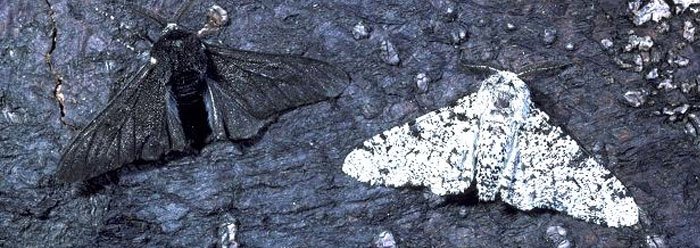
146.
What process is most responsible for the extinction of most species of plants and animals that have lived on Earth?
a)
gene mutation
b)
environmental changes
c)
selective breeding
d)
decrease in reproduction
147.
Which of the following explains adaptation.
a)
An individual organism changes to meet its needs in the environment. These changes pass down to their offspring.
b)
The species as a whole changes their characteristics.
c)
Beneficial traits allow organism to survive and pass on those traits
d)
New characteristics arise in a species as needed.  If these traits are helpful, they are passed down.
148.
Why would a population with a large amount of genetic variation be more likely to survive a severe climate change in its environment?
a)
Individuals will only create offspring well-suited to the climate change
b)
The individuals would produce more offspring
c)
Individuals better suited to the new climate will help less-suited individuals survive
d)
Some individuals will posses traits better suited to the new climate and be more likely to pass them on
149.
When every organism of a species has died.
a)
Evolution
b)
Natural Selection
c)
Extinction
d)
Artificial Selection
150.
Mutations are a change in what?
a)
DNA
b)
tRNA
c)
genotype
d)
phenotype
151.
The trees these moths used to live on were white, but have been covered in soot from coal factories. Which moth will be more successful in this environment?
a)
Dark moth
b)
Light moth
c)
Both will be equally successful
d)
Neither will be successful
152.
What process is being shown in this image?
a)
Variation
b)
Natural Selection
c)
Selective Breeding
d)
Homeostasis
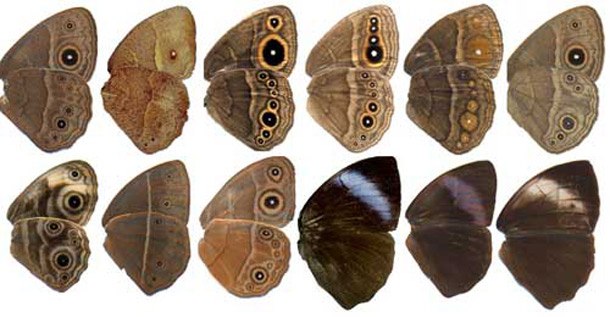
153.
These moths are all the same species. The differences between their wings is an example of ________________
a)
Natural Selection
b)
Variation
c)
Homeostasis
d)
Extinction
154.
An octopus can change its color to match its surroundings. This is an example of which type of behavior?
a)
camouflage
b)
mimicry
c)
cooperative behavior
d)
estivation
155.

The Aztecs and Maya Tribes of Mexico were some of the first humans to slowly change wild corn to the corn we know today. What process did these tribes use?

a)

Natural Selection

b)

Artificial Selection

c)

Mitosis

d)

adaptive radiation

156.
Artificial selection is...
a)
the process by which humans select who lives and dies based on traits of animal or plant.
b)
the process by which natures selects who lives and dies.
c)
the process by which animals adapt to their surroundings.
d)
the process by which people take over ecosystems.
157.
Farmers breed cows to produce high amounts of milk. This is an example of...
a)
Natural Selection 
b)
Variations in a species 
c)
Selective Breeding 
158.
Artificial Selection "Selective Breeding" is a necessary process due to earths population (7 billion humans). Why is artificial selection important for humanity?
a)
Photosynthesis 
b)
For nature
c)
To produce bigger and better food to feed all of humanity.
d)
Nature can create better organisms
159.
Scientist have created larger and sweeter strawberries for humans to consume (eat). What process was used?
a)
Natural Selection 
b)
Artificial Selection 
c)
Cellular Respiration 
d)
Environmental Natural Selection 
160.
If a mouse population changes color from white to black over many generations due to their environment, what selection is taking place?
a)
Natural Selection 
b)
Selective Breeding
c)
Artificial Selection 
d)
Hydrogen and Helium 
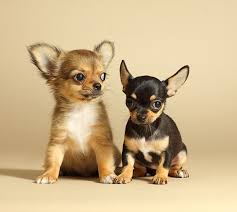
161.
Dogs such as Chihuahuas are examples of....
a)
Artificial Selection 
b)
Natural Selection 
c)
Mutations 
162.
Artificial selection can also be called....
a)
Natural Selection 
b)
Selective Breeding
c)
Mutations 
d)
Variety in a population 
163.
Which option is the best example of environmental pressures that cause natural selection?
a)
Ranchers breeding cows
b)
Farmers creating bigger corn
c)
Climate and Predators 
d)
Artificial Selection 
164.
What is the definition of natural selection?
a)
Genes that are chosen by humans such as farmers and ranchers
b)
Organisms that are chosen by environmental pressures such as climate, available food, predators and habitat.
c)
Dogs and Wolves
d)
Genes that are chosen by scientist and academics.