wayground logo

Free Printable Worksheets

Font size

S
M
L
XL
Worksheets

Microbiology Review

Total questions: 125

Worksheet time: 2hrs 54mins

Name
Class
Date
1.
Name this protist?
a)
Euglena 
b)
Amoeba 
c)
Paramecium 
d)
Volvox
2.
Name this protist?
a)
Volvox
b)
Euglena 
c)
Amoeba 
d)
Paramecium 
3.
Name this protist?
a)
Paramecium 
b)
Amoeba 
c)
Volvox
d)
Euglena 
4.
Name this protist?
a)
Amoeba
b)
Euglena
c)
Paramecium 
d)
Volvox
5.
Reproduction without the use of sex cells is called what? 
a)
Sexual Repoduction
b)
Asexual Reporduction
6.
Fission, budding, and regeneration are all examples of what kind of reproduction? 
a)
Asexual Reproduction 
b)
Sexual Reproduction 
7.
How does this protist move? 
a)
Pseudopods 
b)
Cilia 
c)
Flagellum
8.
How does this protist move? 
a)
Flagellum
b)
Cilia 
c)
Pseudopods
9.
How does this protist move?
a)
Cilia 
b)
Flagellum
c)
It just floats about
d)
Pseudopods
10.
How does this protist move? 
a)
Cilia
b)
Pseudopods
c)
Flagellum 
11.
A protist that can not make its own food is called what? 
a)
Autotroph
b)
Heterotroph 
12.
A protist that can make its own food is called what? 
a)
Heterotroph
b)
Autotroph
13.
Which protist has an eyespot?
a)
Amoeba
b)
Volvox
c)
Euglena 
d)
Paramecium 
14.
Which protist has an oral groove and a gullet? 
a)
Paramecium 
b)
Volvox
c)
Amoeba 
d)
Euglena 
15.
Fine hairs that allow protist to move is called what? 
a)
Pseudopods 
b)
Euglena 
c)
Flagella 
d)
Cilia 
16.
What are the finger like projections called? 
a)
Flagella 
b)
Cilia 
c)
Pseudopods
d)
Veela 
17.
How are protist classified? 
a)
How the eat
b)
How they reproduce 
c)
Where they live
d)
How they move
18.
What type of reproduction is shown in this picture?
a)
Sexual
b)
Asexual
19.
What type of cells are protists?
a)
Prokaryotic 
b)
Eukaryoitc 
20.

If you wanted to find a colony of protists, where might you look?

a)

Forest

b)

Desert

c)

Mountain

d)

Pond

21.

Pseudopod literally means

a)

Small hair

b)

Long tail

c)

No nucleus

d)

False foot

22.

What is the name of the structure shown in the model?

a)

Cilia

b)

Flagella

c)

Amoeba

d)

Pseudopod

23.

What might happen if a protist was missing its flagellum?

a)

It wouldn't be able to digest food.

b)

It wouldn't be able to move.

c)

It wouldn't be able to reproduce.

d)

It wouldn't be able to breathe.

24.
Which of the following is true ALL organisms in the protist kingdom?
a)
They are multicellular
b)
They live in moist environments
c)
They move using cilia
d)
They move using flagella
25.
What is the first phase of Mitosis?
a)
Prophase
b)
Metaphase
c)
Anaphase
d)
Telophase
26.
What phase of mitosis is occuring in the picture?
a)
Prophase
b)
Metaphase
c)
Cytokinesis
d)
Telophase
27.
In which phase does the cell spend most of it's life?
a)
Interphase
b)
Nuclear Division
c)
Telophase
d)
Mitosis
28.
DNA will condense into...
a)
Centromeres
b)
Chromosomes
c)
Nuclei
d)
Spindle fibers
29.
What phase of mitosis is pictured?
a)
Metaphase
b)
Telophase
c)
Prophase
d)
Anaphase
30.
Which of the following is NOT occuring during interphase?
a)
Cell growth
b)
DNA being copied
c)
DNA condensing
d)
Two new cells are made
31.
Which is Metaphase?
a)
A
b)
E
c)
C
d)
F
32.
The process by which the nuclear material is divided equally between two new cells
a)
mitosis
b)
cancer
c)
spindle
d)
centromere
33.
Why would it be important to replicate DNA before a cell divides in mitosis or meiosis?
a)
In order for genetic information to be transferred into daughter cells.
b)
In order for the cell to be able to increase in size.
c)
In order for the DNA to be contained in the nucleus.
d)
In order for the cell to re-order the DNA sequencing in the new cells.
34.
How many chromosomes do humans have?
a)
46
b)
21
c)
10
35.
Name the phase:
a)
Prophase
b)
Metaphase
c)
Anaphase
d)
Telophase
36.
Structure A refers to the _____.
a)
chromatid
b)
chromosome
c)
centromere
37.
Fruit fly body cells have 8 chromosomes. After mitosis, you would expect a resulting fruit fly daughter cell to have -
a)
16 chromosomes.
b)
46 chromosomes.
c)
8 chromosomes.
d)
4 chromosomes.
38.
Before cells can divide, what must be copied?
a)
mitochondria
b)
cytoplasm
c)
DNA
d)
Cell Wall
39.
Structure (b) is a ____.
a)
chromosome
b)
chromatid
c)
centromere
40.
Name the phase:
a)
Prophase
b)
Metaphase
c)
Anaphase
d)
Telophase
41.
The phase in mitosis where chromosomes move away and are pulled apart by spindles to opposite sides of the cell.
a)
prophase
b)
anaphase
c)
metaphase
d)
telephase
42.
In mitosis, the two resulting cells are
a)
different from the starting cell and identical to each other.
b)
different from the starting cell and different from each other.
c)
identical to the starting cell and different from each other.
d)
identical to the starting cell and identical to each other.
43.
Where does a cell contain it's genetic material?
a)
nucleus
b)
nucleolus
c)
cytoskeleton
d)
golgi
44.

What kind of cells are made in MEIOSIS?

a)

Haploid Gametes

b)

Diploid Somatic Cells

c)

Skin Cells

d)

Liver Cells

45.

A human body (somatic) cell usually has how many chromosomes?

a)

6

b)

22

c)

4

d)

46

46.
When an area of a chromatid is exchanged with the matching area on a chromatid of its homologous chromosome, _________________ occurs
a)
crossing over
b)
mutagenesis
c)
hybridization
d)
fertilization
47.
If the Diploid number of Carrots is 18, the haploid number is
a)
18
b)
9
c)
27
d)
36
48.
The cells produced via meiosis are called:
a)
sex cells
b)
somatic cells
c)
body cells
d)
skin cells
49.
If a somatic (body) cell in a butterfly contains 24 chromosomes, a butterfly egg would contain
a)
3
b)
6
c)
12
d)
24
50.
What causes genetic variation in meiosis?
a)
chromosomes lining up
b)
crossing over of chromosomes
c)
separation of chromosomes
d)
chromosomes pulling apart
51.
The purpose of meiosis is to form ________ cells.
a)
body
b)
sex
c)
somatic
d)
brain
52.
How many daughter cells are produced at the end of meiosis?
a)
1
b)
2
c)
3
d)
4
53.

The chromosomes that pair up during meiosis, are called __________ chromosomes.

a)

heterozygous

b)

asexual

c)

homologous pairs

d)

genes

54.
What process, and which type of resulting cells are represented?
a)
mitosis, gametes
b)
mitosis, body cells
c)
meiosis, gametes
d)
meiosis, body cells
55.
Meiosis makes sperm and egg cells. In humans, sperm and egg cells each have _____ chromosomes. Therefore a fertilized human egg cell (sperm and egg cell combined) would create a cell with _____ chromosomes.
a)
23, 46
b)
46, 23
c)
2, 4
d)
50, 100
56.
What is one of the advantages, why is it better to reproduce sexually versus asexually?
a)
survival of the fittest
b)
overproduction
c)
genetic variation
d)
cloning
57.
According to the chromosome theory of inheritance, what are carried from parents to their offspring on chromosomes?
a)
Genes
b)
Spindle Fibers
c)
Centrioles
d)
Cytoplasm
58.
The ___ is the basic unit of sturucture and function of organisms
a)
atom
b)
cell
c)
matter
d)
all other answers are correct
59.
Which statement is a part of the cell theory?
a)
all cells come from preexisting cells
b)
bacteria are prokaryotic cells
c)
eukaryotic cells are complex
d)
humans are multicellular
60.
Who looked at cork and named the cell?
a)
Robert Hooke
b)
Van Leeuwenhoek
c)
Robert Brown
d)
Francesco Redi
61.
The Cell Theory states...
a)
atoms create all matter
b)
living things evolve
c)
the cell is the backbone of all matter
d)
cells are the basic unit of structure and organization of organisms
62.
"All animals are made of cells". This fact was discovered by...
a)
Matthias Schleiden
b)
Theodor Schwann
c)
Robert Hooke
d)
Rudolf Virchow
63.
All plants are made of cells.  This was discovered by....
a)
Matthias Schleiden
b)
Rudolf Virchow
c)
Robert Hooke
d)
Aristotle
64.
Robert Hooke, Anton van Leeuwenhoek, Theodor Schwann, Rudolf Virchow, and Matthias Schliden were all responsible for what theory?
a)
The Theory of Gravity
b)
The Theory of Relativity
c)
The Cell Theory
d)
The Theory of Continental Drift
65.
What tool do you use to view the cells?
a)
metric ruler
b)
centrifuge
c)
microscope
d)
pipette
66.
Rocks are not living because
a)
they never move
b)
they aren't needed for humans
c)
they are not made of cells
d)
they don't break down
67.
Who was the "scientist" who observed pond water and teeth scrapings in his microscope?
a)
Hooke
b)
Leeuwenhoek
c)
Schleidian
d)
Virchow
68.
Which of the following is NOT one of the basic points of Cell Theory?
a)
All living things are made of cells.
b)
The cell is the smallest living thing that can perform all the functions of life.
c)
Cells are too small to see without a microscope.  
d)
All cells must come from pre-existing cells.
69.
Cells are often called "the ____ of life."
a)
bread
b)
road map
c)
building blocks
d)
meaning
70.
For generations, people believed in "spontaneous generation."  Spontaneous generation is the idea that . . . . 
a)
..... all living things are made of cells
b)
... all cells come from other cells.
c)
living things could "generate" from non-living matter. 
d)
cells are the basic unit of structure and function
71.
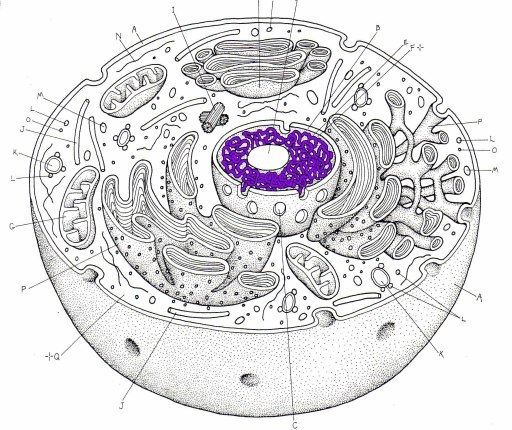
Identify letter H.
a)
nucleus
b)
mitochondria
c)
Golgi complex
72.
Identify letter I.
a)
nucleus
b)
mitochondria
c)
cell membrane
73.
Identify letter K.
a)
nucleus
b)
mitochondria
c)
endoplasmic reticulum
74.
Which type of cells are very complex and have membrane bound structures?
a)
eukaryote
b)
prokaryote
75.
Which type of cells are simple and have no membrane bound organelles?
a)
eukaryote
b)
prokaryote
76.
Identify letter B.
a)
Golgi complex
b)
nucleus
c)
cell wall
77.
Protective layer around cells
a)
Lysosome
b)
Cell membrane
c)
organism
78.
Uses energy from the Sun to make food for plants
a)
chloroplast
b)
cytoskeleton
c)
ribosome
79.
Structures in cytoplasm that help with cell life processes
a)
organ system
b)
cell wall
c)
organelles
80.
Releases energy from food
a)
Golgi Complex
b)
mitochondria
c)
Lysosome
81.
The smallest unit of an organism that carries on the functions of life
a)
cell
b)
tissue
c)
organ
82.
Temporary storage structure; stores water, waste and food
a)
nucleus
b)
endoplasmic reticulum
c)
vacuole
83.
Protects and gives shape to plant cells
a)
chloroplast
b)
cell wall
c)
ribosome
84.
makes proteins
a)
ribosome
b)
vacuole
c)
lysosome
85.
Gelatin-like substance that contains organelles
a)
nucleus
b)
cell membrane
c)
cytoplasm
86.
Any living thing
a)
tissue
b)
organism
c)
organ system
87.
Moves materials around in the cell
a)
endoplasmic reticulum
b)
Golgi complex
c)
ribosome
88.
Sorts and packages substances like proteins into vesicles
a)
vacuole
b)
nucleus
c)
Golgi complex
89.
Contains instructions for everything the cell does
a)
lysosome
b)
cell membrane
c)
nucleus
90.
Breaks down food molecules and cell wastes in animal cells
a)
lysosome
b)
Golgi complex
c)
organelle
91.
Which is an accurate difference between plant cells and animals cells?
a)
Plant cells have a cell wall, but animal cells do not. 
b)
Animal cells have a cell wall, but plant cells do not. 
92.
Which is an accurate statement?
a)
Animal cells contain chloroplast.
b)
Plant cells contain chloroplast.
93.
Which is an accurate statement?
a)
Plant cells have a large central vacuole.
b)
Animal cells have a large central vacuole.
c)
Prokaryotes have a large central vacuole. 
94.
Which type of cell is bigger?
a)
Prokaryotic
b)
Eukaryotic 
95.
All eukaryotes and prokaryotes are surrounded by a _____.
a)
cell wall
b)
cell membrane
c)
cell envelope
d)
loving, supportive family
96.
Which type of cell?
a)
Prokaryote
b)
Eukaryote
97.
Which type of cell?
a)
Prokaryote
b)
Eukaryote
98.
Where is the DNA found in a prokaryotic cell? 
a)
floating around in the cytoplasm 
b)
in the nucleus 
99.
What type of cell has a nucleus? 
a)
eukaryotic
b)
prokaryotic 
100.
One example of a prokaryote is a...
a)
fungus
b)
bacteria
c)
animal
d)
plant
101.
Has membrane bound organelles
a)
Prokaryote
b)
Eukaryote
c)
both
102.
Which of the following is found inside a prokaryote?
a)
cytoplasm
b)
DNA
c)
ribosomes
d)
all of these
103.
Both prokaryotes and eukaryotes have a nucleus.
a)
True
b)
False
104.
What kind of cell is this?
a)
Eukaryotic
b)
Prokaryotic
105.
Which of the following is not a characteristic of a Prokaryotic cell?
a)
unicellular
b)
floating DNA
c)
very small
d)
complex
106.
Plants and animal cells are examples of ___ cells 
a)
prokaryotic cells 
b)
eukaryotic cells 
107.
Animal, fungi, plant, and protista cells are all examples of which type of cell?
a)
Eukaryotic
b)
Prokaryotic
c)
Both prokaryotic and eukaryotic
108.
Which is true of prokaryotic and eukaryotic cells?
a)
Prokaryotic cells are larger than eukaryotic cells.
b)
Eukaryotic cells do not have nuclei, and prokaryotic cells do have nuclei.
c)
Prokaryotic cells lack membrane-bound organelles, and eukaryotic cells contain membrane-bound organelles.
d)
Eukaryotic cells are simpler than prokaryotic cells.
109.
Plant cells are the same as animal cells.
a)
True
b)
False
110.
You can find total magnification by which of the following methods?
a)
ocular PLUS objective
b)
ocular TIMES objective
c)
ocular MINUS objective
d)
ocular DIVIDED BY objective
111.
Find the total magnification: 
Eyepiece = 10X 
Objective lens = 55X
 
a)
10x
b)
55x
c)
65x
d)
550x
112.
What is number 15?
a)
light source
b)
base
c)
coarse adjustment
d)
fine adjustment
113.
What is number 17?
a)
body tube
b)
arm/neck
c)
stage
d)
base
114.
You should always carry the microscope by the
a)
arm and base
b)
arm and body tube
c)
arm only
d)
the objectives
115.
When looking at a specimen on your slide, you should always start with the
a)
low objective lens
b)
medium objective lens
c)
high objective lens
d)
super extra high power lens
116.
The__________ sharpens the image under high magnification.
a)
the diaphragm
b)
fine adjustment knob
c)
coarse adjustment knob
d)
the ocular
117.
Never use this when on high power.
a)
Fine adjustment
b)
Diaphragm
c)
Course adjustment
d)
Stage clips
118.
What is the function of stage clips?
a)
To move the objectives
b)
To keep the slide secure
c)
To adjust the focus
d)
To look through
119.

Which Kingdom are Volvox in?

a)

Animal

b)

Plant

c)

Protista

d)

Fungi

120.

Volvox are

a)

Unicellular

b)

Multicellular

121.
A paramecium moves by using its...
a)
Cilia
b)
Psuedopods
c)
Flagella
d)
Arms
122.
What protist is shapeless and eats by engulfing its food with it's body?
a)
Amoeba 
b)
Euglena
c)
Paramecium
d)
Volvox
123.
This protist is both a producer and a consumer
a)
Paramecium
b)
Volvox
c)
Ameoba
d)
Euglena
124.
A microbe without a nucleus (prokaryote) that can be helpful or make people sick.
a)
Virus
b)
Bacteria
c)
Volvox
d)
Paramecium
125.
Which of the following moves using pseudopodia?
a)
Volvox
b)
Euglena
c)
Amoeba
d)
Paramecium