
Font size
 Worksheets
revision
Total questions: 125
Worksheet time: 3hrs 54mins

What letter points to the Alveoli?
C
D
E
F
What letter points to the trachea?
C
B
E
D
What is the function of the lungs?
organs where gas exchange takes place.
organs where blood is filtered.
organs where blood is pumped around the body.
organ where food is broken down into molecules that the body can use.
What is the function of the trachea?
It is the tube that air travels down after the bronchi. Another name is the throat.
It is the tube that air travels down to the lungs. Another name is the windpipe.
It is the tube that air travels down after the nose. Another name is the windpipe.
It is the tube that air travels down after the pharynx. Another name is the throat.
What is the pathway that air follows throughout the body?
Nose-> Trachea -> Bronchi -> Pharynx -> Lungs -> Alveoli
Nose -> Bronchi -> Pharynx -> Trachea -> Lungs -> Alveoli
Nose -> Trachea -> Alveoli -> Branchi -> Lungs
Nose -> Trachea -> Bronchi -> Lungs -> Alveoli
Muscle that helps your lungs pull in air and push it out.
diaphragm
alveoli
heart
trachea
During exhaling, the diaphragm ______
contracts and moves downward
constrict
relaxes and moves upward
dilate

Which of the following shows what happens to the chest cavity when air rushes into the lungs?
decrease in volume
deflates
expands
relaxes

What happens when you inhale air ?
What gas do plants take in that animal/humans breathe out?
carbon monoxide
carbon dioxide
nitrogen oxide
oxygen
What are the smaller branches of the bronchi called?
bronchioles
alveoli
larynx
lungs
Tiny air sacs in the lungs where the exchange of oxygen and carbon dioxide takes place.
bronchioles
lung lobes
alveoli
capillaries
Bones that surround and protect your lungs and heart.
ribs
diaphragm
pleura
larynx
What are the functions of the respiratory system?
Move oxygen from the outside environment into the body. Removing carbon dioxide and water from the body.
Carries needed substances to cells. Carries waste away from cells.
Breaks down food into molecules that the body can use. Eliminate waste from the body.
Helps the body move. Helps with posture and flexibility.
The tube that leads from the nose and mouth to the trachea
Esophagus
Pharynx
Trachea
Larynx
Which of the following is the pair of spongy air filled organs which occupy a region in the chest?
Rib cage
Heart
Lungs
Kidney
The organ which is domed shape located below the lungs and primary muscle used in respiration
Diaphragm
Lungs
Bronchi
Heart
What is the narrow blood vessels that covers the alveoli?
cilia
capilliaries
epiglottis
voice box
Which organ makes sound when you talk?
Larynx
Pharynx
Tongue
epiglottis
What is a respiratory cycle?
2 inhalations followed by one exhalation
one inhalation followed by one exhalation
one maximal inspiration followed by one forced expiration
one inspiration followed by one forced expiration

Which of the following happens when you exhale?
chest cavity expands
your lumgs become smaller
your chest cavity becomes smaller
your lungs take in and give off oxygen
What is the site of gas exchange?
alveoli
nose
lung
bronchi
The flap of skin that prevents food and water to enter the trachea.
vocal cords
pharynx
larynx
epiglottis

What type of cells carry oxygen in the blood?
red blood cells
white blood cells

Flap of tissue that covers the opening to the windpipe during swallowing
Pharynx
Trachea
Epiglottis
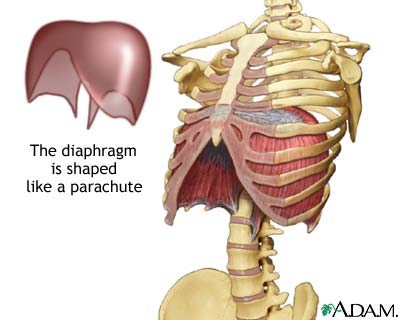
What is function of the dome-shaped diaphragm muscle?
This is where gas exchange happens.
Air passes through the diaphragm on the way to the lungs.
It attaches to the lungs and contracts and relaxes to help in breathing.
Respiration is a vital function that all living things carry out.
True
False
Respiration takes place in
the cells
the lungs
the heart
the brain
Respiration is the process by which (a) is produced.
Respiration is the process of changing (a) into energy.
Respiration is a chemical reaction.
True
False
The glucose used during respiration is provided by our
digestive system
respiratory system
circulatory system
While exercising our body needs to produce
more energy
less energy

During exercise our body needs to produce more energy by respiration thus it needs
less oxygen
more oxygen

Do plant cells carry out respiration
Yes
No
Flap of tissue that covers the opening to the windpipe during swallowing
Pharynx
Trachea
Epiglottis
What type of cells carry oxygen in the blood?
red blood cells
white blood cells
Respiration happens in the
nucleus
mitochondria
chloroplast
vacuole
breathing is done by all living organisms
true
false
gas exchange and the mechanical movement of your chest are parts of
breathing
respiration
Where in the body would Hydrochloric Acid be found?
Mouth
Esophagus
Liver
Stomach
Where in the body would Hydrochloric Acid be found?
Mouth
Esophagus
Liver
Stomach
FATS---->FATTY ACIDS/GLYCEROL
__________________ converts fats to emulsified fats.
Bile juice
Pancreatic juice
Gastric juice
Orange juice
What is the function of an enzyme?
enzymes break themselves into small pieces
enzymes slow down chemical reactions
enzymes speed up chemical reactions
enzymes are a wave-like muscular motion
Protease is an enzyme that acts on
Enzymes are what type of molecule?
carbohydrates
proteins
fats
starch
Enzymes are re-usable
True
False
Lipase breaks down fats into:
fatty acids and glycerol
amino acids
fatty acids and glycogen
maltose
The unique binding area of an enzyme is called the:
substrate site
amazing site
special site
active site
How does an enzymes shape relate to its function?
the shape of the enzyme has no relation to its function
the enzyme is shaped specially for certain substrates to perform a specific reaction
the enzyme shape acts as a receptor to certain products
the enzyme shape can fit into specific substrates to cease a reaction

A is the
substrate
enzyme-substrate complex
products
B is the
substrate
enzyme-substrate complex
products
C is the
substrate
enzyme-substrate complex
products
The enzyme and substrates have
adverse shapes
complementary shapes
contrary shapes
similar shapes
What do enzymes do?
Build things up or break them down
Help filter waste from the body
Create environments where food can be eaten
Add and remove water
What does an enzyme need in order to work properly?
The right amount of oxygen & CO2
The right temperature & amount of water
The right temperature & pH
The right temperature & pressure
Which enzyme breaks down carbohydrates?
Rennin
Amylase
Pepsin
Lipase
Which enzyme breaks down fats into glycerol and fatty acids?
Bile
Amylase
Pepsin
Lipase
Where does amylase start to work?
Mouth
Stomach
Small Intestine
Large Intestine
Where does Protease start to work?
Mouth
Stomach
Small Intestine
Large Intestine
How does increasing the temperature affect enzyme activity?
enzyme activity increases with the increasing of temperature up to an optimal point, after which activity decreases due to denaturation.
Higher temperatures always increase enzyme activity.
Temperature has no effect on enzyme activity.
Enzymes are only active at low temperatures.
What happens to enzymes at high temperatures?
Enzymes become more active at high temperatures.
Enzymes denature and lose their activity at high temperatures.
Enzymes increase their efficiency at high temperatures.
Enzymes remain unchanged at high temperatures.
Why is pH important for enzyme function?
All enzymes function best at a neutral pH of 7.
for maintaining enzyme structure and activity, as each enzyme has an optimal pH for function.
pH has no effect on enzyme activity.
Enzymes are only affected by temperature, not pH.
How does increasing temperature generally affect reaction rates?
Temperature has no effect on reaction rates.
Higher temperatures slow down reactions.
Increasing temperature decreases reaction rates.
Increasing temperature generally increases reaction rates.
What is enzyme denaturation?
Enzyme denaturation is the alteration of an enzyme's active site, leading to loss of function.
Enzyme denaturation is the process of enzyme synthesis.
Enzyme denaturation enhances the enzyme's activity.
Enzyme denaturation is the binding of substrates to enzymes.
Can enzymes function in extreme pH levels?
All enzymes are unaffected by pH changes.
Enzymes thrive in extreme pH levels.
Some enzymes work better in acidic conditions.
enzymes cannot function in extreme pH levels.
What is the effect of low pH on enzyme activity?
Low pH increases enzyme activity by enhancing substrate binding.
Low pH decreases enzyme activity due to denaturation.
Low pH has no effect on enzyme activity whatsoever.
Low pH stabilizes enzyme structure, improving function.
What is the effect of low temperature on enzyme activity?
Low temperature increases enzyme activity
Low temperature decreases enzyme activity
Low temperature has no effect on enzyme activity whatsoever.
Low temperature stabilizes enzyme structure, improving function.
What happens to enzyme activity when the pH is too high?
Enzyme activity increases due to higher substrate availability.
Enzyme activity remains unchanged regardless of pH levels.
Enzyme activity is enhanced by high pH conditions.
Enzyme activity decreases due to denaturation.
How does temperature affect the kinetic energy of molecules?
Kinetic energy is independent of temperature.
Temperature has no effect on kinetic energy.
higher temperatures increase the energy creating more frequent collisions
Lower temperatures increase kinetic energy.
What is the effect of cold temperatures on enzyme activity?
Cold temperatures decrease enzyme activity.
Cold temperatures enhance enzyme stability.
Cold temperatures have no effect on enzyme activity.
Cold temperatures increase enzyme activity.
The protease from the stomach stops working at the small intestine, Give reason for that
Protease in the stomach needs an acidic medium to work while the intestine has a basic medium
The stomach does not contain protease
Small intestine's temperature is higher than the stomach's
The protease from the intestine breaks the protease coming from the stomach
what is meant by optimum pH of the enzyme?
The pH at which enzymes denature
The pH at which enzymes work the slowest
The pH at which enzymes work the best
The pH at which enzymes work decrease
Enzymes in some bacteria has optimum temperature of 100 C, which means enzymes in human can work at 70 C
True
False
What do enzymes do?
Build things up or break them down
Help filter waste from the body
Create environments where food can be eaten
Add and remove water
What does an enzyme need in order to work properly?
The right amount of oxygen & CO2
The right temperature & amount of water
The right temperature & pH
The right temperature & pressure
Enzymes are specific. This means that an enzyme only works with molecules that are....
the right size and shape
broken down already
present in water
too big for the body to handle
Which enzyme breaks down carbohydrates?
Rennin
Amylase
Pepsin
Lipase
Which enzyme breaks down fats into glycerol and fatty acids?
Bile
Amylase
Pepsin
Lipase
Where does amylase start to work?
Mouth
Stomach
Small Intestine
Large Intestine
What does bile do?
Breaks down large fat droplets into smaller ones
Breaks down fat into glycerol and fatty acids
Breaks down carbohydrates into monosaccharides
Breaks down proteins into amino acids

What is the arrow pointing to on the picture?
Enzyme
Substrate
Active Site
Product

What is the arrow pointing to on the picture?
Enzyme
Substrate
Active Site
Product

What is the arrow pointing to on the picture?
Enzyme
Substrate
Active Site
Product

What is the arrow pointing to on the picture?
Enzyme
Substrate
Active Site
Product

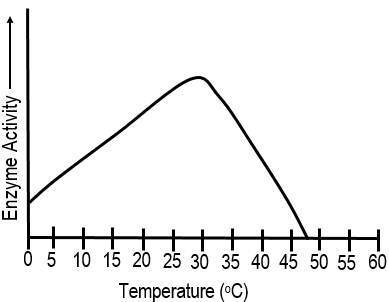
Based on the graph, what temperature does this enzyme work best?
15 C
40 C
30 C
50 C
Which of the following denatures an enzyme?
High Temperatures
Incorrect pH
Both
What is the function of protease?
break down starch into amino acids
break down protein into fatty acids
break down protein into amino acids
break down protein into urea
Where do all enzymes work?
small intestine
large intestine
stomach
liver
Which component of healthy that helps food moving through the gut?
Fibre
Fats
Carbohydrate
Protein
Which most nutrient that contain in chicken, fish, and meat?
Minerals
Protein
Fats
Carbohydrate
Which food contains carbohydrates?
Fish
Egg
Pasta
Carrot
What function to be precise of protein?
Provide energy
For growth and repair the cell
Maintain health
Which of the following factors determine the energy requirement of humans?
Occupation/ Daily activities
Age
Gender
All of the above
causing heart problems

Which statement is correct?
balanced diet makes you feel good
unhealthy food is good for your body
healthy eating is bad for you
by eating healthy you can get sick with a disease that can't be cured

Which of the following statements is true?
A balanced diet should not include anything sweet.
Pasta and vegetables are enough to provide a balanced diet.
A balanced diet must include carbohydrates, fats, proteins, minerals, vitamins, water and fibre.
A balanced diet should not include any fats.
What does the body use carbohydrates for?
Carbohydrates enable the tranport of essential nutrients in the body.
Carbohydrates improve digestion.
Carbohydrates are used by the body for growth.
Carbohydrates provide the body with a source of energy.
Sugars and fats must be a very small propotion of a balanced diet.
True
False
Which of these foods belong to food group of Dairy?


When choosing a food to eat, why is it important to look for the amount of added sugars in the food? Consuming a lot of added sugar...
makes food taste better
is beneficial for your heart
is a leading risk factor for many diseases
gives you wings

Eating too much sugary food causes,
Tooth decay
High on energy
Health probems like diabetes, heart problems and cancer.
All of the above

What individual characteristics are most important in determining how much nutrients a person needs in a daily diet?
gender, age, weight, physical activity level
gender, hunger, age, weight
age, physical activity level, weight, trainer
age, physical activity level, gender, calories

This food item is rich in
Fat
Proteins
Carbohydrates

