wayground logo

Free Printable Worksheets

Font size

S
M
L
XL
Worksheets

Final Review

Total questions: 100

Worksheet time: 1hrs 4mins

Name
Class
Date
1.

What Domain do I belong in?

I am unicellular.

I am prokaryotic.

I reproduce asexually.

I am autotrophic.

I live everywhere!

a)

Eukarya

b)

Archaea

c)

Bacteria

2.

What Kingdom do I belong to?

I am multicellular.

I am eukaryotic.

I reproduce sexually.

I am heterotrophic.

I thrive on a dark, moist ground.

a)

Animalia

b)

Protista

c)

Fungi

d)

Plantae

e)

Archaeabacteria

3.

What Kingdom do I belong to?

I am multicelled.

My cells do have a nucleus.

I reproduce sexually.

I love the sun! It helps me make my food through photosynthesis.

I can be found anywhere in the world.

a)

Archaeabacteria

b)

Protista

c)

Platae

d)

Fungi

e)

Animalia

4.
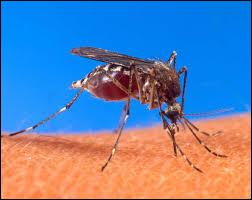
Mosquito  belongs to what kingdom?
a)
Animal Kingdom
b)
Plant Kingdom
c)
Fungi Kingdom
d)
Protista Kingdom
5.
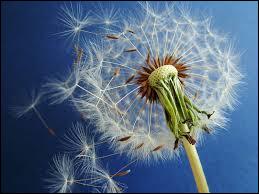
Dandelion, What kingdom does it belongs to?
a)
Plant Kingdom
b)
Animal Kingdom
c)
Fungi Kingdom
d)
Protista Kingdom
6.
Which organisms are most closely related?
a)
Equus caballas (Horse) & Equus burchellii (Zebra)
b)
Cyanea artica (Jellyfish) &
Ctenodiscus crispatus (Mud Starfish)
c)
Naja naja (cobra) & Glycine max (soya bean)
d)
Ophiocomina nigra (black brittle star) & Brassica nigra (black mustard)
7.
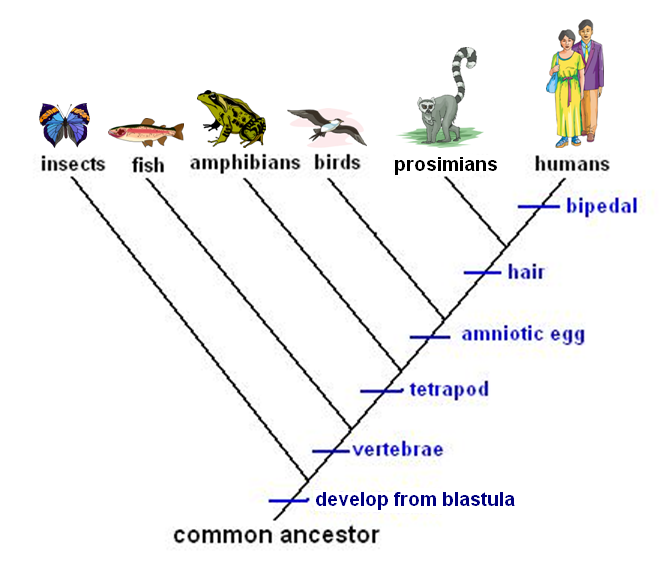
Which organisms pictured on the cladogram have hair?
a)
prosimians only
b)
prosimians and humans
c)
humans only
d)
prosimians and birds
8.
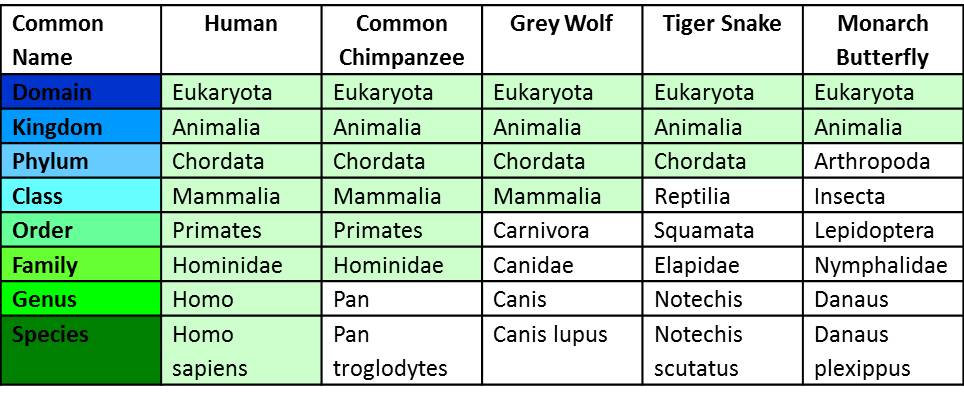
Which organism in the table is least closely related to the chimpanzee?
a)
human
b)
grey wolf
c)
tiger snake
d)
monarch butterfly
9.
Which organism in the table shown is most closely related to the common dolphin?
a)
human
b)
killer whale
c)
giant kelp
d)
bat star
10.
An illustration and a dichotomous key are given. What is the correct classification for this organism?
a)
Class Insecta
b)
Order Amblygygi
c)
Order Araneae
d)
Order Scorpiones
11.

What are the taxonomic groups?

a)

producers, primary consumers, secondary consumers, tertiary consumers

b)

Domain, Kingdom, Phylum

c)

Domain, Kingdom, Phylum, Class, Order, Family, Genus, Species

d)

Class, Order. Family, Species

12.

Who is Linnaeus?

a)

An evolutionary theorist

b)

invented bio-engineering

c)

called founder of modern taxonomy; Invented binomial nomenclature

13.

What is Binomial nomenclature?

a)

Naming an organism with its genus and species name, Binomial means "two-names"

b)

the name of an organism

c)

the study of an organisms environment

14.

What is the purpose of a cladogram?

a)

Represents the DNA that makes up an organism

b)

Diagram that shows the evolutionary relationships among a group of organisms

c)

Shows what an organism eats

15.

Define Dichotomous key

a)

Step by step approach to identify an organism using a series of paired descriptions.

b)

A diagram of the physical structure of an organism

c)

How a species chooses their mating partner

16.
A dichotomous key for trees is provided. Hikers found a tree that has large brown cones and single sharp needles. What species of tree have the hikers found?
a)
Juniper
b)
Pine
c)
Spruce
d)
Fir
17.
A student discovers an arachnid with a segmented abdomen, long legs, and a tail with no stinger. The student uses the dichotomous key below to identify it. Which arachnid has the student found?
a)
Whip Scorpion
b)
Wind Scorpion
c)
Daddy long legs
d)
Scorpion
18.
When using a dichotomous key to identify organisms, what do we look at?
a)
physical features
b)
weather patterns
c)
environment
d)
diet
19.
Which serves as a temporary storage of sperm cells before they are released   in the urethra?
a)
Testes
b)
Epididymis
c)
Prostate gland
d)
Cowper's gland
20.
The skin covered sac that surround the testes.
a)
Scrotum
b)
Prostate gland
c)
Cowper's gland
d)
Seminal vesicles
21.
The 3 functions of the MALE reproductive system:
a)
produce sex hormones, produce eggs, provide nourishing environment for the baby
b)
produce sex hormones, produce/store sperm. deliver sperm to female reproductive system
c)
produce hormones, urination, cleansing of reproductive organs
22.
together these two hormones produced by the pancreas control blood sugar levels
a)
epinephrine and nor-epinephrine
b)
T3 and T4
c)
estrogen and progesterone
d)
insulin and glucagon
23.
produces epinephrine and nor-epinephrine which promote the fight or flight response
a)
pancreas
b)
testes
c)
adrenal glands
d)
pineal gland
24.
What is this?
a)
Vestibule
b)
Semicircular Canals
c)
Cochlea
25.
This part of the eye has photoreceptors called rods and cones.  They help us to see color and see at night.  It is called:
a)
optic nerve
b)
brain
c)
retina
d)
cornea
26.
targets osteoclasts (bone destroying cells) so that they release calcium from bones when calcium levels are low
a)
calcitonin
b)
parathyroid hormone
c)
osteoclast hormone
d)
ADH
27.

Monocytes, lymphocytes and granulocytes are collectively known as?

a)

erythrocytes

b)

WBC's

c)

RBC's

d)

osteocytes

28.
What color is blood?
a)
Red
b)
Blue
c)
Both
29.
What blood type can receive blood from both Type B and Type AB donors?
a)
Type AB
b)
Type B
c)
Type A
d)
Type O
30.
Jim has type AB+ blood. His dad could be type O+.
a)
True
b)
False
31.
Sue's blood pressure is 118/78.
a)
Systolic is 118, diastolic is 78
b)
Diastolic is 118, systolic is 78
c)
She has hypertension
d)
She has hypotension
32.
What are the main organs of gas exchange in the respiratory system?
a)
diapragm
b)
lungs
c)
trachea
d)
bronchi
33.
The tube connecting each kidney to the urinary bladder is the ________.
a)
ureter
b)
urethra
c)
calyx
d)
ductus (vas) deferens
34.
The blood vessel carrying blood from the aorta into the kidney is the ________.
a)
renal artery
b)
hepatic artery
c)
renal vein
d)
glomerulus
35.
How many kidneys do you have?
a)
1
b)
3
c)
5
d)
2
36.
A hollow muscular sac that holds up to 500 mL of urine:
a)
Bladder
b)
Kidney
c)
Ureter
d)
Urethra
37.
The chewing and grinding of food into smaller pieces is an example of...
a)
Mechanical Digestion
b)
Chemical Digestion
38.
What is one secondary (helper) organ of the digestive system?
a)
Small Intestine
b)
Esophagus
c)
Gallbladder
d)
Stomach
39.
Number 4 is pointing to the....
a)
Anus
b)
Rectum
c)
Large Intestine
d)
Small intestine
40.
Bile is stored in which secondary digestive organ?
a)
Stomach
b)
Liver
c)
Gallbladder
d)
Pancreas
41.
What is the substance found in the stomach that allows for chemical digestion to take place?
a)
Gastric Juices
b)
Saliva
c)
Bile
42.
Which of the following is true about most fast foods? 
a)
they are low in nutrient density 
b)
they are high in fat and calories 
c)
they are low in vitamins and minerals 
d)
all of the above  
43.
What is the main reason for eating a wide variety of foods? 
a)
to learn the food label
b)
to provide all the nutrients you need 
c)
to keep from getting bored with your diet 
d)
to help improve physical fitness 
44.
A disease in which the body produces little or no insulin, or cannot properly use insulin.
a)
diabetes
b)
botulism
c)
gastroenteritis
d)
salmonellosis
45.
Which of the sequence best describe how a piece of chicken nugget is digested in the human body?
a)
mouth, esophagus, small intestine, large intestine, stomach
b)
mouth, stomach, small intestine, large intestine, esophagus
c)
mouth, esophagus, stomach, small intestine, large intestine
46.
name the organ labeled 4
a)
pituitary gland
b)
thyroid gland
c)
pancreas
d)
thymus
47.
Which diagram (1 or 2) depicts how a steroid hormone works and why?
a)
diagram 1 because steroid hormones can pass through the lipid bilayer of cells and bond with internal receptors to promote a reaction in cells
b)
diagram 2 because steroid hormones bond to receptors on the surface of target cells because they cannot enter cells to promote a reaction
48.
Which biome, because of its climate, has the largest number of species of plants and animals?
a)
tundra
b)
desert
c)
tropical rainforest
d)
pine forest
49.
One characteristic feature of tundra is that only the surface thaws in the summer and refreezes in the winter, leaving a layer of permanently frozen subsoil.  This characteristic is known as
a)
glaciation
b)
permafrost
c)
crystallization
d)
soilfrost
50.
In which biome is Georgia located?
a)
tropical rainforest
b)
temperate rainforest
c)
temperate deciduous forest
d)
alpine forest
51.
Which biome receives between 0 to 25 centimeters of rain per year, has a temperature range of 0 to 50 degrees Celsius, has poor soil, and is home to lizards, scorpions, and snakes?
a)
desert
b)
mountain
c)
taiga
d)
tundra
52.
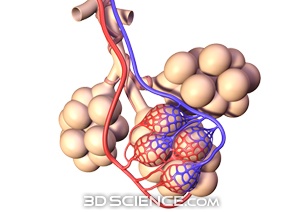
The air sacs that are covered with capillaries where gas exchange takes place
a)
bronchi
b)
lungs
c)
oxygen
d)
alveoli
53.
The two main branches from the trachea (one to each lung)
a)
bronchi
b)
alveoli
c)
capillaries
d)
bronchioles
54.
Gases move from a lower pressure to a higher pressure. 
a)
True
b)
False
55.
White blood cells are an important part of the human immune response. Two types of white blood cells, neutrophils and macrophages, act as phagocytes. Phagocytes perform which of the following functions in the human body? 
a)
They produce antibodies.
b)
They bind to antigens and develop into plasma cells.
c)
They form a barrier against pathogens.
d)
They engulf and destroy bacteria.
56.
What is the body's first line of defense against infection by foreign organisms? 
a)
antibodies
b)
lymph nodes
c)
white blood cells
d)
the skin
57.
How do human diseases caused by bacteria and diseases caused by viruses react to antibiotics? 
a)
Neither responds to antibiotics.
b)
Both respond to antibiotics.
c)
 Viral diseases respond to antibiotics; bacterial diseases do not.
d)
Bacterial diseases respond to antibiotics; viral diseases do not.
58.
True or False
C
omponents of immune system : Bone Marrow, Thymus, Thyroid, Spleen, and Lymph nodes
a)
True
b)
False
59.
These cells are responsible for making antibodies
a)
B Cells
b)
suppressor T Cells
c)
Helper T Cells
d)
Macrophages
60.
Vaccinations are used for
a)
Curing the illness
b)
Preventing the Illness
c)
Getting the illness
61.
What are the 4 types of pathogens that could cause illness?
a)
animals, bacteria, fungi and plants
b)
bacteria, fungi, nucleus, protist
c)
bacteria, fungi, viruses, protist
d)
bacteria, plants, fungi, protist
62.
What is the main purpose of the immune system?
a)
support the body through bones and muscles
b)
get rid of waste from the body
c)
protect the body from pathogens
d)
move blood through the body
63.
Out of t-cells and b-cells which is the helper cell?
a)
b-cells
b)
t-cells
c)
neither
d)
both
64.
B cells mature in the____; T cells mature in the ____.
a)
thyroid; thymus
b)
spleen; liver
c)
thymus; bone marrow
d)
bone marrow; thymus
65.
A(n) _____ is a virus that enters a bacterial cell.
a)
endospore
b)
decomposer
c)
plasmid
d)
bacteriophage
66.
What part of the phage is the DNA?
a)
A
b)
B
c)
C
d)
D
67.
What is a group of similar cells?
a)
Tissue 
b)
Organ
c)
Cell group
d)
Organ system
68.

Where are cardiac muscles located ?

a)

the brain

b)

the spine

c)

the heart

69.
Adipose tissue is responsible for...
a)
cushioning joints and providing insulation
b)
connecting bone to muscle
c)
providing elasticity in the ears and throat
d)
providing structure in the liver
70.
Which type of tissue is this?
a)
Adipose
b)
Blood
c)
Bone
d)
Reticular connective
71.
Which type of tissue is this?
a)
Dense connective
b)
Hyaline cartilage
c)
Adipose
d)
Bone
72.
Which type of tissue is this?
a)
Bone
b)
Elastic cartilage
c)
Blood
d)
Fibrocartilage
73.
Which type of muscle tissue would line the intestines?
a)
Smooth
b)
Cardiac
c)
Skeletal
d)
Transitional
74.
What type of muscle tissue is VOLUNTARILY controlled
a)
Skeletal Only
b)
Skeletal and Cardiac
c)
Smooth and Cardiac
d)
Cardiac Only
75.
Which of the following tissues lines the interior and exterior of organs?
a)
Epithelial
b)
Connective
c)
Muscle 
d)
Nervous
76.
Which of the following tissues is made up of cells that conduct impulses?
a)
Epithelial
b)
Connective
c)
Muscle 
d)
Nervous
77.
Your bicep is a type of .....
a)
Epithelial Tissue
b)
Connective Tissue
c)
Muscle Tissue
d)
Nervous Tissue
78.
Cartilage is a type of .....
a)
Epithelial Tissue
b)
Connective Tissue
c)
Muscle Tissue
d)
Nervous Tissue
79.
What tissue type is this?
a)
Skeletal muscle
b)
Nervous tissue
c)
Adipose tissue
d)
'Specialised' connective tissue
80.

What tissue is this?

a)

Muscle

b)

Epithelial

c)

Nervous

d)

Connective

81.
The muscle tissue shown is called ______.
a)
Skeletal
b)
Cardiac
c)
Smooth
82.

What bone is highlighted?

a)

Skull (Cranium)

b)

Mandible

c)

Scapula

d)

Clavicle

83.

What bone is highlighted?

a)

Skull (Cranium)

b)

Mandible

c)

Clavicle

d)

Scapula

84.

From ankle to toe, what is the order of bones?

a)

Tarsals, metatarsals, phalanges

b)

Phalanges, metatarsals, tarsals

c)

Metatarsals, phalanges, tarsals

d)

Tarsals, phalanges, metatarsals

85.
What is the place where two bones meet?
a)
hinge
b)
bone
c)
spot
d)
joint
86.

Where would you find the humerus?

a)

head

b)

leg

c)

arm

d)

knee

87.

What is a flexible connective tissue that is found in your nose and ears?

a)

cartilage

b)

scapula

c)

patella

d)

cranium

88.
a)
Quadriceps
b)
Satorius
c)
Hamstring
d)
Gastronecmius
89.
a)
Latissmius Dorise
b)
Erectors
c)
Deltoids
d)
Abdominal
90.
a)
Abdominal
b)
External Oblique
c)
Erectors
d)
Satorius
91.
a)
Tricep
b)
Deltoid
c)
Hamstring
d)
Bicep
92.
a)
Trapezius
b)
Gluteals
c)
Deltoid
d)
Hamstring
93.
a)
Hamstrin
b)
Quadricep
c)
Tibialis Anterior
d)
Gastrocenmius
94.
a)
Glutueal
b)
Hamstring
c)
Quadricep
d)
External Oblique
95.
a)
Hamstring
b)
Quadriceps
c)
Gastronecmius
d)
Satorius
96.
a)
Hamstring
b)
Quadriceps
c)
Bicep
d)
Satorius
97.
a)
Latissimius Dorsi
b)
Trapezius
c)
Triceps
d)
Erectors
98.
a)
Biceps
b)
Triceps
c)
Occuli
d)
Trapezius
99.

Name the circled muscle.

a)

Masseter

b)

Orbicularis oris

c)

Orbicularis occuli

d)

Nasalis

100.
a)

Orbicularis Oris

b)

Orbicularis Oculi

c)

Zygomaticus

d)

Temporalis