wayground logo

Free Printable Worksheets

Font size

S
M
L
XL
Worksheets

TBB15_MYA Review

Total questions: 100

Worksheet time: 1hrs 28mins

Name
Class
Date
1.
Which statement is a part of the cell theory?
a)
All cells come from preexisting cells
b)
Bacteria are prokaryotic cells
c)
Eukaryotic cells are complex
d)
Humans are multicellular
2.
Which of the following is NOT one of the three parts of Cell Theory?
a)
All living things are made of cells.
b)
The cell is the smallest living thing that can perform all the functions of life.
c)
Cells are too small to see without a microscope.  
d)
All cells must come from pre-existing cells.
3.
This image shows the detailed structure of the tiny mitochondria organelle.  Which microscope most likely took this image?
a)
Compound Light
b)
Scanning Electron
c)
Dissecting
d)
Transmission Electron
4.
Which microscope would you use to see a bed bug in 3D, with a magnification of about 500,000X?
a)
Compound Light
b)
Scanning Electron
c)
Dissecting
d)
Transmission Electron
5.
Which electron microscope provides details of a cell's internal structures?
a)
Scanning Electron Microscope (SEM)
b)
Transmission Electron Microscope (TEM)
c)
Light Microscope
d)
Dissecting Microscope
6.
Which microscope took a 3D image of this fly's head?
a)
Compound Light
b)
Transmission Electron
c)
Dissecting
d)
Scanning Electron
7.
Which type of microscope would you use to see the outside of a paramecium at 1000X magnification?
a)
Compound Light
b)
Scanning Electron 
c)
Dissecting
d)
Transmission Electron
8.
Which microscope would you use to see the outside of a bee with a magnification under 100X. 
a)
Compound Light
b)
Scanning Electron
c)
Dissecting
d)
Transmission Electron
9.
Light microscopes
a)
Are generally not used to view bacteria
b)
Work by reflecting electrons off the surface of an object being studied
c)
Typically provide more resolution than an electron microscope
d)
Use light and glass lenses to magnify an image
10.

Students were asked to distinguish between a theory and a law. Four student responses were placed in the table below.

a)

Student 1

b)

Student 2

c)

Student 3

d)

Student 4

11.
When humans burn fossil fuels, most of the carbon quickly enters the                       as carbon dioxide.
a)
Water
b)
Atmosphere
c)
Sun
d)
Air
12.
In the carbon cycle, producers take in the gas __
a)
carbon dioxide
b)
oxygen
c)
nitrogen
d)
carbon monoxide
13.
Which one of these does not add CO2 to the atmosphere?
a)
cooking with gas
b)
planting trees
c)
burning wood
d)
riding in a bus
14.

Of the three zones in the pond shown, which would you expect to see little or no photosynthesis, and a greater population of decomposers?

a)

A

b)

B

c)

C

15.
The movement of a single caribou into a herd is an example of
a)
population
b)
immigration
c)
emigration
d)
predation
16.
What pattern of growth will a population with limited resources show?
a)
density-dependent
b)
exponential 
c)
logistic
d)
logical 
17.
What is the most important function of pioneer species?
a)
To create rocks
b)
To create soil and add nutrients to the environment 
c)
To look nice
d)
Food for animals 
18.
A pioneer species is...
a)
a large organism
b)
the first organisms to adapt to a new environment 
c)
The best organism 
d)
Abiotic organisms 
19.
What is the sun's role in the energy pyramid?
a)
to produce chemical energy for the ecosystem.
b)
to provide radiant energy for producers to convert to chemical energy. 
c)
to start the energy flow of the ecosystem. 
d)
to provide mechanical energy for producers to convert to chemical energy. 
20.
In this energy pyramid, what is the proper name for ANY ORGANISM ABOVE THE PRODUCER LEVEL?
a)
decomposers
b)
consumers
c)
producers
d)
omnivores
21.

An organism that lives by breaking apart dead animal and plants into simpler parts is...

a)

scavenger

b)

consumer

c)

decomposer

d)

carnivore

22.
What word describes when water is attracted to other substances?
a)
cohesion
b)
adhesion
c)
capillary action
d)
surface tension
23.

Why does ice float?

a)

As water freezes, the molecules spread out decreasing its density.

b)

As water freezes, it takes up more hydrogen from the atmosphere, causing it to have a greater buoyancy.

c)

As water freezes, air gets trapped making it more dense

d)

As water freezes, it takes up more oxygen from the atmosphere, causing it to be more dense

24.

Why does water move from the roots to the leaves of plants?

a)

Water is pushed by solutes

b)

Capillary action pulls the water molecules up like a chain

c)

Water is pulled by gravity

d)

Water cannot move up roots to leaves

25.
A florist places a bouquet of white carnations in water containing blue dye. After a time, the flowers turn blue. What process helped the carnations to change color?
a)
Specific heat 
b)
Surface tension
c)
Cohesion and adhesion of water molecules 
d)
Formation of covalent bonds between hydrogen and oxygen molecules
26.

Which term refers to water having a slightly positive and a slighty negative charge on its ends?

a)

cohesion

b)

surface tension

c)

polar

d)

adhesion

27.

A paperclip floating on water is an example of what property of water?

a)

capillary action

b)

surface tension

c)

universal solvent

d)

specific heat index

28.
Which major macromolecule is being represented in this image? 
a)
carbohydrate
b)
lipid
c)
protein
d)
nucleic acid
29.
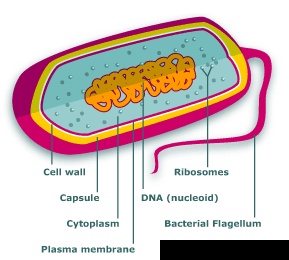
Which type of cell?
a)
Prokaryote
b)
Eukaryote
30.

Which types of organisms developed first due to the early environmental conditions on Earth? 

a)

prokaryotic and aerobic

b)

prokaryotic and anaerobic

c)

eukaryotic and aerobic

d)

eukaryotic and anaerobic

31.

What is the monomer for protein?

a)

Polymer

b)

Nucleic Acids

c)

Amino Acids

d)

Fatty Acids

32.
In which way are photosynthesis and cellular respiration different?
a)
Cellular respiration stores ATP, while photosynthesis releases ATP.
b)
Cellular respiration produces oxygen, while photosynthesis uses oxygen.
c)
Photosynthesis releases energy, while cellular respiration stores energy.
d)
Photosynthesis uses carbon dioxide, while cellular respiration produces carbon dioxide.
33.

Which organism go through cellular respiration?

a)

animals

b)

plants

c)

both animals and plants

d)

none

34.

Cellular Respiration occurs in what cell organelle?

a)

chloroplast

b)

cytoplasm

c)

mitochondria

d)

animal

35.

What type of respiration requires oxygen?

a)

Aerobic

b)

Anaerobic

36.

What type of respiration does not require oxygen?

a)

Aerobic

b)

Anaerobic

37.
What are the two products of photosynthesis?
a)
Oxygen and Carbon Dioxide
b)

Oxygen and Sugar

c)
Sunlight and Sugar
38.
Which of the following is the correct equation for PHOTOSYNTHESIS?
a)
CO+ light + H2O --> O+ Sugar
b)
CO+ sugar + H2O --> O+ light
c)
O2 + light + H2O --> CO+ Sugar
d)
CO+ O2 + H2O --> Light+ Sugar
39.
What are the bubbles rising in the test tube?
a)
nitrogen gas
b)
carbon dioxide gas
c)
glucose
d)
oxygen gas
40.

Crossing over occurs during Prophase I.

a)

Meiosis

b)

Mitosis

41.

Associated with growth and asexual reproduction.

a)

Meiosis

b)

Mitosis

42.

Two daughter cells are produced.

a)

Meiosis

b)

Mitosis

43.

Daughter cells are identical to parent cell.

a)

Meiosis

b)

Mitosis

44.
In which type of cells will mitosis occur?
a)
egg cells
b)
sperm cells
c)
jail cells
d)
Body cells except the sperm and egg cells
45.
Which of the following cells is a gamete?
a)
egg
b)
bone
c)
heart
d)
muscle
46.
What is the name of the process in which DNA (genetic information) is exchanged during meiosis?
a)
crossing under
b)
crossing over
c)
melding
d)
blending
47.
The process on the left is:
The process on the right is:
a)
Left: meiosis
Right: meiosis
b)
Left: meiosis
Right: cloning
c)
Left: mitosis
Right: meiosis
d)
Left: mitosis
Right: mitosis
48.
Creates VARIETY in living things
a)
Mitosis
b)
Meiosis
49.
DNA is replicated before the process starts
a)
mitosis
b)
meiosis
c)
both
50.
Process that begins with diploid parent cell.
a)
Mitosis
b)
Meiosis
c)
Both Mitosis and Meiosis
51.
A cell with 10 chromosomes go through meiosis. What is the end result of the process
a)
4 cells with 10 chromosomes each
b)
2 cells with 10 chromosomes each
c)
4 cells with 5 chromosomes each
d)
2 cells with 5 chromosomes each
52.
Which type of cell?
a)
Prokaryote
b)
Eukaryote
53.
All eukaryotes and prokaryotes are surrounded by a _____.
a)
cell wall
b)

cell (PLASMA) membrane

c)
cell envelope
d)
loving, supportive family
54.

This organelle is found in both plant and animal cells, but is usually much bigger in plant cells causing an increase in TURGOR PRESSURE.

a)
b)
c)
d)
55.
A calico cat shows both the traits for orange fur and black fur. What kind of allele expression is this?
a)
Incomplete Dominance
b)
Co dominance
c)
Independent assortment
d)
Recessive inheritance
56.

Which of these organelles is found in PROKARYOTES and PLANT cells but not found in an animal cell?

a)

Cell Membrane

b)

Nucleus

c)

Mitochondria

d)

Cell Wall

57.

Codominance occurs in calico cats, which allows for the Black and Tan colors to show. What percentage of the offspring represented in this P square will be calico (black and tan spotted)?

a)

25%

b)

50%

c)

75%

d)

100%

58.
If a father is AA and a mother is AB, what is the probability for a child with AB blood? 
a)
0%
b)
25%
c)
50%
d)
75%
59.
If two parents have type AB blood, what is the probability that their child will have type O blood?
a)
0%
b)
25%
c)
50%
d)
100%
60.
What proportion of the offspring in Figure 11-4 would be expected to have white, smooth hair?
a)
9/16
b)
3/16
c)
4/16
d)
1/16
61.

What goes in box 3

a)

Aabb

b)

AABB

c)

AAbb

d)

aaBb

62.
Proteins are made of monomers called ___________
a)
Nucleotides
b)
Monosaccharides
c)
Amino Acids
d)
Glycerol and fatty acids
63.

Which macromolecule is shown?

a)

lipid

b)

protein

c)

nucleic acid

d)

carbohydrate

64.
What type of macromolecule are enzymes?
a)
Protein
b)
Carbohydrate
c)
Lipid
d)
Nucleic Acid
65.

What are two factors that can affect an enzymes ability to function?

a)

No changing

b)

temperature and pH

c)

night and day

d)

hot and cold

66.
Which of the four major biological macromolecules can be easily identified by the nitrogen base and phosphate found in its structure?
a)
carbohydrate
b)
lipid
c)
protein
d)
nucleic acid
67.
Which of these is NOT true?
a)
Enzymes can denature (change shape) when the temperature gets too high.
b)
Enzymes can only be used once in a chemical reaction. 
c)
Extreme pH can denature enzymes.
d)
Enzymes speed up chemical reactions. 
68.
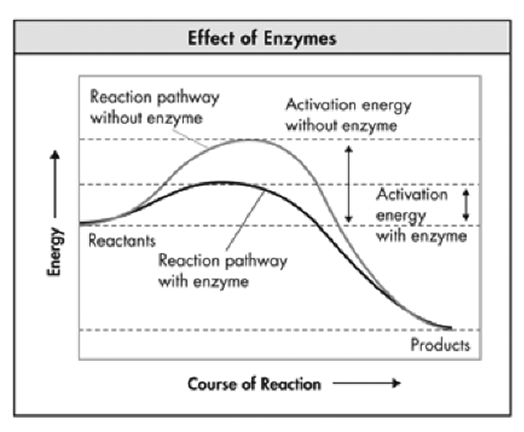
The graph shows how enzymes affect reactions in cells. Which statement best summarizes the information shown in the graph?
a)
Enzymes increase the energy of the reactants.
b)
Enzymes decrease the energy level of the products.
c)
Enzyme decrease the activation energy of the reaction.
d)
Enzymes reverse the direction of the reaction.
69.
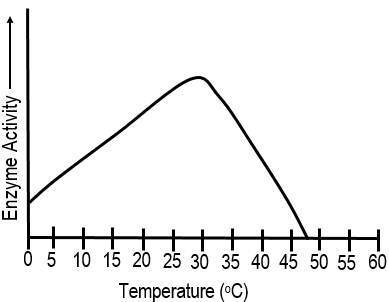
Based on the graph, what temperature does this enzyme work best? 
a)
15 C
b)
40 C
c)
30 C
d)
47 C
70.

Scenario: You want to test whether water helps to improve plant growth. What is the Independent Variable? (Remember: Independent Variables are what "I"change in the experiment.

a)

The growth of the plant

b)

Amount of Sunlight

c)

Amount of Water

71.

A ________________is a critical point where stop and go signals can regulate the cycle

a)

tumor

b)

checkpoint

c)

growth factor

d)

oncogene

72.

What was the independent variable in Redi's experiment?

a)

The type of meat he put in the jars

b)

The amount of time in his experiment

c)

The type of covering on the jars containing meat

d)

The flies's eggs

73.
My main goal is to produce a lot of ATP energy. 
a)
Chloroplast
b)
Mitochondria
74.
Which of the following would provide the most energy in an ecosystem?
a)
Producers
b)
Herbivore
c)
Omnivore
d)
Carnivore
75.

In the energy pyramid here, which type of CONSUMER have the most energy available?

a)
Producers
b)

Carnivore (Secondary Consumer)

c)

Herbivores

(Primary Consumer)

d)

Top Predator (Tertiary Consumer)

76.

What would happen to the organisms in the food web below if the number of phytoplankton and vegetation decreased?

a)

Only the small fish would be affected

b)

Only the osprey would be affected

c)

The small fish and wading birds would be affected

d)

The entire food web would be affected

77.

What would happen to this food chain if we doubled the population of the rabbits?

a)

The populations of the snakes and hawks would also increase.

b)

The populations of the grass, snakes, and hawks would decrease.

c)

The grass population would decrease. The snake and hawk population would increase.

d)

The grass and hawk population would decrease. The snake population would increase.

78.

Trapping (or rabbit hunting) has severely reduced the population of rabbits in an ecosystem as shown in the bar graph. What is the most likely effect this will have on other organisms?

a)

The snake population will decrease while the grass population will increase

b)

The haw population will increase and the rabbit population will decrease

c)

The grass population will decrease and the snake population will increase

d)

The grass, rabbit, snake, and hawk populations will all decrease rapidly

79.

For the food chain shown, which of the following changes would have the most severe consequences?

a)

a drastic decrease in rainfall, causing a drought

b)

the poaching of predatory hawks by game hunters

c)

the introduction of a second predator that eats field mice

d)

a parasitic infestation that reduces the cricket population

80.
The electrical sparks mimicked?
a)
heat waves
b)
lightening
c)
volcano
d)
hurricane
81.
Which of the following was probably not present in the atmosphere of the primitive Earth? 
a)
Methane
b)
Oxygen
c)
Water
d)
Carbon dioxide
82.
Which is an effect of climate change?
a)
melting of sea ice 
b)
burning of fossil fuels
c)
cutting down trees 
d)
vehicle exhaust
83.
Two factors that determine where an organism lives in aquatic ecosystem are 
a)
Temperature and sunlight
b)
Neighbors and housing prices
c)
Fish and wildlife
d)
Darkness and tree height
84.

After a volcanic eruption, lava covers the land. What is the order that plants grow to repopulate the area?

a)

Lichens → Shrubs → Grasses → Trees

b)

Lichens → tree → shrubs→Grasses

c)

Grasses → Lichens → Shrubs → Trees

d)

Lichens → Grasses → Shrubs → Trees

85.
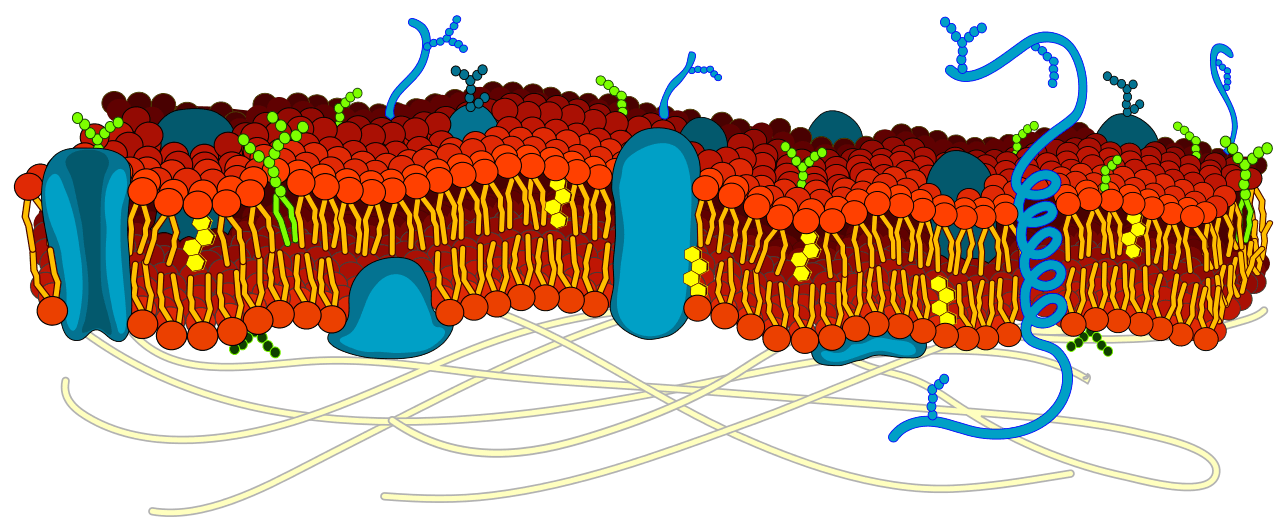
Look at the cross section of a cell membrane of a eukaryotic cell. H+ ions are being pumped from a low concentration to a high concentration. How do you describe this type of transport across the cell membrane?
a)
active transport
b)
passive transport
c)
facilitated diffusion
d)
co-transport
86.
The cell membrane of the red blood cell will allow water, oxygen, and carbon dioxide to pass through. Because other substances are blocked from entering, this membrane is called
a)
perforated
b)
semi-permeable
c)
non-conducive
d)
permeable
87.
Which activity can occur without the use of energy?
a)
contraction of muscle tissue
b)
protein synthesis in a cell
c)
active transport of minerals
d)
movement of water across a membrane
88.
 In pure water, a red blood cell from an animal will swell and burst, but a leaf cell from a plant will not. Which structure in the leaf cell is responsible for this difference?
a)
cell membrane
b)
cell wall
c)
 mitochondrion
d)
nucleus
89.
A person with swollen gums rinses his mouth with warm salt water, and the swelling decreases. Which of the following has occurred?
a)
The swollen gums have absorbed the saltwater solution.
b)
The saltwater solution lowers the temperature of the water in the gums.
c)
The salt in the solution has moved against the concentration gradient.
d)
The water in the gums has moved out due to the high concentration of salt in the solution. 
90.

Which photo shows the mitochondrion of the cell?
a)
b)
c)
d)
91.

What is the function of the organelle depicted in the photo?

a)

To dispose of waste in the cell.

b)

To capture sunlight and convert it into glucose for the cell.

c)

To release energy into the cell.

d)

To control what leaves and enters the cell.
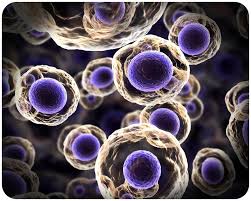
92.
The two kinds of cells are Prokaryotes and Eukaryotes. How are they different?
a)
Prokaryotes have a nucleus.
b)
Eukaryotes have a nucleus.
c)
Prokaryotes are plant cells.
d)
There is no difference.
93.

what is the function of ribosomes

a)

to assemble amino acids to create proteins

b)

to pack proteins

c)

to clean proteins

94.
How do invasive plants damage the environment?
a)
Compete with native species
b)
Change plant community
c)
Alter diversity
d)
All of these
95.

The primary cause of invasive species introduction is

a)

too much food

b)

human actions

c)

weather events

d)

asteroids

96.

Which of the following is NOT a threat to biodiversity?

a)

Pollution

b)

Deforestation

c)

Invasive Species

d)

Ecological Succession

97.
What does conserving resources mean?
a)
Use as much of the resources as you can
b)
Only use the resources at school
c)
Protecting the resource so it does not run out
98.
Which group includes ALL renewable resources?
a)
Coal, trees, water, oil
b)
Water, wind, sun, plants
c)
Minerals, sun, natural gas, water
99.

Energy is released from ATP when:

a)

ATP is exposed to sunlight

b)

a phosphate group is broken

c)

adenine bonds to ribose

d)

a phosphate group is added

100.

After the bond depicted in the photo is broken, what will be the correct name of the molecule?

a)

ATP

b)

Glucose

c)

ADP

d)

NADPH