wayground logo

Free Printable Worksheets

Font size

S
M
L
XL
Worksheets

AP Biology Midterm Review

Total questions: 200

Worksheet time: 3hrs 1mins

Name
Class
Date
1.

What are two types of Nucleic acids?

a)

DNA & BNA

b)

DNA & NNA

c)

RNA & fRNA

d)

DNA & RNA

2.

What are the 4 main elements that make up Organic Molecules?

a)

H, O, B, P

b)

H, C, O, N

c)

H, C, O, He

d)

H, P, O, K

3.

What composes a semi-permeable membrane?

a)

Proteins

b)

Carbohydrates

c)

Phospholipids

d)

Fatty acids

4.

Lipids are grouped together because they all share one trait:

a)

They all booed Cody Parkey when he missed the bears field goal

b)

They mix poorly or not all with water

c)

They mix perfectly or most of the time with water

d)

They all love doing the bird box challenge

5.

What Organic molecule is a biologically functional molecule that consists of one or more polypeptides folded and coiled into a specific 3-D structure?

a)

Lipid

b)

Carbohydrate

c)

Nucleic Acid

d)

Protein

6.

What are simple sugars that serve as a building block for carbohydrates?

a)

Monosaccharides

b)

Disaccharides

c)

Polysaccharides

d)

I have no clue. I'm just selecting random answers waiting for the game to be over

7.

This is two simple sugars put together to make a complex sugar,

a)

Disaccharide

b)

Bisaccharide

c)

dos saccharide

d)

two saccaride

8.
All cells are surrounded by a thin, flexible barrier called a(n)
a)
electron microscopy
b)
cell wall
c)
cell membrane
d)
photo cell
9.
_____ are cells that enclose their DNA in nuclei.
a)
Phototophylites
b)
Prokaryote
c)
Eukaryote
d)
LocoKaryotes
10.
Meagan has a large membrane-enclosed structure within her cells that contain her DNA known as a(n) _______
a)
Necleo Peptide
b)
nucleus
c)
RNA marker
d)
ribozome
11.
In general, Eukaryota cells (including plant and animal cells) are ____ _____ than Prokaryotic cells. 
a)
obviously stronger
b)
less complex
c)
more complex
d)
obviously weaker
12.
What is the total magnification of a microscope with an eyepiece magnification of 10x and an objective lens magnification of 50x ?
a)
500x
b)
50x
c)
5x
d)
5000x
13.
_____ are located near the nucleus, help organize cell division, and are not found in plant cells.
a)
vacuoles
b)
centrioles
c)
chloroplasts
d)
organelles
14.
_____ cells contain an internal membrane system known as the ______ ____ where lipid components of the cell membrane are assembled along with proteins and other materials
a)
Eukaryotic, endoplasmic reticulum (ER)
b)
Prokaryotic, endoplasmic reticulum (ER)
c)
Mutant, oxygen exchanger
d)
New, permeable membrane
15.
______ are the biological equivalent of a solar cell.
a)
Mitochondria
b)
Chloroplasts
c)
ER
d)
Golgi Apparatus
16.
The ____ ____ regulates what enters and leaves the cell and also protects and supports the cell.
a)
Golgi Apparatus
b)
ER
c)
cell wall
d)
cell membrane
17.
Particles moving from a high concentration to a lower concentration are demonstrating _____.
a)
diffusion
b)
confusion
c)
permeable response to environment
d)
permanent membrane
18.
Molecules that are unable to diffuse across the membrane may use _____ ____ or special protein channels to pass through,
a)
permits glucosomine
b)
permits forfietures
c)
facilitated diffusion
d)
optional optusion
19.
Isotonic, as pertains to water and sugar, refers to ______ _____.
a)
strong limbs
b)
same strength
c)
upside down
d)
over production
20.
When it is said that the more concentrated sugar solution is "above strength" then it is referring to _______.
a)
hyper-speed
b)
hyper-solution
c)
hypertonic
d)
supersonic
21.
The ____ ____ gives cell membranes a flexible structure
a)
lipid bilayer
b)
lipid loped
c)
loped liped
d)
multi lingual
22.
When the membrane allows one substance to pass but not another it is said to be ____ ___
a)
picky picky
b)
selectively blind
c)
selectively permeable
d)
permeable lock
23.
The _____ convert chemical energy stored in food into compounds the cells can use.
a)
lipid corigidors
b)
mitochondria
c)
celluliptaz
d)
permitria
24.
Relatively stable internal and external conditions is referred to as ______.
a)
homeopathy
b)
homo-sapiens
c)
homogenous
d)
homeostasis
25.
A group of similar cells that perform a particular function.
a)
tissue
b)
no cells are similar
c)
plutonium
d)
argon
26.
Many groups of tissue work together as a (n) _____.
a)
peticure
b)
organ
c)
oligarchy
d)
olive
27.

Cells tend to be small, with sizes ranging between 1 and 100 mm. These small sizes help to ensure that cells have a favorable surface-area-to-volume ratio. Choose the statement that explains why a favorable surface-area-to-volume ratio is advantageous.

a)

Higher surface-area-to-volume ratios improve the efficiency of transporting materials in and out of cells.

b)

Lower surface-area-to-volume ratios improve the efficiency of transporting materials in and our of cells.

c)

Higher surface-area-to-volume ratios speed up the flow of cytoplasm within cells.

d)

Higher surface-area-to-volume ratios slow down the flow of cytoplasm within cells.

28.

The Endosymbiotic Theory suggests that eukaryotic cells evolved when an ancient cell engulfed another, forming a permanent symbiotic relationship. Choose the evidence that best justifies this claim.

a)

Both mitochondria and chloroplasts perform energy functions

b)

Eukaryotic cells have many mitochondria

c)

Eukaryotic cells have traits in common with archaea

d)

Mitochondria and chloroplasts contain circular loops of unique DNA

29.

Both prokaryotic and eukaryotic cells contain all of the following EXCEPT

a)

Cell (Plasma) Membrane

b)

Chloroplast

c)

Cytoplasm

d)

Ribosomes

30.

Eukaryotic cells possess an extensive endomembrane system. The extensive use of internal membranes gives eukaryotic cells certain useful advantages not seen in prokaryotic cells. Choose the example that correctly describes one of these advantages.

a)

Nucleic acids can freely mingle with cytoplasmic enzymes

b)

Lysosomes can maintain a much lower pH than surrounding cytoplasm

c)

Endoplasmic reticulum is prevented from forming vesicles

d)

Surface area available for chemical reactions is greatly decreased

31.
Which of the following is major cause of the size limits for certain types of cells?
a)
evolutionary progression in cell size; more primitive cells have smaller sizes.
b)
the need for sufficient surface area to support the cell's metabolic needs.
c)
limitation on the strength and integrity of the plasma membrane as cell size increases
d)
the difference in plasma membranes between prokaryotes and eukaryotes
32.
Large numbers of ribosomes are present in cells that specialize in producing which of the following molecules?
a)
glycogen
b)
cellulose
c)
proteins
d)
lipids
33.
A protein that is destined for the membrane would be made 
a)
on a ribosome that is in the cytoplasm
b)
within a lysosome
c)
on a ribosome attached to the rough endoplasmic reticulum 
d)
within the Golgi body
34.

In order to keep the rate constant over the entire time course, which of the following should be done?

a)

Add more enzyme.

b)

Gradually increase the temperature after 60 seconds.

c)

Add more substrate.

d)

Add H2SO4 after 60 seconds

35.
Eggs and sperm cells must be:
a)
haploid
b)
diploid
36.
Meiosis has how may cell division?
a)
2
b)
3
c)
4
d)
5
37.
Meiosis results in how many daughter cells?
a)
2
b)
3
c)
4
d)
5
38.
Crossing over occurs in which phase?*
a)
Prophase I
b)
Prophase II
c)
Metaphase I
d)
Anaphase I
39.
Meiosis produces
a)
Body cells
b)
Somatic
c)
Gametes
d)
Skin cells
40.
Identify the phase.
a)
Metaphase I
b)
Metaphase II
c)
Prophase I
d)
Anaphase II
41.
If a somatic (body) cell in a butterfly contains 24 chromosomes, a butterfly egg would contain
a)
3
b)
6
c)
12
d)
24
42.
A herd of zebras would be considered a
a)
community
b)
species
c)
ecosystem
d)
population
43.
Two organisms of different species exist in a relationship in which each individual benefits from the activity of the other:
a)
commensalism
b)
parasitism
c)
herbivory
d)
mutualism
44.
All of the following are density-dependent factors that limit animal populations EXCEPT.
a)
weather
b)
predation
c)
food competition
d)
birthrate
45.
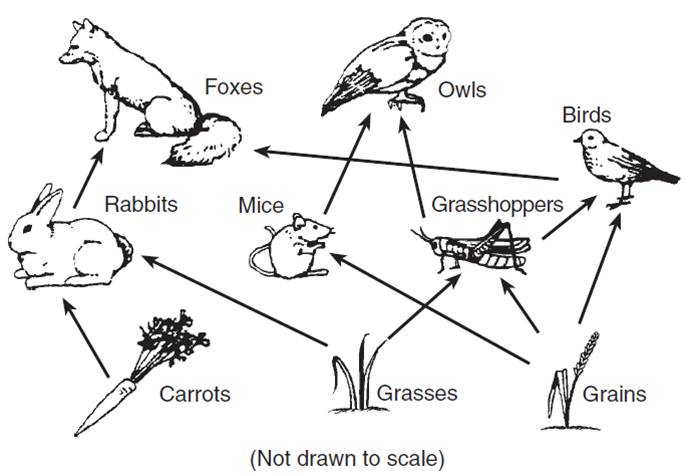
Which of the following is a primary consumer in this food web?
a)
Foxes
b)
Carrots
c)
Mice
d)
Owls
46.
Which organism contains the most energy?
a)
Rabbit
b)
Grains
c)
Birds
d)
Mice
47.
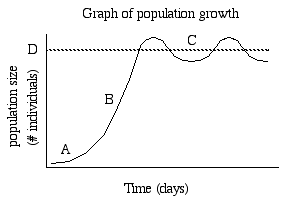
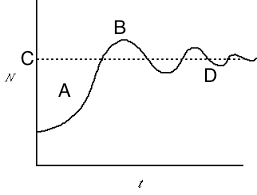
Which point on the graph represents carrying capacity?
a)
A
b)
B
c)
C
d)
D
48.
Why is only 10% of the energy passed along to the next trophic level?
a)
90% is lost through heat, reproduction, and movement
b)
90% is gained
c)
90% is lost in light energy
d)
because only 10% is lost
49.
All of the following statements concerning characteristics of predator-prey relationship are correct EXCEPT:
a)
Camouflage is an adaptation that protects prey.
b)
A rise in the population of predators is followed by a decreased in the population of prey.
c)
A rise in the population of prey is often followed by a rise in the population of predators.
d)
The population of predators most often eliminates the population of prey
50.
Which of the following best explains why there are seldom more than five trophic levels in a food chain?
a)
Most carnivores function at more than one trophic level
b)
Trophic levels about this numbers contain too many individuals
c)
Energy is lost from each trophic level
d)
The ecosystem contains too much biomass
51.
Which of the following encompases all the others?
a)
ecosystem
b)
community
c)
population
d)
individual
52.
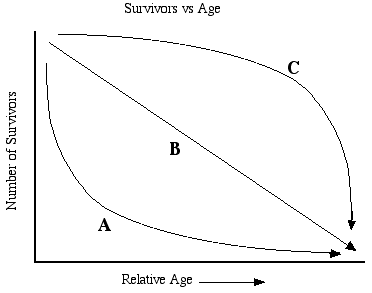
Refer to the diagram of the survivorship curve.
Which curve best describes an organism that invests a lot of energy in parenting?
a)
A
b)
B
c)
C
d)
this is not a survivorship curve
53.
Which letter shows the the exponential growth of a population?
a)
A
b)
B
c)
C
d)
D
54.
The two species, Paramecium aurelia and Paramecium caudatum, which do not prey upon each other, fighting to grow in the same test tube is an example of which of the following?
a)
Competition
b)
Predation
c)
Commensalism
d)
Exclusion
55.
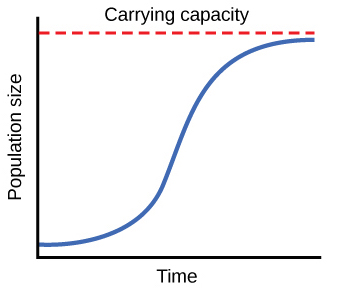
The maximum population size for a species based on the environmental factors is called
a)
ecological footprint
b)
carrying capacity 
c)
population growth
d)
environmental capacity
56.
There are 200 bears in an area.  10 emigrate, 15 immigrate, 10 are born and 20 die.  How many are left?
a)
195
b)
205
c)
200
d)
260
57.
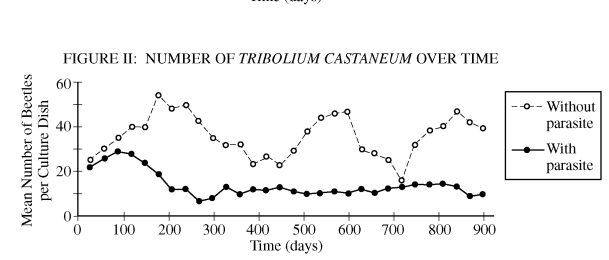
Which of the following correctly describes the interactions between T. castaneum and the parasite.
a)
The parasite decreases the population density of beetles in each culture dish.
b)
The parasite increases the population density of beetles in each culture dish.
c)
The parasite has no effect on the population density of the beetles.
58.
How do matter and energy flow differently?
a)
Energy flows in one direction, matter is recycled
b)
Matter flows in one direction, Energy is recycled
c)
Energy and Matter are both recycled
d)
Energy and Matter both flow in one direction
59.
Which of the following is an example of a density-independent limiting factor?
a)
A parasite
b)
A natural disaster
c)
A decrease in prey
d)
A food shortage
60.
Primary consumer's energy is 54,000 joules. How much energy was provided to secondary consumers?
a)
53,460 J
b)
540 J
c)
5,400 J
d)
54 J
61.
Which of the following statements best describes the concept of NPP (Net Primary Production)
a)
energy captured minus energy lost
b)
total amount of energy lost
c)
total amount of energy produced from photosynthesis
d)
total amount of energy available within an ecosystem
62.
__________ growth shows growth of a population under environmental constraints (carrying capacity-K) that sets a maximum population size 
a)
logistic
b)
exponential
c)
niche
d)
uniform
63.
These types of organisms which multiply rapidly in numbers 
a)
R-strategists
b)
K-strategists
c)
predators
d)
mutualists
64.
A species that exerts a large, positive impaction on its ecosystem is known as a:
a)
Keystone species
b)
Invasive species
c)
Indicator species
d)
Poached species
65.
Which kind of dispersion is #1?
a)
clumped
b)
random
c)
uniform
66.
Most of the organisms in the ocean exists in the shallow water over the continental shelves.  Why is this true?
a)
Producers, the beginning of all food chains, can only exist where there is sunlight.
b)
Sea predators can easily catch their prey where the water is shallow.
c)
Water over the continental shelves has more minerals than deep ocean water.
d)
Ocean storms destroy organisms living in deep water.
67.
Invasive species are:
a)
non-native
b)
harmful to an ecosystem
c)
organisms that can lack predators in the new environment
d)
all of the answers are correct
68.
Two animals live together in close association.  One benefits, while the other is unaware of the first animal. The relationship is best described as
a)
Parasitism
b)
Mutualism
c)
Commensalism
d)
Predation
69.
Which of the following is NOT an abiotic factor?
a)
air 
b)
water 
c)
decomposers 
d)
temperature
70.
Which of these populations is experiencing the fastest growth?
a)
A
b)
B
c)
C
d)
D
71.
Which of these populations is most nearly experiencing zero population growth over the time period represented in the diagram?
a)
A
b)
B
c)
C
d)
D
72.
Which of these populations is experiencing the effect of severe limiting factors.
a)
A
b)
B
c)
C
d)
D
73.
All of the following increases the concentration of CO2 in the atmosphere EXCEPT
a)
photosynthesis
b)
slash and burn clearing of tropical rainforests
c)
burning of fossil fuels
d)
burning of wood for cooking and heating
74.
Refer to the diagram of the survivorship curve.
Which best describes an organism that fertilizes externally?
a)
A
b)
B
c)
C
d)
this is not a survivorship curve
75.
To measure primary productivity, you can measure carbon dioxide consumption, total carbohydrates produced or ________________.
a)
dissolved oxygen
b)
total proteins produced
c)
light energy entering system
76.
The monomer, building block, of proteins
a)
Amino Acid
b)
Fatty Acid
c)
Nucleotide
d)
monosaccharide
77.
Combines with 3 fatty acid chains to make up a triglyceride; part of the monomer of lipids
a)
Amino Acid
b)
Fatty Acid
c)
Glycerol
d)
Nucleotide
78.
The monomer, building block, of DNA and RNA; made up of a sugar, phosphate, and nitrogenous base
a)
Amino Acid
b)
Fatty Acid
c)
Nucleotide
d)
Monosaccharide
79.
The process/reaction used to link compounds/monomers together.  Releases water.
a)
Dehydration
b)
Hydrolysis
c)
Enzomatic
d)
Tetratonic
80.
The monomer, building block, of carbohydrates; simple sugar
a)
Amino acid
b)
Fatty Acid
c)
Nucleotide
d)
Monosaccharide
81.
The process used to split polymers; this is done by adding water
a)
Dehydration
b)
Hydrolysis
c)
Enzomatic
d)
Tetratonic
82.
Which of the following is not a job of a protein
a)
Act as hormones and enzymes
b)
Do much of the work in cells and transport materials
c)
Build tissues and muscles 
d)
store and transmit genetic information 
83.
What is a substance called if it speeds up a chemical reaction?
a)
reusable
b)
catalyst
c)
specific
d)
fragile
84.
Where do substrates bind on an enzyme?
a)
voltage-gated channels
b)
surface receptor
c)
calcium channels
d)
active site
85.
Which is not a use or function of protein?
a)
forms enzymes and hormones
b)
forms transport channel in cell membrane
c)
forms structural proteins in the body
d)
quick energy
86.
These organic molecules are used by the body for long term storage of energy and make up the structure of cell membranes.
a)
Carbohydrates
b)
Lipids
c)
Proteins
d)
Nucleic Acids
87.
___________ are some functions of lipids.
a)
storing energy and  cell membrane structure
b)
providing actin & providing myosin
c)
cellulose structure and digestive assistance
d)
storing & transferring genetic info
88.
What 3 letters do enzymes typically end in?
a)
-ose
b)
-ase
c)
-ese
d)
-tic
89.
Changes in pH and temperature can damage an enzymes active site.  What is this called?
a)
reusable
b)
catalyst
c)
specific
d)
denature
90.
The energy needed to start a reaction
a)
activation energy
b)
adhesion energy
c)
chemical energy
d)
cohesion energy
91.
Which property makes water molecules stick to other water molecules?
a)
adhesion
b)
cohesion
c)
capillary action
d)
polarity
92.
All organic compounds contain the element
a)
carbon
b)
nitrogen
c)
phosphorus
d)
sulfur
93.
Which of the following elements make up nucleic acids?
a)
C, H, O
b)
C, H, O, N
c)
C, H, O, N, P
d)
C, H, O, Ca, S
94.
Carbohydrates are made of... 
a)
C H O
b)
C H O N
c)
C H O N P
d)
C H O N S
95.
Which macromolecule is shown?
a)
lipid
b)
protein
c)
nucleic acid
d)
carbohydrate
96.
The diagram shows a bond forming between two amino acids. What is the name of this reciprocation?
a)
Dehydration Synthesis
b)
Hydrolysis
c)
Pepysis
d)
Oxidation
97.
The bond that joins amino acids are called:
a)
Peptide Bonds
b)
Ester Bonds
c)
Glycosidic Linkages
d)
Phosphodiester Bonds
98.
What property of water allows it to be such a versatile solvent that it is often called the "universal solvent?"
a)
Purity
b)
Polarity and cohesion
c)
High heat capacity
d)
Expansion upon freezing
99.
Which of the following properties of water enables molecules to cling together as they move from the roots to the leaves of plants?
a)
Water expands as it freezes.
b)
Water is an excellent solvent.
c)
Water exhibits cohesive behavior.
d)
Water moderates temperature.
100.
Capillary action is the result of adhesion. Which aspect of water is responsible for this?
a)
Nonpolar covalent bonds enable water to dissolve other substances.
b)
Polar covalent bonds join molecules of water to other substances.
c)
Hydrogen bonds form between water and another substance.
d)
Ionic bonds enable electrons to flow through water and into another substance.
101.
Large bodies of water do not quickly fluctuate, or change, in temperature. Why?
a)
Water is a solvent.
b)
Water has a high heat capacity.
c)
Water acts as a buffer.
d)
Water is non-polar.
102.
What term describes when water is attracted to other substances?
a)
Cohesion
b)
Adhesion
c)
Capillary Action
d)
Surface Tension
103.
Why does water move from the roots to the leaves of plants?
a)
Water is pushed by solutes.
b)
Capillary action pulls the water molecules like a chain.
c)
Water is pulled by gravity.
d)
Water’s cohesion causes it to “pull” towards the leaves.
104.
Attractions between water molecules due to polarity are called:
a)
Covalent bonds
b)
Ionic bonds
c)
Polar bonds
d)
Hydrogen bonds
105.
The attraction that causes water and other liquids to form drops on thin films is called ________________. This is also water’s ability to be attraction to other water molecules.
a)
adhesion
b)
capillary action
c)
cohesion
d)
surface tension
106.
Why does ice float?
a)
As water freezes, it expands and its density decreases.
b)
As water freezes, it takes up more hydrogen from the atmosphere, causing it to have a greater buoyancy.
c)
As water freezes, air becomes trapped between the hydrogen bonds of water molecules.
d)
As water freezes, it takes up more oxygen from the atmosphere, causing it to have a greater buoyancy.
107.
What two elements make up water?
a)
Helium and oxygen
b)
Hydrogen and oxygen
c)
helium and carbon
d)
oxygen and carbon
108.
What property of water helps to moderate earth's temperature?
a)
adhesion
b)
chohesion
c)
Specific heat capacity
d)
Latent heat of vaporization
109.

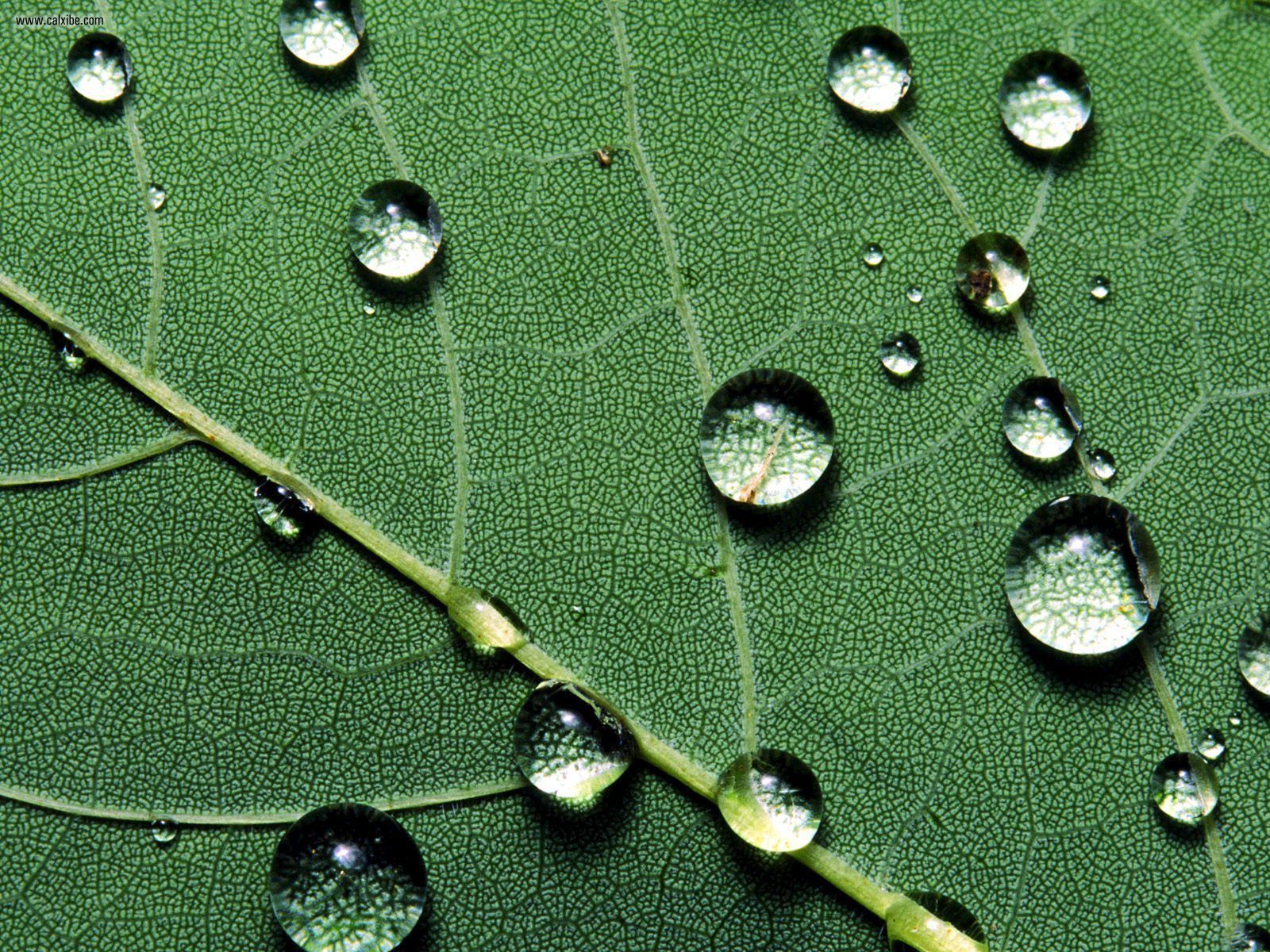
Refer to the picture; the water sticks to the leaf because of:

a)

Adhesion

b)

Cohesion

110.
Refer to the picture; this is occurring due to:
a)
Adhesion
b)
Cohesion
111.

How does a hydrogen bond form?

a)

Between the positive hydrogen of one water molecule and the negative oxygen of another

b)

Between the positive hydrogen of one water molecule and the negative hydrogen of another

c)

Between the positive oxygen of one water molecule and the negative oxygen of another

d)

Between the positive hydrogen of one water molecule and the positive hydrogen of another

112.
A measure of how difficult it is to stretch or break the surface of a liquid is called...
a)
polar molecule
b)
surface tension
c)
capillary action
d)
specific heat
113.
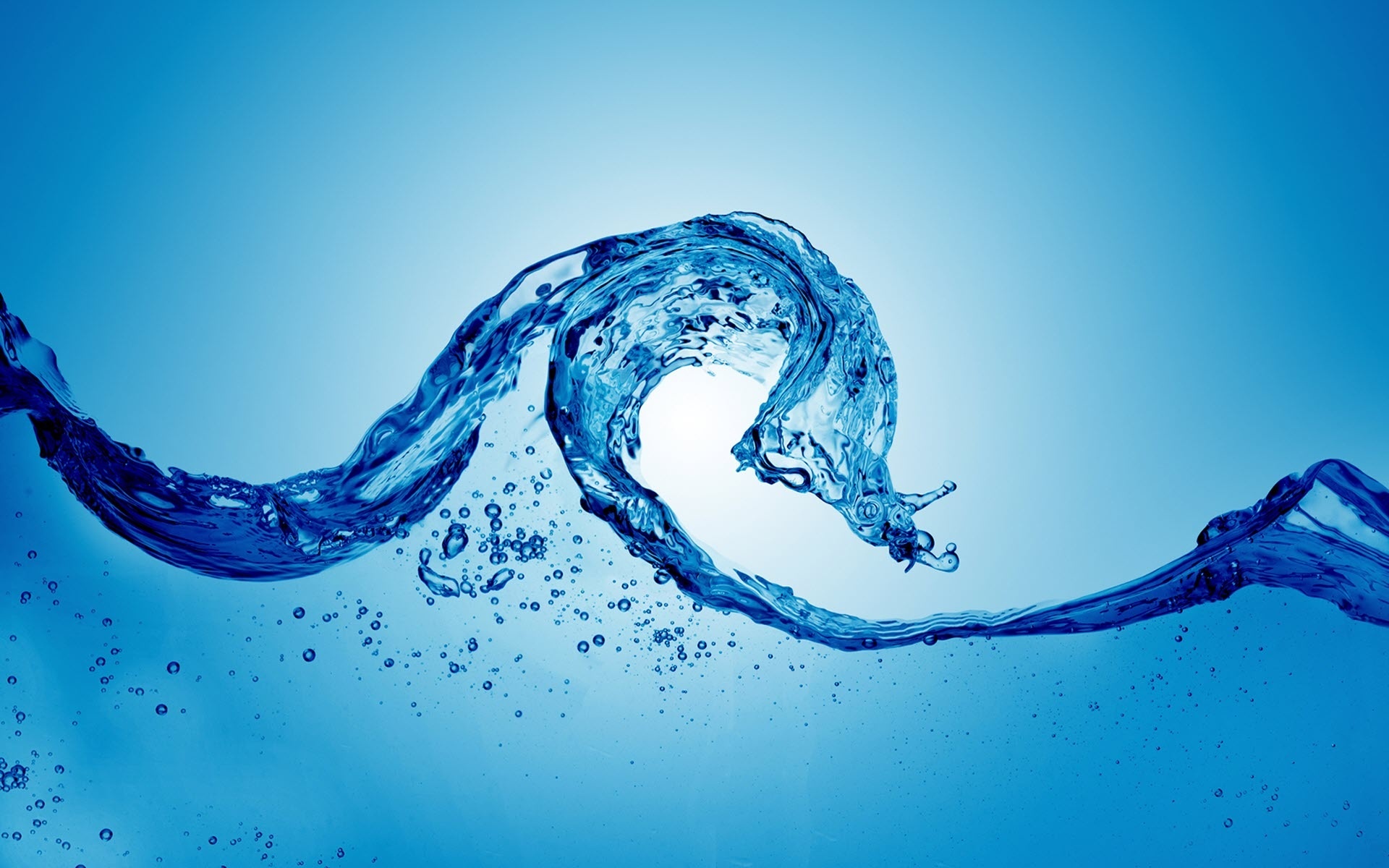
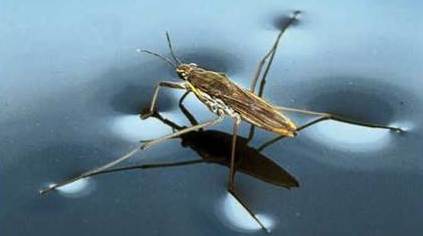
What property of water is shown in the picture?
a)
capillary action
b)
surface tension
c)
evaporation
d)
universal solvent
114.
A water molecule is a ________ molecule, which has one oxygen that has a __________ charge and two hydrogens that have a ___________ charge.
a)
nonpolar, positive, negative
b)
polar, positive, negative
c)
polar, negative, positive
d)
nonpolar, negative, positive
115.

Pure water has a pH of

a)

6

b)

15

c)

3

d)

7

116.
Which of the following correctly describes how enzymes work?  
a)
they lower the energy of the reactants to increase the rxn rate
b)
they supply energy to the reaction to increase the rxn rate
c)
they lower the energy of the products to increase the rxn rate
d)
they lower the activation energy of the reaction to increase the rxn rate
117.
The part of the enzyme that the substrate bonds to is called the _____.
a)
active site
b)
activation energy
c)
bond site
d)
peptide bond
118.
The energy needed to start a reaction
a)
activation energy
b)
adhesion energy
c)
chemical energy
d)
cohesion energy
119.
Which of these is NOT true?
a)
Enzymes can denature (change shape) when the temperature gets too high.
b)
Enzymes can only be used once in a chemical reaction. 
c)
Extreme pH can denature enzymes.
d)
Enzymes speed up chemical reactions. 
120.

Which of the following is directly responsible for the shape of an enzyme/protein?

a)

The amino acid sequence of the protein and the properties of the amino acids that make up the protein.

b)

The temperature of the surrounding environment.

c)

The pH of the surrounding environment.

d)

The amount of substrate present.

121.
Blocking Active site of an enzyme
a)
competitive inhibition
b)
allosteric inhibition
122.
Vitamin C
a)
Cofactor
b)
Coenzyme
c)
Competitive inhibitor
123.
Zinc and Iron
a)
Coenzymes
b)
Cofactors
c)
Organic
124.
What was the substrate in our enzyme lab?
a)
Hydrogen peroxide
b)
Catalase
c)
Yeast
d)
Oxygen gas
125.
This picture represents what type of cell transport?
a)
endocytosis
b)
exocytosis
c)
osmosis
d)
passive transport
126.
Which is true about active transport?
a)
It requires energy
b)
it does not require energy
c)
It moves substances down the concentration gradient
d)
it moves material from high to low concentration
127.
Molecules diffusing with the concentration gradient through a protein channel is...
a)
Facilitated Diffusion
b)
Simple Diffusion
c)
Active Transport
d)
Osmosis
128.
In a nerve cell, ATP energy is used to pump sodium (Na) out of the cell and potassium (K) into the cell. This is an example of...
a)
Facilitated Diffusion
b)
Simple Diffusion
c)
Active Transport
d)
Osmosis
129.
The cell below is in a _________ solution.
a)
Hypotonic
b)
Hypertonic
c)
Isotonic
130.
The cell below is in a _____________ solution.
a)
Hypertonic
b)
Hypotonic
c)
Isotonic
131.
A cell in an isotonic solution will
a)
swell
b)
shrink
c)
stay the same size
d)
impossible to tell
132.
When a cell is placed in a hypertonic (more concentrated) solution water
a)
moves from the inside of the cell to the solution
b)
moves from the solution to the inside of the cell
c)
moves equally in and out of the cell
d)
none of these
133.
When a cell is placed in a hypotonic solution (less concentrated), water
a)
moves from the inside of the cell to the solution
b)
moves from the solution to the inside of the cell
c)
moves equally in and out of the cell
d)
none of these
134.
What type of transport is this?
a)
facilitated diffusion
b)
active transport
c)
diffusion
d)
osmosis
135.
When cells take on too much water and burst, this condition is called
a)
plasmolysis
b)
turgor pressure
c)
crenation
d)
cytolysis
136.
An amoeba ingests large, solid food particles by what process?
a)
diffusion
b)
phagocytosis
c)
osmosis
d)
pinocytosis
137.
How is cellular respiration related to photosynthesis?
a)
Both require oxygen to start
b)
respiration is the opposite of photosynthesis
c)
Both start with glycolysis
d)
Both end with 38 ATP for cells
138.
Which of the following statements are false?
a)
Glycolysis can occur with or without oxygen
b)
Glycolysis is the first step in both anaerobic and aerobic respiration
c)
Glycolysis occurs in the mitochondria
d)
Glycolysis produces 2 ATP, 2 Pyruvates, and 2 NADH
139.
What are the products (things that are made) in cellular respiration
a)
ATP
b)
Carbon dioxide (CO2)
c)
Water
d)
All of the above
140.
Glucose is broken down into pyruvate in a process known as 
a)
glycolysis
b)
electron transport
c)
the Krebs cycle
d)
phosphorylation
141.
This term refers to the production of ATP without oxygen being present.
a)
anaerobic
b)
prokaryotic
c)
biogenic
d)
organic
142.
What is the correct equation for cellular respiration?
a)
6O2 + C6H12O6 -> 6CO2 + 6H2O + Energy
b)
6O2 + C6H12O6 + Energy -> 6CO2 + 6H2O
c)
6CO2 + 6H2O -> 6O2 + C6H12O6 + Energy
d)
6CO2 + 6H2O + Energy -> 6O2 + C6H12O6
143.
What is cellular respiration?
a)
the breakdown of glucose  to release ATP
b)
the breakdown of glucose to release NADH
c)
the breakdown of glucose to release FADH
d)
the breakdown of glucose to release carbon
144.
Which of these molecules is released during the Kreb's cycle
a)
nitrogen
b)
oxygen
c)
hydrogen sulfide
d)
Carbon Dioxide (CO2)
145.
What is the main job of the electron carriers in cellular respiration? 
a)
Transport electrons and hydrogen atoms to the electron transport chain 
b)
Capture energy throughout the process of cellular respiration
c)
Provide the reactants for the process of cellular respiration
d)
Pump positive hydrogen ions and shuttle electrons across the electron transport chain and contribute to chemiosmosis
146.
Glycolysis is a _______ process
a)
Anabolic
b)
Catabolic
c)
Single Step
d)
Strictly Eukaryotic
147.
NADH is a ______ form of NAD+.
a)
Reduced
b)
Oxidized
c)
Catabolized
d)
Hydrolized
148.
How many ATP are gained through glycolysis?
a)
0
b)
2
c)
4
d)
30-38
149.
Cellular respiration involves the net _______ of glucose.
a)
Reduction
b)
Oxidation
c)
ATP
d)
REDOX
150.
Which molecule enters Kreb's Cycle?
a)
Pyruvate
b)
Glucose
c)
Acetyl CoA
d)
reducing powers
151.
What enzyme in the ETC is responsible for generating the ATP molecules?
a)
ATPase
b)
ATP synthase
c)
Hexokinase
d)
none of the above
152.
Where does ETC occur?
a)
Mitochondrial matrix
b)
Outer mitochondrial membrane
c)
Inner mitochondrial membrane
d)
Cytosol
153.

after strenuous exercise, a muscle cell would contain decreased amounts of ______ and increased amounts of ______ ____

a)

glucose; ATP

b)

ATP; glucose

c)

oxygen; lactic acid

d)

lactic acid; ATP

154.
site of the krebs cycle
a)
1
b)
2
c)
3
d)
4
155.
Which process takes place in the presence of oxygen and produces nearly 20 times as much as ATP as glycolysis alone?
a)
photosynthesis
b)
lactic acid fermentation
c)
aerobic respiration
d)
alcoholic fermentation
156.
Two different species of bacteria are examined. Scientists find that species X always produces CO2 and H2O during cellular respiration. Species Y always produces ethyl alcohol and CO2. Which conclusion can be made from these observations?
a)
Only species Y is aerobic.
b)
Only species Y is anaerobic
c)
Both species X and Y are aerobic.
d)
Both species X and Y are anaerobic.
157.

A weightlifter is using heavy weights in short bursts for a competition. Because his muscle cells are not able to take in enough oxygen to make very much ATP the weightlifter begins to get fatigue in his muscles. Which of the following processes is most likely going on in the muscles of the weightlifter as he competes in his event?

a)

As the cells run out of oxygen they switch to anaerobic respiration (fermentation), which allows the cell to make small amounts of ATP in the absence of oxygen.

b)

As the cells run out of oxygen, they die off gradually and the weightlifter's muscles have fewer contracting muscle cells.

c)

The cells will never run out of oxygen if the weightlifter is breathing.

d)

As the cells run out of oxygen, they will continue to make the same amount of ATP, since oxygen is not required to make ATP.

158.
What are the reactants in the equation for cellular respiration?
a)
oxygen and lactic acid
b)
carbon dioxide and water
c)
glucose and oxygen
d)
water and glucose
159.
What process is found in both aerobic and anaerobic metabolism?
a)
the Kreb's cycle
b)
oxidative phosphorylation
c)
the citric acid cycle
d)
glycolysis
160.
At the end of the Kreb's cycle, where is most of the energy from the original glucose stored?
a)
in CO2
b)
in ATP
c)
in NADH
d)
in pyruvate
161.
During chemiosmosis
a)
H+ ions serve as the final electron acceptor
b)
a concentration gradient is generated when H+ ions are passively transported from the matrix to the intermembrane space of the mitochondrion
c)
energy is released as H+ ions move freely across the mitochondrial membrane
d)
ATP is synthesized when H+ ions move through a channel in ATP synthase
162.
What are the stages of cellular respiration in order?
a)
glycolysis, oxidative phosphorylation, the citric acid cycle
b)
oxidative phosphorylation, glycolysis, the citric acid cycle
c)
glycolysis, the citric acid cycle, oxidative phosphorylation
d)
the citric acid cycle, oxidative phosphorylation, glycolysis
163.
In yeast cells
a)
alcohol is produced during the citric acid cycle
b)
lactic acid is produced during the citric acid cycle
c)
alcohol is produced after glycolysis
d)
lactic acid is produced after glycolysis
164.
What is the main purpose of the Krebs cycle?
a)
to produce ATP
b)
to produce electron donators
c)
to produce water
d)
to produce carbon dioxide
165.
The final electron acceptor of aerobic respiration is
a)
oxygen
b)
water
c)
carbon dioxide
d)
NAD+
166.
The main purpose of anaerobic respiration is to
a)
produce oxygen
b)
replenish NAD+ for glycolysis
c)
replenish oxaloacetic acid for the Krebs cycle
d)
produce ATP
167.
Use the diagram to answer the question. Between which parts of the molecule must the bonds be broken to form an ADP molecule?
a)
A and B
b)
A and C
c)
B and C
d)
C and D
168.
The main source of energy for all life comes from ____.
a)
the Earth
b)
the moon
c)
the sun
d)
the food we eat/make
169.
Which of the following is the correct equation for PHOTOSYNTHESIS?
a)
6CO2 + 6H2O --> 6O+ C6H12O6
b)
6CO+ C6H12O6 + 6H2O --> O
c)
6O2 + 6H2O --> 6CO+ C6H12O6
d)
C6H12O6 + 6O2 ---> 6H2O + 6CO2 
170.
Which gas is removed from the atmosphere during photosynthesis?
a)
hydrogen
b)
oxygen
c)
nitrogen
d)
carbon dioxide
171.
What gas is released by plants during photosynthesis?
a)
sulfur
b)
carbon dioxide
c)
oxygen
d)
hydrogen
172.
How can photosynthesis be related to cellular respiration?
a)
What's produced (made) by one is needed (the reactants) for the other
b)
They both produce the same products
c)
They both have the same reactants (need the same things)
d)
These 2 processes have nothing in common
173.
Where does carbon dioxide enter plants>
a)
The leaves
b)
Stomata
c)
Roots
d)
Stem
174.
What does photo mean?
a)
Print
b)
Picture
c)
Make
d)
Light or Color
175.
What does synthesis mean?
a)
Photo
b)
Make
c)
Light
d)
Color
176.
Where does a plant absorb the water that it uses during photosynthesis?
a)
Leaves
b)
Stem
c)
Roots
d)
Petals
177.
In which organelle (part of the cell) does photosynthesis take place?
a)
mitochondria
b)
chloroplast
c)
nucleus
d)
cell membrane
178.
Most plants appear green because chlorophyll
a)
absorbs green light.
b)
absorbs violet light.
c)
does not absorb green light.
d)
does not absorb violet light.
179.
What is the source of energy for photosynthesis?
a)
carbohydrates-chemical
b)
sunlight-radiant
c)
heat-thermal
d)
television-electrical
180.
Where does the Calvin cycle take place?
a)
stroma of the chloroplast
b)
thylakoid membrane
c)
outer membrane of the chloroplast
d)
interior of the thylakoid membrane
181.
Which of the following are products of the light reactions of photosynthesis that are utilized in the Calvin cycle?
a)
CO2 and glucose
b)
H2O and O2
c)
electrons and H+
d)
ATP and NADPH
182.
When oxygen is released as a result of photosynthesis, it is a direct by-product of
a)
reducing NADP+
b)
splitting water molecules
c)
chemiosmosis
d)
electron transfer in photosystem II and I
183.
Which of the following events occurs in the light reactions of photosynthesis?
a)
NADP+ is produced
b)
ATP is consumed to yield ADP
c)
carbon dioxide is fixed in organic molecules
d)
light is absorbed and funneled to reaction-center chlorophyll a
184.
Which of the following is directly associated with Photosystem I?
a)
harvesting light energy to make ATP
b)
receiving electrons from the thylakoid membrane ETC
c)
generation of molecular oxygen
d)
extraction of hydrogen electrons from the splitting of water
185.
What is the primary function of cyclic electron flow?
a)
to produce additional NADPH
b)
to produce additional ATP
c)
to produce additional oxygen
d)
to produce additional carbon dioxide
186.
Which of the following statements about the relationship between photosynthesis and cellular respiration is true?
a)
In cellular respiration the biochemical pathways of photosynthesis run in reverse.
b)
In photosynthesis the biochemical pathways of cellular respiration run in reverse.
c)
Cellular respiration occurs only in animals and photosynthesis occurs only in plants.
d)
Cellular respiration is catabolic and photosynthesis is anabolic.
187.
What is the primary function of the Calvin cycle?
a)
regenerate ATP for use in the light reactions of photosynthesis
b)
produce carbon dioxide for use in the light reactions of photosynthesis
c)
produce oxygen by oxidizing water
d)
produce simple sugars from carbon dioxide
188.
Reactions that consume CO2 take place in
a)
the light reactions of photosynthesis only
b)
the calvin cycle only
c)
the light reactions and the calvin cycle
d)
the calvin cycle and the citric acid cycle
189.
Which of the following statements best represents the relationships between the light reactions and the Calvin cycle?
a)
The light reactions provide ATP and NADPH to the Calvin cycle, and the Calvin cycle returns ADP, ℗i, and NADP+ to the light reactions.
b)
The light reactions provide ATP and NADPH to the carbon fixation step of the Calvin cycle, and the Calvin cycle provides water and electrons to the light reactions.
c)
The light reactions supply the Calvin cycle with CO2 to produce sugars, and the Calvin cycle supplies the light reactions with sugars to produce ATP.
d)
The light reactions provide the Calvin cycle with oxygen for carbon fixation, and the Calvin cycle provides the light reactions with sugars to produce ATP.
190.
CAM plants keep stomata closed in daytime, thus reducing loss of water. They can do this because they
a)
fix CO2 into organic acids during the night when temperatures are cooler.
b)
fix CO2 into by combining it with RuBP in the Calvin cycle.
c)
obtain CO2 through their roots during the day.
d)
fix CO2 into organic acids in the mesophyll cells, which do not rely on stomata.
191.
What is the name of a pigment-containing complex found in a thylakoid?
a)
chlorophyll a
b)
photosystem
c)
grana
d)
stroma
192.
Where do the light-dependent reactions occur? 
a)
thylakoid membrane
b)
stroma
c)
mesophyll
d)
mitochondria
193.
Which of the following is NOT a product of the light reactions?
a)
ATP
b)
NADPH
c)
Oxygen
d)
Glucose
194.
What is the primary function of the light reactions of photosynthesis?
a)
To produce glucose
b)
To produce NADPH and ATP
c)
To use ATP
d)
To produce RuBP
195.
What does ATP synthase do?
a)
Create ATP in chemiosmosis.
b)
Break down ATP in chemiosmosis.
c)
Break down NADPH. 
d)
Create NADPH.
196.
What supplies the electrons that are lost in PS I?
a)
the electrons from PS II
b)
water
c)
glucose
d)
oxygen
197.
What is the function of NADP+?
a)
It absorbs light
b)
It is an electron carrier
c)
It is a light-reflecting pigment
d)
It acts as long-term energy storage
198.
Which substance from the light-dependent reactions of photosynthesis is a source of energy for the light-independent reactions?
a)
ADP
b)
H2O
c)
NADPH
d)
pyruvic acid
199.
If an aquatic plant is placed into a test tube with water near a light source, what will it produce?
a)
Glucose and Oxygen
b)
Carbon dioxide and ATP
c)
Water and Oxygen
d)
Glucose and ATP
200.
Beyond Basics:  Carbon fixation
a)
is part of the Krebs Cycle
b)
is part of the Calvin Cycle
c)
is part of the ETC
d)
is part of the Light Reactions