Wayground logo

Free Printable Worksheets

Font size

S
M
L
XL
Worksheets

DNA

Total questions: 67

Worksheet time: 1hrs 2mins

Name
Class
Date
1.
What are the nucleotides made of?
a)
Sugar, Phosphate, nitrogen base
b)
Phosphate, Adenine, nitrogen base
c)
Thymine, Adenine, Cytomine
d)
Phosphate, Nitrogen, Adenine
2.
Which of the following best describes a DNA molecule?
a)
double helix
b)
contains ribose
c)
made of amino acids
d)
contains Uracil
3.
Adenine bonds with ______________.
a)
Guanine
b)
Thymine
c)
Cytosine
d)
Adenine
4.
Guanine bonds with ______________.
a)
Adenine
b)
Guanine
c)
Cytosine
d)
Thymine
5.
Why is DNA important?
a)
it is very small and very complicated
b)
it's in everything
c)
it serves as the blueprint for traits of all living things
d)
because we eat it every day for energy
6.

What are the 4 nitrogen bases found in DNA?

a)

adenine, thymine, uracil, and guanine

b)

adenine, thymine cytosine, and guanine

c)

adenine, thymine, cytosine, and gylcerol

d)

adenine, thymine, cytosine, and glucose

7.

Which 2 molecules forms the sides (handrails) of the DNA ladder?

a)

deoxyribose and adenine

b)

deoxyribose and a hydrogen bond

c)

sugar and the nucleus

d)

deoxyribose sugar and phosphate

8.
Which organelle is DNA usually found in?
a)
cell membrane
b)
vacuole
c)
chloroplast
d)
nucleus
9.

Which sequence of DNA bases would pair with this partial strand

ATG TGA CAG

a)

UAC TGA CAG

b)

TAC ACT GTC

c)

GTA AGT GAC

d)

ATG TCA CTG

10.

What does DNA stand for?

a)

Deoxyribonucleic acid

b)

Deoxyribose sugar

c)

Deribonucleic acid

d)

Diribonucleic acid

11.
What is responsible for holding the two strands of the DNA double helix together?
a)
hydrogen bonds
b)
alleles
c)
London dispersion forces
d)
deoxyribose sugars
12.
A process in which DNA has the unique ability to make an exact copy of itself.
a)
Replication
b)
Translation
c)
Transcription
13.
In a molecule of double-stranded DNA, the amount of Adenine present is always equal to the amount of
a)
cytosine
b)
guanine
c)
thymine
d)
uracil
14.
What determines the code, or information, of a DNA molecule?
a)
the shape (structure) of the nitrogen bases
b)
the order (sequence) of the nitrogen bases
c)
the color of the nitrogen bases
d)
the frequency (number) of nitrogen bases
15.

What unzips the DNA to prepare for replication?

a)

phosphate

b)

nitrogen base

c)

scissors

d)

enzyme

16.
DNA replication results in two DNA molecules,
a)
each one with two original strands
b)
each one with two new strands
c)
each one with one new strand and one original strand
d)
one with two new strands and the other with two original strands
17.

order of replication

a)

3, 2, 1, 4

b)

2, 1, 4, 3

c)

2, 3, 1, 4

d)

3, 4, 1, 2

18.
A process in which DNA has the unique ability to make an exact copy of itself.
a)
Replication
b)
Translation
c)
Transcription
19.

These two men were the given credit for being the first to make a model showing DNA's double helix structure.

a)

Watson & Cricket

b)

Lewis & Clark

c)

Watson & Crick

d)

Mickey & Minnie

20.
In RNA, Uracil pairs with ______. 
a)
cytosine
b)
adenine
c)
guanine
d)
thymine
21.
The mRNA leaves the ________ to find the ribosome to make proteins.
a)
cell
b)
nucleotide
c)
nucleus
22.

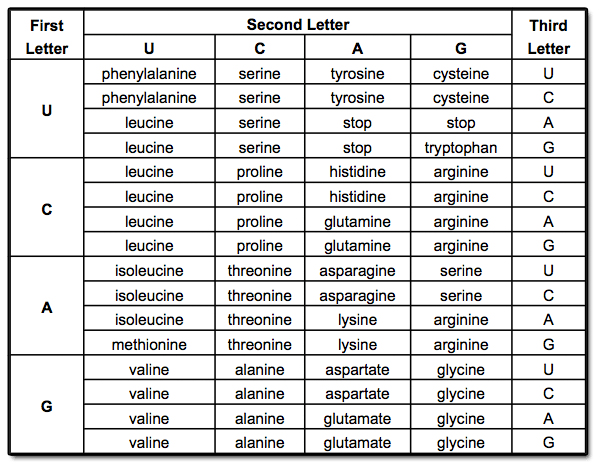
What amino acid is represented by the codon UUA?

a)

Phenylalanine

b)

Tyrosine

c)

Leucine

d)

Stop codon

23.

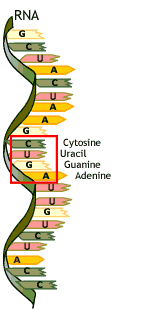
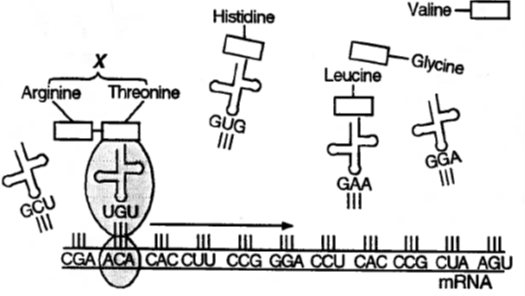
What process is going on in this photo?

a)

Transcription

b)

Translation

c)

Replication

d)

All the above

24.
Which is the mRNA molecule that would be transcribed from this DNA template:
TGGCAAGTACGT
a)
ACCGTTCATGCA
b)
UGGCAAGUACGU
c)
UCCGUUCUUGCU
d)
ACCGUUCAUGCA
25.

During replication where do the extra parts used to rebuild the DNA come from?

a)

The cytoplasm

b)

The ribosome

c)

The Golgi body

d)

The mitochondria

26.
Which of these bases is not present in RNA?
a)
Cytosine
b)
Thymine
c)
Adenine
d)
Guanine 
27.
Which of the following units are repeatedly joined together to form a strand of DNA?
a)
amino acids
b)
nucleotides
c)
fatty acids
d)
polysaccharides
28.
The sugar in DNA is ?
a)
sucrose
b)
glucose
c)
deoxyribose
d)
fructose
29.

What sugar is in RNA?

a)

deoxyribose

b)

ribose

c)

oxyribose

d)

deoxyose

30.
Any change in the DNA is called a/an
a)
mistake
b)
exon
c)
mutation
d)
intron
31.

A major difference between DNA and RNA is

a)

the fact that DNA is single stranded

b)

the shape of the two molecules, as RNA typically remains in a double helix

c)

uracil is found in place of adenine in RNA

d)

that DNA stays in the nucleus

e)

none of these are differences

32.

True or False. DNA is directly involved in translation

a)

True

b)

False

33.

The order of the bases in DNA is important so that it can

a)

code for the right amino acids

b)

bind with tRNA

c)

convert its thymines to uracils

d)

none of these

34.

True or False. mRNA transcribes DNA's code and brings it to a ribosome.

a)

True

b)

False

35.
What is the relationship between a protein, the cell, and DNA?
a)
DNA is produced by protein which is produced in the cell
b)
Protein is composed of DNA which is produced in the cell
c)
DNA controls the production of protein in the cell
d)
A cell is composed of DNA and protein
36.
Where does Translation take place?
a)
RNA
b)
ribosome
c)
nucleus
d)
chromosome
37.
DNA codes for...
a)
cholesterol
b)
proteins
c)
fatty acids
d)
a sandwich
38.

The main function of tRNA is to...

a)

carry a message that, when translated, forms proteins

b)

form a portion of ribosomes

c)

string together complementary RNA and DNA strands

d)

bring amino acids from the cytoplasm to the ribosomes

39.

Which component of DNA determines the traits of an organism?

a)

Nitrogen Bases

b)

deoxyribose sugar

c)

Hydrogen bonds

d)

phosphate

40.

What is the three base sequence of nitrogen bases that codes for a single amino acid?

a)

Anticodon

b)

Codon

c)

Protein

41.

What are the handrails (sides) of the DNA structure made up of?

a)

repeating phosphates and deoxyribose sugars

b)

nitrogen bases

c)

nucleotides

d)

adenine and thymine

42.
Translation is the process where
a)
mRNA is created in the Nucleus
b)
mRNA is decoded to form a protein 
c)
glucose molecules are made
d)
is where lipids are synthesised
43.

Does DNA have double or single strand?

a)

double

b)

single

44.

DNA is a

a)

amino acid

b)

protein

c)

nucleic acid

d)

carbohydrate

45.
Codes for a single protein
a)
DNA
b)
Gene
c)
Chromosome
d)
Chromatin
46.
DNA is...
a)
skin cells
b)
the size of a school bus
c)
the blueprint for our bodies
d)
how we're all held together
47.
What part of the cell cycle is the DNA in a cell's nucleus replication?
a)
Prophase
b)
Metaphase
c)
Interphase
d)
Telophase
48.

Where are genes found?

a)

On Chromosomes

b)

In the Cytoplasm

c)

In a Trait

d)

Outside of the Nucleus

49.

What do genes "code" for?

a)

Traits

b)

Physical Characteristics

c)

Hair Color, Skin Color, Eye Color

d)

Size of Nose, Shape of Nose, # of Fingers

e)

All of These are Correct

50.

What do genes code for?

a)

Lipids

b)

Protein

c)

Carbohydrates

d)

DNA

51.
When an extra base is inserted into the DNA sequence of a gene, the protein doesn't work. Which explains why?
a)
the base increases rate of translation
b)
the base causes DNA to be transcribed in opposite direction
c)
the inserted base causes the codons in the sequence to be incorrect for the desired protein
d)
the base signals enzymes to translate DNA rather than RNA
52.

What is the end result of DNA replication

a)

One DNA strand

b)

Two identical DNA strands

c)

Two new cells

d)

One new cell

53.

This is short for deoxyribonucleic acid

a)

NBC

b)

DNA

c)

CAT

d)

PAMS

54.

The organelle where proteins are made.

a)

nucleus

b)

mitochindria

c)

ER

d)

ribosomes

55.

_________RNA copies the coded message from the DNA and carries it into the cytoplasm.

a)

messenger

b)

transfer

56.

A chain of _______________ link together to form a protein.

a)

chromosomes

b)

amino acids

c)

nitrogen bases

d)

phosphates

57.

The order of the bases along a gene determines the order in which ____________ are put together to form a protein,

a)

DNA

b)

chromosomes

c)

amino acids

d)

ribosomes

58.
Which series is arranged in order from largest to smallest in size?
a)
chromosome, nucleus, cell, DNA, nucleotide
b)
cell, nucleus, chromosome, DNA, nucleotide
c)
nucleotide, chromosome, cell, DNA, nucleus
d)
cell, nucleotide, nucleus, DNA, chromosome
59.
DNA replication produces ___ molecules of DNA.
a)
2 Identifcal
b)
2 Different
c)
4 Identical
d)
4 Different
60.

How many codons are in the sequence AUG CCU UAG?

a)

1

b)

2

c)

3

d)

9

61.

Differentiate DNA from RNA.

a)

RNA is single stranded; DNA is double stranded

b)

RNA is found in nucleus; DNA is found everywhere in the cell

c)

DNA contains ribose; RNA contains Deoxyribose

d)

RNA's bases are A-T, G-C; DNA's bases are U-A, C-G

62.
Replicate the following strand of DNA: 
AATCATGGA
a)
AATCATGGA
b)
TTAGTACCT
c)
UUAGUACCU
d)
GGATAUCUA
63.
What is the product of translation?
a)
DNA
b)
mRNA
c)
tRNA
d)
proteins
64.

In RNA the base T is replaced with

a)

U

b)

G

c)

C

d)

A

65.

What is the order for Protein Synthesis?

a)

Transcription -> Translation -> Protein

b)

Translation - > Transcription -> Protein

c)

Protein -> Transcription -> Translation

d)

Translation -> Protein -> Transcription

66.

Genetic mutations can be. . .

a)

harmful only

b)

beneficial only

c)

neutral only

d)

beneficial, harmful, or neutral

67.

RNA is different from DNA because RNA _________

a)

Is single stranded

b)

has the nitrogen base uracil instead of thymine

c)

contains the sugar ribose

d)

All of the above