
Font size
S
M
L
XL
 Worksheets
Chemical Equations
Total questions: 91
Worksheet time: 1hrs 8mins
Name
Class
Date
1.
The substances listed on the right side of a chemical equation are the
a)
Yields
b)
Reactants
c)
Products
d)
Precipitates
2.
CaCO3 represents a chemical
a)
Symbol
b)
Formula
c)
Subscript
d)
Reaction
3.
The substances listed on the left side of a chemical equation are the
a)
Products
b)
Coefficients
c)
Precipitates
d)
Reactants
4.
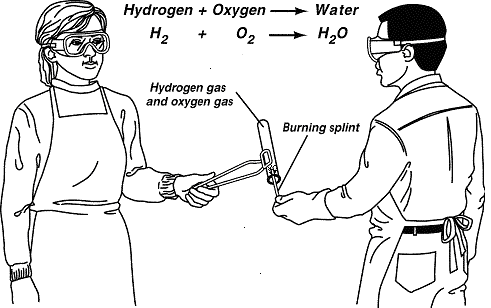
Identify the reactant(s) and product(s) of the reaction.
a)
All three are reactants and none are products.
b)
Hydrogen and water are the reactants, and oxygen is the product.
c)
Water and oxygen are the reactants, and hydrogen is the product.
d)
Hydrogen and oxygen are the reactants, and water is the product.
5.
A molecule is smaller than an atom.
a)
True
b)
False
6.
How many Oxygen (O) atoms are in 2C2HO8Cl2
a)
2
b)
16
c)
8
d)
5
7.
How many Hydrogen (H) atoms are in NH3O5
a)
3
b)
4
c)
5
d)
1
8.
A molecule is________
a)
a glob of gelatinous goo
b)
smaller than an atom
c)
filled with raisons
d)
more than one atom bonded together
9.
How many molecules of Carbon are in the following formula? 3C2H6
a)
3
b)
6
c)
12
d)
18
10.
How many elements are in C6H12O6?
a)
1
b)
2
c)
3
d)
4
11.
How many atoms of carbon (C) are in C6H12O6?
a)
3
b)
6
c)
12
d)
24
12.
How many Sodium (Na) are in 6NaCl?
a)
1
b)
12
c)
6
13.
How many Aluminum are in Al2O3?
a)
3
b)
2
c)
5
14.
How many O's are in Al₂(SO₄)₃
a)
4
b)
12
c)
7
d)
24
15.
How many Hydrogen are in 4H2O?
a)
6
b)
8
c)
2
d)
4
16.
Number of H in 3(NH₄)₂CrO₄
a)
4
b)
2
c)
8
d)
24
17.
Which coefficients balance this equation:
NH3 + O2 ----> NO + H2O
NH3 + O2 ----> NO + H2O
a)
2,3,5,6
b)
5,5,4,6
c)
4,6,4,5
d)
4,5,4,6
18.
How many Oxygen (O) atoms are in 2C2HO8Cl2
a)
2
b)
16
c)
8
d)
5
19.
How many Hydrogen (H) atoms are in NH3O5
a)
3
b)
4
c)
5
d)
1
20.
How many Sodium (Na) are in 6NaCl?
a)
1
b)
12
c)
6
21.
How many O's are in Al₂(SO₄)₃
a)
4
b)
12
c)
7
d)
24
22.

The red numbers in the image below represent ________
a)
subscripts
b)
coefficients
c)
I don't know, and don't want to try
d)
None of the answers are correct
23.

The blue numbers in the image below represent ________
a)
I don't know, and don't want to try
b)
coefficients
c)
subscripts
d)
none of the answers are correct
24.
What is a coefficient?
a)
The small number on the right of the chemical symbol.
b)
The large number to the left of a formula.
25.

Identify the Reactants in this equation.
a)
A
b)
B
26.
Element or compound?
H2O
H2O
a)
element
b)
compound
27.
Element or compound?
O2
O2
a)
Element
b)
Compound
28.
Which of the following is a compound?
a)
Co
b)
O2
c)
C
d)
CO2
29.
Which is the correct formula for:
three hydrogen (H)
one sulfur (S)
four oxygen (O)
three hydrogen (H)
one sulfur (S)
four oxygen (O)
a)
H3SO4
b)
HSO4
c)
H4S3O
d)
H2O
30.
Which is the correct formula for:
one carbon (C)
two oxygen (O)
one carbon (C)
two oxygen (O)
a)
CO2
b)
CO
c)
C2O
d)
2CO
31.
How many elements are in H2O?
a)
1
b)
2
c)
3
d)
4
32.
Which of the following is NOT an element?
a)
H2O
b)
H2
c)
O2
d)
Au
33.
How many atoms are there TOTAL in:
H2SO4
H2SO4
a)
6
b)
5
c)
7
d)
3
34.
The red numbers in the image below represent ________
a)
subscripts
b)
coefficients
c)
I don't know, and don't want to try
d)
None of the answers are correct
35.
In the equation, 2Mg + O2 ---> 2MgO, which are the reactants?
a)
Mg and O
b)
MgO
c)
Mg and MgO
d)
O and MgO
36.
Is the following equation balanced or unbalanced?
Fe + S --> FeS
Fe + S --> FeS
a)
balanced
b)
unbalanced
37.
How many Aluminum are in Al2O3?
a)
3
b)
2
c)
5
38.
Number of H in 3(NH₄)₂CrO₄
a)
4
b)
2
c)
8
d)
24
39.
How many Magnesium are in 10MgCl2?
a)
10
b)
5
c)
20
40.
The coefficient in 3H2O is
a)
6
b)
2
c)
3
d)
5
41.
A chemical reaction is balanced when
a)
both sides have the same elements
b)
Both sides have the same number of atoms
c)
Same subscripts
d)
Same coefficients
42.

The blue numbers in the image below represent ________
a)
I don't know, and don't want to try
b)
coefficients
c)
subscripts
d)
none of the answers are correct
43.
How many oxygen atoms are present in the following?
4Ca(OH)2
4Ca(OH)2
a)
4
b)
6
c)
8
d)
1
44.
How many E atoms are there in this silly formula?
2E2Fg3Hi4
2E2Fg3Hi4
a)
4
b)
2
c)
1
d)
3
45.
Which of the following can be broken apart in a chemical reaction?
a)
Noble gases
b)
Molecules and compounds
c)
only molecules
d)
only compounds
46.
A(n) ___ is a substance that is used up in a chemical reaction.
a)
reactant
b)
product
c)
subscript
d)
coefficient
47.
An equation that uses symbols to represent a chemical reaction is called a(n)
a)
chemical equation
b)
chemical reaction
c)
chemical symbol
d)
atomic mass
48.
Hydrogen and ___ react to produce water.
a)
oxygen
b)
hydroxide
c)
hydronium
d)
calcium
49.
Which are the reactants in the following equation: H2 + O2 => H2O?
a)
H2 and O2
b)
H2
c)
O2
d)
H2O
50.
What separates the reactants from the products in a chemical equation?
a)
plus sign
b)
subscripts
c)
coefficients
d)
arrow
51.
What symbol is used to signify that a reactant or product is a solid in a chemical equation?
a)
s
b)
l
c)
g
d)
aq
52.
What symbol is used to signify that a reactant or product is a liquid in a chemical equation?
a)
s
b)
l
c)
g
d)
aq
53.
What symbol is used to signify that a reactant or product is a gas in a chemical equation?
a)
s
b)
l
c)
g
d)
aq
54.
What symbol is used to signify that a reactant or product is dissolved in water in a chemical equation?
a)
s
b)
l
c)
g
d)
aq
55.
Gaseous hydrogen and gaseous oxygen react to produce gaseous water
a)
H2 (g) + O2 (g) => H2O (g)
b)
H (g) + O (g) => H2O (g)
c)
H (aq) + O (aq) => H2O (aq)
d)
H2 (l) + O2 (l) => H2O (l)
56.
In the following equation, what are the products?
HCl + Zn → H2 + ZnCl2
HCl + Zn → H2 + ZnCl2
a)
HCl + Zn
b)
H2 + ZnCl2
c)
Zn → H2
d)
the stuff on the outside
57.
Ammonia can be manufactured by the Haber process. In the Haber process, nitrogen combines with hydrogen to form ammonia.
xN2 + yH2 → zNH3
What is the value of x, y and z?
a)
x = 1, y = 1, z = 2
b)
x = 1, y = 3, z = 2
c)
x = 2, y = 1, z = 2
d)
x = 2, y = 3, z = 2
58.
Ice melting
a)
Chemical Change
b)
Physical Change
59.
Water freezing
a)
Chemical Change
b)
Physical Change
60.
Wood burned in a fireplace
a)
Chemical Change
b)
Physical Change
61.
Cake batter baked in an oven
a)
Chemical Change
b)
Physical Change
62.
Blue liquid and yellow liquid mixed to make a green liquid
a)
Chemical Change
b)
Physical Change
63.
Baking soda and vinegar combine to make carbon dioxide
a)
Chemical Change
b)
Physical Change
64.
Light used to produce food in plants
a)
Chemical Change
b)
Physical Change
65.
Glass bottle that is shattered
a)
Chemical Change
b)
Physical Change
66.
Copper roof changing color
a)
Chemical Change
b)
Physical Change
67.
Copper roof changing color
a)
Chemical Change
b)
Physical Change
68.
Burning coal
a)
Chemical Change
b)
Physical Change
69.
Boiling water
a)
Chemical Change
b)
Physical Change
70.
Which of the following is a physical change?
a)
Dissolving
b)
Rapid release of heat
c)
Fizzing (release of gas)
d)
Rusting
71.
Which of the following is a chemical change
a)
Evaporating
b)
Bending
c)
Melting
d)
Bleaching of pigments
72.
What happens to temperature as water freezes?
a)
The temperature increases
b)
The temperature decreases
c)
The temperature stays the same
73.
Solubility (dissolves): Chemical or Physical Property
a)
Chemical Property
b)
Physical Property
74.
Flammability (burns): Chemical or Physical Property
a)
Chemical Property
b)
Physical Property
75.
Density: Chemical or Physical Property
a)
Chemical Property
b)
Physical Property
76.
Reacts with Water: Chemical or Physical Property
a)
Chemical Property
b)
Physical Property
77.
Hardness: Chemical or Physical Property
a)
Chemical Property
b)
Physical Property
78.
Odor: Chemical or Physical Property
a)
Chemical Property
b)
Physical Property
79.
Reacts with Air: Chemical or Physical Property
a)
Chemical Property
b)
Physical Property
80.
The coefficient in 3H2O is
a)
6
b)
2
c)
3
d)
5
81.
LiBr is called
a)
lithium bromine
b)
lithium (I) bromine
c)
lithium bromide
d)
lithuim (I) bromide
82.
Name the following ionic compound: MgSO4
a)
magnesium sulfoxide
b)
magnesium sulfide
c)
magnesium sulfate
d)
magnesium oxide
83.
Given the equation:
2Na + S --> Na2S
Name the reactant(s).
2Na + S --> Na2S
Name the reactant(s).
a)
Na only
b)
S only
c)
Na2S only
d)
Na and S
84.
Given the equation:
2Na + S --> Na2S
Name the product(s).
2Na + S --> Na2S
Name the product(s).
a)
Na only
b)
S only
c)
Na2S only
d)
Na and S
85.
Given the equation:
2Na + S --> Na2S
What is the subscript for Na?
2Na + S --> Na2S
What is the subscript for Na?
a)
1
b)
2
c)
3
d)
0
86.
what is the definition of chemical change?
a)
any change that results in the formation of new chemical substances.
b)
changing clothes
c)
matter cannot be created or destroyed, only change form
d)
changes affecting the form of a chemical substance, but not its chemical composition.
87.
what is the definition of physical change?
a)
any change that results in the formation of new chemical substances.
b)
rusting
c)
changes affecting the form of a chemical substance, but not its chemical composition.
d)
any property that is measurable, whose value describes a state of a physical system
88.
what is digestion?
a)
body function
b)
chemical change
c)
physical change
89.

Exploding Fireworks?
a)
Physical Change
b)
Chemical Change
90.

Melting a chocolate bar?
a)
Physical Change
b)
Chemical Change
91.

Rotting bananas?
a)
Physical Change
b)
Chemical Change
Reset

