wayground logo

Free Printable Worksheets

Font size

S
M
L
XL
Worksheets

Test 1 Review (1/24/19)

Total questions: 119

Worksheet time: 2hrs 8mins

Name
Class
Date
1.
Which of the following is a term for a group of similar organisms that can reproduce fertile offspring?
a)
individual
b)
population
c)
species
d)
fossil
2.
Which of the following is a fossil?
a)
a plant that has recently died
b)
a group of organisms that can reproduce
c)
a structure or organ that no longer functions
d)
a trace of an organisms that existed in the past
3.
The difference in the physical traits of an individual from those of other individuals in a group is called a(n)
a)
change
b)
adaption
c)
species
d)
variation
4.
what did Charles Darwin observe in finch populations of the Galapagos Islands off the coast of South America?
a)
different species on different islands
b)
all species on one of the islands
c)
identical species on all the islands
d)
the same species as North America
5.
In natural selection, the selective agent is the
a)
humans
b)
mutations
c)
breeders
d)
environment
6.
All rabbits living in a particular area would be an example of a(n)
a)
population
b)
species
c)
fossil
d)
individual organism
7.
a bird that can easily outcompete other birds for food and that can produce many eggs has a high
a)
life expectancy
b)
mutation rate
c)
fitness
d)
adaptability
8.

Which of the following describes natural selection?

a)

it acts on genetic material directly

b)

it acts on existing physical traits

c)

it forms new traits

d)

it forms new genetic material

9.
which of the folllowing is an exammple of a vestigial structure?
a)
the wings of a red-tailed hawk
b)
the hind limbs of a house cat
c)
the fins of sharks
d)
the wings of an ostrich
10.

What is suggested by the anatomical similarity of different species of vertebrates?

a)

no evolutionary relationships between the groups

b)

recent common ancestry

c)

similar environments in the past

d)

evolution from a distant common ancestor

11.
Some organisms that share a common ancestor have features that have different functions, but similar structures.  These are known as
a)
vestigial structures
b)
analogous structures
c)
homologous structures
d)
fossil structures
12.
Two organisms that are closely related would have
a)
very similar DNA sequence
b)
exactly the same DNA sequences
c)
no proteins in common
d)
completely different DNA sequence
13.
protein sequences in one organism that resemble those of another suggest a 
a)
coincidence
b)
lack of evolutionary relationship
c)
great number of mutations
d)
shared ancestry
14.
a measure of how commonly a particular allele occurs in a population is known as the 
a)
gene pool
b)
allele frequency
c)
mutation rate
d)
phenotype
15.

The more genetic variation a population has,

the more likely it is for some individuals to

a)

evolve

b)

migrate

c)

survive

d)

mutate

16.
Genetic variation can arise from a random change in the DNA of a gene.  The change is called a(n)
a)
mutation
b)
gene flow
c)
gene pool
d)
allele
17.
What increases genetic variation when animals move  from one population to another
a)
genetic drift
b)
sexual selection
c)
bottleneck effect
d)
gene flow
18.
Mutations are important because they bring about
a)
death of the organism in which they develop
b)
genetic variation needed for a population to evolve
c)
benefits for the individual, not for the population
d)
Hardey-Weinberg equilibrium within a population
19.
asexual reproduction produces offspring with
a)
half of a single parent's genes
b)
the same genes as the parent
c)
a mix of genes from two parents
d)
lots of genetic variation
20.

What is the term for a feature that allows an organism to survive better in its environemtn?

a)

variation

b)

adaptation

c)

homologous structure

d)

vestigial structure

21.
the hind leg bones in a whale are examples of
a)
homologous structures
b)
analogous structures
c)
fossils
d)
vestigals
22.
What is the process in which humans breed organisms for certain traits?
a)
natural selection
b)
inheritance
c)
artificial selection
d)
descent withOUT modification
23.

The combined alleles of all individuals in a population is called the population's

a)

phenothype

b)

gene pool

c)

mutation rate

d)

allele frequency

24.

Natural selection could not occur without

a)

geographic isolation

b)

variation in the population

c)

stable environments

d)

competition for unlimited resources

25.
What is the main cause of genetic variation that occurs in all organisms?
a)
Mutation
b)
Recombination
c)
Environment
d)
Transcription
26.
Which of the following is true about individuals who survive in a changing environment?
a)
They live longer than those less suited to the environment
b)
They reproduce more rapidly than those less suited to the environment
c)
They are smaller and need less food that those less suited to the environment
d)
They reproduce more successfully than those less suited to the environment
27.
When a population is very small, genetic changes happen very quickly. This is known as ____________.
a)
Extinction
b)
Genetic Drift
c)
Speciation
d)
Isolation
28.
Fossil evidence tells us that ___________.
a)
The number of species alive today is a very small number compared to the total number of species that has lived
b)
Carbon dioxide using plants were among the first organisms on Earth
c)
Plant cells, animal cells, bacterial cells, and viruses all have the same nucleic acid
d)
There are more species alive today than in the Earth’s past
29.
When two populations of an organism do not interact and reproduce with one another, after a long period of time _______________ will occur.
a)
Mutation
b)
Extinction
c)
Speciation
d)
Death
30.
The image illustrates what evolutionary concept?
a)
Embryological similarities
b)
Variation among species
c)
Vestigial structures
d)
Homologous structures
31.
A structure that seems to serve no purpose in an organism is called:
a)
Homologous
b)
Vestigial
c)
Dichotomous
d)
Fossilized
32.
Through careful observation, Charles Darwin came to understand that:
a)
Populations of plants and animals in nature most often consist of individuals that are clones of each other
b)
Those individuals whose variation gives them an advantage in staying alive long enough to reproduce are more likely to pass their traits on to the next generation
c)
Populations of a species that become isolated from others by adapting to different environmental niches quickly become extinct
d)
All of the above
33.
In a population of woolybeasts, individuals with long snouts tend to survive better on an island that has burrowing termites. Over time, the woolybeast population consists of individuals with extremely long snouts. This is an example of:
a)
Stabilizing selection
b)
Disruptive selection
c)
Direction selection
d)
Allopatric specation
34.
Cheetahs nearly became extinct but recovery efforts managed to save them. Now, most cheetahs are genetically identical. This is due to:
a)
Gene flow
b)
The Bottleneck Effect
c)
Selective mating
d)
Random mating
35.
Female guppies tend to choose brightly colored mates. Over time, the population of guppies becomes more colorful. This is an example of:
a)
Kin Selection
b)
Natural selection
c)
Gamete compatibility
d)
Sexual selection
36.
Charles Darwin came up with this theory 
a)
Natural Selection
b)
Mutation
37.
Darwin wrote that organisms with traits that are best suited to the environment will ________________
a)
increase in number
b)
become extinct
38.
Which of the following is NOT an example of natural selection? 
a)
People selectively breeding hamsters.
b)
Insect populations developing resistance to certain pesticides.
c)
Bacteria becoming resistant to antibiotics.
d)
Male birds of certain species developing colorful feathers to attract female mates.
39.
What characteristic did Darwin observe about the finches on the Galapagos Islands?
a)
Their feathers 
b)
Genotypes 
c)
Their beaks
d)
Their body sizes
40.
Which term refers to the process by which individuals that are better suited to the environment survive and reproduce therefore passing down their genes to their offspring? 
a)
Evolution 
b)
Variation 
c)
Adaptation
d)
Natural Selection 
41.
When an organism completely dies out, it is called.....
a)
Adaption
b)
Extinction
c)
Fossilization
d)
Mutation
42.
Change over time...
a)
Evolution
b)
Nucleotide 
43.
Remains of ancient organisms are called
a)
Extinctions
b)
Fossils
c)
Mutations
d)
Variations
44.
The evidence suggests that the first organism was:
a)
Eukaryotic
b)
Prokaryotic
c)
An animal
d)
A plant
45.
Which of the following conditions are necessary for natural selection to occur?
a)
overproduction of offspring
b)
variation within a population
c)
struggle for existence
d)
all of the above
46.
Which of the following are examples of common descent involving molecular biology?
a)
homologous structures
b)
fossils
c)
analogous proteins
d)
universal genetic code in DNA
47.
How would you describe this evolution?
a)
Homologous structure
b)
Analogous structure
c)
Structural adaption
d)
Functional adaption
48.
Which of the following explains how natural selection causes a trait to become predominant in a population?
a)
Individuals with traits that are favorable to the environment reproduce more.
b)
Traits of an individual change in order to adapt to changes in enviornment.
c)
organisms select which traits they wish to inherit
d)
all of these answers
49.
The Table below shows the # of differences in amino acids in a protein called “Cytochrome C” when comparing humans to other organisms. The protein is used by many plants and animals to convert energy in cells.
List the 4 closest human relatives based on this biochemical comparison.
a)
chimpanzee, horse, rattlesnake, snapping turtle
b)
chimpanzee, gorilla, rhesus monkey, horse
c)
fruit fly, bread mold, tuna fish, snapping turtle
d)
gorilla, rhesus monkey, rattlesnake, gorilla
50.
The white feathers of a snowy owl allow it to blend in with its environment during the winter months (snow). This is an example of ________________
a)
Species
b)
Environmental Change
c)
Adaptation
d)
Variation
51.
A graph regarding the effect of agricultural bioengineering on insect pests is shown below How has natural selection affected species of insect pests?
a)
A.  Natural selection has not affected the number of species that are resistant to pesticides
b)
A.  Natural selection has rapidly increased the number of species that are resistant to pesticides
c)
A.  Natural selection has only affected the number of species that are resistant to pesticides
52.
Mutations are a change in what?
a)
DNA
b)
tRNA
c)
genotype
d)
phenotype
53.
Natural selection is the process by which
a)
change occurs in the genetic characteristics of individuals that live together in an environment from one generation to another
b)
organisms with traits well-suited to their environment reproduce at a greater rate than less well-adapted organisms in the same environment
c)
use and disuse of a characteristic leads to evolutionary change
d)
baseball players pass on the trait for strong arm muscles to children
54.
Which of the following organisms are LEAST closely related?
a)
organisms that share a domain
b)
organisms that share a family 
c)
organisms that share a genus 
d)
organisms that share a species 
55.
The scientific name for an organism is made from the:
a)
class and family name
b)
genus and species name
c)
domain and kingdom name
d)
kingdom and phylum name
56.
The 8 levels of classification, most broad to most specific.
a)
Domain, Genus, Family, Order, Class, Phylum, Kingdom, Species
b)
Domain, Species, Kingdom, Genus, Phylum, Family, Class, Order
c)
Domain, Kingdom, Phylum, Class, Order, Family, Genus, Species
d)
Order, Kingdom, Species, Domain, Phylum, Family, Class, Genus
57.
Term given to describe the 2 name naming system is:
a)
dichotmous key
b)
binomial nomenclature
c)
2 scientific names
d)
binomial key
58.
Cells that do not have a true nucleus are called....
a)
eukaryote
b)
prokaryote
c)
unicellular
d)
multicellular
59.
Cells that have a true nucleus are called....
a)
eukaryotes
b)
prokaryotes
c)
unicellular
d)
multicellular
60.
An organisms scientific name is made of (in order) ...
a)
species, class
b)
genus, kingdom
c)
genus, species
d)
species
61.
Which 2 organisms have the fewest characteristics in common?
a)
2 organisms in the same kingdom
b)
2 organisms in the same genus
c)
2 organisms in the same species
d)
2 organisms in the same family
62.
Besides the species name, what other category is used for the scientific name?
a)
Phylum
b)
Class
c)
Order
d)
Genus
63.
Fill-in-the-blank:
Domain--Kingdom--Phylum--____________
a)
Order
b)
Family
c)
Class
d)
Species
64.
Which organisms are closely related? 
a)
American badger and leopard
b)
coyote and gray wolf
c)
european otter and leopard
d)
coyote and american badger
65.
Mosquito  belongs to what kingdom?
a)
Animal Kingdom
b)
Plant Kingdom
c)
Fungi Kingdom
d)
Protista Kingdom
66.
Dandelion, What kingdom does it belongs to?
a)
Plant Kingdom
b)
Animal Kingdom
c)
Fungi Kingdom
d)
Protista Kingdom
67.
Organisms in this smallest taxonomic group share many characteristics.
a)
domain
b)
kingdom
c)
species
d)
class
68.
Which organisms are most closely related?
a)
Equus caballas (Horse) & Equus burchellii (Zebra)
b)
Cyanea artica (Jellyfish) &
Ctenodiscus crispatus (Mud Starfish)
c)
Naja naja (cobra) & Glycine max (soya bean)
d)
Ophiocomina nigra (black brittle star) & Brassica nigra (black mustard)
69.
The science of describing, classifying, and naming living things is called:
a)
Geology
b)
Biology
c)
Taxonomy
d)
Chemistry
70.
Prokaryotes do not have a nucleus or membrane bound organelles.
a)
True
b)
False
71.
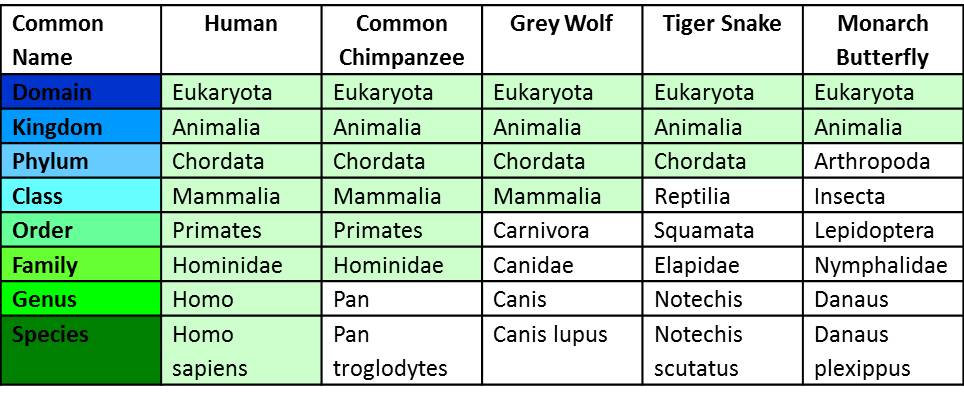
Which organism in the table is least closely related to the chimpanzee?
a)
human
b)
grey wolf
c)
tiger snake
d)
monarch butterfly
72.
Which organism in the table shown is most closely related to the common dolphin?
a)
human
b)
killer whale
c)
giant kelp
d)
bat star
73.

Which 2 organisms would be able to reproduce and produce fertile offspring?

a)

2 organisms in the same class

b)

2 organisms in the same family

c)

2 organisms in the same genus

d)

2 organisms in the same species

74.
Which domain includes all animals and plants?
a)
Archaea
b)
Eukarya
c)
Bacteria
75.
What is the genus name here:
Canis lupus
a)
Canis
b)
lupus
76.
Which taxon is broader (more organisms included)?
a)
Phylum
b)
Family
c)
Order
d)
Class
77.
Hermit crab is a scientific name.
a)
TRUE
b)
FALSE
78.
The grouping, Genus is just before the most specific category.
a)
TRUE
b)
FALSE
79.
What are humans?
a)
Prokaryote 
b)
Eukaryote 
80.
What do viruses need to reproduce?
a)
they need genetic material
b)
They need a host cell
c)
They need  bacteria
d)
They need insulin
81.
How does a virus cause a person to develop the common cold?
a)
invades the host cell to reproduce
b)
removes energy from the host cell
c)
produces toxins in the host cell
d)
protects the host cell from bacteria
82.
A virus can be classified by its type of
a)
mitochondria
b)
chromosomes
c)
nucleic acid
d)
carbohydrates
83.
True or False
The flu is caused by a virus.
a)
true
b)
false
84.
Antibiotics kill viruses
a)
True
b)
False
85.
What part of a virus is the protein capsule that houses the genetic material (DNA/RNA)?
a)
tail
b)
nucleus
c)
capsid
d)
glycoprotein
86.
Which of these is a plant virus?
a)
tobacco mosaic virus
b)
bacteriophage
c)
influenza
d)
polio
87.

Which of the following supports the argument that viruses are nonliving?

a)

Their DNA does not encode proteins

b)

They have RNA rather than DNA

c)

They are not cellular

d)

They do not evolve

88.

Viruses _____.

a)

use the host cell to copy themselves and then viruses to synthesize their own proteins

b)

metabolize food to produce their own ATP

c)

use the host cell to copy themselves and make viral proteins

d)

manufacture their own ATP, proteins, and nucleic acids

89.

Which of the following can be effective in preventing the onset of viral infection in humans?

a)

taking antibiotics

b)

taking vitamins

c)

taking drugs that inhibit transcription

d)

getting vaccinated

90.

Most new viral diseases arise as a result of

a)

genetic engineering mistkaes

b)

humans coming in contact with isolated habitats

c)

mutation of existing viruses

d)

the overuse of antibiotics

91.
Viruses are...
a)
prokaryotic
b)
eukaryotic
c)
non-living
d)
endospores
92.
Viruses...
a)
use a host to reproduce
b)
breath oxygen
c)
grow
d)
eat food
93.
Bacteria reproduce by
a)
mitosis
b)
meiosis
c)
binary fission
d)
photosynthesis
94.
Archeabacteria...
a)
are eukaryotic
b)
live in extreme environments
c)
are non-living
d)
live in the soil
95.
Which of the following is not a bacterial shape?
a)
bacilli
b)
spirilla
c)
spacecraft
d)
cocci
96.
Spherical shaped bacteria are called...
a)
cocci
b)
bacilli
c)
spirilla
d)
rod
97.
Bacteria are used to make which of the following foods?
a)
yogurt
b)
bread
c)
pickles
d)
all of these are correct
98.
Prokaryotes are unlike all other organisms in that their cells 
a)
do not have a nucleus
b)
have organelles
c)
have cell walls
99.
Name the three cell shapes of prokaryotes
a)
rod, circle spiral
b)
cocci, bacilli, spirilli
c)
crystal, tube, spaghetti
100.
Name this bacteria shape
a)
coccus
b)
spirillum
c)
bacillus
101.
Name this bacteria shape
a)
bacillus
b)
coccus
c)
spirillum
102.
Name this bacteria shape
a)
coccus
b)
bacillus
c)
spirillum
103.
True or False: Some types of bacteria eat and clean up oil spills
a)
True
b)
False
104.
All bacteria are harmful to humans
a)
True
b)
False
105.
Bacteria are unicellular
a)
True
b)
False
106.
The term "antibiotic resistance" refers to bacteria that 
a)
are resistant to a vaccine.
b)
evolve to survive in the presence of an antibiotic.
c)
are weakened and destroyed by antibiotics.
d)
are dead or altered.
107.
In asexual reproduction the offspring look ________ as their parent.
a)
identical
b)
different
c)
the opposite
d)
as happy
108.

Hydrogenovibrio crunogenus is a chemoautotroph. How does this bacteria obtain nutrition?

a)

from sunlight

b)

from inorganic molecules

c)

from ingesting nutrients

d)

from decomposing matter

109.
 A cell that contains a nucleus is
a)
prokaryote
b)
eukaryote
110.
Bacteria exchange genetic information during 
a)
asexual reproduction
b)
binary fission
c)
conjugation
d)
photosynthesis
111.
The bacteria seen in the picture is
a)
bacillus
b)
coccus
c)
spirilla
112.
Photoheterotrophs will use 
a)
oxygen or carbon dioxide for energy
b)
nitrogen or peptidoglycan for energy
c)
Organic compounds or light
d)
Chemicals or light
113.
The bacteria seen in the picture is
a)
cocci
b)
bacillus
c)
spirilla
114.
The bacteria seen in the picture is
a)
bacillus
b)
cocci
c)
spirilla
115.
A prokaryote will contain a cell membrane
a)
False
b)
True
116.
Cyanobacteria are
a)
eubacterial heterotrophs
b)
photosynthetic autotrophs
c)
self-loving archaebacteria
d)
chemosynthetic autotrops
117.
Which of the structures is NOT found in bacteria?
a)
ribosome
b)
cell membrane
c)
cytoplasm
d)
nuclear membrane
118.

The part of the bacteria cell labeled "E" which helps the bacteria move is called a

a)

Pilus

b)

DNA/Chromosome

c)

Ribosome

d)

Flagella

119.
Bacteria obtain food by being
a)
autotrophs
b)
heterotrophs
c)
both autotrophs or heterotrophs
d)
photosynthesis and chemosynthesis