wayground logo

Free Printable Worksheets

Font size

S
M
L
XL
Worksheets

Biology - Unit 2 Exam Revision

Total questions: 118

Worksheet time: 2hrs 9mins

Name
Class
Date
1.
The cell spends most of it's life in ________________.
a)
mitosis
b)
cytokinesis
c)
Interphase
d)
None of the above
2.
Before cells can divide, what must be copied?
a)
mitochondria
b)
cytoplasm
c)
DNA
d)
Cell Wall
3.
In the S stage of interphase_______________
a)
the cell grows
b)
the nucleus divides
c)
the cell membrane divides
d)
the DNA is replicated
4.
When an animal cell goes through cytokinesis,__________
a)
a cell plate forms dividing the 2 new nuclei.
b)
the cell membrane pinches off the 2 new cells.
c)
4 new cells are formed.
d)
None of the above
5.
The stages of mitosis in order
a)
Metaphase, Anaphase, Prophase, Telophase
b)
Prophase, Anaphase, Metaphase, Telophase
c)
Prophase, Metaphase, Anaphase, Telophase
d)
Anaphase, Prophase, Telophase, Metaphase
6.
Interphase contains three stages, including the G1 and G2 stages.  Which of the following occurs during these gap stages? 
a)
separation of chromosomes
b)
cellular growth 
c)
DNA replication
d)
viral transformation 
7.
During which part of the cell cycle is DNA copied?
a)
Mitosis
b)
Cytokinesis
c)
S phase
8.
During which parts of the cell cycle does the cell grow?
a)
G1 and G2
b)
G1 and S
c)
M phase and cytokinesis
9.
What is the purpose of the cell cycle?
a)
To create new daughter cells
b)
To prevent cancer from developing
c)
To help the body fight viruses and bacteria
10.

Uncontrolled cell division which usually leads to tumors and disease is called:

a)

Metaphase

b)

Cytokinesis

c)

Cancer

d)

Diabetes

11.
Why would it be important to replicate DNA before a cell divides in mitosis or meiosis?
a)
In order for genetic information to be transferred into daughter cells.
b)
In order for the cell to be able to increase in size.
c)
In order for the DNA to be contained in the nucleus.
d)
In order for the cell to re-order the DNA sequencing in the new cells.
12.
Put the following actions in order: DNA replicates, cell grows, cell divides, cell prepares for mitosis. 
a)
DNA replicates, cell grows, cell prepares for mitosis, cell divides
b)
cell grows, cell prepares for mitosis, DNA replicates, cell divides
c)
cell grows, DNA replicates, cell prepares for mitosis, cell divides
d)
DNA replicates, cell prepares for mitosis, cell grows, cell divides
13.

Radiation is often used for cancer therapy because it can trigger __________________.

a)

the immune system

b)

apoptosis

c)

cells to skip the cell cycle

d)

further cell mutation

14.
At the end of the G1 phase, there's a checkpoint. What is this checkpoint probably checking for?
a)
To see if the cell has grown enough
b)
To see if the DNA was correctly replicated
c)
To make sure the cell does not have cancer
d)
To make sure that the enzymes aren't amalyzed
15.
Neuron cells, like the one pictured, rarely replicate. Therefore, we consider them to be in the _____ phase.
a)
G0
b)
G1
c)
S
d)
Delay
16.

Which molecules act as gatekeepers for each checkpoint of the cell cycle?

a)

p53 gene

b)

cyclins and cycline-dependent kinases

c)

thyroid hormones

17.

What is the purpose the the cell cycle checkpoints?

a)

To repair damaged cells before they enter cell division.

b)

To remove damaged cells from an organism.

18.

How many cell cycle checkpoints are there?

a)

1

b)

2

c)

3

d)

4

19.

What is the first checkpoint of the cell cycle?

a)

Mitosis checkpoint

b)

G1 checkpoint

c)

G2 checkpoint

20.

When is apoptosis initiated?

a)

When DNA damage is repaired.

b)

When cells are removed from the cell cycle.

c)

When DNA damage cannot be repaired.

21.
Uncontrolled cell division is stopped by...
a)
tumor suppressor genes
b)
oncogenes
22.
Which is an example of a tumor suppressor gene?
a)
apoptosis
b)
proto-oncogenes
c)
p53
d)
oncogenes
23.
This is the cell cycle checkpoint that makes sure environmental conditions are ideal for cell survival.
a)
G1 Checkpoint
b)
G2 Checkpoint
c)
M Checkpoint
d)
I Checkpoint
24.
This is the cell cycle checkpoint that makes sure DNA has been replicated correctly during S phase.
a)
G1 Checkpoint
b)
G2 Checkpoint
c)
M Checkpoint
d)
I Checkpoint
25.
This is the cell cycle checkpoint that makes sure the correct number of chromosomes are present and attached to microtubules.
a)
G1 Checkpoint
b)
G2 Checkpoint
c)
M Checkpoint
d)
I Checkpoint
26.

Name the 3 checkpoints of the cell cycle

a)

Anaphase checkpoint, mitosis/metaphase checkpoint, and telophase checkpoint

b)

Interphase checkpoint, S phase checkpoint, and M phase checkpoint

c)

G1 checkpoint, G2 checkpoint, and S phase checkpoint

d)

G1 checkpoint, G2 checkpoint, and mitosis/metaphase checkpoint

27.

Some advantages of sexual reproduction include: (select all that apply)

a)

genetic variation

b)

improves chances of adapting to the environment

c)

helps species survive catastrophes

d)

it doesn't take as much energy as asexual reproduction

28.

What are some disadvantages to sexual reproduction? (select all that apply)

a)

it takes a lot of energy to find a mate

b)

you don't need another mate

c)

it requires a male and a female

d)

more genetic errors can occur

29.

Male and female reproductive cells are collectively known as:

a)

spores

b)

pollen

c)

gametes

d)

offspring

30.

____________________ occurs when a male gamete (sperm) combines with a female gamete (egg).

a)

sporulation

b)

fertilization

c)

fission

d)

regeneration

31.

How many parents are required for sexual reproduction?

a)

0

b)

1

c)

2

d)

3

32.
Sexual reproduction requires _____ parents and asexual reproduction requires ___ parents
a)
1,1
b)
2,2
c)
2,1
d)
1,2 
33.
If an environment suddenly changes, which type of reproduction would be most beneficial? Why?
a)
Asexual, because asexual organisms always have variation within species.
b)
Sexual, because sexual organisms have variation within species.
c)
Both Asexual and Sexual reproduction would be beneficial, because they both have variation within species.
d)
Asexual, because asexual organisms have no variation, so they can adapt to a changing environment.
34.
Which of the following describes the main advantages of sexual reproduction
a)
requires lots of time/energy
b)
no new gene combos can arise 
c)
diversity
d)
looks identical to the parent
35.
What causes genetic variation in meiosis?
a)
chromosomes lining up
b)
crossing over of chromosomes
c)
separation of chromosomes
d)
chromosomes pulling apart
36.
What kind of cells are made in MEIOSIS?
a)
Haploid cells
b)
Diploid Cells
c)
Skin Cells
d)
Liver Cells
37.
Diploid Cells are represented by
a)
2n
b)
n
c)
4n
d)
1/2 n
38.
If the Diploid number of Carrots is 18, the haploid number is
a)
18
b)
9
c)
27
d)
36
39.
The process of crossing over occurs in what phase of meiosis?
a)
anaphase 1
b)
prophase 1
c)
prophase 2
d)
telophase 1
40.
The chromosomes that pair up during meiosis, are called __________ chromosomes.  
a)
homozygous 
b)
asexual
c)
homologous
d)
genes
41.
Crossing over creates
a)
male genotype
b)
genetic variation (differences)
c)
DNA replication
d)
mitosis
42.
Which of the following represents chromosome # during fertilization?
a)
n+n=2n
b)
n=n
c)
2n=n+n
d)
2n=2n
43.
Meiosis makes sperm and egg cells. In humans, sperm and egg cells each have _____ chromosomes. Therefore a fertilized human egg cell (sperm and egg cell combined) would create a cell with _____ chromosomes.
a)
23, 46
b)
46, 23
c)
2, 4
d)
50, 100
44.
How many daughter cells does Meiosis create?
a)
2
b)
4
c)
8
d)
1
45.
In meiosis, Prophase 1 is when chromosomes...
a)
cross over
b)
mutate
c)
hybridize
d)
fertilize
46.
Which statement best describes the process of asexual reproduction?
a)
new organisms are usually genetically identical to the parent
b)
the reproductive cycle involves the production of games
c)
nuclei of sex cells fuse to form a zygote
d)
it involves the production of genetic copies 
47.
A hydra reproduces when an outgrowth, or bud, forms and continues to develop until if falls off of the parent. This is an example of:
a)
Binary Fission
b)
Sporulation
c)
Budding
d)
Vegetative Propagation
48.
a)
budding
b)
binary fission
c)
sporulation
d)
regeneration
49.
What are some of the facts about asexual reproduction?
a)
Takes only one mate to reproduce and takes a longer time to reproduce
b)
Takes a shorter amount of time to reproduce and it takes two mates to reproduce
c)
Reproduces diverse offspring and takes a longer time to reproduce
d)
Takes only one mate to reproduce and takes a shorter time to reproduce
50.
Prokaryotes reproduce asexually through -
a)
Spore formation
b)
Vegetative propagation
c)
Binary fission
51.
Which type of asexual reproduction is taking place?
A planarian is a non-parasitic flatworm.  If a planarian was injured by a predator, it could re-grow its body parts.  If the body parts were not eaten by the predator, the part could re-grow into a whole new planarian as well.
a)
Budding
b)
Fission
c)
Vegetative propagation
d)
Regeneration
52.
Provided is a table of organisms and some data on their characteristics. Based on the information in the table, which organism is likely to produce offspring with the greatest genetic diversity?
a)
Black mold
b)
Bell tree dahlia
c)
Spruce
d)
Hydra
53.

___________________ is a type of asexual reproduction in which a piece of a parent organism breaks off to form an new organism (ex. starfish).

a)

fission

b)

budding

c)

fragmentation

d)

fertiliztion

54.

What are some advantages of asexual reproduction are: (select all that apply)

a)

it only requires one organism

b)

it takes less energy than sexual reproduction

c)

offspring are already well-adapted for the environment

d)

there is a lot of genetic variety

55.

What is this phase of Mitosis?

a)

Prophase

b)

Metaphase

c)

Anaphase

d)

Telophase

56.

What is this phase of Mitosis?

a)

Prophase

b)

Metaphase

c)

Anaphase

d)

Telophase

57.

Meiosis is the _____.

a)

division of sex cells

b)

division of body cells

58.
Identify the stage of mitosis.
a)
interphase
b)
prophase
c)
anaphase
d)
cytokinesis
59.
Identify the stage of mitosis. 
a)
interphase
b)
prophase
c)
anaphase
d)
cytokinesis
60.
How many chromosomes do humans have?
a)
46
b)
21
c)
10
61.
Structure A refers to the _____.
a)
chromatid
b)
chromosome
c)
centromere
62.

Which of the following is metaphase?

a)
b)
c)
d)
63.

In the diagram below, which part of the diagram represents the asexual reproduction part of the cycle?

a)

a

b)

b

64.

What type of asexual reproduction shown in figure?

a)

regeneration

b)

parthenogenesis

c)

sexual

d)

lay egg

65.

Strawberry plants produce offspring by sending out specialized stems. This is an example of...

a)

runners.

b)

tubers.

c)

fragmentation.

d)

budding.

66.
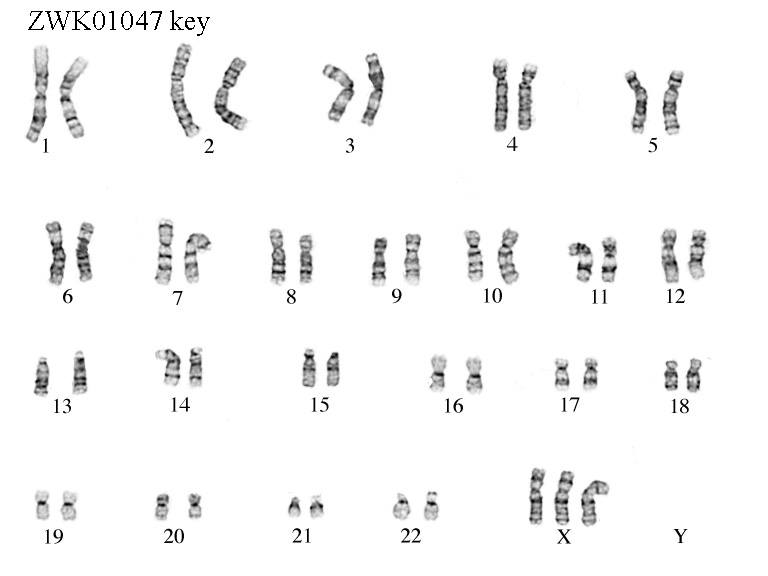
What is the haploid number for this Karyotype?
a)
26
b)
27
c)
52
d)
54
67.

Based on the karyotype, can you guess the name of this genetic disorder?

a)

Curvy 3

b)

Jacob's syndrome

c)

Triple X

d)

Superwoman syndrome

68.

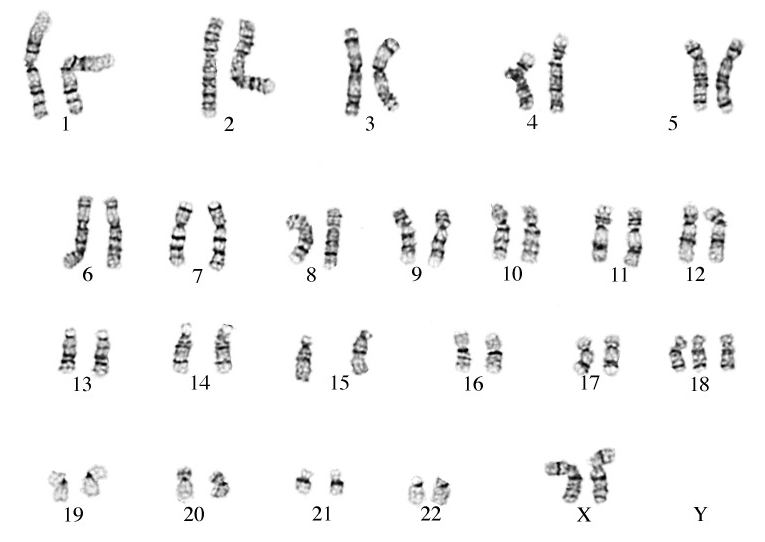
This is known as Edwards Syndrome, can you identify the chromosomal mutation?

a)

Chromosomes 1 and 2 are bent

b)

There is no Y chromosome

c)

This persons chromosomes are normal

d)

There are 3 of chromosomes 18

69.

What is non-disjunction?

a)

Unable to form cells

b)

Unable to form chromosomes

c)

Unable to separate cells

d)

Unable separate chromosomes

70.
In pea plants, the tall allele is dominant to the short allele. What key would demonstrate this?
a)
Tall = T
Short = S
b)
Tall = T
Short = t
c)
Tall = t
Short = T
d)
Tall = TT
Short = tt
71.
A heterozygous long-tusked elephant is crossed with a homozygous recessive short-tusked elephant. What is the probability of the offspring having short tusks?
a)
0%
b)
25%
c)
50%
d)
75%
72.
What is the probability of heterozygous offspring?
a)
25%
b)
50%
c)
0%
d)
100%
73.
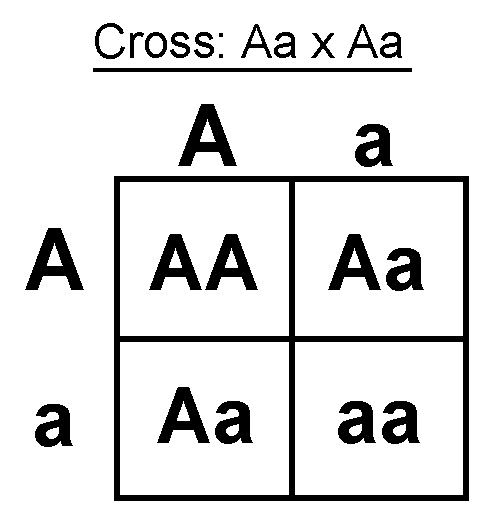
What allele combination should go in the missing box?
a)
AA
b)
Aa
c)
aa
d)
none of these
74.
In a flowering plant species, red flower color (R) is dominant over white flower color (r). What is the genotype of any red-flowering plant resulting from this species?
a)
rr
b)
R
c)
RR
d)
RR or Rr
75.
What is the phenotype of the offspring? (A-Brown hair; a-blond hair) 
a)
50 % Brown Hair and 50% Blond Hair 
b)
25 % Brown Hair and 75% Blond Hair 
c)
75 % Brown Hair and 25% Blond Hair 
d)
0% Brown Hair and 100% Blond Hair 
76.
What ratio of the offspring from the cross shown will be homozygous recessive for the  trait of tallness
a)
0 in 4
b)
1 in 4
c)
2 in 4
d)
4 in 4
77.
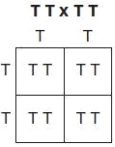
What are the possible genotypes for this cross?
(Click the picture to see it without the text)
a)
TT = 25% Tt= 50% tt=25%
b)
all tall
c)
TT= 75% tt = 25%
d)
Tt = 100%
78.
In a certain species of plant, the color purple (P) is dominant to the color white (p).
According to the Punnett Square, what is the probability of an offspring being white?
a)
25%
b)
0%
c)
100%
d)
50%
79.
Purple (P) is dominant to the white (p).
According to the Punnett Square, what is the probability of an offspring being purple?
a)
25%
b)
0%
c)
100%
d)
50%
80.
Which of the following is homozygous dominant?
a)
Jj
b)
Rr
c)
MM
d)
ee
81.
Which of the following is homozygous recessive?
a)
Tt
b)
tt
c)
TT
d)
T
82.
This is an example of ___________?
a)
Incomplete dominance
b)
Co-Dominance
83.
This is an example of ___________.
a)
 Incomplete Dominance
b)
 Codominance
84.
A calico cat shows both the traits for orange fur and black fur. What kind of allele expression is this?
a)
Incomplete Dominance
b)
Co dominance
85.

H= normal blood clotting

h=hemophilia


XHXh x XHY


What is the probability that any of their offspring will have hemophilia?

a)

4/4

b)

3/4

c)

2/4

d)

1/4

86.
Which structure is labeled as C in the diagram?
a)
Centromere
b)
Chromosome
c)
Sister chromatids
87.
Which structure is labeled as A in the diagram?
a)
Centromere
b)
Chromosome
c)
Sister chromatids
88.
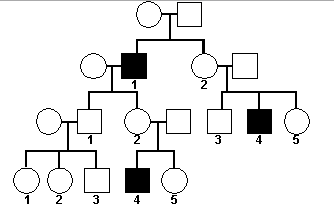
If this pedigree shows an autosomal recessive disorder, what MUST the genotype of individual II-3 be?
a)
HH
b)
Hh
c)
hh
d)
None of the above
89.
How are individuals III-2 and II-4 related?
a)
Cousins
b)
Dad and Daughter
c)
Uncle and Niece
d)
Grandpa and Granddaughter
90.
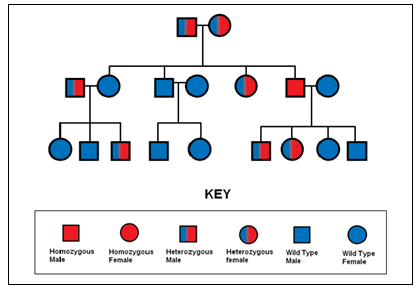
What type of heredity is shown in the pedigree?
(hint: check your notes - "modes of inheritance")
a)
Sex-Linked Dominant
b)
Sex-Linked Recessive
c)
Autosomal Dominant
d)
Autosomal Recessive 
91.
In a pedigree, what shape represents a male?
a)
circle
b)
square
c)
triangle
d)
diamond
92.
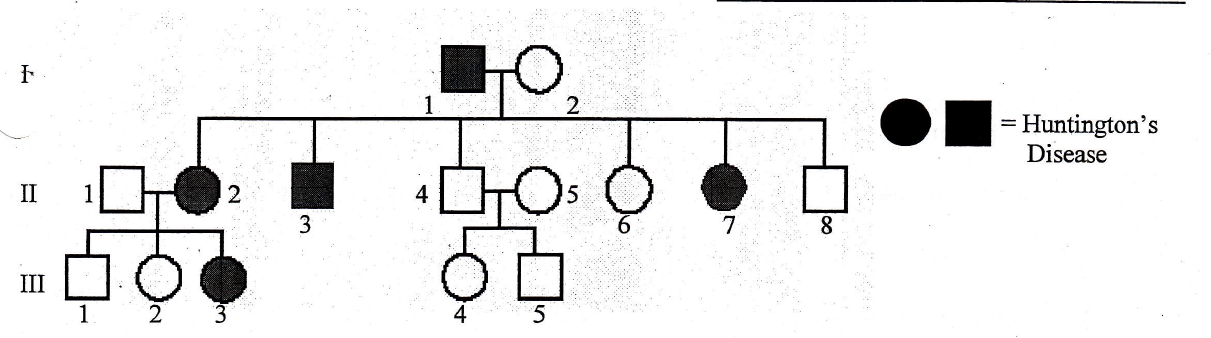
There are no carriers for Huntington's Disease- you either have it or you don't. Is Huntington's disease caused by a dominant or recessive trait?
a)
Dominant
b)
Recessive
93.
Does this pedigree show a dominant or recessive trait?
a)
Dominant
b)
Recessive
94.
In the second generation-how many people are carriers of the trait?
a)
2
b)
3
c)
5
d)
6
95.

This is a __ trait.

a)

autosomal recessive

b)

sex-linked recessive

c)

autosomal dominant

96.
What type of heredity is shown in the pedigree?
a)
Sex-Linked Dominant
b)
Sex-Linked Recessive
c)
Autosomal Dominant
d)
Autosomal Recessive 
97.

pedigreeWhat type of heredity is shown in the pedigree?

a)

Sex-Linked Recessive

b)

Autosomal Dominant

c)

Autosomal Recessive

98.
Stem cells are
a)
cells that grow uncontrollably
b)
undifferentiated and can be any type of cell
c)
never go through cell division
d)
only found in embryos
99.
Stem cells can be obtained from
a)
embryos
b)
some adult tissues
c)
umbilical cord blood
d)
all of the above
100.
What does "pluripotent" mean?
a)
able to divide and make many different types of cells
b)
not able to divide
c)
can only divide and make one cell type 
d)
if it divides, it will make a cancerous tumor
101.
What process best explains how muscle cells and nerve cells can develop from the same fertilized egg?
a)
genetic engineering
b)
survival of the fittest
c)
differentiation
d)
selective breeding
102.
Which best explains why muscle cells are different from blood cells?
a)
Muscle cells are produced by the brain, but blood cells are produced by the heart. 
b)
Different genes are activated in muscle cells than in blood cells. 
c)
Muscles cells experience different environmental influences than blood cells. 
d)
A mutation occurs during the development of muscle cells but not in blood cells. 
103.
What is the difference between embryonic stem cells and adult stem cells?
a)
Embryonic stem cells can differentiate into more cell types than adult stem cells
b)
Adult stem cells are pluripotent, just like embryonic stem cells
c)
Adult stem cells can differentiate into more cell types than embryonic stem cells
d)
Adult stem cells grow bigger than embryonic stem cells
104.
How do stem cells know what type of cells to differentiate into?
a)
The nucleus has instructions to turn some genes on and some genes off.
b)
Signals from chemicals in the organism or from the environment determine which genes will be turned on and off.
c)
Genes turn on and off randomly.
d)
The cell has unique DNA that determines what the cell will become.
105.

_________ refers to a stem cell's ability to differentiate into other cell types

a)

potency

b)

potential

c)

dormancy

d)

aptitude

106.

a cell that has the most potential, able to become any type of cell.

a)

Totipotent

b)

Pluripotent

c)

Multipotent

107.

can become any of the three cell layers in a

developing embryo (endoderm, mesoderm, ectoderm), but not the placenta surrounding the embryo.

a)

Totipotent

b)

Pluripotent

c)

Multipotent

108.

partially differentiated, with only the capacity to become one cell type.

a)

Totipotent

b)

Pluripotent

c)

Multipotent

109.
What are iPS cells, and what do they mean to stem cell research?
a)
Induced purpose stem cells, mean embryo cells were made into adult-like cells
b)
Induced purpose stem cells, mean adult cells were reversed to baby cells
c)
Induced pluripotent stem cells, mean adult cells were made into embryo-like cells
d)
Induced pluripotent stem cells, mean cells were totipotent and are now pluripotent
110.
The developing embryo forms a gastrula with 3 distinct layers endoderm, mesoderm and ectoderm. These are known as ...
a)
Dermal layer
b)
Epiderm layer
c)
Zygoderm layer
d)
Germ layer
111.
Thalidomide was a drug given to pregnant women to counteract the effects of morning sickness. It caused congenital malformations such as the absence of limbs. When would it have been the most dangerous time to take Thalidomide?
a)
Weeks 3-4
b)
Weeks 5-6
c)
Weeks 7-8
d)
Weeks 9-10
112.
Advantages of embryonic stem cells over Adult and iPS stem cells are;
a)
Cell can divide indefinitely
b)
Cells can differentiate into any type
c)
Can grow large quantities
d)
All of the above
113.

Why is the use of embryonic stem cells controversial?

a)

The embryos are destroyed in the process of extracting the stem cells.

b)

People consider their use as destroying a life.

c)

They are taken from little kids, which is painful.

d)

They are put into a different person.

114.

The animal's digestive tract forms from the _______.

a)

endoderm

b)

mesoderm

c)

ecotoderm

d)

protostome

115.

The embryo layer that forms the skin and nervous tissue is the _____.

a)

endoderm

b)

mesoderm

c)

ectoderm

d)

deuterostome

116.

The ectoderm is on the outside of the developing embryo.

a)

True

b)

False

117.

The innermost layer of the blastocyst is the

a)

endoderm

b)

gastrula

c)

ectoderm

d)

mesoderm

118.

The middle layer of the blastocyst is the

a)

endoderm

b)

ectoderm

c)

mesoderm

d)

deuterostome