
 Worksheets
Biology FInal Exam Study Guide
Total questions: 123
Worksheet time: 2hrs 44mins
What are the properties of life?
Reproduction, growth and development, energy processing, evolutionary adaptation, regulation, response to the environment, order
Hierarchy of organization
Atomic structure
What is the hierarchy of organization in biology? (Lowest to highest)
Biosphere, Ecosystem, Community, Population, Organism, Organs and Organ Systems, Tissues, Cell, Organelle, Molecules, atoms
Atomic structure
Atoms, Molecules, Organelle,Tissues, Cell, Organs and Organ Systems, Organism, Population,Community,Ecosystem,Biosphere
What is Evolution?
Process of creation of life in the heritable characteristic of biological populations over successive generations
Process of change in the non inheritable characteristic of biological populations over successive generation
Process of change in the heritable characteristic of biological populations over successive generation
What is Natural Selection?
Process where organisms with traits that are better suited to their environment are more likely to die off
Process where organisms with traits that are better suited to their environment are more likely to survive and reproduce
Process where organisms with features that are worse suited to their environment are more likely to survive and reproduce
Process where organisms with traits that are better suited to their environment are more likely to die
Three properties of Natural Selection
Variation
Death
Heritability
survival + reproduction
Domain Bacteria is in what kingdom?
Kingdom Eubactertia
Kingdom Archaebacteria
Kingdom Animalia, Plantae, Fungi, and Protista
Domain Archaea belongs to which kingdom?
Kingdom Eubacteria
Kingdom Archaebacteria
Kingdom Animalia, Planate, Fungi, and Protist
Domain Eukarya belongs to which kingdom?
Kingdom Eubacteria
Kingdom Archaebacteria
Kingdom Animalia, Planate, Fungi, and Protist
Domain Bacteria cell type
Prokaryotic (has a nucleus)
Eukaryotic (has a nucleus)
Prokaryotic (lacks a nucleus)
Eukaryotic (lacks a nucleus)
Domain Archaea cell type
Prokaryotic (lacks a nucleus)
Prokaryotic (has a nucleus)
Eukaryotic (lacks a nucleus)
Eukaryotic (has a nucleus)
Domain Eukarya cell type
Prokaryotic (has a nucleus)
Eukaryotic (lacks a nucleus)
Prokaryotic (lacks a nucleus)
Eukaryotic (has a nucleus)
Protons have what charge, are located where, and how many atomic mass unit?
Negative charge (-1), located in the Nucleus, and has 1 atomic mass unit
No charge (0), located in the Nucleus, and has 1 atomic mass unit
Positive charge (+1), located in the Nucleus, and has 1 atomic mass unit
Negative charge (-1), located outside of the Nucleus, and has 1 atomic mass unit
Neutrons have what charge, are located where, and how many atomic mass unit?
Negative charge (-1), located outside of the nucleus, and have an atomic mass unit closer to 0
No charge (neutral), located in the nucleus, and have 1 atomic mass unit
Positive charge (+1), located in the nucleus, and have 1 atomic mass unit
Electrons have what charge, are located where, and how many atomic mass unit?
Negative charge (-1), orbits the nucleus, and has an atomic mass unit closer to zero
No charge (neutral), located in the nucleus, and has an atomic mass unit of 1
Positive charge (+1), located in the nucleus, and has an atomic mass unit of 1
Protons function
Determines the atomic number and thus identity of the element
Contributes to the atom's mass. Atoms of the same element can have different number of Neutrons
In Neutral atoms, the number of electrons equal the number of protons, balancing the atom's charge
Neutrons Function
Determines the atomic number and this the identity of the element
Contributes to the atom's mass. Atoms of the same element can have different number of Neutrons
In neutral atom, the number of electrons equal the number of protons, balancing the atom's charge
Electrons function
Determines the atomic number and thus the identity of the element
Contribute to the atom's mass. Atoms of the same element can have different number of neutrons
In neutral atom, the number of electrons equal the number of protons, balancing the atom's charge
Covalent bonding
A complete transfer of one or more valence electrons from a metal atom to a nonmetal atom.
Atoms share one or more pairs of valence electrons.
A positively charged ion that has lost one or more electrons
A negatively charged ion that has gained one or more electrons
Ionic bonding
Sharing of electron pairs between atoms.
gain or lose of an electron
A positively charged ion that has lost one or more electrons
A negatively charged ion that has gained one or more electrons
Anion bonding
.Complete transfer of one or more electrons from one atom to another.
Sharing of electron pairs between atoms.
A positively charged ion that has lost one or more electrons
A negatively charged ion that has gained one or more electrons
Cation bonding
Complete transfer of one or more electrons from one atom to another
Sharing of electron pairs between atoms.
A positively charged ion that has lost one or more electrons
A negatively charged ion that has gained one or more electrons
Water is essential for life. Its special properties make water the single most important molecule in plant life. Which of the following properties of water enables it to move from the roots to the leaves of plants?
Water expands as it freezes.
Water exhibits cohesive behavior.
Water is an excellent solvent.
Water is able to moderate temperature.
Large bodies of water, such as lakes and oceans, do not quickly fluctuate in temperature. What is the reason for this phenomenon?
Water is an acid.
Water has a high heat capacity.
Water is a versatile solvent.
Water acts as a buffer.
Why does ice stay at the top of oceans instead of sinking to the bottom?
Ice is colder than liquid water.
Ice is more dense than liquid water.
ice is less dense than liquid water.
Ice is warmer than liquid water.
Water is often called the "universal solvent" because many substances can be dissolved in water. What property of water allows it to be such a versatile solvent?
purity
high heat capacity
polarity and cohesion
expansion upon freezing
A florist places a bouquet of white carnations in water containing blue dye. After a time, the flowers turn blue. What process helped the carnations to change color?
Specific heat
Cohesion and adhesion of water molecules
Surface tension
Formation of covalent bonds between hydrogen and oxygen molecules
Water makes up approximately 60% of the human body and plays a vital role in regulating body temperature. Which property of water makes it good at regulating temperature?
Water is a good solvent.
Water has an unusual crystalline structure.
Water exhibits strong cohesion.
Water has a high capacity for heat.
Water has a much higher specific heat than most other covalent compounds. What do you predict might happen if water had a low specific heat instead?
Flooding would occur and animals would be forced to migrate
Organisms that are sensitive to changes in temperature would die
Harmful organisms living in water would reproduce at a rapid rate
Plants would not have enough water to effectively carry out photosynthesis
Many fish and aquatic plants can survive a cold winter because the layer of ice that forms at the top of the lake insulates the water below and prevents the lake from freezing solid. What unique property of water contributes to this effect?
Water absorbs heat when it evaporates and forms a gas
Water molecules completely separate into ions in solutions.
Water expands and becomes less dense when it freezes.
Water forms hydrogen bonds with ions and other polar substances.
Which of the following characteristics of water is not a result of hydrogen bonding?
adhesive strength
cohesive strength
capillarity
All of the above are a result of hydrogen bonding.
Carbohydrates function
Primary energy source, structural support
Long-term energy storage, cell membrane formation, insulation, protection
Store, transmit, and express genetic information
Lipids function
Primary energy source, structural support
Long-term energy storage, cell membrane formation, insulation, protection
Store, transmit, and express genetic information
Nucleic acid function
Primary energy source, structural support
Long-term energy storage, cell membrane formation, insulation, protection.
Store, transmit, and express genetic information
Building blocks for Carbohydrates
(Monomers): Monosaccharides (simple sugars)
(Monomers): Fatty acids and glycerol (though not true polymers).
(Monomers): Nucleotides (sugar, phosphate group, nitrogenous base).
Building blocks for Lipids
(Monomers): Monosaccharides (simple sugars).
(Monomers): Fatty acids and glycerol (though not true polymers).
(Monomers): Nucleotides (sugar, phosphate group, nitrogenous base).
Building blocks for Nucleic acids
(Monomers): Monosaccharides (simple sugars).
(Monomers): Fatty acids and glycerol (though not true polymers).
(Monomers): Nucleotides (sugar, phosphate group, nitrogenous base).
Examples of Carbohydrates
Glucose, fructose (sugars); starch, cellulose, glycogen (polymers)
Fats, oils, waxes, cholesterol, steroids.
DNA (Deoxyribonucleic Acid), RNA (Ribonucleic Acid).
Examples of lipids
Glucose, fructose (sugars); starch, cellulose, glycogen (polymers).
Fats, oils, waxes, cholesterol, steroids.
DNA (Deoxyribonucleic Acid), RNA (Ribonucleic Acid).
Examples of Nucleic acids
Glucose, fructose (sugars); starch, cellulose, glycogen (polymers).
Fats, oils, waxes, cholesterol, steroids.
DNA (Deoxyribonucleic Acid), RNA (Ribonucleic Acid).
What is diffusion?
The diffusion of free water across a selectively permeable membrane
The random movement of particles that results in the net movement of a substance down its concentration gradient from a region where its most concentrated to a region where its less concentrated
What is osmosis?
the diffusion of free water across a selectively permeable membrane
The random movement of particles that results in the net movement of a substance down its concentration gradient from a region where its most concentrated to a region where its less concentrated
What is Hypotonic Solution:?
The surrounding solution has fewer solutes (more water) than the cell.
The surrounding solution has more solutes (less water) than the cell.
The solute concentration is the same inside and outside the cell.
Effect: No net water movement, so the cell's volume remains stable.
What is Hypertonic Solution
The surrounding solution has fewer solutes (more water) than the cell.
The surrounding solution has more solutes (less water) than the cell.
The solute concentration is the same inside and outside the cell.
What is Isotonic Solution
The surrounding solution has fewer solutes (more water) than the cell.
The surrounding solution has more solutes (less water) than the cell.
The solute concentration is the same inside and outside the cell
Hypotonic In animal cells
Water rushes in, cell swells and lyses (bursts) (e.g., red blood cells in pure water).
Water leaves, cell shrinks, wrinkles, and crenates (e.g., red blood cells in saltwater).
Ideal state; cell maintains normal shape
Hypertonic In animal cells
Water rushes in, cell swells and lyses (bursts) (e.g., red blood cells in pure water).
Water leaves, cell shrinks, wrinkles, and crenates (e.g., red blood cells in saltwater).
Ideal state; cell maintains normal shape
Isotonic In animal cells
Water rushes in, cell swells and lyses (bursts) (e.g., red blood cells in pure water
Water leaves, cell shrinks, wrinkles, and crenates (e.g., red blood cells in saltwater)
Ideal state; cell maintains normal shape
Hypotonic In a plant cell
Water enters, pressing against the wall, creating turgor pressure, making the cell firm (ideal for support)
Water leaves, cell membrane pulls away from the wall (plasmolysis), causing wilting (flaccid state))
No net water movement; cell becomes flaccid (limp), losing turgor pressure.
Hypertonic In a plant cell
Water enters, pressing against the wall, creating turgor pressure, making the cell firm (ideal for support)
Water leaves, cell membrane pulls away from the wall (plasmolysis), causing wilting (flaccid state)
No net water movement; cell becomes flaccid (limp), losing turgor pressure.
Isotonic In a plant cell
Water enters, pressing against the wall, creating turgor pressure, making the cell firm (ideal for support).
Water leaves, cell membrane pulls away from the wall (plasmolysis), causing wilting (flaccid state).
No net water movement; cell becomes flaccid (limp), losing turgor pressure.
What is the end result of the cell cycle and mitosis?
The creation of four haploid genetically identical daughter cells from a single parent cell
The creation of two diploid, genetically identical daughter cells from a single parent cell
The creation of four diploid unique daughter cells from a single parent cell
The creation of four haploid unique daughter cells from a single parent cell
What is the end result of Meiosis?
Four genetically Identical diploid cells
Two genetically Identical diploid cells
Two genetically unique haploid cells
Four genetically unique haploid cells
Mitosis starts with one diploid cell (with duplicated chromosomes)
True
False
Meiosis starts with one diploid cell (with two sets of chromosomes) that has already replicated its DNA, and after two rounds of division (Meiosis I & II)
True
False
G1 (First Gap)
The cell continues to grow and synthesizes proteins needed for mitosis, making final preparations for cell division.
The cell replicates its DNA, resulting in two identical sets of chromosomes (sister chromatids).
The cell grows, duplicates organelles, and synthesizes proteins and other molecular building blocks for the cell.
S (Synthesis)
The cell replicates its DNA, resulting in two identical sets of chromosomes (sister chromatids)
The cell grows, duplicates organelles, and synthesizes proteins and other molecular building blocks for the cell.
The cell continues to grow and synthesizes proteins needed for mitosis, making final preparations for cell division.
G2 (Second Gap)
The cell replicates its DNA, resulting in two identical sets of chromosomes (sister chromatids).
The cell continues to grow and synthesizes proteins needed for mitosis, making final preparations for cell division.
The cell grows, duplicates organelles, and synthesizes proteins and other molecular building blocks for the cell.

The spindle disappears, nuclear envelopes reform around the two sets of chromosomes, and new nuclei are formed.
Chromosomes line up along the center of the cell at the metaphase plate.
Sister chromatids separate and are pulled to opposite poles of the cell.
Chromatin condenses into visible chromosomes, the nuclear envelope breaks down, and the mitotic spindle begins to form.
The cytoplasm divides, physically separating the cell into two identical daughter cells.

Metaphase
The spindle disappears, nuclear envelopes reform around the two sets of chromosomes, and new nuclei are formed.
Chromatin condenses into visible chromosomes, the nuclear envelope breaks down, and the mitotic spindle begins to form.
Chromosomes line up along the center of the cell at the metaphase plate.
Sister chromatids separate and are pulled to opposite poles of the cell.
The cytoplasm divides, physically separating the cell into two identical daughter cells.

Sister chromatids separate and are pulled to opposite poles of the cell.
The spindle disappears, nuclear envelopes reform around the two sets of chromosomes, and new nuclei are formed.
Chromosomes line up along the center of the cell at the metaphase plate.
The cytoplasm divides, physically separating the cell into two identical daughter cells.
Chromatin condenses into visible chromosomes, the nuclear envelope breaks down, and the mitotic spindle begins to form.

Telophase
Chromatin condenses into visible chromosomes, the nuclear envelope breaks down, and the mitotic spindle begins to form.
The cytoplasm divides, physically separating the cell into two identical daughter cells.
Chromosomes line up along the center of the cell at the metaphase plate.
Sister chromatids separate and are pulled to opposite poles of the cell.
The spindle disappears, nuclear envelopes reform around the two sets of chromosomes, and new nuclei are formed.
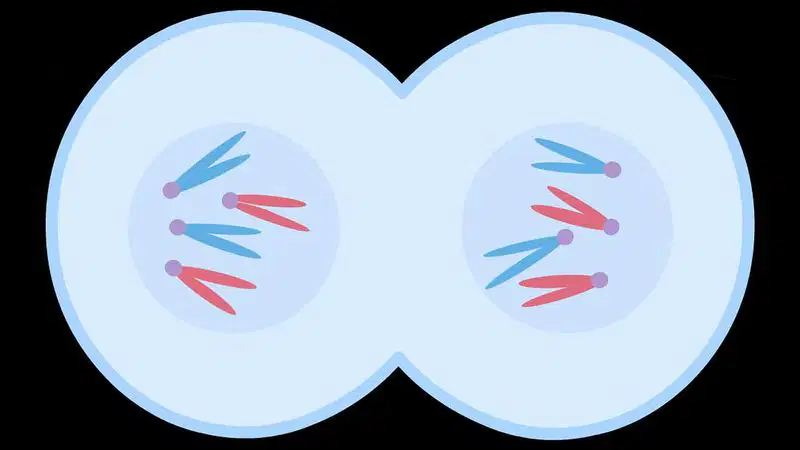
Chromosomes line up along the center of the cell at the metaphase plate.
The cytoplasm divides, physically separating the cell into two identical daughter cells.
The spindle disappears, nuclear envelopes reform around the two sets of chromosomes, and new nuclei are formed.
Sister chromatids separate and are pulled to opposite poles of the cell.
Chromatin condenses into visible chromosomes, the nuclear envelope breaks down, and the mitotic spindle begins to form.
protein synthesis
Translation and then transcription
translation only
Transcription only
Transcription and then translation
Transcription - what happens, where does it take place, three types of RNA
copying a DNA gene's sequence into RNA,taking place in the nucleus of eukaryotes and the cytoplasm of prokaryotes, mRNA, rRNA and tRNA
copying a DNA gene's sequence into RNA,taking place in the cytoplasm of eukaryotes and the nucleus of prokaryotes, mRNA, rRNA and tRNA
copying a RNA gene's sequence into RNA,taking place in the cytoplasm of eukaryotes and the nucleus of prokaryotes, mRNA, rRNA and tRNA
translation is the process of synthesizing a protein from an mRNA template. It takes place on ribosomes, which are molecular machines located in the cytoplasm of a cell
True
False
Apoptosis is
programmed cell reconstruction
The programmed cell death
Proteins form and function: A protein's specific 3D shape, determined by its amino acid sequence (primary structure) and subsequent folding (secondary, tertiary, quaternary levels), is absolutely crucial for its function, dictating how it binds to other molecules, acts as enzymes, forms structures, or transports substances, with even slight changes to this shape (denaturation) often rendering it non-functional.
True
False
Enzymes: Act as catalysts by precisely positioning substrates.
true
false
denaturation, unfolds the protein, destroying its specific 3D structure and, consequently, its ability to function.
True
False
building blocks for proteins
Glucose
glycerol and fatty acids
Amino acids
nucleotides
Prokaryotes vs. Eukaryotes similarities
Prokaryotes vs. Eukaryotes differences
Nucleus
Organelles
Size/Complexity
DNA
Organisms
Plant vs. Animal Cells (Both Eukaryotic) similarities
Nucleus
Mitochondria
Ribosomes
Cell membrane
Golgi
Plant vs. Animal Cells (Both Eukaryotic) differences
What are dominant traits?
Traits that are expressed when an individual has no copies of the dominant allele.
Traits that are expressed when an individual has at least one copy of the dominant allele.
Traits that are expressed when an individual has at least one copy of the recessive allele.
Traits that are expressed when an individual has two copies of the dominant allele.
What are recessive traits?
Genetic traits that are only expressed when an individual has one copy of the recessive allele.
Genetic traits that are always expressed regardless of the number of copies of the recessive allele.
Genetic traits that are only expressed in males.
Genetic traits that are only expressed when an individual has two copies of the recessive allele.
What is a Punnett square used for?
To predict the possible outcomes of a genetic cross.
To calculate the probability of winning a game.
To determine the gender of a baby.
To analyze the results of a scientific experiment.
An organism's genetic makeup, or allele combinations.
P1 generation
Gene
Genotype
Phenotype
An organism's physical appearance, or visible traits.
P1 generation
Gene
Genotype
Phenotype
Having two different alleles for a given gene.
Heterozygous
The Law of Independent Assortment
Molecular genetics
Cross

What is the probability of obtaining a heterozygous offspring from a homozygous dominant parent and a homozygous recessive parent?
50%
0%
100%
25%

What is the probability of obtaining a heterozygous offspring from two heterozygous parents?
50%
10%
75%
25%

What is the probability of obtaining a homozygous recessive offspring from a heterozygous parent?
25% or 1/4
75% or 3/4
10% or 1/10
50% or 1/2
The cell's command center, housing DNA and controlling growth, reproduction, and protein synthesis.
Known as the "powerhouses," they convert food energy into usable cellular energy (ATP).
Contain digestive enzymes to break down waste, foreign invaders, and old cell parts, acting as the cell's recycling center.
Sites of protein synthesis, translating messenger RNA into polypeptide chains (proteins).
The cell's command center, housing DNA and controlling growth, reproduction, and protein synthesis.
Known as the "powerhouses," they convert food energy into usable cellular energy (ATP).
Contain digestive enzymes to break down waste, foreign invaders, and old cell parts, acting as the cell's recycling center.
Sites of protein synthesis, translating messenger RNA into polypeptide chains (proteins).
The cell's command center, housing DNA and controlling growth, reproduction, and protein synthesis.
Known as the "powerhouses," they convert food energy into usable cellular energy (ATP).
Contain digestive enzymes to break down waste, foreign invaders, and old cell parts, acting as the cell's recycling center.
Sites of protein synthesis, translating messenger RNA into polypeptide chains (proteins).
The cell's command center, housing DNA and controlling growth, reproduction, and protein synthesis.
Known as the "powerhouses," they convert food energy into usable cellular energy (ATP).
Contain digestive enzymes to break down waste, foreign invaders, and old cell parts, acting as the cell's recycling center.
Sites of protein synthesis, translating messenger RNA into polypeptide chains (proteins).
Golgi Body (Apparatus)
Modifies, sorts, and packages proteins and lipids from the ER for transport or secretion.
Small vesicles involved in metabolic processes, breaking down fatty acids and detoxifying harmful substances like hydrogen peroxide.
The outer boundary that separates the cell from its environment, controlling the passage of substances in and out.
Modifies, sorts, and packages proteins and lipids from the ER for transport or secretion.
Small vesicles involved in metabolic processes, breaking down fatty acids and detoxifying harmful substances like hydrogen peroxide.
The outer boundary that separates the cell from its environment, controlling the passage of substances in and out
Cell Membrane (Plasma Membrane):
Modifies, sorts, and packages proteins and lipids from the ER for transport or secretion.
Small vesicles involved in metabolic processes, breaking down fatty acids and detoxifying harmful substances like hydrogen peroxide.
The outer boundary that separates the cell from its environment, controlling the passage of substances in and out.
Photosynthesis
6𝐶𝑂2+6𝐻2𝑂+Light Energy→𝐶6𝐻12𝑂6+6𝑂2
𝐶6𝐻12𝑂6+6𝑂2→6𝐶𝑂2+6𝐻2𝑂+Energy (ATP)
Cellular respiration
6𝐶𝑂2+6𝐻2𝑂+Light Energy→𝐶6𝐻12𝑂6+6𝑂2
𝐶6𝐻12𝑂6+6𝑂2→6𝐶𝑂2+6𝐻2𝑂+Energy (ATP)
Photosynthesis
Cytoplasm (Glycolysis) & Mitochondria (Krebs Cycle, Electron Transport Chain)
Chloroplasts (thylakoid membranes for light reactions, stroma for Calvin cycle)
Cellular respiration
Cytoplasm (Glycolysis) & Mitochondria (Krebs Cycle, Electron Transport Chain)
Chloroplasts (thylakoid membranes for light reactions, stroma for Calvin cycle)
Photosynthesis
Light energy is converted into ATP (and NADPH) during light reactions, which then powers the synthesis of glucose in the Calvin cycle.
The main goal is to generate large amounts of ATP, the cell's energy currency, from the breakdown of glucose, primarily in the mitochondria's inner membrane via oxidative phosphorylation.
Cellular respiration
Light energy is converted into ATP (and NADPH) during light reactions, which then powers the synthesis of glucose in the Calvin cycle.
The main goal is to generate large amounts of ATP, the cell's energy currency, from the breakdown of glucose, primarily in the mitochondria's inner membrane via oxidative phosphorylation.
DNA replication, the process of complementary base pairing ensures that the genetic code is copied accurately, using the rule that Adenine (A) always pairs with Thymine (T), and Guanine (G) always pairs with Cytosine (C)
True
False

What is this? Where is it in the cell? What does it contain?
RNA, nucleus, proteins
DNA, ribosome, proteins
DNA, nucleus, genetic information
RNA, cell membrane, phospholipids

DNA is the complete set of genetic instructions for an organism. How are the instructions determined?
by the sequence (order) of the base pairs
by how many of each base pair there are
by the size of the base pairs
by the percentage of the base pairs
GAG-CTC-GAC-AGA
Mutant
GAG CTC-CAC-AGA
The mutated DNA segment is TTCGCAAG. This is an example of ___ mutation.
Mutation: ATC GCAT
What mutation occurred?
ATG CCA AAT

Original DNA: CAT GAT CCA
New DNA: CAT TGA TCC A
What mutation occurred? (one has been added)
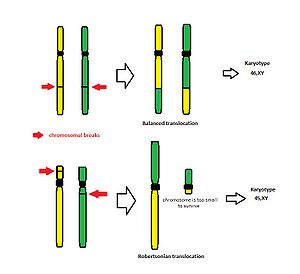
deletion
substitution
tranverse
insertion
In DNA, A goes with __ and C goes with __
T, G
G, T
C, A

Biotechnology uses living organisms, cells, or biological processes to create products and technologies that improve human health, agriculture, and the environment
True
False
All organisms can go under some form of cellular respiration
True
False
Plants store sugar as?
Starch
Glycerol
Animal store sugar as?
starch
glycerol
Amino acids are held by what kind of bonds
ionic bonds
hydrogen bonds
peptides bonds
covalent bonds
A cation has __________ and has a __________ charge.
gained protons, positive charge
gained electrons, negative charge
gained electrons, negative charge
lost electrons, positive charge
An anion has __________ and has a __________ charge.
gained electrons, negative charge
gained protons, positive charge
lost protons, negative charge
lost electrons, positive charge
The sodium atom contains 11 electrons, 11 protons, and 12 neutrons. What is the mass number of sodium?
34
23
22
11
Which organelle is involved in the catabolism of fatty acids and the detoxification of alcohol?
Golgi apparatus
ribosomes
smooth ER
peroxisome
Life is organized in a hierarchical fashion. Which sequence correctly lists that hierarchy from least inclusive to most inclusive?
Question 12Select one:
A.
cell, molecule, organ system, organ, organelle, population, tissue, organism, ecosystem, community
B.
molecule, cell, organism, organ system, tissue, population, organ, organelle, community, ecosystem
C.
molecule, organelle, cell, tissue, organ, organ system, organism, population, community, ecosystem
D.
ecosystem, population, organ system, cell, community, molecule, organ, organism, organelle, tissue
A.
cell, molecule, organ system, organ, organelle, population, tissue, organism, ecosystem, community
molecule, cell, organism, organ system, tissue, population, organ, organelle, community, ecosystem
molecule, organelle, cell, tissue, organ, organ system, organism, population, community, ecosystem
ecosystem, population, organ system, cell, community, molecule, organ, organism, organelle, tissue
Glucose molecules are to starch as ________ are to proteins.
monosaccharides
amino acids
oils
fatty acids

