wayground logo

Free Printable Worksheets

Font size

S
M
L
XL
Worksheets

Practice final

Total questions: 126

Worksheet time: 3hrs 0mins

Name
Class
Date
1.
What phase is  shown in the picture?
a)
anaphase 1
b)
anaphase 2
c)
metaphase 1
d)
telophase 1
2.
Meiosis makes sperm and egg cells. In humans, sperm and egg cells each have _____ chromosomes. Therefore a fertilized human egg cell (sperm and egg cell combined) would create a cell with _____ chromosomes.
a)
23, 46
b)
46, 23
c)
2, 4
d)
50, 100
3.
What kind of cells are made in MEIOSIS?
a)
Haploid Gametes
b)
Diploid Somatic Cells
c)
Skin Cells
d)
Liver Cells
4.
Diploid Cells are represented by
a)
2n
b)
n
c)
4n
d)
1/2 n
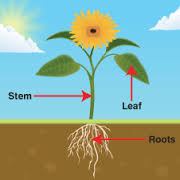
5.
If a somatic cell in a butterfly contains 24 chromosomes, a butterfly egg would contain
a)
3
b)
6
c)
12
d)
24
6.
The chromosomes that pair up during meiosis, are called __________ chromosomes.  
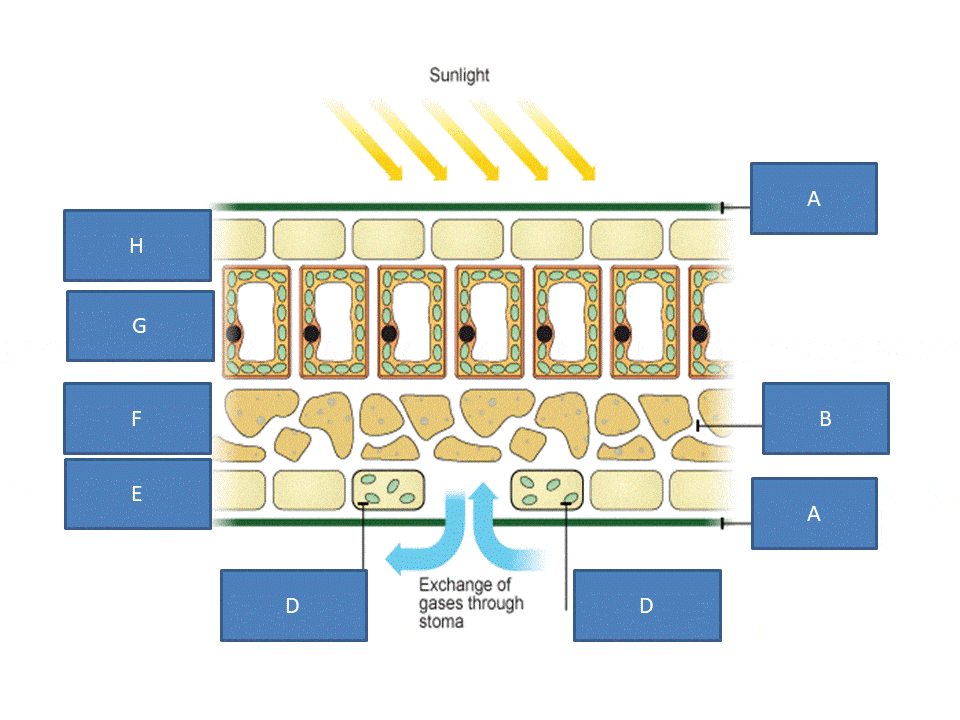
a)
homozygous 
b)
asexual
c)
homologous
d)
genes
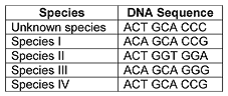
7.
Identify the phase.
a)
Metaphase I
b)
Metaphase II
c)
Prophase I
d)
Anaphase II
8.
During anaphase 1 _________. 
a)
homologs separate
b)
chromatids are pulled apart
c)
nuclei break down
d)
centrioles break down
9.
a)
Metaphase I
b)
Metaphase II
c)
Anaphase I
d)
Anaphase II
10.
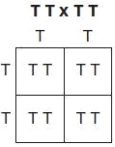
What ratio of the offspring from the cross shown will be homozygous recessive for the  trait of tallness? 
a)
0 in 4
b)
1 in 4
c)
2 in 4
d)
4 in 4
11.
Which of the following genotypes is homozygous dominant?
a)
A
b)
Aa
c)
AA
d)
aa
12.
What you see, or the physical appearance.
a)
Genotype
b)
Phenotype
c)
Homozygous
d)
Heterozygous
13.
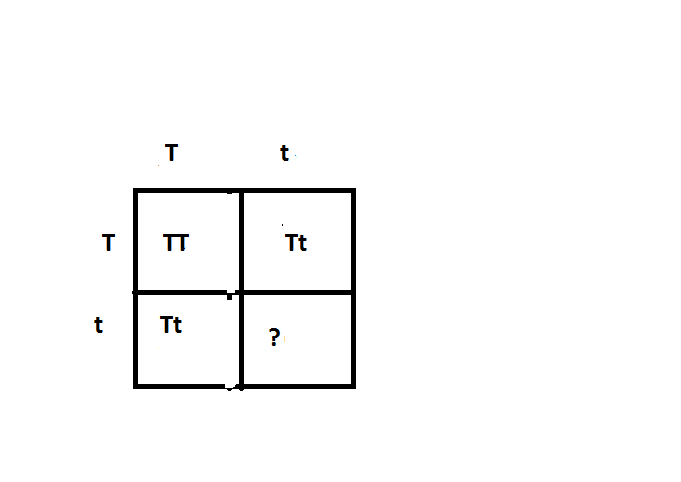
T - tall and t = short
In the punnett square below, what belongs in the missing square
a)
tt
b)
Tt
c)
Bb
d)
TT
14.
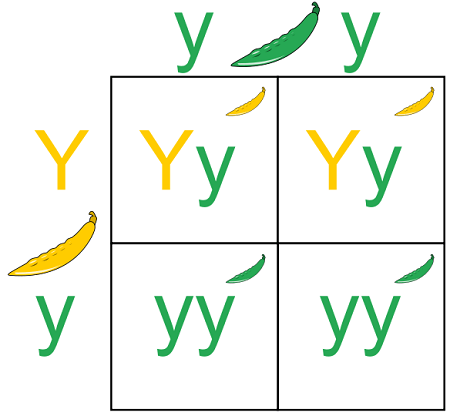
Which choice best represents the genotype of this cross?
a)
1 Yy: 2 yy: 0 YY
b)
2 Yy: 2 yy: 0 YY
c)
3 Yy: 1 yy: 0 YY
d)
1 Yy: 3 yy: 0 YY
15.
Prokaryotes are unlike all other organisms in that their cells 
a)
do not have a nucleus
b)
have organelles
c)
have cell walls
16.
The process of converting nitrogen into a form plans can use is known as nitrogen
a)
conjugation
b)
sterilization
c)
fixation
d)
decomposition
17.
Name this bacteria shape
a)
coccus
b)
spirillum
c)
bacillus
18.
Name this bacteria shape
a)
coccus
b)
bacillus
c)
spirillum
19.
What do viruses need to reproduce?
a)
they need genetic material
b)
They need a host cell
c)
They need  bacteria
d)
They need insulin
20.
What happens in the lysogenic cycle? 
a)
Virus goes in and leaves the host cell
b)
Virus quickly kills the host cell
c)
Virus inject the nucleic acid into the host cell, and the nucleic acid integrates into the host cell DNA, and stay dormant for a long time
d)
Bacteria injects DNA into a host cell
21.
What happens in the lytic cyle?
a)
Virus goes in and leaves the host cell
b)
Virus quickly kills the host cell
c)
Virus sleeps inside of the host cell
d)
Virus stay dormant for a long time
22.
These cells are responsible for making antibodies
a)
B Cells
b)
Killer T Cells
c)
Helper T Cells
d)
Macrophages
23.
The blue molecule in this image is a(n) _______
a)
Antibody
b)
Antigen
c)
Pathogen
d)
Blood cell
24.
Which best describes the relationship between antibodies and antigens?
a)
Antibodies are specific to one antigen
b)
Antigens are produced in response to antibodies
c)
One antibody can affect several different antigens
d)
Immunity develops when an antigen destroys an antibody.
25.

Which of the following antigens would bind to this B cell receptor?

a)
b)
c)
d)
26.

Which part of the graph would represent a secondary response?

a)

A

b)

B

c)

C

d)

none of them

27.

What is the result of this interaction?

a)

A T-cell is activated

b)

The virus can't bind to and infect a cell

c)

A B cell starts making antibodies

d)

An antigen presenting cell will present its antigen

28.
Which type of protist is shown in the picture?
a)
euglena
b)
paramecium
c)
amoeba
d)
autotroph
29.
What is the name for an organism that can produce its own food?
a)
heterotroph
b)
autotroph
c)
amoeba
d)
eukaryotic
30.
What is the name of an organism that cannot produce its own food and must get it from another source?
a)
prokaryotic
b)
eukaryotic
c)
autotroph
d)
heterotroph
31.
What is the name of the structure shown in the model?
a)
cilia
b)
flagella
c)
amoeba
d)
pseudopod 
32.
Which protist has an oral groove and a gullet? 
a)
Paramecium 
b)
Volvox
c)
Amoeba 
d)
Euglena 
33.
Fine hairs that allow protist to move is called what? 
a)
Pseudopods 
b)
Euglena 
c)
Flagella 
d)
Cilia 
34.
Many protists, particularly flagellates, use a _________ to regulate how much water they have in their cell.
a)
contractile vacuole
b)
food vacuole
c)
gullet
d)
mitochondria
35.
What organism uses the pseudopod for both movement and capturing its food?
a)
amoeba
b)
paramecium
c)
volvox
d)
pretzel mold
36.
What is the single most important characteristic that separates protists from bacteria and viruses?
a)
They are prokaryotic.
b)
They are eukaryotic.
c)
They eat in multiple different ways.
37.
___ are threadlike fungal filaments that form chains.
a)
hyphae
b)
roots
c)
fibers
d)
chitin
38.
A ____ is a partnership between a fungus and a green alga or cyanobacterium.
a)
mycorrhiza
b)
lichen
c)
hyphae
d)
spore
39.

Mushrooms belong to which kingdom?

a)

animal

b)

plant

c)

fungi

d)

protist

e)

moneran

40.

Which of the following is the genus and species?

a)

panthera Leo

b)

panthera leo

c)

Panthera Leo

d)

Panthera leo

41.

Which of the following best describes how a fungi gets food?

a)

By using its cilia to sweep food inside

b)

by secreting enzymes outside and then absorbing the broken down nutrients

c)

by absorbing sunlight and photosynthesizing

d)

by using its gastrovascular cavity to digest food

42.

What does xylem carry up the stem?

a)

Water

b)

Nutrients

c)

Water and MInerals

d)

None of the above

43.
What does phloem carry up the stem
a)
Sugar
b)
Water
c)
Oxygen
d)
All of the above
44.

Root hairs are...

a)

Mycorrhizal fungi that look like hair

b)

cells that are part of Phloem tissue

c)

tiny extensions of the root to help with absorption

45.

Cohesion is...

a)

water molecules attracted to other water molecules

b)

water molecules attracted to other molecules

c)

water molecules evaporating through the leaf

46.
An example of adhesion is
a)
Water molecules sticking to each other
b)
Water molecules sticking to cellulose in xylem walls
c)
Magnets sticking to a metal wall
d)
Gravity pulling water down
47.

What are guard cells?

a)

Cells that regulate photosynthesis

b)

Cells that push nutrients and water up xylem

c)

Cells that turn sunlight into energy

d)

Cells that regulate water loss through stomata

48.
Both the xylem and phloem are considered-
a)
Stomata
b)
Leaves
c)
Roots
d)
Vascular tissue
49.
Water exits the leaf through the __.
a)
Stomata
b)
Flower
c)
Roots
d)
Phloem
50.
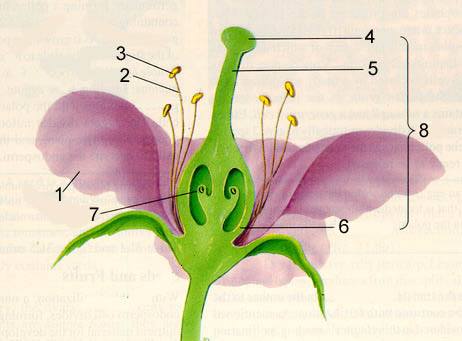
The male part of the flower is known as the _____.
a)
stamen
b)
pistil
c)
ovary
d)
petal
51.
What is #3 pointing to?
a)
stigma
b)
filament
c)
ovary
d)
anther
52.
What is #4 pointing to?
a)
anther
b)
style
c)
stigma
d)
ovary
53.
What is #6 pointing to?
a)
stigma
b)
style
c)
ovary
d)
petal
54.
What anchors the plant, absorbs water and nutrients from the soil, and stores food for the plant?
a)
leaves
b)
stem
c)
xylem
d)
roots
55.
What is the sticky top of the pistil where pollen grains land during pollination?
a)
anther
b)
filament
c)
stigma
d)
style
56.
What is the way a plant grows or responds to light called?
a)
photosynthesis
b)
phototropism
c)
hydrotropism
d)
thigmotropism
57.

Roots grow towards gravity and shoots grow away from gravity. This is known as

a)

hydrotropism

b)

phototropism

c)

gravitropism

d)

thigmotropism

58.
Where is pollen made?
a)
ovary
b)
petal
c)
pistil
d)
anther
59.
Which of the following processes is responsible for the bending of the stem of a plant toward a light source?
a)
The amount of chlorophyll produced on the side facing the light increases
b)
The rate of cell division on the side facing the light increases
c)
The rate of cell division on the side away from the light increases
d)
The cells on the side of the stem away from the light elongate
60.
How does the sperm of flowering plants reach the egg?
a)
Via a pollen tube that grows from the pollen grain through the carpel tissues to the egg
b)
Via raindrops of a dew film that allows the sperm to swim from the male plant to the female plant
c)
Usually via an insect, which places sperm in the ovary while probing for nectar
d)
By actively swimming down though the style to the egg
61.

Plants that have xylem and phloem in true roots, stems and leaves are called ____.

a)
nonvascular plants
b)
vascular plants
c)
seed plants
d)
spore plants
62.
____ are plants that produce naked, or not covered, seeds.
a)
Nonvascular
b)
Vascular
c)
Gymnosperms
d)
Angiosperms
63.
primary growth in plants starts in 
a)
apical meristem
b)
lateral meristem
c)
tracheids
d)
vascular cambium
64.
hormone for ripening fruit
a)
abscisic acid
b)
gibberlin
c)
auxin
d)
ethylene
65.

Which are growth hormones that are produced by the apical meristem?

a)

Gibberelins

b)

Auxins

c)

Cytokins

d)

Etiolations

66.
What is the name of part G?
a)
Palisade mesophyll
b)
Guard cell
c)
Spongy Mesophyll
d)
Lower epidermis
67.
In which structure does photosynthesis take place?
a)
Cuticle
b)
Epidermis
c)
Palisades mesophyll
d)
Guard cells
68.
Name part 6
a)
Palisade mesophyll
b)
Spongy mesophyll
c)
Stomata
d)
Stoma
69.

Movement of sugar from source to other parts of plant is assist by

a)

active transport

b)

diffusion

c)

endosmosis

d)

capillary action

70.

In water transport, water is _____________ up the xylem

a)

actively transported

b)

pulled up by cohesion

c)

pushed up by water pressure

d)

diffusion

71.

In phloem, sucrose and sugars are actively transported. This creates a high concentration of solutes. What will happen next?

a)

water will enter the phloem and create a water pressure

b)

water will be pulled up through the xylem

c)

water will be actively transported next

d)

plants will close their guard cells to conserve water
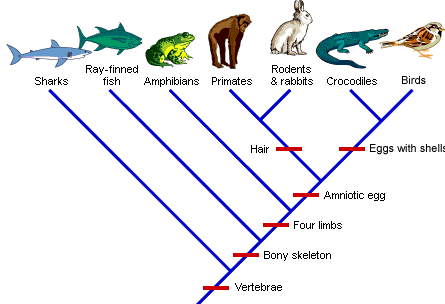
72.
Which two orgainsms have hair? 
a)
Sharks & Ray Finned Fish
b)
Primates & Rodents
c)
Birds & Crocodiles
d)
Rabbits & Birds
73.

How many differences exist in the sequence of amino acids that codes for hemoglobin proteins in horses and zebras?

a)

1

b)

2

c)

3

d)

4

74.
According to this data, the unknown bacterial species is most closely related to: 
a)
Species I
b)
Species II
c)
Species III
d)
Species IV
75.

Which cladogram best fits the data table?

a)
b)
c)
76.

How many Domains are there

a)

10

b)

2

c)

3

d)

6

77.

I have cell walls

I am an autotroph

I am multicellular

What am I?

a)

Plant

b)

Animal

c)

Eubacteria

d)

Protist

78.

I have no cell walls

I am eukaryotic

I reproduce sexually

I am multicellular

What kingdom do I belong to?

a)

Plant

b)

Animal

c)

Protist

d)

Fungi

79.

I am unicellular

I am prokaryotic

I am found in extreme ecosystems

What kingdom do I belong to?

a)

Protist

b)

Plant

c)

Animal

d)

Archaebacteria

80.

What is the correct order?

a)

Domain, Kingdom, Class, Phylum, Family, Order, Genus, Species

b)

Domain, Kingdom, Phylum, Class, Order, Family, Genus, Species

c)

Kingdom, Domain, Order, Class, Family, Phylum, Genus, Species

d)

Domain, Kingdom, Family, Class, Order, Genus, Phylum, Species

81.

Which scientist studied taxonomy?

a)

Mendeleev

b)

Leeuwenhoek

c)

Linnaeus

d)

Darwin

82.

A scientific name consist of which two categories

a)

Class and Family

b)

Family and Genus

c)

Genus and Species

d)

Species and Class

83.

I am plant-like

but not a plant

I absorb nutrients from organic matter

What am I?

a)

Protist

b)

Fungi

c)

Plant

d)

Animal

84.

The first word in a scientific name is the

a)

species

b)

phylum

c)

genus

d)

class

85.

Which of the following is the CORRECT form of a scientific name?

a)

canis lupus

b)

Canis Lupus

c)

Canis lupus

d)

canis lupus

86.

A FAMILY of organisms would be grouped into a LARGER taxonomic level of a

a)

phylum

b)

class

c)

genus

d)

order

87.

A FAMILY of organisms would be divided into a SMALLER taxonomic level of a

a)

phylum

b)

genus

c)

class

d)

order

88.
Which two organisms are least closely related?
a)
two organisms from the same kingdom
b)
two organisms from the same order
c)
two organisms from the same family
d)
two organisms from the same genus
89.
A few deer wander out of their native woods into a completely new park where no deer had ever been before. They go on to create an entirely new population.
a)
Genetic Drift
b)
Natural Selection
c)
Non-random mating
d)
Mutation
90.

Which of these is a condition that must be met for Hardy-Weinberg equilibrium?

a)

extremely small population size

b)

no natural selection

c)

gene flow

d)

nonrandom mating

91.
A biological ____________ is a group of interbreeding populations that is reproductively isolated from other groups.
a)
species
b)
family
c)
phylogeny
d)
hybrid
92.

Male birds of paradise have extremely long, showy tail feathers. Which of the following statements best

describes a selective advantage for having this trait?

a)

The bird attracts more females and therefore mates more frequently.

b)

The bird is easier for predators to spot.

93.

What is one benefit of having an amniotic egg?

a)

Their egg does not require oxygen

b)

their can have external fertilization

c)

their eggs are protected by jacobson's organs

d)

they do not have to return to the water to reproduce

94.
I am spiny, have a water vascular system with tube feet, radial symmetry, and am called a brittle star.
a)
Mullosk
b)
Arthropod
c)
Echinoderm
d)
Cnidarian
95.

I have a mantle, a radula, and a shell.  What am I?

a)
Mollusk
b)
Arthropod
c)
Echinoderm
d)
Cnidarian
96.

flat body

a)

cnidarian

b)

insect

c)

flatworm

d)

roundworm

97.

Sand dollars and star fish exhibit _______ symmetry.

a)

bilateral

b)

radial

c)

lateral

98.

Numerous fingerlike projections in the folds of the wall of the ileum is classified as

a)

Bolus

b)

Chyme

c)

Bile

d)

Villi

99.

What increases the surface area of the small intestine?

a)

duodenum

b)

villi

c)

ileum

d)

pancreas

100.

Gas exchange is needed to supply _____________ to cells and remove __________________

a)

carbon dioxide; oxygen

b)

oxygen; food

c)

oxygen; carbon dioxide

d)

carbon dioxide; water

101.

The air sacs that are covered with capillaries where gas exchange takes place.

a)

Bronchi

b)

Trachea

c)

Oxygen

d)

Alveoli

102.

An animal that has a high metabolic rate (very active), a high demand for oxygen, and larger bodies with complex cavities, needs

a)

high surface area for many organs

b)

4 chambered heart

c)

closed circulation

d)

All of the above

103.

Alveoli, Villi, Nephrons, and capillaries all aid in absorption or movement because they

a)

all diffuse oxygen

b)

they all get rid of wastes

c)

they are all involved in aborbing nutrients

d)

they all increase surface area

104.

Animals that do not need any circulatory system must be

a)

very thin

b)

only two tissues, both facing water

c)

multiple layers of cells

d)

highly active

105.

A virus's genetic material is surrounded by

a)

a protein capsid

b)

DNA

c)

a tail fiber

d)

nothing

106.

Viruses attach only to a particular host because of the presence of

a)

DNA

b)

magnetic attraction

c)

surface receptors

d)

other viruses

107.
Which best describes the basic structure of a virus?
a)
nucleic acid strand surrounded by a protein coat
b)
a tail surrounded by a protein coat
c)
a tail surrounded by a carbohydrate coat
d)
nucleic acid strand surrounded by a carbohydrate coat
108.
What part of the virus is number 1?
a)
Capsid
b)
DNA
c)
Surface Markers
d)
Envelope
109.
What part of the virus is number 2?
a)
Capsid
b)
DNA
c)
Surface Markers
d)
Envelope
110.
What part of the virus is number 3?
a)
Capsid
b)
DNA
c)
Surface Markers
d)
Envelope
111.
What part of the virus is number 4?
a)
Capsid
b)
DNA
c)
Surface Markers
d)
Envelope
112.
What is the purpose of surface marker on a virus
a)
As defense.
b)
They provide structural support.
c)
To allow the virus to move.
d)
To attach to the host cell.
113.

Structure E is the

a)

chromatin

b)

plasmid

c)

cell membrane

d)

cell wall

114.

Bacteria that require oxygen in order to survive are called

a)

Obligate anaerobes

b)

Obligate aerobes

c)

Facultative anaerobes

115.

Why are advantageous traits more likely to be passed onto offspring?

a)

Because they are more likely to survive and reproduce.

b)

Because they come from dominant alleles.

c)

Because they come from recessive alleles.

d)

Because the organism knew it needed that trait, survives, and passes it on.
116.
What is the advantage of having different shaped beaks?
a)
To look different from other species.
b)
To be able to eat the food readily available in the environment.
c)
To protect itself against predators.
d)
To protect itself against prey.
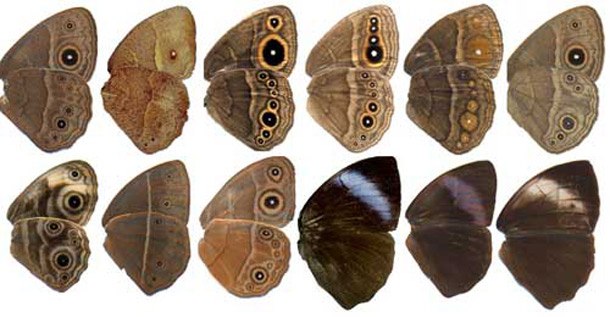
117.
These moths are all the same species. The differences between their wings is an example of ________________
a)
Natural Selection
b)
Variation
c)
Homeostasis
d)
Extinction
118.
Flashy tails on many animals is an example of coloration. Why might flashy tailed animals display their colors to another of the same species? 
a)
make friends
b)
help build a nest
c)
attract a mate 
d)
scare predators
119.

individuals with alleles for an extreme type are more likely to survive and reproduce

a)

stabilizing selection

b)

directional selection

c)

disruptive selection

d)

genetic drift

120.

the selection pressure favors the extreme phenotypes, dividing the population into 2 distinct groups

a)

directional selection

b)

stabilizing selection

c)

geographic selection

d)

disruptive selection

121.
A flash flood carried a raft of Amazon ants away from their original population. There is enough distance between the two groups, that they will never meet in nature again. What type of reproductive barrier is this?
a)
behavioral isolation
b)
temporal isolation 
c)
gametic isolation
d)
geographic isolation 
122.

Definition: ​

Attack on character rather than argument​

a)

Strawman

b)

Begging the question

c)

Ad Hominem

123.
speaker presents two extreme options as the only possible choices
a)
straw man
b)
either/or
c)
false analogy
d)
hasty generalization
124.

Believes in a literal 24 hour day

a)

Young Earth

b)

Gap Theaory

c)

Intelligent Design

125.

"I believe that the earth and the universe is less than 30,000 years old. While I accept some forms of speciation I reject macroevolution

a)

Young earth creationism

b)

Day-age / old earth creationism

c)

Gap theory

d)

evolutionary creation

126.

An organism with external fertilization, such as Cnidarians

a)

Must produce a high number of egg and sperm

b)

releases sperm into the female reproductive tract

c)

tends to have high parental care

d)

releases sperm and egg into the water