wayground logo

Free Printable Worksheets

Font size

S
M
L
XL
Worksheets

Atomic Structure and Periodic Table Review

Total questions: 71

Worksheet time: 2hrs 53mins

Name
Class
Date
1.

symbol for sulfide

a)

S2-

b)

S

c)

S6

d)

S2+

2.

What ending change will Al3+ have?

a)

-ide

b)

ion

c)

(III)

3.

K+ is

a)

a loser of 1 electron

b)

a cation

c)

potassium (I)

d)

a metal

4.
Use your periodic table.  There are two isotopes of rubidium: 85Rb and 87 Rb. Which is more abundant?
a)
equally abundant
b)
rubidium-85
c)
rubidium-85.47
d)
rubidium-87
5.
Which of the following element is most likely to form an ion with a 2+ charge?
a)
calcium (Ca)
b)
potassium (K)
c)
carbon (C)
d)
fluorine (F)
6.
This is the name for electrons in the outer energy level.
a)
charged electrons
b)
bonding electrons
c)
valence electrons
d)
stable electrons
7.
This is the term for any atom that has a charge.
a)
anion
b)
cation
c)
ion
d)
atom
8.
These atoms steal (gain) electrons and become anion with a -1 charge.
a)
Alkali metals
b)
Alkaline Earth metals
c)
Halogens
d)
Noble gasses
9.
These atoms loose an electron and become cations with a +1 charge.
a)
Alkali metals
b)
Alkaline Earth metals
c)
Halogens
d)
Noble gasses
10.

What is the atomic number?

a)

the number of protons

b)

the number of protons and neutrons

c)

the number of neutrons

d)

the number of protons and electrons

11.

What is the mass number?

a)

the number of protons

b)

the number of protons and neutrons

c)

the number of neutrons

d)

the number of protons and electrons

12.

What is the atomic number of this nucleus?

a)

1

b)

3

c)

4

d)

7

13.

What is the mass number of this nucleus?

a)

1

b)

3

c)

4

d)

7

14.

What is the mass number of this atom?

a)

4

b)

5

c)

9

d)

none of the above

15.
A fluorine atom has 9 protons and 10 neutrons. What is the atomic number of fluorine?
a)
9
b)
10
c)
19
d)
1
16.
An atom of argon has 18 protons and 22 neutrons. How many electrons does it have?
a)
18
b)
22
c)
40
d)
4
17.

What element is represented in this Bohr Model?

a)

Carbon

b)

Hydrogen

c)

Aluminum

d)

Lithium

18.
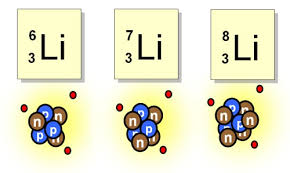
How many neutrons does the isotope of lithium have?
a)
8
b)
3
c)
4
d)
5
19.
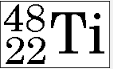
How many protons does this isotope of titanium have?
a)
48
b)
22
c)
26
d)
70
20.
In a correctly written symbol what would be located in the "A" position?
a)
number of neutrons
b)
atomic number
c)
number of electrons 
d)
mass number
21.
What quantities vary between isotopes of an element?
a)
protons, electrons, and atomic mass
b)
protons, electrons, and atomic number
c)
neutrons and electrons
d)
neutrons and atomic mass
22.
which atom has  4 neutrons?
a)
Li-6
b)
Li-7
c)
Li-8
d)
they have the same # of neutrons
23.
Isotopes are atoms of the same element with different #’s of __________ & therefore different __________.
a)
n0 ;  atomic #’s
b)
p+ ; atomic #’s
c)
e- ; atomic masses
d)
n0 ; atomic masses
24.
How many neutrons does the isotope below have?     89 36Kr
a)
53
b)
36
c)
89
d)
125
25.
If X is the symbol for an element, which of the following two symbols represent    isotopes of the same element?     I. 7735X  II. 7733X  III. 8137X  IV. 8135 X
a)
I and II
b)
III and IV
c)
I and IV
d)
I and III
26.
Four isotopes of lead include lead-204, lead-206, lead-207, and lead-208.  The average atomic mass of lead is 207.2.  Which isotope of lead is likely to be the most abundant.
a)
204
b)
206
c)
207
d)
208
27.
An atom is electrically neutral when
a)
protons and neutrons are the same
b)
protons and electrons are the same
c)
neutrons and electrons are the same
d)
neutrons balance the protons and electrons
28.
Two isotopes of carbon are carbon-12 and carbon-14.  These isotopes differ from one another by two protons.
a)
true
b)
false
29.
How many electrons are in an atom that has an atomic number of 34, an atomic mass of 74 and a charge of -2?
a)
34
b)
36
c)
2
d)
40
30.
How many neutrons does an Oxygen-19 isotope have?
a)
19
b)
8
c)
11
d)
10
31.
What is the symbol for an ion which has 8 protons and 10 electrons?
a)
N³⁻
b)
O²⁻
c)
F⁻
d)
O³⁻
32.
9. How many protons, neutrons, and electrons does ⁷₄Be²⁺ have?
a)
4,3,2
b)
4,3,6
c)
4,3,4
d)
4,6,3
33.

Which term describes an atom with an unequal number of protons and electrons?

a)

ion

b)

isotope

c)

both ion and isotope

d)

stable

34.

Which term describes an atom with a number of neutrons that is different from the expected number, based on the Periodic Table?

a)

ion

b)

isotope

c)

both ion and isotope

d)

stable

35.

How many protons, neutrons, and electrons should a stable atom of aluminum have?

a)

13 protons, 13 electrons, 13 neutrons

b)

13 protons, 13 electrons, 14 neutrons

c)

13 protons, 13 electrons, 12 neutrons

d)

None of the above

36.

The diagrams provided show the configuration of protons (+), neutrons (N), and electrons (-) in an atom, along with three different configurations of these same subatomic particles. Which of the labeled configurations represent the ion and the isotope of the atom shown?

a)

A Configuration 1 = ion, Configuration 2 = isotope

b)

Configuration 1 = isotope, Configuration 2 = ion

c)

Configuration 1 = ion, Configuration 3 = isotope

d)

Configuration 2 = isotope, Configuration 3 = ion

37.

The table provided gives information on the number of protons, neutrons, and electrons in an ion, as compared to a neutral atom. The table also provides the number of protons, neutrons, and electrons in the isotopes of an element. What are the missing data, labeled 1, 2, and 3, in the table?

a)

1 = no change, 2 = different, 3 - different

b)

1 = no change, 2 = no change, 3 - different

c)

1 = different, 2 = no change, 3 - no change

d)

1 = different, 2 = different, 3 - no change

38.

The table provided shows the type of ions formed by several elements when they gain or lose electrons. Based on this data, it is reasonable to conclude that which of the following elements would form an ion with a charge of -1?

a)

Nitrogen

b)

Bromine

c)

Potassium

d)

Barium

39.

The table provided shows the properties of four elements. Based on this data, it is reasonable to conclude that which element is a metalloid?

a)

1

b)

2

c)

3

d)

4

40.

In which highlighted section of the periodic table in the diagram provided above are the elements whose atoms have 1 valence electron located?

a)

A

b)

B

c)

C

d)

D

41.

The picture provided shows the arrangement of electrons in atomic shells around the nucleus of four different elements.Which statement is true about these elements?

a)

All elements belong to the same period.

b)

All elements belong to the same group.

c)

Elements 1 and 4 belong to the same group.

d)

Elements 2 and 3 belong to the same period.

42.

The table provided shows the phase of matter at room temperature for four different elements. Based on this data, which of the following trends emerges? At room temperature–

a)

most metals exist as solids.

b)

lighter elements are gaseous.

c)

liquid elements are metals.

d)

non-reactive elements are solids.

43.
A neutral atom of Lithium has 3 p+, 4 n, and 3 e-. The Lithium atom pictured is a....
a)
Positive ion
b)
Negative ion
c)
Isotope
d)
Neutral atom
44.
A neutral atom of Boron has 5 p+, 6 n, and 5 e-. The Boron atom pictured is a....
a)
Positive ion
b)
Negative ion
c)
Isotope
d)
Neutral atom
45.
A neutral atom of Boron has 5 p+, 6 n, and 5 e-. The Boron atom pictured is a....
a)
Positive ion
b)
Negative ion
c)
Isotope
d)
Neutral atom
46.
A neutral atom of Helium has 2 p+, 2 n, and 2 e-. The Helium atom pictured is a....
a)
Positive ion
b)
Negative ion
c)
Isotope
d)
Neutral atom
47.
Which type of model is shown?
a)
Plum Pudding
b)
Bohr / Orbits
c)
Electron Cloud
d)
Billiard Ball
48.

Which of the following elements is most likely to have similar properties to those of sodium (Na)?

a)

Magnesium (Mg)

b)

Sulfur (S)

c)

Francium (Fr)

d)

Titanium (Ti)

49.

Which element is most likely to have six valence electrons?

a)

Barium (Ba)

b)

Carbon (C)

c)

Oxygen (O)

d)

Americium (Am)

50.

Which element is most likely to have three electron energy levels?

a)

Argon (Ar)

b)

Lithium (Li)

c)

Boron (B)

d)

Europium (Eu)

51.

Which element is most likely to have six electrons in its 4th energy level?

a)

Oxygen (O)

b)

Selenium (Se)

c)

Krypton (Kr)

d)

Potassium (K)

52.

In which group would an element that is not reactive most likely be located?

a)

1

b)

2

c)

16

d)

18

53.

In which group would an element that is very reactive most likely be located?

a)

1

b)

5

c)

15

d)

18

54.

Which of the following elements is most likely a metal?

a)

W

b)

X

c)

Y

d)

Z

55.

Which of the following elements is most likely a metalloid?

a)

W

b)

X

c)

Y

d)

Z

56.

Which of the following elements is most likely a poor conductor of electricity?

a)

Beryllium (Be)

b)

Gold (Au)

c)

Phosphorus (P)

d)

Copper (Cu)

57.
Which of the following will have a larger radius than Zinc?
a)
Gallium
b)
Aluminum
c)
Magnesium
d)
Strontium
58.
Which of the following will have a higher electronegativity than arsenic (As)?
a)
Carbon (C)
b)
Neon (Ne)
c)
Antimony (Sb)
d)
Germanium (Ge)
59.
Which of the following will have a lower ionization energy than Scandium (Sc)?
a)
Helium (He)
b)
Titanium (Ti)
c)
Calcium (Ca)
d)
Magnesium (Mg)
60.
As atoms of elements in group 16 are considered in order from top to bottom, the electronegativity of each successive element....
a)
decreases
b)
increases
c)
remains the same
d)
none of the above
61.
As you move down the periodic table atoms get bigger.  This is because ____________.
a)
The atoms have more mass.
b)
The atoms have more protons.
c)
The atoms have more energy levels
d)
The atoms have more neutrons
62.
As you move across the periodic table atoms tend to get smaller because, ______________.
a)
the atoms have more mass.
b)
the atoms have less mass
c)
the atoms have more protons.
d)
the atoms have less electrons.
63.
The atom with the largest atomic radius in Group 18 is - 
a)
Ar
b)
He
c)
Kr
d)
Rn
64.
Metals have the largest - 
a)
atomic radius and electronegativity
b)
electronegativity and ionization energy
c)
atomic radius only
d)
ionization energy and atomic radius
65.
Which statement correctly and completely identifies a trend?
a)
Atomic radius decreases across a period and increases down a group.
b)
Electronegativity decreases across a period and decreases down a group.
c)
Ionization energy increases across a period and increases down a group.
d)
Ionic radius increases across a period and increases down a group.
66.
Electronegativity __________ from left to right within a period and __________ from top to bottom within a group.
a)
decreases, increases 
b)
increases, increases
c)
increases, decreases 
d)
stays the same, increases
67.
Atomic radius generally increases as we move __________.  
a)
down a group and from right to left across a period 
b)
up a group and from left to right across a period 
c)
down a group and from left to right across a period 
d)
up a group and from right to left across a period 
68.

What is the oxidation number of Magnesium (Mg)?

a)

+2

b)

-2

c)

+4

d)

-4

69.
What is the oxidation number for Flourine (F)?
a)
+1 
b)
-1
c)
17
d)
7
70.

Which two elements on the periodic table are in the same period?

a)

Sn and Rb

b)

K and Ba

c)

F and Cl

d)

Se and Te

71.

What is the charge for an ion in group 3?

a)

+3

b)

-7

c)

-3

d)

+4