wayground logo

Free Printable Worksheets

Font size

S
M
L
XL
Worksheets

Genetics

Total questions: 66

Worksheet time: 1hrs 1mins

Name
Class
Date
1.
A homozygous dominant dog with brown fur is crossed with a heterozygous dog with brown fur. What are the percentages of the possible genotypes?
a)
100% BB
b)
75% BB and 25%Bb
c)
50 % BB and 50% Bb
d)
50% Bb and 50% bb
2.
The man who studied genetics and came up with genetics is
a)
Watson
b)
Crick
c)
Mendel
d)
Darwin
3.
Genotype refers to the ...
a)
physical expression of the genes
b)
the possible combination of alleles in a gene
c)
whether an allele is dominant or recessive
d)
how an organism will appear
4.
Squidward has light blue skin, and his genotype for this trait is Bb. Would Squidward be considered a purebred or hybrid for light blue skin?
a)
Purebred
b)
Hybrid
5.
An offspring will receive how many alleles from each parent to determine a specific trait?
a)
one
b)
two
c)
three
d)
five
6.
Which of the following is a phenotype?
a)
BB
b)
Bb
c)
bb
d)
Blue eyes
7.
What is a phenotype
a)
The genetic make up (code)
b)
The physical trait
8.
the passing of genetic traits from parent to offspring.
a)
heredity
b)
trait
c)
gene
d)
allele
9.
having two of the same genes for the trait (sometimes called purebred).
a)
homozygous
b)
hetrozygous
c)
protein
d)
chromosome
10.
having two different genes for a trait (sometimes called hybrid).
a)
protein
b)
homozygous
c)
heterozygous
d)
genotype
11.
Magda is a tall, 11 year old drummer. She has a scar on her right cheek. She is good at swimming. Which of her traits did Magda most likely inherit?
a)
height
b)
the scar
c)
ability to swim
d)
ability to play drums
12.
Two brown eyed parents (Bb) have a baby. What is the chance the baby is blue eyed?
a)
0 %
b)
25%
c)
50%
d)
75%
13.
G = green, g = yellow
The genotype for a yellow plant is...
a)
GG
b)
Gg
c)
gg
d)
all of the choices result in yellow
14.
An allele whose trait only shows up when no dominant allele is present.
a)
hidden allele
b)
dominant allele
c)
recessive allele
d)
present allele
15.
Two heterozygous (Tt) tall pea plants are crossed. Which describes their offspring?
a)
50% tall and 50% short
b)
75%tall and 25% short
c)
100%short
16.
Which answer best describes codominant alleles?
a)
Both are equally dominant
b)
Both are equally recessive
c)
Neither are dominant or recessive
17.
Which of the following genotypes is a purebred?
a)
Bb
b)
Gg
c)
bb
d)
Dd
18.
What is the percentage of offspring that have green pods?
a)
100%
b)
75%
c)
50%
d)
25%
19.
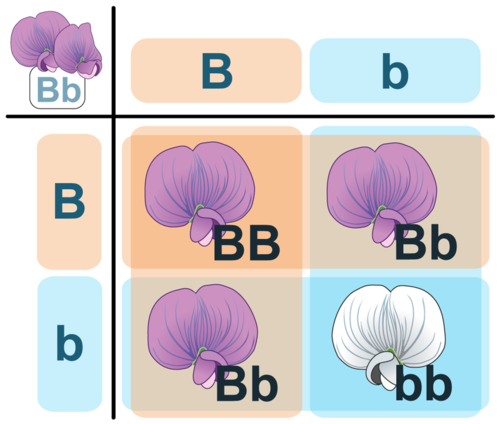
In this punnett square, which is the dominant trait?
The B stands for bud.
a)
purple flower bud
b)
white flower bud
c)
dominant
d)
recessive
20.
W=white hair
w= non-white hair
If you cross a horse with WW and a horse with ww what fraction of the offspring would be expected to have white hair?
a)
none
b)
3/4
c)
1/2
d)
all
21.
Dominant alleles are represented by a:
a)
Male gene
b)
lowercase letter
c)
recessive trait
d)
capital letter
22.
How many boxes would say BB?
a)
1
b)
2
c)
4
d)
0
23.
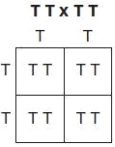
What is the genotypic ratio here
a)
TT = 25% Tt= 50% tt=25%
b)
all tall
c)
TT= 75% tt = 25%
d)
Tt = 100%
24.
T - tall and t = short
In the punnett square below, what belongs in the missing square
a)
tt
b)
Tt
c)
Bb
d)
TT
25.
If B = brown hair and b = blonde hair, what is the probability of brown hair?
a)
25%
b)
50%
c)
0%
d)
75%
26.
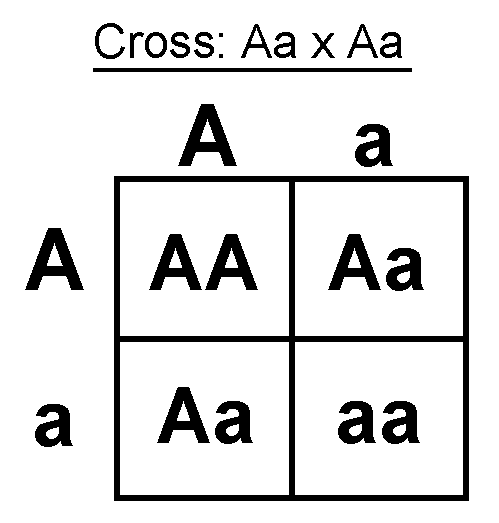
What allele combination should go in the missing box?
a)
AA
b)
Aa
c)
aa
d)
none of these
27.

What does a punnet square show us?

a)

The age of the offspring

b)

The chance of a genotype (trait) showing up in offspring

c)

Numbers

d)

Blue eyes

28.

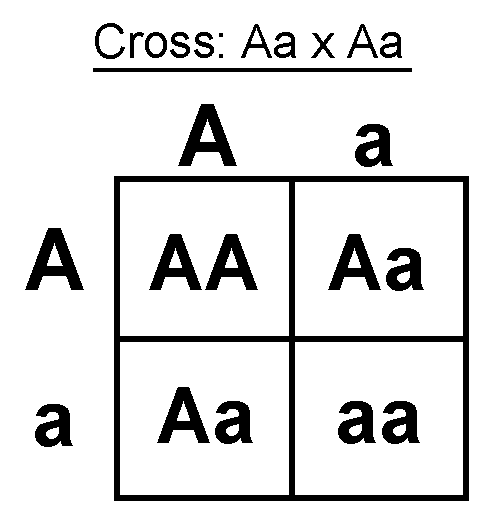
What are the chances that the offspring will have homozygous recessive traits?

a)

1 in 4

b)

3 out of 4

c)

75%

d)

50%

29.

What are the chances of heterozygous genotypes in offspring?

a)

50%

b)

25%

c)

1 in 4

d)

75%

30.

A father has brown hair (B), but the offspring have red hair (a recessive trait), like their mother (b). How is this possible?

a)

It's not the real mother

b)

It can't be the real father

c)

The mother carries the dominant trait (Bb)

d)

The father carries the recessive trait as well (Bb)

31.

A recessive genotype will show when:

a)

The offspring have both dominant and recessive genotypes

b)

The offspring has two recessive genotypes

c)

The offspring have two dominant genotypes

d)

The mother has blue eyes

32.

If the father's genotypes are SS and the mothers are ss, the offspring will have:

a)

All Ss

b)

Half will be SS, half ss

c)

Mostly SS

d)

Only recessive genes

33.

Which is Heterozygous?

a)

Tt

b)

BB

c)

ff

d)

Dominant

34.

Which is homozygeous?

a)

Tt

b)

BB

c)

Ff

d)

Blue

35.

Genotypes are:

a)

Green

b)

Dominant only

c)

Recessive only

d)

traits that appear in offspring

36.

Which set of traits goes at the top of the punnet square?

a)

Father

b)

Mother

c)

Dominant

d)

Recessive

37.
Which of the following is a phenotype?
a)
Aa
b)
red hair
c)
heterozygous
d)
DNA
38.
The dominant trait is
a)
yellow pea seeds
b)
green pea seeds
c)
there is no dominant seed
d)
Jolly green giant
39.
To be a yellow seed genotype must be
a)
aa
b)
Aa
c)
AA
d)
AA or Aa
40.
To express the recessive trait you must be
a)
homozygous dominant
b)
heterozygous
c)
alleleerific
d)
homozygous recessive
41.
Which of the following is homozygous recessive?
a)
rr
b)
AA
c)
TT
d)
Ff
42.
In some animals, brown eyes (B) are dominant over blue eyes (b). Which of these genotypes will complete the Punnett Square to the right?
a)
B
b)
bb
c)
Bb
d)
BB
43.
This image shows a...
a)
Punnett Square
b)
Phenotype
c)
Genotype
d)
Dominant allele
44.
What percent of offspring will have the recessive trait?
a)
25
b)
50
c)
75
d)
100
45.
If B = brown hair and b = blonde hair, what is the probability of brown hair?
a)
25%
b)
50%
c)
0%
d)
75%
46.
In rabbits, black fur (B) is dominant over brown fur (b). If a rabbit has brown fur, what can you conclude about its genotype?
a)
It is BB.
b)
It is Bb
c)
It is brown
d)
It is bb.
47.
What is the probability of homozygous dominant offspring?
a)
0%
b)
100%
c)
50%
d)
25%
48.
Two brown eyed parents (Bb) have a baby. What is the chance the baby is blue eyed?
a)
0 %
b)
25%
c)
50%
d)
75%
49.
G = green, g = yellow
The genotype for a yellow plant is...
a)
GG
b)
Gg
c)
gg
d)
all of the choices result in yellow
50.
What is the phenotype of the offspring? (A-Brown hair; a-blond hair) 
a)
50 % Brown Hair and 50% Blond Hair 
b)
25 % Brown Hair and 75% Blond Hair 
c)
75 % Brown Hair and 25% Blond Hair 
d)
0% Brown Hair and 100% Blond Hair 
51.
What percent of offspring will have the recessive trait?
a)
25
b)
50
c)
75
d)
100
52.
What is the probability of heterozygous offspring?
a)
25%
b)
50%
c)
0%
d)
100%
53.
In a pedigree, what shape represents a male?
a)
circle
b)
square
c)
triangle
d)
diamond
54.
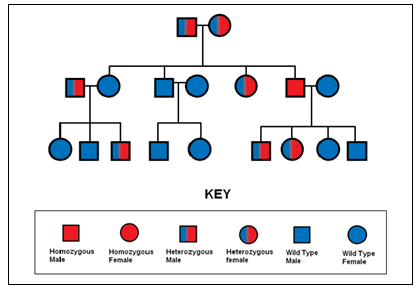
In the second generation-how many people are carriers of the trait?
a)
2
b)
3
c)
5
d)
6
55.
How many individuals are there in the 3rd generation?
a)
2
b)
3
c)
4
d)
6
56.
Because hemophilia is a sex-linked disorder, it occurs more frequently in females than males?
a)
True
b)
False
57.
In order to trace occurrence of a trait through several generations of a family, you could create a ____________.
a)
karyotype
b)
hemoglobin
c)
pedigree
d)
chromosomal map
58.
AA and Aa always show up as
a)
dominant
b)
recessive
59.
aa always shows up as
a)
dominant
b)
recessive
60.

What % of the offspring from the cross shown will be homozygous recessive for the trait of tallness?

a)

0%

b)

25%

c)

50%

d)

100%

61.
Which of the following is homozygous dominant?
a)
Yy
b)
Y
c)
yy
d)
YY
62.
What gender has an X and a Y chromosome?
a)
male
b)
female
c)
transgender 
d)
all of the above
63.

W=white hair

w= non-white hair

If you cross a horse with WW and a horse with ww what % of the offspring would be expected to have white hair?

a)

none

b)

75%

c)

50%

d)

100%

64.
This pedigree represents the inheritance of hemophilia in this family. How many of the females have the hemophilia trait?
a)
8
b)
5
c)
2
d)
3
65.
What do we use pedigrees for?
a)
To look at families
b)
To make determinations about the offspring
c)
To track traits in families
d)
Nothing
66.
What do half colored symbols represent?
a)
The individual is a carrier (heterozygous).
b)
The individual expresses the trait.
c)
The individual has both recessive alleles.
d)
The individual has both dominant alleles.