wayground logo

Free Printable Worksheets

Font size

S
M
L
XL
Worksheets

Marine Invert. Part 1 Review

Total questions: 100

Worksheet time: 59mins

Name
Class
Date
1.

How an organism's body is arranged is known as...

a)

symmetry

b)

geometry

c)

shadows

d)

trigonometry

2.

when an organisms body is arranged in a circle

a)

asymmetrical

b)

bilateral

c)

radial

d)

ludacrisacal

3.

when an organisms body has no defined shape

a)

asymmetrical

b)

bilateral

c)

radial

d)

ludacrisacal

4.

when an organisms body is the same on both sides

a)

asymmetrical

b)

bilateral

c)

radial

d)

ludacrisacal

5.

sponges are

a)

asymmetrical

b)

radial

c)

bilateral

6.

how do sponges get their food?

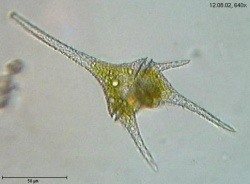
a)

use sharp teeth and claws

b)

filter feed through pores

c)

photosynthesis

d)

use stealthiness and extreme speed

7.

Sponges are sessile, which means they cannot move

a)

true

b)

false

8.

Where can you find a medusa's nematocysts?

a)

On its tentacles

b)

Near its mouth

c)

Along its back

d)

Inside its body

9.

Where would you find a sessile organism?

a)

Swimming through the sea

b)

Drifting on ocean currents

c)

Anchored to a rock

d)

Walking across the seafloor

10.

How is a jellyfish's digestive system different from yours?

a)

Jellyfish excrete waste through their skin

b)

A jellyfish's digestive system has only one opening

c)

Jellyfish digest food outside their bodies

d)

Jellyfish are not able to digest meat

11.

The Latin name "cnidaria" refers to what feature?

a)

Tentacles

b)

Stinging cells

c)

Lack of mobility

d)

Radial symmetry

12.

Flagella inside a sponge keep water moving through its body. Why is this necessary?

a)

It prevents the sponge from floating away

b)

It allows the sponge to feed

c)

It allows the sponge to absorb carbon dioxide

d)

It maintains the water pressure inside the sponge

13.

A new sponge may begin life as:

a)

A growth on an older sponge

b)

A piece cut off of an older sponge

c)

A mobile larva

d)

All of these

14.

Which of the following is a true statement?

a)

Sponges live only in saltwater environments

b)

Sponges do not need oxygen to survive

c)

Most bath sponges are living creatures

d)

Sponges have few natural predators

15.
What is the name of the phylum sponges belong to?
a)
mammals
b)
chordate
c)
cnidarians
d)
Porifera
16.
___________ are tiny hard particles that give a sponge support and can provide protection when they stick out of a sponge.
a)
spongin
b)
bones
c)
buds
d)
spicules
17.
cells have sticky, funnel-shaped collar to collect food particles and a flagellum that creates a water current
a)
amoebocyte
b)
ostiocyte
c)
pinacocyte
d)
choanocyte
18.
large opening at the top of a sponge where water exits.
a)
ostia
b)
osculum
c)
orifice
d)
opening
19.
skeleton structures made of silica or calcium carbonate 
a)
spicules
b)
spongin
c)
sessile
d)
something
20.
What is true about sponges?
a)
They have organs
b)
They have bilateral symmetry
c)
They have a true coelom
d)
They are animals
21.
Asexual reproduction in sponges can produce capsules that are resistant and can survive harsh conditions.  These cells are called
a)
choanocytes
b)
gemmules
c)
spongocoel
d)
gametes
22.

The small openings all over a sponge are...

a)

Collar cells

b)

Flagella

c)

Osculum

d)

Pores

23.

The cells inside the sponge that have flagella (and absorb food) are called...

a)

Collar cells

b)

Flagella

c)

Osculum

d)

Pores

24.

The large empty space in the middle of the sponge is called the...

a)

central cavity

b)

pores

c)

collar cells

d)

flagella

25.

When a sponge reproduces asexually, it is a process called...

a)

budding

b)

filter feeding

c)

osculum

d)

metamorphosis

26.

Which one is NOT true about sponges?

a)

They are multicellular

b)

They are autotrophs

c)

They are eukaryotes

d)

They are the simplest animals on Earth

27.

What type of symmetry do Cnidarians have?

a)

Asymmetrical

b)

Bilateral

c)

Radial

d)

Medial

28.

What are cnidocytes?

a)

digestive cells

b)

another name for eyes

c)

reproductive cells

d)

stinging cells

29.

What is the name of the algae that inhabit the coral?

a)

green algae

b)

euglenoids

c)

zooxanthellae

30.

Can coral sting you?

a)

yes

b)

no

31.

What type of digestive system do most cnidarians have?

a)

complete

b)

incomplete

32.

what are the two body forms of a cnidarian?

a)

polyp and medusa

b)

medusa and sessile

c)

polyp and sessile

d)

medusa and radual

33.
Sea anemones and corals lack
a)
a medusa stage
b)
a polyp stage
c)
a sexual stage
d)
an asexual stage
34.
Instead of a digestive system, cnidarians have a
a)
gastrovascular cavity
b)
multiple stomachs
c)
nothing, and instead use osmosis
d)
a gastrointestinal tract
35.
Cnidarians have nerves, but no central nervous system
a)
True
b)
False
36.
How many body openings do cnidarians have?
a)
1
b)
2
c)
3
d)
None
37.
The larva of cnidarians is known as
a)
a planula
b)
a polyp
c)
a medusa
d)
a mesoglea
38.
The bell shaped, free swimming form of cnidarians is the
a)
polyp
b)
medusa
c)
planula
d)
mesoglea
39.
Sea anemones are sessile
a)
True
b)
False
40.
Microscopic zooanthellae are photosynthetic algae that
a)
live in coral tissue and make food
b)
prey on cnidarians
c)
live in the stomachs of jellyfish and help them digest
d)
help cnidarians camoflague themselves
41.
There are approximately ______ species of cnidarians
a)
9,000
b)
1,000
c)
15,000
d)
500
42.
What form is this organism? (Image 1)
a)
Polyp
b)
Medusa
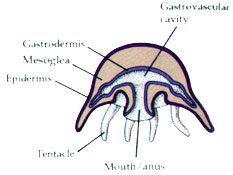
43.
Which body form is represented by this diagram?
a)
Mesoglea
b)
Medusa
c)
Moses
d)
Nematocyst
44.
The ______________ enables cnidarians to respond to stimuli in their environment. 
a)
nerve net
b)
tentacles
c)
spicules
d)
cnematocysts
45.
What kingdom do jellyfish belong to?
a)
Cnidaria
b)
Animalia 
c)
Scyphozoa
d)
Porifera
46.

This is a

a)

medusa

b)

polyp

c)

sea anemone

d)

hydra

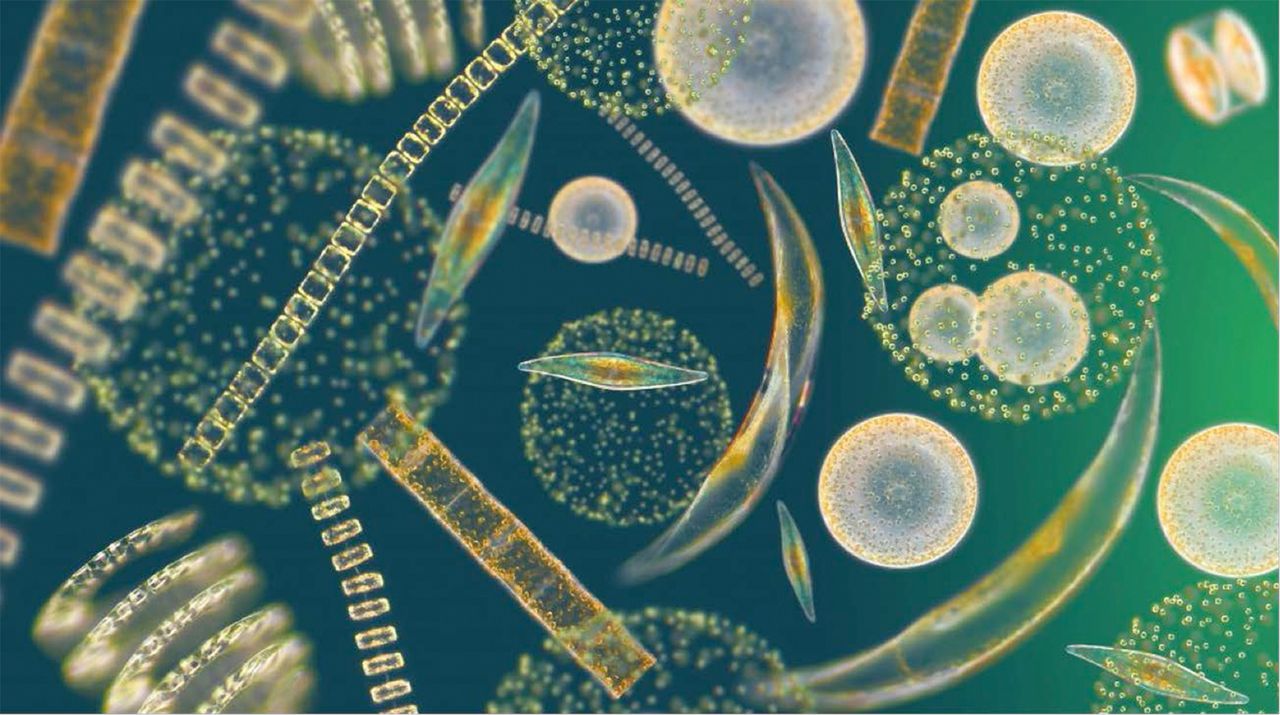
47.

This silica (glass) bodied plankton is a

a)

amoeba

b)

flatworm

c)

diatom

d)

nekton

48.
Plankton that uses photosynthesis:
a)
Phytoplankton
b)
Zooplankton
49.
Dinoflagellates can cause __________ which is toxic to fish, shellfish and humans.
a)
Green TIde
b)
Red Tide
c)
Malaria
d)
Algal Bloom
50.
Phytoplankton are associated with the photic zone because they rely on the sun for the process of:
a)
Respiration
b)
Photosynthesis
c)
Chemosynthesis
d)
Heterotrophs
51.
Zooplankton are grouped into which kingdom?
a)
Monera
b)
Protista
c)
Plantae
d)
Animalia
52.
What do dinoflagellates use to move?
a)
cilia
b)
1 flagella
c)
2 flagella
d)
spines
53.
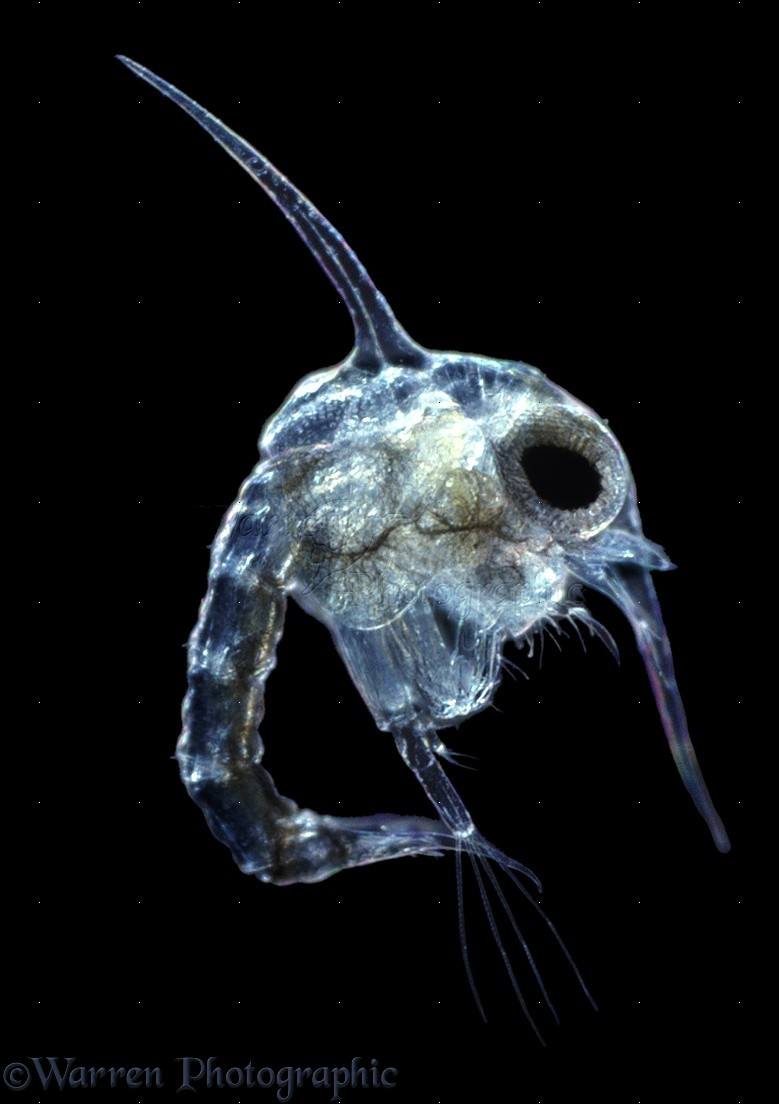
The larvae of crabs and krill belong to which group of plankton?
a)
Phytoplankton
b)
Meroplankton
c)
Holoplankton
d)
None of the above
54.
Identify this seaweed. (image b)
a)
Sea Grass
b)
Sea Lettuce
c)
Irish Moss
d)
Sargassum
55.
Which term refers to the entire body of the seaweed?
a)
blade
b)
thallus
c)
pneumatocyst
d)
stipe
56.
What is the leaf-like flattened portion of the seaweed?
a)
holdfast
b)
thallus
c)
blade
d)
stipe
57.
Which type of algae includes sargasso weed and kelp?
a)
Green algae
b)
Red algae
c)
Brown algae
58.
What is the main pigment in green algae?
a)
chlorophyll
b)
phycobilins
c)
fucoxanthins
59.
Which part of the seaweed acts as a root-like structure that attaches the seaweed to a hard surface?
a)
stipe
b)
holdfast
c)
blade
d)
thallus
60.
Which part of the seaweed is a stem-like structure that supports the blades?
a)
thallus
b)
stipe
c)
holdfast
d)
pneumatocysts
61.
What type of brown algae is capable of floating in large masses far from shore?
a)
kelp
b)
algal turf
c)
sargasso
62.
Which of the following is the reason that kelp must live in deep, calm waters?
a)
there is more nutrients in calm waters
b)
the temperature is more stable in calm waters
c)
it prevents them from being ripped off their substrates
63.
A unicellular algae with cell walls filled with silica is called
a)
dinoflagellates
b)
red algae
c)
diatoms
d)
green algae
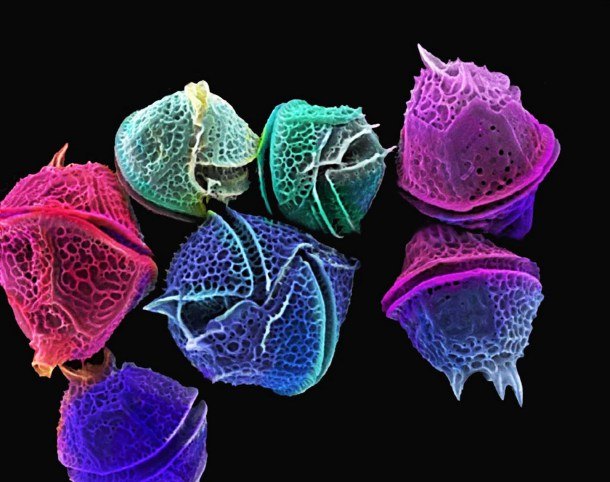
64.
These are protists called _____
a)
diatoms
b)
dinoflagellates
c)
green algae
d)
amoeba
65.
The immature stage of an organism
a)
Larva
b)
Nekton
c)
Benthic
d)
Sessile
66.
______ are all organisms that swim freely, independent of currents.
a)
Benthic 
b)
Zooplankton 
c)
Nekton 
d)
plankton
67.
Organisms that live on the bottom of aquatic ecosystems are known as 
a)
littoral 
b)
benthic 
c)
nekton
d)
whales
68.
What are Plankton?
a)
They are small plants and animals.
b)
They are any plants or animals that drift with the currents of the ocean.
c)
They are only microscopic animals.
d)
They are only microscopic plants.
69.
Which is a kind of phytoplankton?
a)
 lion’s mane jellyfish
b)
sea butterfly 
c)
algae
d)
copepod 
70.
What is the newly hatched young of many of the marine animals that look very different for their adult forms?
a)
hatchlings
b)
babies
c)
larva
d)
plankton
71.
This is a larva of
a)
a lobster
b)
a sea slug
c)
a starfish
d)
a sea urchin
72.
This is the larva of a
a)
barnacle
b)
squid
c)
octopus
d)
jellyfish
73.
This is the larval form of a
a)
lobster
b)
alien
c)
crab
d)
shrimp
74.
Larval form of
a)
crab
b)
lobster
c)
sea urchin
d)
barnacle
75.
Largest of the algae. The_______ grows to up to _______.
a)
bull kelp, 6'
b)
sea lettuce, 100'
c)
giant kelp, 300'
d)
Japanese kelp, 6'
76.
The copepod eats other plankton its entire life and stays plankton, thus it is termed__________.
a)
nekton
b)
holoplankton
c)
meroplankton
77.
These horseshoe crab larvae are termed_________ since they grow into entirely different adult forms.
a)
nekton
b)
meroplankton
c)
holoplankton
d)
phytoplankton
78.
Coconut crabs are the largest land crustaceans. Their larva part of the______.
a)
phytoplankton
b)
zooplankton
c)
holoplankton
d)
nekton
79.
These tiny shrimp are the important source of food for whales among other animals.
a)
brine shrimp
b)
Gulf Coast prawns
c)
krill
d)
Tiger shrimp
80.

A voracious predator of kelp.

a)

starfish

b)

sea urchin

c)

parrotfish

d)

jellyfish

81.

From the video "Green Seas" which fish are these?

a)

Parrotfish

b)

Garibaldi fish

c)

Haddock

d)

Ling cod

82.

This jellyfish kills more people per year than sharks! Lives in __________ of course!

a)

Portugese man o war, Ireland

b)

Box jellyfish, Australia

c)

Box jellyfish, Caribbean

d)

Box jellyfish, Pacific Ocean

83.

This is

a)

seaweed

b)

Giant kelp

c)

sea lettuce

d)

Sargasso seaweed

84.

This is _____________ and we have it at Surfside!

a)

Giant kelp

b)

Sargasso seaweed

c)

seaweed

d)

Dulce

85.

This jellyfishcan have tentacles over 75! And....yes, can be deadly.

a)

box jellyfish

b)

Lions Mane jellyfish

c)

Portuguese Man O War

d)

Comb jelly

86.
Animals that have no backbone are called ______________.
a)
Invertebrates
b)
Vertebrates
c)
Exoskeleton
d)
Endoskeleton
87.
What would help you determine if an organism is in kingdom Animalia?
a)
Chloroplasts
b)
Unicellular
c)
Heterotroph
d)
Prokaryote
88.
A goldfish's scientific name is Carassius auratus.  What would a scientist in Germany call a goldfish?
a)
Goldfisch
b)
Carassius auratus
c)
Schnell fishy
d)
How should I know, I don't speak German
89.
True or False: most animals are invertebrates.
a)
True
b)
False
90.
Humans belong to the Class ____ because we are warm-blooded, have hair, and give birth to live young.
a)
Aves
b)
Mammalia
c)
Reptilia
d)
Amphibia
91.
The first major division for a kingdom
a)
Phylum
b)
Class
c)
Order
d)
Genus
92.
The first word of an organism's scientific name.
a)
Class
b)
Order
c)
Genus
d)
Species
93.
This is the second word of an organism's scientific name.
a)
Class
b)
Order
c)
Genus
d)
Species
94.
Genus and species of this wolf
a)
Felis lupus
b)
Canis lupus
c)
Animalia
d)
Chordata
95.
Species is always
a)
Capitalized
b)
lower case
96.
Broadest level of animal classification?
a)
Chordata
b)
Phylum
c)
Kingdom
d)
Species
97.
Which of the following is an mammal family?
a)
Mammalia
b)
Chordata
c)
porosis
d)
Cervidae
98.
Which of the following is a mammal order?
a)
Carnivora
b)
Felidae
c)
Chordata
d)
Mammalia
99.
The Komodo dragon is a species within the genus
a)
Varanidae
b)
Reptila
c)
Varanus
d)
komododinsus
100.
The fennec fox is in the class
a)
Mammalia
b)
Canidae
c)
Canis
d)
Carnivora